Lifestyle
CNN has endured turmoil for years. With Warner Bros. sale, things will get bumpier


CNN anchors Jake Tapper and Dana Bash speaking to members of the audience before the start of the CNN Republican presidential debate in Des Moines, Iowa, Jan. 10, 2024.
Andrew Harnik/AP/AP
hide caption
toggle caption
Andrew Harnik/AP/AP
After Netflix made a big play to buy most of CNN’s parent company, journalists and executives at the news network thought they had dodged a bullet. One week later, it’s pretty clear they hadn’t.
Two questions remain: Why did they think that in the first place? And what’s ahead?
Netflix, which is already the nation’s leading streamer, had struck a deal to acquire the movie studios, archives, intellectual property and streaming services of CNN’s parent company, Warner Bros. Discovery.
But Netflix did not want to become Newsflix. CNN and its sister cable channels were to be spun off in a separate company. Inside CNN, that seemed like good news.
“It will enable us to continue to roll out our strategy to secure a great future for CNN by successfully navigating our digital transition,” Mark Thompson, the chairman and CEO of CNN Worldwide, wrote in a memo to staff shortly after Warner said it would accept the Netflix offer.

Mark Thompson, chairman and CEO of CNN Worldwide, speaks onstage during Warner Bros. Discovery Upfront 2024 on May 15, 2024 in New York City.
Dimitrios Kambouris/Getty Images for Warner Bros. Di/Getty Images North America
hide caption
toggle caption
Dimitrios Kambouris/Getty Images for Warner Bros. Di/Getty Images North America
Staffers recalled the mass layoffs caused when new corporate owners at Warner canceled the network’s streaming service CNN+ in April 2022, just a month after it launched. They say they had been heartened to think their new efforts might actually get off the ground.
But in the new plan, as part of a corporate family of fading cable channels loaded with debt from the merger that created Warner Bros. Discovery, CNN’s fate would remain entirely up for grabs.
And President Trump, who has long called networks such as CNN fake news and long sought to taunt or toss out CNN’s reporters, now wants a deciding role in the network’s future.
“I think the people that have run CNN for the last long period of time are a disgrace,” Trump said Wednesday at the White House in response to a question from a Daily Mail reporter. “I think it’s imperative that CNN be sold.”
This account is based on interviews with seven current and former CNN staffers, including journalists and executives. They spoke on condition they not be named due to the uncertainty surrounding the network’s future and, for those still at CNN, their jobs.
CNN put in play by corporate maneuvers
CNN’s status was put in play this past summer, when Warner CEO David Zaslav announced the company would split in two. Unsolicited, David Ellison, backed by his billionaire father Larry, bid for the entire company. Zaslav turned them down. They kept at it. He finally put the company up for auction.
Larry Ellison is the co-founder of Oracle, one of the richest people on the planet, and an ally of Trump. David is the head of Skydance, a Hollywood production company. Since last summer, he’s also the head of Paramount Global, which includes CBS, Paramount Studios and other properties.
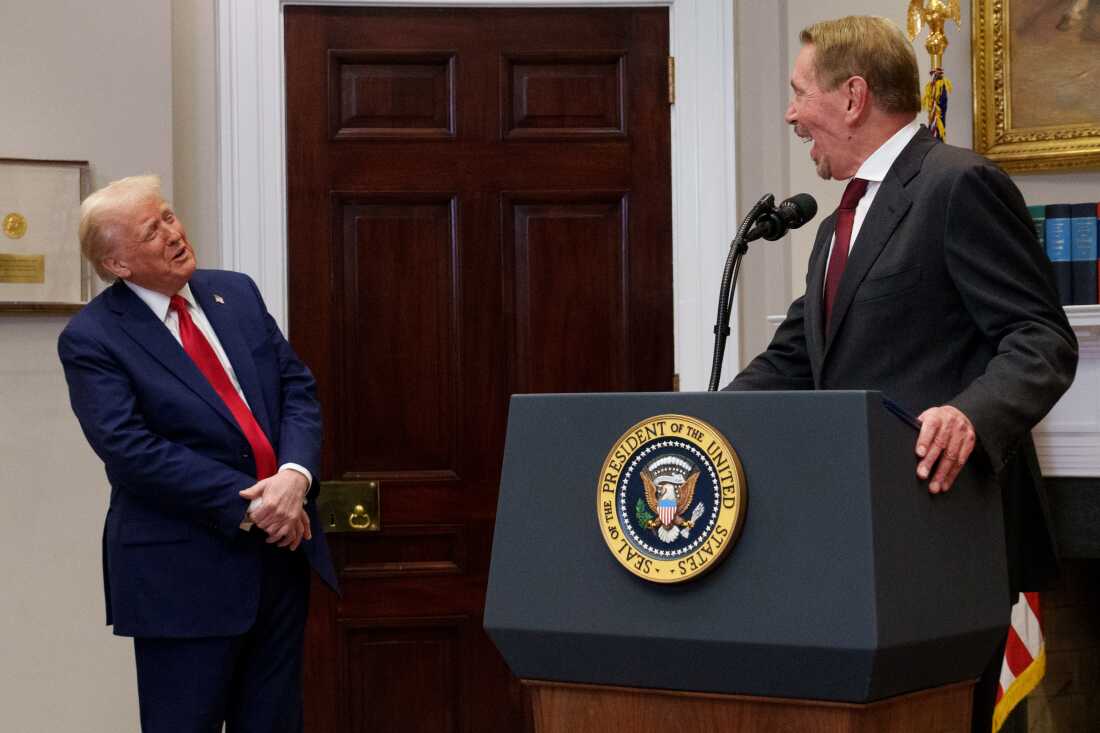
Billionaire and Oracle co-founder Larry Ellison shares a laugh with President Trump as Ellison stands on a stool at a news conference at the White House on Jan. 21, 2025. Ellison’s son David is making a hostile bid for Warner Bros. Discovery.
Andrew Harnik/Getty Images/Getty Images North America
hide caption
toggle caption
Andrew Harnik/Getty Images/Getty Images North America
Presidents do not – or are not supposed to – play a role in anti-trust decisions. They are typically handled by Justice Department officials or semi-autonomous regulatory agencies.
Yet to get the sale of Paramount to the finish line, its prior ownership paid $16 million to settle a lawsuit Trump filed against CBS’s 60 Minutes – a lawsuit that outside legal observers considered flimsy. The company also announced the end of the late night show of longtime Trump critic and satirist Stephen Colbert.
The Federal Communications Commission approved the Ellisons’ takeover of Paramount, required because the company owns 28 local television stations and needed government signoff to allow the transfer of their broadcast licenses.
With David Ellison now at the helm of CBS, there have been more changes that appear to be aimed at responding to Trump’s criticism of the network and to appeal to conservatives, according to four people at CBS. (They spoke on condition of anonymity to characterize sensitive corporate matters.)
Ellison named Kenneth Weinstein, a former head of a conservative think tank, as ombudsman at CBS News and he also selected Bari Weiss, the founder of the right-of-center Free Press, as the network’s editor in chief. Ellison also fulfilled pledges to scrap DEI initiatives at the network.
Despite feeling of relief, CNN still vulnerable
Hence the sigh of relief inside CNN when news broke of Netflix and Warner’s deal: many of CNN’s journalists didn’t want the political implications of having Paramount as owner. Nor did they want to merge with CBS, which would entail massive job losses.
Yet the Netflix deal, assuming it is consummated, would leave CNN and its sister channels exposed, vulnerable to purchase by someone else. Maybe a local TV giant like Nexstar or Sinclair Broadcast Group, which have a center-right and a hard right orientation, respectively, would want to acquire it. Maybe an investment fund would.
It is just as likely Paramount itself would give it another go – and pick up the former Warner channels on the cheap. Ellison had suggested they were worth $1 a share. (He is currently offering $30 a share for the whole company.) And now, among some staffers at CNN, there’s a sense of growing dread.
Trump’s comments Wednesday about the network’s leadership were “extremely unprecedented, perhaps not surprising, coming from President Trump, given his long dislike for any journalism that holds him accountable,” CNN anchor Jake Tapper said on his show Wednesday in a clip he reposted on social media. “He made it so clear that the fate of CNN is what’s driving his view and his potential involvement [in] this potential transaction when it comes to who buys Warner Bros. Discovery.”
Tapper’s on-air guest was former CNN reporter Oliver Darcy, founder of the media newsletter Status. He told Tapper that Trump was “a thin-skinned aspiring autocrat who wants to seize control of the media. And he wants an obedient press.”
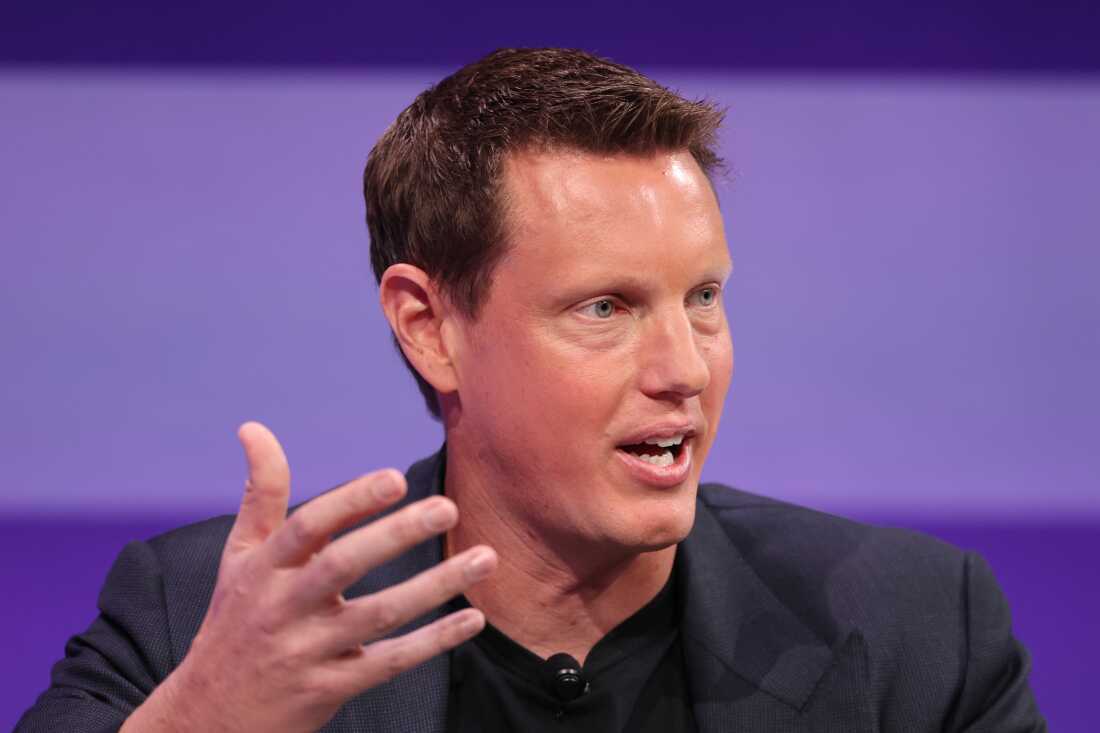
David Ellison has mounted a hostile takeover bid for Warner Bros. Discovery. Here, the Paramount Skydance CEO speaks during the Bloomberg Screentime conference in Los Angeles on Oct. 9, 2025.
PATRICK T. FALLON/AFP via Getty Images/AFP
hide caption
toggle caption
PATRICK T. FALLON/AFP via Getty Images/AFP
Paramount seeks to build trust as it seeks to bulk up
As this week has proven, the Ellisons are far from finished in their pursuit of the entire company. They upped their offer a bit. They pledged to unify big studios and beef up streaming, sports rights and cable properties to take on the likes of Netflix. They promised to save Hollywood from being swallowed by the giant streamer. The Ellisons are seeking to rally the creator class on their behalf.
Having been frozen out by Warner chief Zaslav, Paramount pitched itself to Warner’s investors as the logical and more profitable choice — backed by far more cash up front than Netflix’s offer. Paramount’s new chief legal officer is Makan Delrahim, perhaps best known as the head of the U.S. Justice Department’s antitrust division during Trump’s first term in office. Ironically, in office Delrahim unsuccessfully sought to block AT&T from acquiring CNN and its then-corporate parent.
AT&T may have wished Delrahim had succeeded in court; it spun off its media holdings to merge them with Discovery several years later, creating Warner Bros. Discovery.
Sen. Elizabeth Warren, a Massachusetts Democrat, is among the lawmakers who have raised questions about media consolidation on bids from both Netflix and Paramount.
“We’ve got two already giant companies, both of which have these big streaming services,” Warren said Thursday on NPR’s Morning Edition. “We’re going to spend a bazillion dollars to do this. But we’re going to make even more bazillions of dollars.
“And how do they plan to do that?” she asked rhetorically. “Well, there’s only two places to go. They plan to do it by squeezing the workers. That is, there’ll be fewer places to pitch your movie. There’ll be fewer places to be a makeup artist or to drive trucks for. And they plan to squeeze the consumers. And they do that, of course, by raising prices.”
Major investors, major ties to Trump
David Ellison argues the administration will more readily approve Paramount than Netflix. And he’s not been shy about touting his family’s ties to Trump. “I’m incredibly grateful for the relationship that I have with the President, and I also believe he believes in competition,” Ellison told CNBC earlier this week. Earlier this year, Trump arranged for Larry Ellison to receive a significant stake in the U.S. version of TikTok.

Crown Prince and Prime Minister Mohammed bin Salman of Saudi Arabia holds a joint press conference with President Trump in the Oval Office of the White House on Nov. 18, 2025.
Win McNamee/Getty Images/Getty Images North America
hide caption
toggle caption
Win McNamee/Getty Images/Getty Images North America
As for the financing of the Paramount deal: According to the small print of Paramount’s filings with federal financial regulators, it involves the Public Investment Fund of the Kingdom of Saudi Arabia, controlled by Saudi Crown Prince Mohammad bin Salman, an ally of the president who was implicated in the assassination of Washington Post columnist Jamal Khashoggi in 2018. At least two Republican senators said after classified briefings they believed Prince Mohammad was involved in the hit. The Office of the Director of National Intelligence concluded the prince approved an operation to capture or kill Khashoggi.
Other investment partners in the Paramount bid include the L’imad Holding Co. PJSC of Abu Dhabi, the Qatar Investment Authority and the U.S. investment fund Affinity Partners. The last of those funds is controlled by Jared Kushner — the president’s son-in-law and former White House adviser. In its securities filing, Paramount said all agreed to foreswear any claim to a seat on the board of directors.
In interviews, CNN staffers recoiled at the idea that the Saudi royal or the Trump in-law would have any ownership stake in the network – even given the promises they would keep their distance.
“They could be in it purely for profit,” says Kelly Shue, a finance professor at the Yale School of Management said of the investors. “But it is also disturbing that they could control media framing and news.”
That’s the appeal for Trump.
When a reporter for ABC News questioned Prince Mohammad about Khashoggi and the Saudi involvement in the September 2001 terror strikes on the U.S in an Oval Office appearance last month, Trump attacked her for being “insubordinate” — as though she worked for him somehow.
Similarly, on Wednesday, when Trump was asked about the release of a video showing the U.S. strikes on Venezuelan vessels that his Defense Department claims are operated by terrorists, he turned his ire on the questioner.
“I thought that issue was dead. I’m surprised. You must be with CNN,” Trump said to the reporter, who indeed was with CNN. “You know you work for the Democrats, don’t you? You’re basically an arm of the Democrat party.”
With that, Trump shut down questions from all reporters present.
Paramount’s current offer to buy Warner is good through Jan. 8th, although it could be extended.
On Monday, Netflix co-chief Ted Sarandos told investors that he foresaw a new bid from Paramount and that he expects Netflix’s deal to hold.
There’s no sign that this auction is over yet. And there’s no more clarity on who will own — or control — CNN.
Editor’s note: CNN, Paramount Plus, Warner Bros. Discovery and Warner Bros. Pictures are among NPR’s financial supporters.



Can you say no to a friend’s wedding?
Getty Images/Getty images
hide caption
toggle caption
Getty Images/Getty images
Are we spending too much on other people’s weddings?
Going to a friend’s weddings can be so fun and meaningful… but it can also really hurt your wallet. A survey by LendingTree found that 31% of people who had been to a wedding in the past five years had accrued debt to attend. So what’s driving up the cost of weddings for guests? And what makes it so hard to say no to these expenses?
Brittany breaks it down with Allyson Rees, senior analyst at trend forecasting firm WGSN, and Annie Joy Williams, assistant editor at The Atlantic.
This episode was produced by Liam McBain, with additional support from Corey Antonio Rose. It was edited by Neena Pathak. Our Supervising Producer is Cher Vincent. Our Executive Producer is Barton Girdwood. Our VP of Programming is Yolanda Sangweni.

After the eight-day-long fire in a 500,000-square-foot Boyle Heights warehouse, eastern Los Angeles residents are contending with putrid smells, soot and potentially hazardous airborne chemicals after heavy plumes of smoke spread throughout the city. But those who grow food in nearby neighborhoods may also be wondering: How will the fires affect the plants and produce in my garden?
The Boyle Heights warehouse, owned by Lineage — a global temperature-controlled storage facility operator — housed 85 million pounds of frozen food and other products. In the days since the fire, local emergency visits for smoke inhalation and throat pain spiked while agencies still scramble to measure the amount of PM 2.5 — harmful fine particles — and heavy metals, like lead and arsenic, in the air.
According to researchers, any toxic airborne chemicals would likely stem from the charred foam insulation, metal exterior, burned solar panels and any lithium batteries that might have been present inside the warehouse.
After a fire, heavy metal particles can spread through ash and smoke over gardens and inhibit growth, said Olukayode Jegede, an agricultural toxicologist and assistant professor at UC Davis. Since the warehouse fire is so recent and cleanup has just begun, Jegede said the precise impact on gardens can’t be measured until comprehensive soil tests are conducted in the area.
While the L.A. city government hasn’t announced plans for soil testing, the Contaminant Level Evaluation and Analysis for Neighborhoods project at USC is offering free contaminant testing for Boyle Heights and East L.A. residents. Residents can collect soil samples and deliver them to Boyle Heights City Hall and other locations for an evaluation of lead, arsenic, chromium and mercury levels.
The good news is produce, plants and roots can still be preserved. According to Jegede, many of the soil tests conducted last year in the Altadena area after the Eaton fire showed that gardens and poultry were not as contaminated as one might expect.
“Quite a number of the soils we tested [in Altadena] were not really contaminated,” Jegede said. “We weren’t seeing many soils with concerning elevated levels of metal, so gardeners should not be too alarmed when these things happen.”
Nevertheless, there are several measures that gardeners can take to keep themselves, their children, plants and produce safe from potentially harmful contaminants stemming from the fire. Researchers, gardening experts and horticulturists offered some guidance on the handling, recultivation and cleanup that can keep you and your garden in good health.
How do I remove ash and contaminants from my garden?
Altadena horticulturist Leigh Adams said Boyle Heights plants and produce already live in a difficult environment, surrounded by industrial warehouses that spread contaminants daily.
“That area has been used industrially for 100 years, and the soil is impacted by many, many, many things,” Adams said. “Low-income neighborhoods and gardens usually don’t have a lot of resistance against dominant manufacturing.”
This means that the contamination of gardens in eastern L.A. won’t be as catastrophic as compared with those in Altadena, a more suburban environment, Adams said. But fallen ash still poses major health risks if ingested or inhaled.
An advisory from University of California Agricultural and Natural Resources last year recommended suiting up in an N95/KN95 mask, long sleeves, pants, close-toed shoes and gloves before attempting to deal with ash in the garden to limit exposure to potentially toxic contaminants. The advisory added that individuals should make sure all of this gear is cleaned thoroughly before bringing it back inside.
Once in the proper gear, Adams recommends removing the top two inches of topsoil from gardens, where the highest concentration of contaminants will settle after a fire. Using a plastic bag to collect the soil and disposing of it in the garbage — not green yard waste bins — will help to reduce the spread of airborne chemicals.
Gardeners with raised beds are advised to remove approximately six inches of soil, because excess ash can raise the pH level and prevent nutrients from soaking into the soil bed.
After this, watering the garden gently but plentifully will help to promote soil health and get rid of most of the ash present on plant leaves and stems. Adams said replacing the top two inches of soil with store-bought mulch or straw will help to contain any remaining ash and prevent it from spreading any further.
Experts say to avoid using leaf blowers if ash is present in the garden because they can send particles airborne. Doing so will increase the likelihood of heavy metal particles, which can carry lung irritants and carcinogens, being spread and inhaled.
A Boyle Heights resident keep a watchful eye on the fire at the 5,000-square-foot commercial building, which stores 85 million pounds of frozen food.
(Genaro Molina / Los Angeles Times)
Is it safe for me to eat produce from my garden?
Several studies, including one from the UC Cooperative Extension of Sonoma County, have shown that consuming produce in a fire-affected area poses minimal health risks.
Jegede said most root vegetables like potatoes and carrots, along with any fruit that has an outer layer, can be washed to remove potential contaminants, even if they were covered in ash. Peeling the outer layer of your produce can also help to reduce potential risks, he said.
Lettuce and other leafy foods with multiple layers pose a higher risk of contamination, but with a vigorous wash and peeling the outer layers, even the greens can be saved. The County of Los Angeles Department of Public Health recommends soaking leafy produce and fuzzy fruits like peaches in a 10% white vinegar and 90% water mixture.
Jegede said if the leaves or fruit are too delicate to wash or ash is still visible, it would be best to dispose of the produce.
How can I tell if my soil is contaminated?
After ridding your garden of visible ash, you might wonder how to tell if your plants will still thrive in the soil.
At-home soil tests that measure for alkaline, fertility and pH levels are widely available and can be purchased for $15 to $100 (for more detailed results) online. But Jegede said these tests can’t tell the full story of soil health.
Comprehensive soil testing is “something you can’t do properly at home,” Jegede said. “In labs, we are testing for metals like lithium and zinc, stuff that an at-home test will not show … If it comes to the point that you’re worried about your soil, I would just send it out to a lab.”
Wallace Laboratories in El Segundo, Babcock Laboratories in Riverside, Waypoint Analytical in Anaheim and other labs offer more detailed soil tests that measure heavy metal particles in addition to other fertility factors. Prices at Wallace Laboratories can range from $115 to $295 for a complete compost test.
The soil below two inches should be unharmed, Adams said, so long as new compost is set and plants are watered plentifully, which will promote natural biological cycles.
“What you’re doing is capping the soil, so that moisture stays in there, and instead of being dirt, it’s a living system called soil,” Adams said. “The more carbon we can get into our soil, the better.”
What can I do to help my soil recover?
For the last 12 years, Adams has been working with Metabolic Studio, a Los Angeles-based art and research hub focused on environmentalism, on methods for bioremediation, the practice of using additional fungi, plants and compost to decontaminate ash and break down contaminants.
Adams said straw, mushrooms, corn, rye and sunflowers are great bioremediators that can help to repair damage to soils. She said certain samples she’s worked on with Metabolic Studio have gone from testing at high heavy metal levels to nearly contaminant-free.
But for a more immediate fix, wash your produce, water your plants and have a little patience during ash cleanups. Your garden should look better in no time, Adams and Jegede said.

Inde Navarrette and Michael Johnston in Obsession.
Focus Features
hide caption
toggle caption
Focus Features
Two big horror films, Obsession and Backrooms, just smashed all box office expectations. So much of their success has been driven by Gen Z, which is now the biggest moviegoing demographic. But what makes a movie a Gen Z movie? Today we’re bringing you an episode of NPR’s It’s Been a Minute. Host Brittany Luse talks about this trend with Sam Adams and Reanna Cruz.
If you want to hear more about these movies, check out these episodes:
In ‘Obsession,’ love hurts. It really, really, really hurts.
‘Backrooms’ brings YouTube horror to the big screen
Zendaya brings ‘The Drama,’ we bring the spoilers
Connect with Pop Culture Happy Hour:
Letterboxd / Facebook
Our weekly newsletter
Support Pop Culture Happy Hour+
-

 Boston, MA51 seconds ago
Boston sues social media companies over ‘addictive’ features, joining nationwide litigation
-

 Denver, CO6 minutes ago
Peyton Watson landing spots: Could Nuggets star actually leave Denver?
-

 Seattle, WA13 minutes ago
14-year-old dies in Seattle e-bike crash at Colonnade Park after losing control on steep stairs – MyNorthwest.com
-
 San Diego, CA16 minutes ago
San Diego Humane Society Releases 4 rare western spotted skunks into the wild
-
Milwaukee, WI21 minutes ago
Former Judge Hannah Dugan fined $5,000, won’t serve prison time, judge rules
-

 Atlanta, GA28 minutes ago
Jermaine Dupri sues Sony Music over alleged $18 million royalty dispute involving So So Def artists
-

 Minneapolis, MN31 minutes ago
Traffic shift starts Wednesday on I-394 in Minneapolis
-

 Indianapolis, IN36 minutes ago
DC BLOX cuts building from data center plans near Irvington, makes environmental pledges

