West
Your guide to key ballot measures being voted on in California and New York City on Tuesday

NEWYou can now listen to Fox News articles!
Voters in California and New York City will be voting on key ballot measures on Tuesday, with some of them drawing national attention for their significance.
Both measures could have ripple effects far beyond their borders — influencing control of Congress and reshaping how America’s biggest city conducts elections. Together, the proposals offer voters in the nation’s two largest blue strongholds a chance to reshape how political power and housing policy are decided.
Read on to learn more about each of the top measures.
LIVE UPDATES: ELECTION DAY 2025
California’s Proposition 50
The most notable ballot measure being voted on is Proposition 50 in California, where residents are deciding whether to pass a ballot proposition which would dramatically alter the state’s congressional districts. The measure puts the left-leaning state front and center in the high-stakes political fight over redistricting.
California state lawmakers this summer approved a special proposition on the November ballot to obtain voter approval to temporarily sidetrack the state’s nonpartisan redistricting commission and return the power to draw the congressional maps to the Democratic-dominated legislature.
GOP HOPEFUL WARNS SOCIALIST MAYORAL CANDIDATE IN MINNEAPOLIS IS A ‘COPY-PASTE’ OF MAMDANI
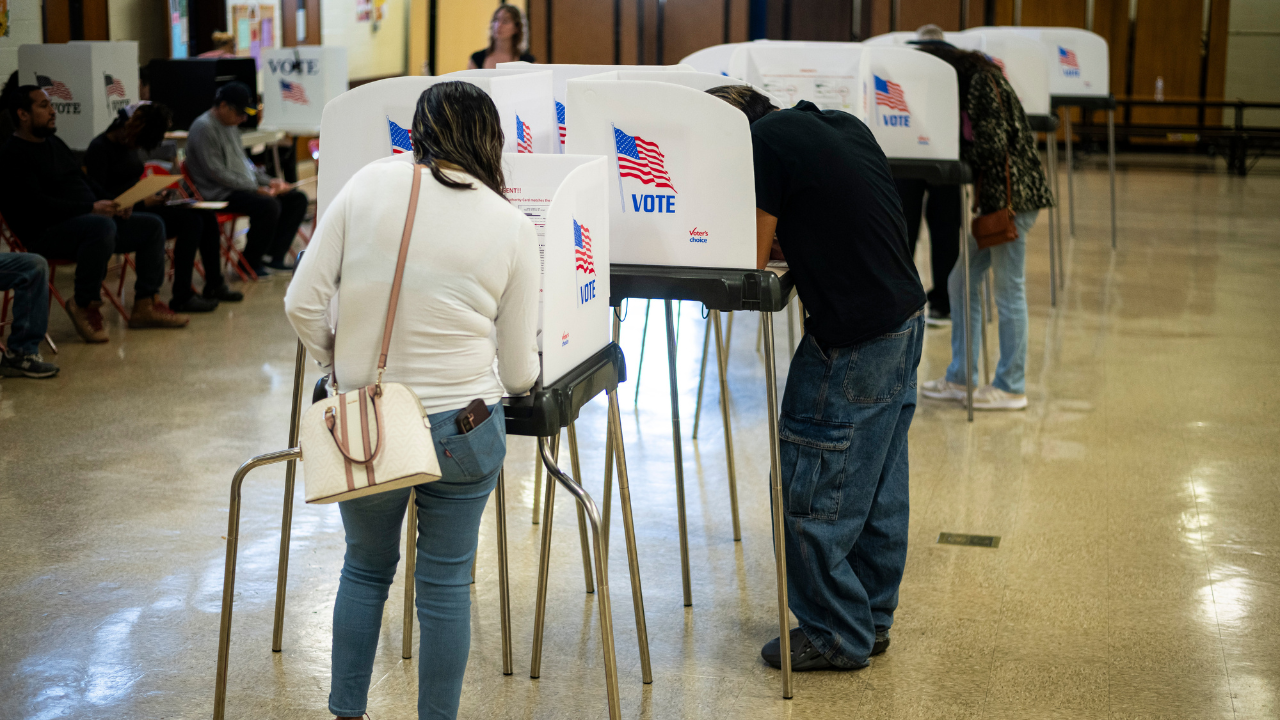
Voting booths and voters are seen at a polling location. (Graeme Sloan for The Washington Post/Getty Images)
The effort, which could create five more Democratic-leaning congressional districts, aims to counter the passage in the red-state of Texas of a new map that aims to create up to five right-leaning House seats. Failure to approve the measure would be a stinging setback for Democrats.
Proponents and opponents of Proposition 50 reported raising more than $215 million as of Oct. 2, with much of the money being dished out to pay for a deluge of ads on both sides.
One of the two main groups countering Gov. Gavin Newsom and the Democrats is labeling its effort “Stop Sacramento’s Power Grab.”
Also getting into the fight is former Gov. Arnold Schwarzenegger, the last Republican governor of California.
EVERYTHING YOU NEED TO KNOW ABOUT ELECTION DAY 2025: CRITICAL ELECTIONS, BALLOT MEASURES AND MORE
Gov. Gavin Newsom looks on during a bill signing event related to redrawing the state’s congressional maps on Aug. 21, 2025, in Sacramento, California. (Justin Sullivan/Getty Images)
“That’s what they want to do is take us backwards. This is why it is important for you to vote no on Prop 50,” Schwarzenegger says in an ad against Proposition 50. “Democracy — we’ve got to protect it, and we’ve got to go and fight for it.”
When voters head to the polls, a “Yes” vote will approve the Newsom-backed plan to re-draw the maps starting in 2026 and a “No” vote would keep the existing maps.
New York City’s Proposal 6
In addition to deciding who will be the city’s next mayor, 5.1 million registered New York City voters will also decide on a measure, known as Question 6, that would move election dates for city offices to the same year as federal presidential elections.
According to the city’s official election website, “‘Yes’ moves City elections to the same year as Federal Presidential Elections, when permitted by state law. ‘No’ leaves laws unchanged.”
Advocates of moving the election to coincide with federal elections argue it will increase turnout and thus provide results more representative of the electorate as a whole.
Opponents argue that key local issues will get buried in national politics if the elections are moved.
Housing related ballot measures in New York City
“I voted today” stickers (Joseph Prezioso/AFP via Getty Images)
Affordable housing is perhaps the most talked about campaign issue in New York City and voters will be asked two questions related to that issue when they walk into polling places on Tuesday.
Proposal 2 is framed as a way to “fast track” affordable housing in the city.
“This proposal would make two new processes to fast-track certain affordable housing projects,” New York City’s election website says. “The first process is for publicly financed affordable housing projects. The second process is for affordable housing projects in the 12 community districts with the lowest rates of affordable housing development.”
Proposal 4 in New York City is described by the collection committee as a vote to, “Establish an Affordable Housing Appeals Board with Council, Borough, and Citywide Representation.”
“This proposal would change the current land use review process when the City Council rejects or changes an affordable housing project,” the measure is framed.
“The proposal would create an Affordable Housing Appeals Board, made up of the local Borough President, Speaker of the City Council, and Mayor. The proposal would allow the Appeals Board to reverse the City Council’s decision with a two-to-one vote.”
Housing is also the focus of Proposal 3, “where a Yes” vote “simplifies review for limited land-use changes, including modest housing and minor infrastructure projects” and a “no” vote is described as a vote that “leaves these changes subject to longer review, with final decision by City Council.”
Read the full article from Here



The San Francisco Giants conclude this four-game series against the Colorado Rockies this afternoon from Oracle Park.
Taking the mound for the Giants will be right-hander Trevor McDonald, who enters today’s game with a 5.46 ERA, 3.99 FIP, with 50 strikeouts to 20 walks in 59.1 innings pitched. His last start was in the Giants’ 9-3 loss to the Toronto Blue Jays on Tuesday, in which he allowed eight runs on 11 hits and one walk in two and a third innings.
He’ll be facing off against Rockies right-hander Michael Lorenzen, who enters today’s game with a 6.46 ERA, 4.83 FIP, with 72 strikeouts to 35 walks in 92 innings pitched. His last start was in the Rockies’ 4-3 win over the Los Angeles Dodgers on Tuesday, in which he allowed three runs (two earned) on six hits with five strikeouts and three walks in six innings.
Who: San Francisco Giants vs. Colorado Rockies
Where: Oracle Park, San Francisco, California
Regional broadcast: NBC Sports Bay Area
Radio: KNBR 680 AM/104.5 FM, KSFN 1510 AM

The Nuggets have made a habit of signing bench players with Colorado ties.
The latest homecoming they’ve arranged is for Alpha Diallo, who played a season of high school basketball at Denver West and is now signing a one-year, $1.4 million minimum contract with Denver in NBA free agency, a league source told The Denver Post on Sunday.
Diallo, 29, was named Defensive Player of the Year in the EuroLeague last season. This will be his first foray into the NBA after a five-year stint with AS Monaco. He recently committed to join Dubai Basketball on a multiyear deal, according to a report by the European media outlet BasketNews, but his contract included a clause granting his release if he left for the NBA by July 15.
The Nuggets have signed Diallo, Reggie Jackson (Palmer High School), David Roddy (Colorado State) and KJ Simpson (CU) to various deals in the last three years.
Born in New York, Diallo helped lead Denver West to the Colorado Class 4A Sweet 16 as a sophomore. He transferred to Lincoln High before his junior season, but he was ruled ineligible to compete for the entire school year due to what CHSAA deemed an implicit recruiting violation; Lincoln’s coach at the time had just coached Diallo in a summer tournament.
The eligibility fight with CHSAA eventually led Diallo to leave the state. He returned to the East Coast and played four years of college basketball at Providence, where he earned Second Team All-Big East honors twice.
Signing Diallo is the latest example of Denver’s attempt to prioritize defense and athleticism around Nikola Jokic. Last month, the Nuggets drafted Trevon Brazile and Bryce Hopkins in the second round, betting on defensive upside in both cases. They’ve also replaced backup center Jonas Valanciunas with the younger, bouncier Marvin Bagley III on a veteran minimum contract.
Denver tentatively has 12 players under contract on its 15-man roster for the 2026-27 season now: Nikola Jokic, Jamal Murray, Aaron Gordon, Cam Johnson, Christian Braun, Zeke Nnaji, Julian Strawther, DaRon Holmes II, Tyus Jones, Bagley, Brazile and Diallo. Restricted free agency negotiations have not yet been resolved with Peyton Watson and Spencer Jones.
Diallo will count for $2.45 million toward the luxury tax despite his $1.4 million salary, the minimum for NBA rookies. The accounting quirk exists so that owners aren’t incentivized to overlook more experienced free agents for tax purposes; the tax ramifications are equal for all minimum signings, regardless of NBA service time.
Want more Nuggets news? Sign up for the Nuggets Insider to get all our NBA analysis.

PORTLAND, Ore. (KATU) — Portlanders are being invited to help BIKETOWN mark its 10th birthday with what organizers hope will become a new world record: the largest electric bicycle party and ride.
The Portland Bureau of Transportation is organizing a GUINNESS WORLD RECORDS attempt on Sunday, July 19, aiming to beat the current record set in Seattle in 2018 with 405 e-bikes. PBOT is seeking the GUINNESS WORLD RECORDS title for the Largest Electric Bicycle Party and Ride.
Riders will gather at Salmon Springs, the fountain in Tom McCall Waterfront Park, starting at 8:30 a.m.
Check-in begins at 8:30 a.m., and the ride is scheduled to start at 9:30 a.m. from Southwest Naito Parkway and Southwest Salmon Street. PBOT said the date is “10-years-to-the-day since BIKETOWN service started with a maiden voyage group ride across the Willamette River.”
“I can’t wait to see all of Portland come out to celebrate the ways BIKETOWN has transformed our community,” PBOT Director Millicent Williams said. “Since 2016, BIKETOWN has introduced thousands of Portlanders to biking, and e-bikes in particular, and made biking more accessible for more people. By breaking this GUINNESS WORLD RECORDS title, we will remind everyone of Portland’s place at the front of the pack of leading bike cities across the nation.”
PBOT said the event is designed for massive participation and will follow a 2-mile loop that includes Tilikum Crossing, the Eastbank Esplanade and the Hawthorne Bridge, taking place mostly on the Waterfront and Eastbank Esplanade. Organizers said participants should expect a slow ride with some stops and are asked to stay on the route to be counted, while watching for pedestrians and other riders.
People riding personal e-bikes and pedal bikes are welcome, though PBOT said only e-bikes will be counted toward the record attempt. PBOT said registration is strongly encouraged to ensure riders are counted and that participants will need to provide their e-bike make and model. Riders are also encouraged to arrive early to check in and get a bib.
For people without an e-bike, PBOT said BIKETOWN will have bikes available to reserve on a first-come, first-served basis, with early registration recommended. Riders must be 16 or older to use BIKETOWN.
After the ride, PBOT said the event will conclude with a celebration featuring vendors, refreshments and remarks from City of Portland and BIKETOWN partners. PBOT said an official judge from Guinness World Records is expected to verify the attempt and confirm whether Portland set a new record.
PBOT also encouraged participants to head to the Portland Pride Parade and Festival afterward. The first 1,000 people who register for the ride will receive free entry to the Pride Festival, supported by BIKETOWN founding partner and title sponsor Nike.
PBOT said the event is possible with financial support from Nike, with additional support from Lyft and the City of Portland.
BIKETOWN launched July 19, 2016, with 1,000 bikes. PBOT said the system has deployed 3,000 electric pedal-assist bicycles serving a 50.5-square-mile service area, including portions of East Portland. BIKETOWN is a partnership between the City of Portland’s PBOT and Nike, and is operated by Lyft.
-
 News16 minutes ago
Want to own a real T. rex? It could cost you $30 million
-

 Los Angeles, Ca2 hours ago
Rare, corpse flower double bloom underway at Huntington Library
-

 Detroit, MI2 hours ago
Around 400 pairs of shoes intended for charity giveaway stolen from Detroit nonprofit, organization says
-

 San Francisco, CA2 hours ago
How to watch San Francisco Giants vs. Colorado Rockies
-

 Dallas, TX3 hours ago
3 unanswered questions before training camp: Dallas Cowboys edition
-

 Miami, FL3 hours ago
“Love & Hip Hop: Atlanta” star Tommie Lee among 6 arrested during World Cup match in Miami, sheriff says
-

 Boston, MA3 hours ago
‘More than just a cyclist’: Hundreds mourn Boston transit planner killed while biking – The Boston Globe
-

 Denver, CO3 hours ago
Nuggets sign former Denver West basketball player Alpha Diallo out of EuroLeague

