California
Chance of more showers in L.A., with a new storm set to hit Thursday

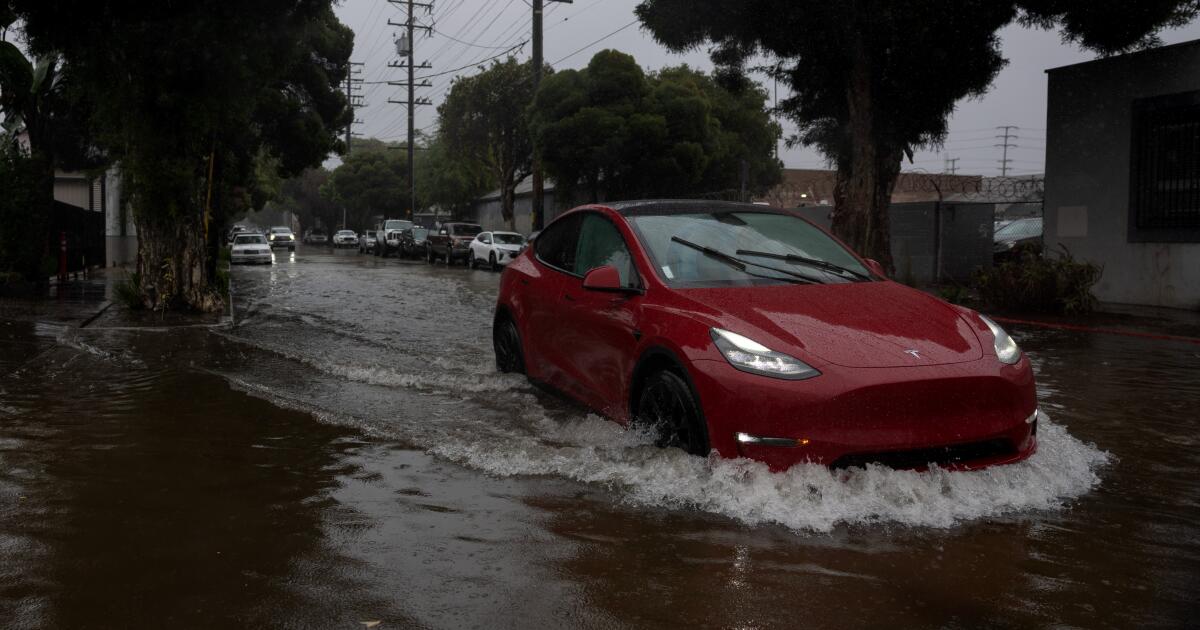
Showers could linger in Los Angeles on Tuesday following four straight days of rain — and even more rain is likely on Thursday and Friday.
There’s a 20% to 30% of showers and thunderstorms Tuesday across much of Los Angeles County, the National Weather Service said, although it’s expected to be mostly sunny. The thunderstorms will remain a slight risk because of a cold front that ushered in unstable air Monday.
By Tuesday, the cold front will have moved away from L.A., but the cold core of the low-pressure system will still be around. “This will bring enough instability to the area for a slight chance of thunderstorm development,” the weather service in Oxnard said.
Temperatures have chilled with the latest storm. While the L.A. coast and San Gabriel Valley on Monday reached the mid-60s, due to late arriving rain, most of L.A. County’s coastal areas and valleys “struggled to get out of the 50s,” the weather service said.
Wednesday will bring a reprieve with sunny skies, but another storm is expected to enter Southern California on Thursday and continue through Friday.
Thursday’s storm is expected to drop from 0.25 to 0.75 inches of precipitation. That’s on top of the 0.74 inches of rain that fell on downtown L.A. in the 24-hour period that ended at 9 p.m. Monday. Before that, the weekend storm that began Friday brought 2.68 inches of rain to downtown.
For the 24-hour period ending 9 p.m. Monday, Porter Ranch received 1.61 inches; La Cañada Flintridge, 1.5; Northridge, 1.43; Bel-Air, 1.21; Castaic, 1.15; Van Nuys, 1.12; and Beverly Hills, 1.11.
Warm Springs Camp, in the mountains overlooking the Santa Clarita Valley, recorded an 18-hour rainfall total of 2.5 inches by Monday evening.
The storms, thus far, have caused some mayhem but no severe or life-threatening damage in recently burned areas.
By late Monday night, landslides and flooding were reported on a number of roads. The 5 Freeway near Highway 14, between Sylmar and Santa Clarita, suffered flooding Monday afternoon, as did an offramp on the 91 Freeway at Carmenita Road. The California Highway Patrol said there was flooding at onramps to the 10 Freeway in El Monte and the 605 Freeway on the southern border of Baldwin Park.
Mountain roads were hard hit. One motorist on Angeles Crest Highway, a road that winds through the San Gabriel Mountains, became “stuck in mud, dirt and rock” in a northbound lane, while the southbound lane was completely blocked with multiple landslides, according to reports filed to the National Weather Service. Snowplows couldn’t haul away the debris because it was too heavy.
Near the 101 Freeway in Hidden Hills, a number of vehicles hydroplaned as Round Meadow Road flooded near Mureau Road.
Monday afternoon and evening also brought rockslides or mudsldies to San Francisquito Canyon Road, the mountainous route that connects Santa Clarita to the Antelope Valley; a section of Kanan Dume Road, which leads into the Santa Monica Mountains from Malibu; and on Mulholland Highway south of Calabasas.
Snow levels were at around 7,000 feet on Monday but were expected to drop to 5,000 feet by Tuesday. Officials issued a winter weather advisory for the eastern San Gabriel Mountains and the northern Ventura County mountains that is set to last through Tuesday night. About 2 to 5 inches of snow could fall in the mountains.
“As for the Grapevine area, there is a chance of a dusting of snow Tuesday morning as the snow levels lower,” the weather service said. The Grapevine is a key travel corridor on the 5 Freeway that connects L.A. and Santa Clarita with the Central Valley and the San Francisco Bay Area.
The highest point of the Grapevine section is the Tejon Pass, which peaks in elevation at 4,144 feet above sea level. At that location, “some non-accumulating snow is possible,” the weather service said.


BAKERSFIELD, Calif. (KBAK/KBFX) — The California Highway Patrol is urging drivers to stay focused on the road as they head out for Fourth of July celebrations.
The holiday weekend can be a dangerous time on our roads as millions of drivers are expected to travel.
CHP Officer Jorge Toro joined Eyewitness News Mornings to share how drivers can stay safe behind the wheel.
Officer Toro also highlighted the importance of sober driving over the holiday.
BE THE FIRST TO COMMENT
He says anyone hosting a party should make sure all of their guests get home safely, ensuring anyone who may be impaired doesn’t drive.

California is returning a stretch of rugged Mendocino County coast to the Indigenous nations whose ancestors once stewarded its shores.
State transportation officials recently approved the transfer of Blues Beach and the surrounding bluffs to Kai Poma, a nonprofit founded by representatives of the Sherwood Valley Band of Pomo Indians, Round Valley Indian Tribes and Coyote Valley Band of Pomo Indians.
The transfer of 136 acres just south of the community of Westport will mark the first time land managed by the California Department of Transportation has been returned to Indigenous tribes.
“This is beyond huge,” said J. Carlos Rivera, tribal chairman of the Sherwood Valley Band of Pomo Indians. “It’s enormous from our tribal perspective that we are basically obtaining the land that our people once lived on before colonization.”
California purchased the swath of rocky cliffs and windswept shoreline in the 1960s to expand the construction of Highway 1 and create a scenic viewpoint for highway travelers, according to a California Coastal Commission report.
More recently, public access has been largely unregulated, and summer weekends and holidays have drawn large groups who camp and party on the beach, at times driving through sensitive areas, damaging cultural sites and leaving behind trash, the report states.
Kai Poma plans to conduct cultural and archaeological resource studies and environmental surveys and then prepare a resource management plan for the property, according to planning documents. The nonprofit and the Coastal Commission have drafted a public access management plan that states the land will be open from sunrise to sunset.
Rivera described the entire property as a sacred site. The coastal waters are used by tribal people for seaweed and abalone gathering, and the shores host youth cultural camps, he said. “Protecting the land, it has a deeper meaning for us because we’re connected to the land,” he said.
The effort to acquire the land took years — and required a change in state law. Caltrans lacked the ability to transfer land to tribal governments until 2021, when Gov. Gavin Newsom signed a bill sponsored by state Sen. Mike McGuire (D-Healdsburg) that enabled the transfer, according to a news release issued at the time. The law also bars commercial activity on the property and requires public access be maintained.
“With 136 acres now officially transferred into tribal stewardship, one of the most spectacular stretches of the Mendocino Coast will be forever protected,” McGuire said in a statement.
“This agreement, the first of its kind in California, gives these three dynamic Native American tribes the rightful opportunity to reclaim sacred lands and cultural traditions on this special piece of earth. And it’s about damn time.”
The land transfer cleared its last regulatory hurdle June 26 with the approval by the California Transportation Commission, said Neil Thapar, an attorney who works as an advisor and legal consultant to Kai Poma. Caltrans staff will next record the deed transferring the title from the state of California to Kai Poma, which is expected to happen any day, he said.


Fireworks Safety Guide
Essential safety tips for buying, handling, and watching fireworks to ensure a safe celebration.
With July 4 falling on a Saturday this year, many businesses and organizations are taking the day off Friday, July 3, to mark America’s 250th birthday. From banking to mail service, here’s what’s open and closed for the holiday weekend.
Most federal offices closed, mail service to continue
Non-essential federal offices will be closed on July 3. However, mail service will continue as normal, and post offices are scheduled to remain open.
Most California government offices to remain open
Most California government offices will be open on July 3, with some exceptions.
DMV offices throughout the state will be open. However, the Employment Development Department will be closed.
DMV offices that offer Saturday hours will be closed on July 4.
Private parcel services to remain open
UPS and FedEx are both scheduled to operate normally on July 3, but will suspend service on July 4.
Stock markets closed
Both the New York Stock Exchange and Nasdaq will be closed on July 3.
Most banks to stay open
While most banks were expected to operate normally on July 3, some may operate under modified holiday hours. All banks will be closed on July 4.
Online banking services should remain operational.
Grocery stores
Most major grocery chains will be open on both July 3 and July 4. Trader Joe’s locations will be open for regular business on July 3 but will close early at 5 p.m. on the Fourth of July.
Retailers
Many major retail stores, such as Walmart and Target, plan to operate under normal business hours on both July 3 and 4. All Costco warehouse stores operate under normal business hours on July 3, but will close on July 4.
Restaurants
Most major restaurant chains remain open on July 4, but some will have limited hours. All Raising Cane’s locations will close on July 4.
-

 Technology3 minutes ago
Cheap streaming box could hijack your home internet
-
 Business6 minutes ago
How the FIFA World Cup is providing a boost for L.A. businesses
-
 Entertainment11 minutes ago
Who is on Elle Woods’ playlist? ’90s bands like No Doubt and Sleater-Kinney
-
 Lifestyle17 minutes ago
L.A. Affairs: He wanted L.A. I wanted New York. A panic attack changed everything
-
 Politics21 minutes ago
Trump refashions America’s 250th as a celebration of himself
-
 Sports36 minutes ago
How Dodgers’ Max Muncy, vying for his third All-Star selection, continues to evolve
-

 World48 minutes ago
Germany’s Merz defends NATO spending after Trump calls it ‘ridiculous’
-
 News1 hour ago
Oregon ER doctors win a ‘David and Goliath’ battle against a national company

