Lifestyle
When a life coach manifests nothing for you but debt and delusion


When Anela Pasalic moved from her rural hometown in Småland, Sweden, to study in the capital of Stockholm, she remembers feeling isolated and severely depressed. It was then that she happened across a glamorous spiritual guru.
Pasalic watched on her phone screen as Kathrin Zenkina shared, from roughly 5,500 miles away in Los Angeles, how she turned her life around through manifestation, which is the philosophy that we can will things into existence by believing they’ll happen. “It just felt like she was an ordinary girl who went for it and had amazing shifts in her life. She also seemed very kind, caring and understanding,” Pasalic says.
For Pasalic, Zenkina felt like an online best friend — one who boasts almost 450,000 followers on Instagram, identifies herself as a “seven-figure entrepreneur” and sells manifestation courses through her business, the Manifestation Babe Academy. Pasalic, who first encountered Zenkina in 2018 when she was 23, took out a payment plan to cover a $1,300 program that Zenkina advertised as the only course one would need to manifest their dreams. Now 30, she estimates she has spent more than $6,000 on Manifestation Babe Academy courses. To pay for them, she borrowed money from family and skipped payments on other bills, like student loans. This was partially due to Zenkina’s suggestion that behaving as though you have money is a technique for attracting it. “I wanted to manifest better circumstances, like me being happy, me having better friendships, me feeling aligned with life,” she explains. Zenkina declined to comment.
Although manifestation has been around since the 1800s, it has moved from the margins to the spotlight amid the recent wellness boom fueled by social media. By summer 2020, Google searches for the term “manifestation” increased, and ample books and podcasts on the practice were released. Since then, the term has been used colloquially (if often semi-ironically) in both pop culture and in everyday life: Sabrina Carpenter employed it in her song “Bed Chem,” and in 2024, “manifest” was Cambridge Dictionary’s word of the year.
“Manifestation” search interest grew in the first half of 2020.
(Google Trends)
At the same time, some life coaches began incorporating manifestation into their services. Their guidance, from relationship to financial to career, can cost $50 per month to thousands of dollars per course. And some followers, like Pasalic, may end up feeling cheated and confused.
The life coaching arena is largely unregulated. Although coaches can receive certifications from various bodies, not all of them do, and these certifications vary in legitimacy as there is no overarching board. “Coaching is not a regulated field, it’s not a regulated practice. … When you see a licensed professional, such as myself or other psychologists, we have accountability to our licensing body,” explains Lynn F. Bufka, head of practice at the American Psychological Association. What’s more, anyone can call themselves a coach.
Zenkina, who doesn’t advertise that she has certifications, teaches manifesting, journaling, tapping specific points on the body while focusing on particular thoughts and taking actions that feel “aligned” with one’s desires. She has clients record themselves vocalizing their wants, turning down the volume on the recording until it’s inaudible, overlaying it with calming music and listening to it on repeat — a technique known as “subliminal hypnosis.” Pasalic attended online programs that involved prerecorded webinars alongside worksheets and live Q&As.
Pasalic followed Zenkina with religious fervor, but her life didn’t change. She began to feel helpless and out of control, especially as most of Zenkina’s teachings focused on inner work over practical change. (As manifestation is intangible, it can be difficult for clients to ascertain whether or not their coaching is “working.”)
“In many ways, manifesting takes the problems with life coaching to a new level, further moving the process away from the concrete, practical advice that coaching should be about and into the abstract, occult, less researched and even riskier realm.”
— Dr. Elias Aboujaoude
“In many ways, manifesting takes the problems with life coaching to a new level, further moving the process away from the concrete, practical advice that coaching should be about and into the abstract, occult, less researched and even riskier realm,” says Dr. Elias Aboujaoude, a psychiatry professor at Stanford University, a research scientist at Cedars-Sinai and the author of “A Leader’s Destiny: Why Psychology, Personality and Character Make All the Difference.”
Zenkina warned her followers that their lives would fall apart before they improved, and that the universe would help them in the “11th hour.” So Pasalic trudged on. Then, in January 2020, her parents convinced her to visit a doctor who prescribed her an antidepressant. The medication helped, but then Zenkina said something that made Pasalic doubt its effectiveness.
On a live Q&A, according to Pasalic, Zenkina said antidepressants can help people get to a higher vibration (spiritual parlance for happiness and positivity), but then, perhaps, they should let them go. “I had been on antidepressants for maybe 10 months. And I was just like, ‘Oh, maybe she’s right. Maybe I should quit antidepressants; maybe I’m better now,” recalls Pasalic.
“If you don’t have any expertise in mental health, you might dangerously cross a line into a territory where you really need to have some expertise in order to be effective,” says Bufka, regarding coaches giving medical advice.
Pasalic says she had a wake-up call when midway through a roughly $2,400 Sovereign Money course — which promised to help disciples “hack the money game using the spiritual laws of money manifestation,” create “generational wealth for lifetimes” and “become recession proof” — didn’t work. She asked for a refund, but was denied.
“I was just so delusional,” Pasalic says. “I was stuck in my life for seven years because I believed what she was teaching.”
To vent, she took to the Life Coach Snark subreddit — one of several forums where people share their experiences with life coaches they suspect are taking advantage of people — and a deluge of similar tales came in. Pasalic says members of the various subreddits fear retribution for speaking out.
Nevertheless, the camaraderie was cathartic. “It felt comforting knowing other people were validating my feelings and what I went through,” she says.
Dane Schwaebe, too, was depressed and unhappy with his life when he stumbled into the coaching universe. A friend had recommended he look into Nick Unsworth, the charismatic founder of Life on Fire, a spiritual life and business coaching program which promises to help people unleash their “god-given potential.” On LinkedIn, he boasts certifications in hypnosis; neuro-linguistic programming, an unproven form of therapy that involves reprogramming how people process information; and time line therapy, which aims to teach people to respond to current circumstances without being informed by the past.
Schwaebe says he was seduced by how Unsworth presents on social media: He lives in a large house in Texas, drives a Dodge Viper sports car and, to Schwaebe, kind of resembles Channing Tatum. He’s also a family man, featuring his wife and three kids heavily in his Instagram content.
In 2018, Schwaebe signed up for a free introductory event in San Diego, about an hour’s drive from his Temecula home. Per Schwaebe’s account, it lasted from early in the morning until late at night, with a 20-minute lunch break, and attendees were asked to turn their phones off and put them away. As well as a group visit to church, Schwaebe says, the event featured new-age spirituality techniques like group meditation, Reiki and manifestation.
Unsworth also allegedly regaled attendees with the story of the time he was deep in debt and turned his life around through coaching (a recurring theme in his content.) “They offer a light, you know? They’re kind of like angler fish … You’re down and you’re in this darkness, and you see a light,” reflects Schwaebe. Unsworth did not respond to multiple requests for comment through his website’s contact form, email and Instagram.
After the free event, Schwaebe says he paid $6,000 for Life on Fire offerings. Per Schwaebe, one course called “Abundance” involved participants shouting a description of the person they wanted to become while a member of Unsworth’s team evaluated how much their eyes widened as they yelled — the wider, the better. Attendees also gathered in a circle to make a confession and confront a group member who resembled someone who had hurt them. Schwaebe chose a woman who reminded him of his birth mom and, per instruction, let it all out, which involved screaming and crying. One of the testimonies on the course’s website reads, “my favorite part of the event was breaking through generational sins, shame and regret.”
“I’m a perfect candidate for this sh—. I had a credit card to cover the coaching balance and was in a depressed, wounded state. I was willing to throw money at whatever would theoretically make me better,” says Schwaebe.
The title of “life coach” could potentially cause confusion, says Aboujaoude. “When life becomes your topic, you are a de facto therapist,” he says. “While any new helping profession is a welcome addition to our well-being landscape, this totally unregulated Wild West risks doing serious harm.”
Another Life on Fire event, Schwaebe says, guided attendees on how to manifest money, freedom and their own business. Schwaebe grew uneasy when Unsworth used it to pitch another course, suggesting those who couldn’t afford it ask someone they know to help pay for it. He also offered a commission for enticing friends and family to join, framing it as a business opportunity, says Schwaebe, who had signed up for the program via his friend’s affiliate link.
Unsworth also offers a course teaching people how to become a life and business coach in 90 days. Indeed, over the past few years, coaches coaching coaches have become a key component of the industry’s business model.
Today, Schwaebe says he is doing better. He’s been diagnosed with depression and ADHD; he takes medication and sees a therapist. He’s also set up an online marketing business, the success of which he attributes to no one but himself.
His advice for anyone considering following a life coach with a manifestation focus? “Don’t drink the Kool-Aid.”
So how can people seeking life and emotional support — whatever the form — navigate that search safely, particularly given the onslaught of coaches with polished social media presences? Bufka recommends asking the practitioner all of the questions you can. “It’s very appropriate to ask questions. How do you know this is effective? When should I expect to see some changes? What will we do to adjust if I’m not seeing the kinds of changes [I need]? You know, asking questions like that can help somebody make a more informed decision,” she says.
She also recommends enlisting the help of a friend, who can weigh in if things start feeling off. And if someone suspects they need mental health support, a qualified professional would best serve their needs, Bufka says. “Seeing the professional with the education and experience in the domain in which you’re struggling is going to be really important,” she says.
Today, Pasalic says she still struggles sometimes because of how much she invested into (and relied on) Zenkina’s teachings, but she feels more independent. “I’m so, so much better and feeling much happier,” she says. “I feel so much more like myself than I did before.”


Sunday Puzzle
NPR
hide caption
toggle caption
NPR

On-air challenge
I’m going to give you two five-letter words. Add the same two letters at the end of the first one and the start of the second one, in each case to complete a familiar seven-letter word.
Ex. Later Ready –> LATERAL/ALREADY
1. Habit Tempt
2. Laten Press
3. Blank Ching
4. Since Venue
5. Shack Groom
6. Surge Stage
Last week’s challenge
Last week’s challenge came from Rawson Sheinberg. of Plymouth, Mich. Think of a U.S. city with a two-word name. Add a letter to the first word, without rearranging letters, to name a country. Then, without adding a letter, rearrange the letters of the second word to name another country. What places are these?
Answer: Los Angeles –> Laos, Senegal
Winner
Elaine Neel of Derby, Kansas.
This week’s challenge
Next weekend will be the 186th convention of the National Puzzler League, in Bloomington, Ind., which I’ll be attending as always. Two other people who will be there are Henri Picciotto and Joshua Kosman, who created this week’s challenge. Name two words that are opposites. They share a single letter. Remove that shared letter from each word, put a hyphen between the two starting words, and you’ll get a term you sometimes see in food ads. What are the two words?
If you know the answer to the challenge, submit it here by Thursday, July 9 at 3 p.m. ET. Listeners whose answers are selected win a chance to play the on-air puzzle. Important: include a phone number where we can reach you.
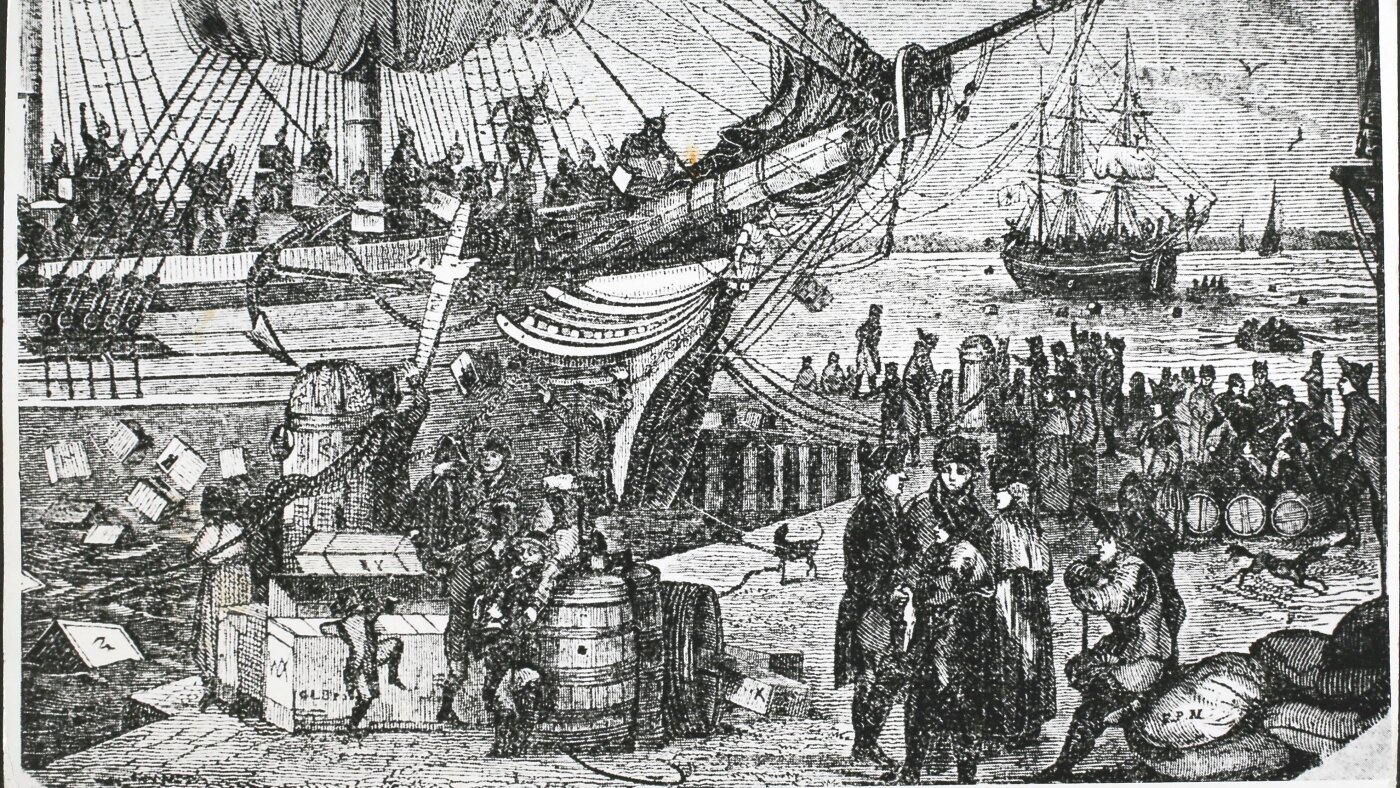
An illustration of the Boston Tea Party, when colonists dumped British East India Company tea into the harbor on Dec. 16, 1773. Some accounts say this marked a pivotal moment when Americans started loving coffee. But one historian says Americans were drinking lots of coffee before then.
Hulton Archive/Getty Images
hide caption
toggle caption
Hulton Archive/Getty Images
A consequential act of defiance secured tea’s place as perhaps the most iconic beverage of America’s colonial era.
The Boston Tea Party became an essential ingredient in the recipe for revolution in the following years.
But tea wasn’t the only hot beverage with a prominent role in America’s fight for independence.
Coffee was an important part of American culture from the start. And coffeehouses were essential, too — serving as hubs for brewing ideas of independence.
As the United States celebrates 250 years, here’s what to know about America’s early history of coffee.

Colonists were drinking coffee long before the United States existed
Europeans brought coffee with them when they came to America.
“The first documented example of a mortar and pestle used to grind coffee beans was on the Mayflower” in 1620, says historian Michelle Craig McDonald, the author of Coffee Nation: How One Commodity Transformed the Early United States.
“The fact that coffee was present so early is not surprising if you think about it,” McDonald says. “A number of those who were on the Mayflower came to North America from Amsterdam, which was a major coffee trading center in Western Europe by the 17th century.”
The first coffeehouse in the colonies opened in 1676 in Boston, a century before the U.S. declared independence, she says. Some taverns sold coffee even earlier.
The Boston Tea Party probably wasn’t the dramatic turning point toward coffee that some claim
On the night of Dec. 16, 1773, disgruntled colonists boarded three ships moored in Boston Harbor and threw overboard more than 92,000 pounds of tea owned by the British East India Company.
Tensions had been building between the Crown and the colonies over the previous decade, as Britain tried to levy taxes on its colonies to recoup war debts.
The Boston Tea Party protest was targeted at the British government’s passing of the Tea Act in 1773, which granted the East India Company a monopoly over tea sales in the colonies. While the British had removed some unpopular taxes in the preceding years, they left tea taxes in place. Colonial merchants were especially upset that the act allowed the East India Company to undercut their tea business.
To build solidarity for their cause of sovereignty, some patriots called on colonialists to swear off tea in favor of coffee. It’s why many histories point to the Boston Tea Party as a turning point when Americans switched from mostly drinking tea to mostly coffee. The anti-tea sentiment was immortalized in a founding father’s now-famous letter.
In July 1774, John Adams (before he became the second U.S. president) wrote to his wife Abigail, recounting an incident during his travels. After a long day, he asked the proprietor of the house where he was lodging for a cup of tea, provided it was smuggled and free of British taxes.
” ‘No sir, said she, we have renounced all Tea in this Place. I cant make Tea, but I’le make you Coffee.’ Accordingly I have drank Coffee every Afternoon since, and have borne it very well. Tea must be universally renounced. I must be weaned, and the sooner, the better,” Adams wrote.
Despite John Adams claiming a newfound patriotic duty to appreciate coffee, McDonald says colonists had been drinking lots of coffee all along.
She studied advertisements from the 1760s and ’70s to estimate how many shops sold coffee versus tea. Even before the Boston Tea Party, she says, “coffee is definitely more broadly available than tea is.”
A big reason? It was cheaper. “Its price again per pound is significantly less, which tells you about its availability, its accessibility to drinkers.”
Historians say it’s hard to definitively compare tea with coffee consumption, though, as official records from before America gained independence were inconsistent.
And smuggling was rampant, making official records even less reliable.
“There is a vast amount of smuggling,” says Joyce Chaplin, a professor of early American history at Harvard University. “So they’re not paying formal duties on tea that they get from the Dutch. They’re probably not paying formal duties on coffee from the French Caribbean.”
And Chaplin notes that people who loudly proclaimed a new appreciation for coffee over tea weren’t always doing what they said. It could have been political pandering. “I do not drink tea that comes via the East India Company,” she posits someone of the era saying. “But, you know, other sources are fine. Ditto for the coffee.”
Coffeehouses were a hub for revolutionary ideas
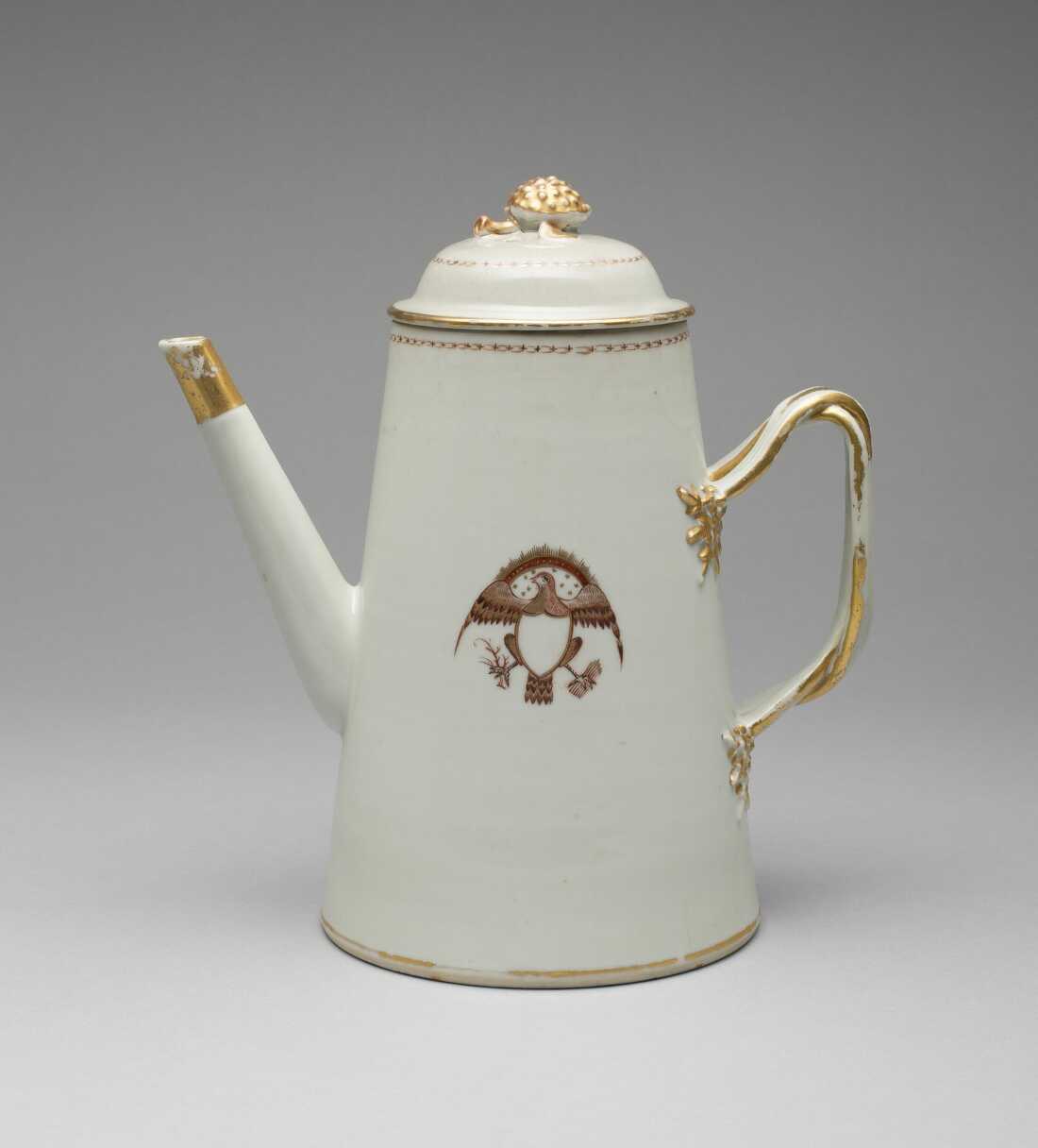
A coffeepot with cover, circa 1795. It has an American eagle motif, made in China for the American market. Coffee was part of a growing trend of globalization in the colonial era.
Heritage Art/Heritage Images via Getty Images
hide caption
toggle caption
Heritage Art/Heritage Images via Getty Images
In the colonial era, coffeehouses were hotbeds for seditious thought — where people planned acts of revolution.
“Coffeehouses are kind of famous for being places where people think and plot things,” says Mark Pendergrast, author of Uncommon Grounds: The History of Coffee and How It Transformed Our World.
A coffeehouse called the Green Dragon served as one of the locations for planning the Boston Tea Party. Years earlier, the Old London Coffeehouse in Philadelphia was a meeting place for strategizing responses to another British tax, the Stamp Act of 1765.
In Britain, coffeehouses were nicknamed “penny universities,” Pendergrast says: “because for a penny you could go and learn a whole lot by sitting around in a coffeehouse and discussing everything.” The same attitude traveled across the Atlantic.
Early American coffeehouses would commonly have city business directories, libraries of newspapers and currency exchange information. People could get maritime insurance there or buy things at auction.

“There’s a reason why coffeehouses become places of colonial protest … in the 1760s, in the 1770s, and it’s because it is the place where traders and merchants tended to gather,” historian McDonald says. “That’s where they heard about the economics of the day.”
Taverns were more likely than coffeehouses to have rooms for rent and stables for travelers’ horses. They were also more likely to have food.
Interestingly enough, coffeehouses could serve alcohol and taverns could serve coffee.
But the vibes at each were different. While women and men could “riotously drink together” in taverns, coffeehouses often didn’t allow women, according to Chaplin of Harvard.
“The sense was the coffeehouse was the place where you had a clear head — to argue about politics, to find out what was going on in the business world, to cut a business deal,” she says. “Whereas taverns were places where, in a sense, you refueled.”
Still, she says, the lines between the two “weren’t completely clear.”
The cost of America’s revolutionary drink
Coffee (and tea for that matter) was part of a growing globalization of trade around this time.
Much of the coffee in the colonies was grown in the Caribbean, while tea came from China.

Supply was up and coffee was easier than ever to drink. “Trade and frankly, imperialism, are making it possible for … colonial products to be produced and transferred to other parts of the world in greater and greater quantities,” says Chaplin.
As a result, by the time of the American Revolution, both coffee and tea were in reach for many common people. “They’re both becoming affordable luxuries,” Chaplin says.
Fancy coffee and tea paraphernalia were also part of this increasingly global market. Middle and upper-class people would have wanted special implements for drinking these beverages and a place to drink it. That meant they needed wood for coffee tables, silver for coffeepots, and porcelain for teapots.
“These two beverages are encouraging people to consume all kinds of new stuff,” says Chaplin. “The mahogany that comes out of the Caribbean, the china coming out of China, silver that is mined principally in South and Central America and processed in a lot of the parts of the world.”
There’s a dark side to coffee’s history, too. The plantations that supplied the crop ran on the labor of enslaved people. By 1790, half of the world’s coffee was being grown in the French colony of Saint-Domingue, in what is today Haiti, Pendergrast says, where slaves were routinely mistreated, raped and murdered.

The Declaration of Independence, signed in 1776, is infamous for a contradiction. It proclaimed that “all men are created equal,” but failed to acknowledge the hundreds of thousands of enslaved people living in America at the time.
Coffee carried a similar contradiction. The beverage that fueled conversations that inspired America’s fight for independence — centered on the ideals of life, liberty and the pursuit of happiness — depended on enslavement.
“Coffee had this paradoxical effect, that it did promote revolutionary thought,” Pendergrast says. “But it was also grown by slaves.”
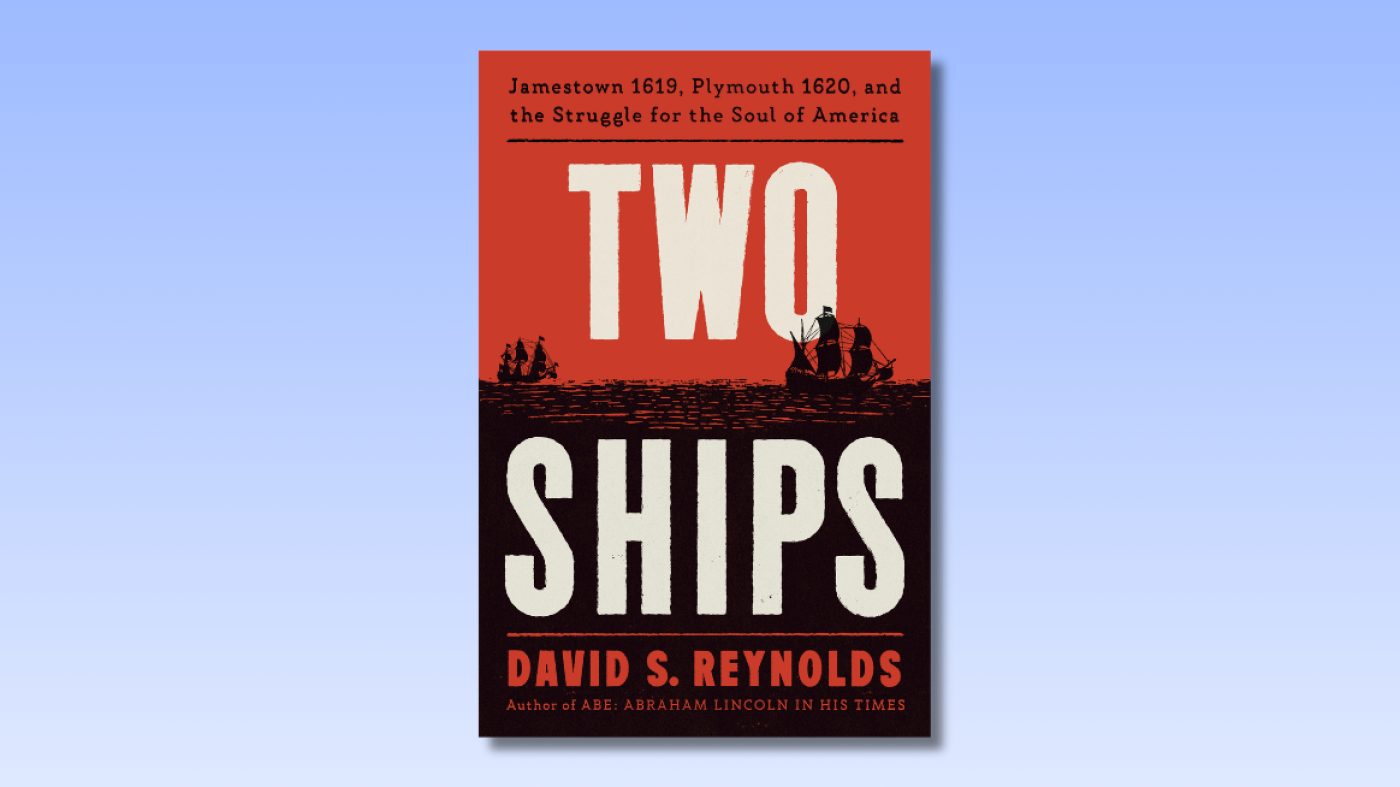
Just in time for a contentious 250th anniversary of the United States of America, historian David S. Reynolds’ latest book, Two Ships, helps us realize that any country that couldn’t agree on its own origin story is destined for divisive times.
Two Ships is about the complicated, conjoined legacy of the landings of the Mayflower, which carried the Pilgrims to Plymouth, Mass., in 1620, and the White Lion, which arrived in Jamestown a year earlier, bringing the first enslaved Africans to Virginia.
As Reynolds demonstrates, it’s not so much the facts of these two voyages, as it is the meanings ascribed to them, that made them such a powerful metaphor for two conflicting visions of American identity.
To simplify, the Mayflower’s passengers were separatist Puritans, dissenters to the reign of the English king, James I. As the United States developed, the Mayflower was credited with carrying the seeds of a radical democracy to the New World, one in which all men (in theory, at least) were equal before God.
In contrast, the European settlers of Jamestown were Royalists, also known as Cavaliers. Loyal to the monarchy, they believed in a strict hierarchy.
But the meaning of the images of the two ships shifted depended on who was invoking them and when. Not surprisingly, the metaphor was deployed most vigorously during the Civil War. In abolitionist speeches and writings, the White Lion or the “Slave-Ship,” as it was commonly called, was condemned for infecting America with the “plague-spot” of slavery.
Reynolds says that Frederick Douglass resorted to the “two ships” metaphor frequently, while Lincoln avoided it, hoping to preserve a unified ship of state. Meanwhile, Southern descendants of Cavaliers invoked the Mayflower to emphasize the intolerance and “cruel, persecuting” character of the Puritans. In a comment that resonates for our own times, Reynolds says:
It didn’t matter to the South that … by the mid-nineteenth century, the North had become a kaleidoscope of religious denominations, …, few of which resembled the faith of the Plymouth colonists. Distortion is intrinsic to cultural memory, especially when amplified by sectional or political bias. For Southerners, the Mayflower had brought Puritanism, which had yielded fanatical movements like abolitionism, now a dire threat to the Union.
In a brief-but-fascinating digression into the unpredictable power of literary fiction, Reynolds observes that the South’s fondness for Nathaniel Hawthorne’s anti-Puritan novel, The Scarlet Letter, and, even more, for the medieval historical romances of Sir Walter Scott, bolstered its nostalgia for a largely-imagined feudal society.

Reynolds quotes the always-quotable Mark Twain, no fan of Scott’s, as saying that Scott “did measureless harm; more real and lasting harm, perhaps, than any other individual that ever wrote …”
Two Ships is a dazzling survey of some three centuries of American history through a close reading of a metaphor. By the 1890s, Reynolds says, the interpretive tide had turned again: “Southern and Northern whites, feeling threatened by people of color and by an array of European immigrants, were retreating to a cocoon of racial solidarity that Mayflower celebrations helped reinforce.”
By the later-20th century, the image of the Mayflower was depoliticized and commercialized into Pilgrim hats and Black Friday sales. The powerful metaphor of the two ships receded into the mist.
Seven years ago, however, the 1619 Project piloted the White Lion — “The Slave-Ship” — back into view and anchored it at the center of debates about slavery’s place in the national story. The 1619 Project has been faulted for its historiography, and it does lie outside of the chronological boundaries of Reynolds’ book; still, it seems too momentous a reappearance of the White Lion not to at least acknowledge in this book.
That criticism noted, I think reading Two Ships would be an excellent way to observe this particular Fourth of July. It’s wise for all of us to have a more informed awareness of how Americans have understood, misunderstood and, often, flattened each other into stereotypes. Or, as Ernest Hemingway, one of the Mayflower Pilgrims’ more cynical descendants, might say in response to that sentiment: “Isn’t it pretty to think so?”

-

 Illinois12 minutes ago
Our Chicago: Celebrating America’s 250th birthday in Illinois
-

 Indiana15 minutes ago
Fever vs. Aces Prediction, Odds, Best WNBA Prop Bet for Sunday, July 5
-

 Iowa20 minutes ago
2027 Recruiting Class Shaping Up To Be Special One for Iowa State Football
-

 Kansas27 minutes ago
2026 K-State Football Early Opponent Preview, Game 6: Kansas
-

 Kentucky27 minutes ago
Recovery operations underway to find possible drowning victim on Kentucky Lake | NewsRadio 1230 AM/99.3 FM | Hopkinsville’s News Leader
-

 Louisiana35 minutes ago
Man killed, officer injured in shooting in alleyway near Sand Bar in downtown Shreveport
-
Maine42 minutes ago
People We’ve Lost
-
 Maryland45 minutes ago
BGE working to restore power to over 40,000 customers after July 4th storms move through central Maryland


