Science
Should bioplastics be counted as compost? Debate pits farmers against manufacturers


Greg Pryor began composting yard and food waste for San Francisco in 1996, and today he oversees nine industrial-sized composting sites in California and Oregon that turn discarded banana peels, coffee grounds, chicken bones and more into a dark, nutrient-rich soil that farmers covet for their fields and crops.
His company, Recology, processes organic waste from cities and municipalities across the Bay Area, Central Valley, Northern California, Oregon and Washington — part of a growing movement to reduce greenhouse gas emissions by minimizing food waste in landfills.
But, said Pryor, if bioplastic and compostable food packaging manufacturers’ get their way, the whole system could collapse.
At issue is a 2021 California law, known as Assembly Bill 1201, which requires that products labeled “compostable” must actually break down into compost, not contaminate soil or crops with toxic chemicals, and be readily identifiable to both consumers and solid waste facilities.
The law also stipulates that products carrying a “compostable” label must meet the U.S. Department of Agriculture’s National Organic Program requirements, which only allow for plant and animal material in compost feedstock, and bar all synthetic substances and materials — plastics, bioplastics and most packaging materials — except for newspaper or other recycled paper without glossy or colored ink.
Close-up of text on plastic cup reading Made From Corn, referring to plant derived bioplastics.
(Getty Images)
The USDA is reviewing those requirements at the request of a compostable plastics and packaging industry trade group. Its ruling, expected this fall, could open the door for materials such as bioplastic cups, coffee pods and compostable plastic bags to be admitted into the organic compost waste stream.
Amid pressure from the industry, the California Department of Resources Recycling and Recovery said it will await implementing its own rules on AB 1201 — originally set for Jan. 1, 2026 — until June 30, 2027, to incorporate the USDA guidelines, should there be a change.
Pryor is concerned that a USDA ruling to allow certain plastic to be considered compost will contaminate his product, make it unsaleable to farmers, and undermine the purpose of composting — which is to improve soil and crop health.
Plastics, microplastics and toxic chemicals can hurt and kill the microorganisms that make his compost healthy and valued. Research also shows these materials, chemicals and products can threaten the health of crops grown in them.
And while research on new generation plastics made from plant and other organic fibers have more mixed findings — suggesting some fibers, in some circumstances, may not be harmful — Pryor said the farmers who buy his compost don’t want any of it. They’ve told him they won’t buy it if he accepts it in his feedstock.
“If you ask farmers, hey, do you mind plastic in your compost? Every one of them will say no. Nobody wants it,” he said.
However, for manufacturers of next-generation, “compostable” food packaging products — such as bioplastic bags, cups and takeout containers made from corn, kelp or sugarcane fibers — those federal requirements present an existential threat to their industry.
That’s because California is moving toward a new waste management regime which, by 2032, will require all single-use plastic packaging products sold in the state to be either recyclable or compostable.

A worker at Recology’s Blossom Valley composting site rides his bike back to the sorting machines after a break in Vernalis, Calif., on June 26.
(Susanne Rust / Los Angeles Times)
If the products these companies have designed and manufactured for the sole purpose of being incorporated in the compost waste stream are excluded, they will be shut out of the huge California market.
They say their products are biodegradable, contain minimal amounts of toxic chemicals and metals, and provide an alternative to the conventional plastics used to make chip bags, coffee pods and frozen food trays — and wind up in landfills, rivers and oceans.
“As we move forward, not only are you capturing all this material … such as coffee grounds, but there isn’t really another packaging solution in terms of finding an end of life,” for these products, said Alex Truelove, senior policy manager for the Biodegradable Product Institute, a trade organization for compostable packaging producers.

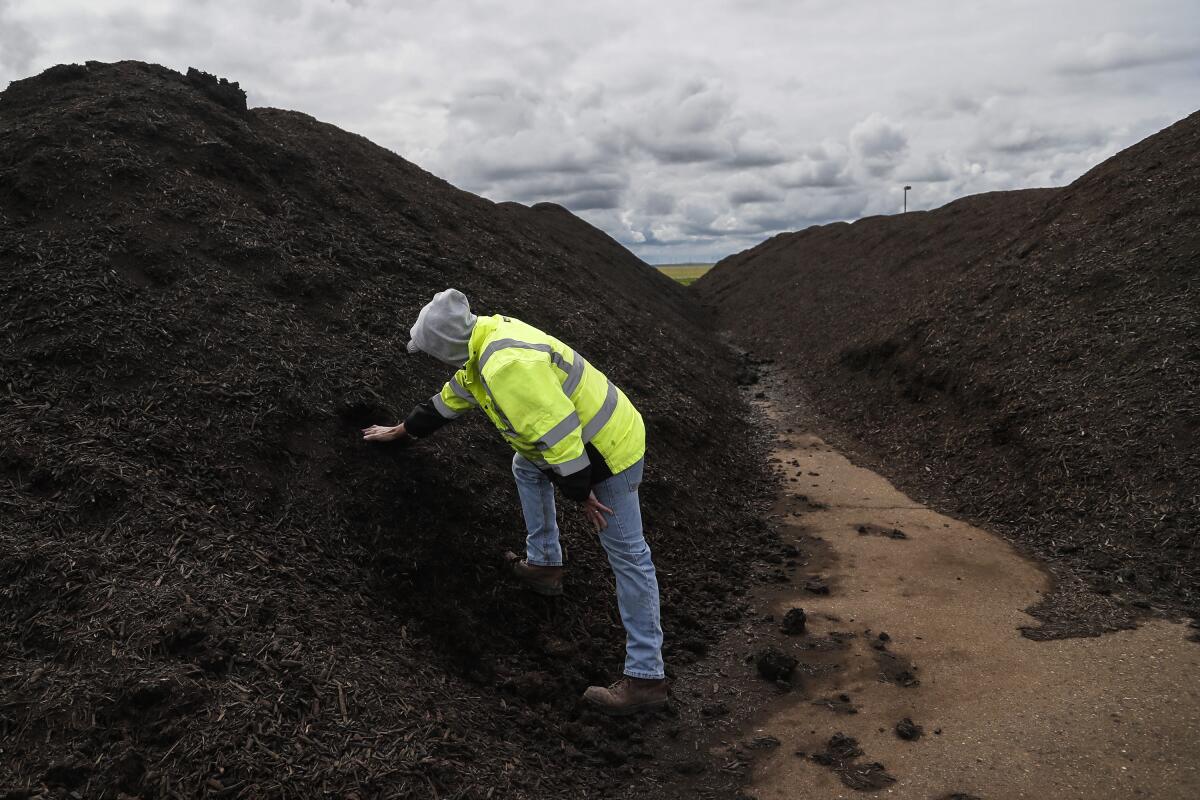
(Robert Gauthier/Los Angeles Times)

Material is loaded into a mixing truck where biosolids and amendments are combined then stored in climate controlled piles to cure at the Tulare Lake Compost plant. (Robert Gauthier/Los Angeles Times)
“Even if you could recycle those little cups, which it seems like no one is willing to do … it still requires someone to separate out and peel off the foil top and dump out the grounds. Imagine if you could just have a really thin covering or really thin packaging, and then you could just put it all in” the compost he said. “How much more likely would it be for people to participate?”
Truelove and Rhodes Yepsen, the executive director of the bioplastic institute, also point to compost bin and can liners, noting that many people won’t participate in separating out their food waste if they can’t put it in a bag — the “yuck” factor. If you create a compostable bag, they say, more people will buy into the program.
The institute — whose board members include or have included representatives from the chemical giant BASF Corp., polystyrene manufacturer Dart Container, Eastman Chemical Co. and PepsiCo — is lobbying the federal and state government to get its products into the compost stream.

Greg Pryor, Recology’s director of landfill and organics, stands in front of a pile of processed compost at the integrated waste management’s Blossom Valley compost site in Vernalis, Calif., on June 26.
(Susanne Rust / Los Angeles Times)
The institute also works as a certifying body, testing, validating and then certifying compostable packaging for composting facilities across the U.S. and Canada.
In 2023, it petitioned the USDA to reconsider its exclusion of certain synthetic products, calling the current requirements outdated and “one of the biggest stumbling blocks” to efforts in states, such as California, that are trying to create a circular economy, in which products are designed and manufactured to be reused, recycled or composted.
In response, the federal agency contracted the nonprofit Organics Material Review Institute to compile a report evaluating the research that’s been conducted on these products’ safety and compostability.
The institute’s report, released in April, highlighted a variety of concerns including the products’ ability to fully biodegrade — potentially leaving microplastics in the soil — as well as their tendency to introduce forever chemicals, such as per- and polyfluoroalkyl substances (PFAS), and other toxic chemicals into the soil.
“Roughly half of all bioplastics produced are non-biodegradable,” the authors wrote. “To compensate for limitations inherent to bioplastic materials, such as brittleness and low gas barrier properties, bioplastics can contain additives such as synthetic polymers, fillers, and plasticizers. The specific types, amounts, and hazards of these chemicals in bioplastics are rarely disclosed.”
The report also notes that while some products may break down relatively efficiently in industrial composting facilities, when left out in the environment, they may not break down at all. What’s more, converting to biodegradable plastics entirely could result in an increase in biodegradable waste in landfills — and with it emissions of methane, a powerful greenhouse gas, the authors wrote.
Yepsen and Truelove say their organization won’t certify any products in which PFAS — a chemical often used to line cups and paper to keep out moisture — was intentionally added, or which is found in levels above a certain threshold. And they require 90% biodegradation of the products they certify.
Judith Enck, a former regional Environmental Protection Agency director, and the founder of Beyond Plastics, an anti-plastic waste environmental group based in Bennington, Vt., said the inclusion of compost as an end-life option for packaging in California’s new waste management regime was a mistake.
“What it did was to turn composting into a waste disposal strategy, not a soil health strategy,” she said. “The whole point of composting is to improve soil health. But I think what’s really driving this debate right now is consumer brand companies who just want the cheapest option to keep producing single-use packaging. And the chemical companies, because they want to keep selling chemicals for packaging and a lot of so-called biodegradable or compostable packaging contains those chemicals.”
Bob Shaffer, an agronomist and coffee farmer in Hawaii, said he’s been watching these products for years, and won’t put any of those materials in his compost.
“Farmers are growing our food, and we’re depending on them. And the soils they grow our crops in need care,” he said. “I’ll grow food for you, and I’ll grow gorgeous food for you, but give us back the food stuff you’re not using or eating, so we can compost it, return it to the soil, and make a beautiful crop for you. But be mindful of what you give back to us. We can’t grow you beautiful food from plastic and toxic chemicals.”
Recology’s Pryor said the food waste his company receives has increasingly become polluted with plastic.
He pointed toward a pile of food waste at his company’s composting site in the San Joaquin Valley town of Vernalis. The pile looked less like a heap of rotting and decaying food than a dirty mound of plastic bags, disposable coffee cups, empty, greasy chip bags and takeout boxes.
“I’ve been doing this for more than three decades, and I can tell you the food we process hasn’t changed over that time,” he said. “Neither have the leaves, brush and yard clippings we bring in. The only thing that’s changed? Plastics and biodegradable plastics.”
He said if the USDA and CalRecycle open the doors for these next-generation materials, the problem is just going to get worse.
“People are already confused about what they can and can’t put in,” he said. “Opening the door for this stuff is jut going to open the floodgates. For all kinds of materials. It’s a shame.”


new video loaded: NASA Announces Artemis III Crew
transcript
transcript
NASA Announces Artemis III Crew
NASA announced the crew of Artemis III mission, which will fly to low-Earth orbit to test rendezvous and docking maneuvers with one or two lunar landers.
-
“I am excited to welcome you as the next crew in the Artemis journey to successfully return to the moon — this time to stay.” “I’m honored by the role that I’ve been given. I’m also very humbled by the task in front of us. But first and foremost, I’m grateful.” “So with that, the Artemis II crew, comrade, hands you the baton. You got the controls.” “As you know, we had a significant anomaly at our Launch Complex 36A on May 28. We’ve redoubled our efforts and are moving forward.”
By Alisa Shodiyev Kaff
June 9, 2026
Science
Santa Monica Mountains’ last steelhead trout survived the Palisades fire — and even had babies

Scientists feared the Santa Monica Mountains’ last remaining steelhead trout were dead, smothered by debris flows unleashed by the Palisades fire.
But the endangered fish surprised them: A team of biologists recently spotted 30 of the rare trout — and 21 babies — in Topanga Creek.
“There was a lot of happy dancing in the creek,” said Rosi Dagit, principal conservation biologist for the Resource Conservation District of the Santa Monica Mountains, which works with public and private landowners to conserve natural resources.
That’s because the steelhead here are endangered, at both the state and federal levels. Once, they swam in most streams of the Santa Monicas, but their numbers plummeted amid overfishing and coastal development. Increasingly frequent wildfire has further stressed their habitat. Topanga Creek, a biodiversity hot spot, is home to their last known population in the mountains that stretch from the Hollywood Hills to Point Mugu in Ventura County.
The trout that were spotted, including this one, are part of a distinct Southern California population that’s listed as endangered at the state and federal levels.
(RCDSMM Stream Team)
The California Department of Fish and Wildlife spearheaded a complex mission to rescue trout threatened by the Palisades fire that sparked in January 2025.
Time was of the essence. The fire hadn’t yet been fully contained. But rain was on the way, which would sweep massive amounts of sediment from the denuded hillsides into the water. Fish are often killed this way.
Crews stunned the fish with electricity, scooped them up in buckets, trucked them to a hatchery and ultimately moved them to Arroyo Hondo Creek in Santa Barbara County.
Within days, Topanga Creek was choked with mud. Some assumed the fish left behind were goners.
But in March, the conservation district’s team found four. The following month, when water conditions were clearer, they saw more.
“These fish continue to amaze me,” said Kyle Evans, environmental program manager for the state Department of Fish and Wildlife, who had seen the damage to the creek. “I had seen populations get wiped out in similar situations. So when I heard, I was thrilled.”
Evans surmises the fish that survived were in an area of the creek where less charred material and sediment were swept in.
“These fish likely hunkered down, were hiding under some rocks or places to try to get away from the main concentration of flow,” he said. “And luckily they weren’t buried.”
The ones that were spotted were fairly small, around 6 to 14 inches. Rainbow trout and steelhead trout are the same species, but with different lifestyles. If the fish remain in freshwater, they’ll be considered rainbows. However, they can migrate to the ocean and become steelhead, where they typically grow larger before returning to their natal waters to spawn.
Topanga Creek hasn’t fully recovered from the damage it sustained, but scientists say it’s looking better. Surveys last year were “so depressing,” Dagit said, with very few animals, and stretches that were essentially transformed into flat roads from all the sediment buildup. Some of the riparian canopy burned right down to the creek.
Then came 32 inches of rain over the last nine months, scouring out and moving sediment, creating deeper pools. Dagit said they recently found newt egg masses for the first time in years, as well as a few adult newts and many frogs. Plants that provide cover are starting to recover.
She provided photos comparing certain pools last year and this year, some dramatically transformed. In September 2025, the Shrine Pool could have been an overgrown hiking trail. This April, it was filled with shallow water.

The Shrine Pool in September 2025, left, and the same location in April 2026, right, with RCDSMM’s Isaac Yelchin donning a wetsuit.
(RCDSMM Stream Team)
Topanga Creek is home to another endangered fish, the small but hardy northern tidewater goby, often described as cute. Not long before the trout operation, Dagit led a rescue of hundreds of these fish too. Many were repatriated to the lagoon at the mouth of the creek in a moving ceremony last June.
There’s still the matter of what to do with the trout that were moved to Santa Barbara County last year. Evans would like to bring them home to the Santa Monicas at some point, but isn’t sure if it will happen. On one hand, they could bolster the small, genetically isolated surviving population. On the other, they might inadvertently bring in a disease or bacteria. There is some time to decide. Evans estimates the creek still needs to recover for two to three more years.
For now, the fish are functioning fine in their adopted creek. Experts worried the trauma wrought by the move would disrupt their spawning process, but they had babies that spring. This year, they spawned again.

The Pacifica Municipal Pier was shut down and taped off Thursday after city workers noticed cracks running through the landmark structure and concrete chunks falling into the ocean.
It’s just one of many coastal California structures that have recently crumbled under pressure from a rising and relentless ocean.
Officials from the small, beach city south of San Francisco said the pier was closed due to “cracking, separation, and displacement of the concrete walkway and structural elements.”
It will stay closed while structural engineers asses its safety.
Photos taken by city employees show a wide crack that runs from top to bottom and across the structure as well. Other photos show a large horizontal crack under the foundation of a small restaurant on the pier, the Chit Chat Cafe.
The cafe was also shut down.
This is not the first time the 53-year-old pier has shown signs of stress. In 2021, part of it was shut down after handrails along the edge collapsed. And in 2023, after a series of storms pummeled the Central California coast, damaging parts of the pier, the structure was partially closed for more than year.
Those same storms caused extensive damage in Aptos and Capitola, 70 miles south, where piers and waterfront infrastructure were swept away or damaged.
In 2024, a 150- to 180- foot section of the Santa Cruz wharf was ripped off by powerful waves.
At least 10 of the state’s dozens of coastal public piers were closed for part or all of 2024 due to structural damage sustained in winter storms since 2022. At least five others have longer-term upgrades planned to address structural issues.
“These things are costly to maintain,” said Zach Plopper, senior environmental director at Surfrider. “They are a part of our California coastal culture in many ways, but we’re going to need to reckon with, one, the state that they’re in, and two, the continuous and worsening threats they’re going to experience,”
He said most of the piers were constructed in the early 1900s, and they weren’t built to withstand decades of rough seas, storms and rising sea level.
“With this incoming El Niño, which is forecasted to be significant, and this marine heat wave we’re in the midst of, we’re kind of in uncharted waters as far as what this winter could bring in terms of storms and swells to the California coast, and we’re likely going to see a lot more damage,” he said. “Not just piers, but roads and other coastal infrastructure up and down the state.”
There was no storm in Pacifica earlier this week, so no single event could be blamed for the destruction.
However, a 2025 report from an outside engineering firm, GHD, found that several sections of the pier were in “poor” or “serious” condition, and they recommended closure before anticipated storms or events that could “subject the piles to high winds, swells and large waves.”
The firm found several areas of the pier where concrete was missing and rebar was exposed and corroding.
“The pier has continued to experience high winds and large waves in a harsh marine environment,” the engineers wrote in the report, noting that continuous exposure to seawater or marine spray was “detrimental” to the structure.
A 2023 city report estimated it would cost $19 million to repair.
That same year, a state law was enacted to require local governments along the California coast to plan for sea level rise in the coming decades.
Sea level has risen some 8 inches, on average, along the coast in the past 150 years, Plopper said, and researchers anticipate another foot in the next 25 years.
“We’re going to see profound shifts on our coastline, none that we have ever experienced before, and building static structures on the coast just doesn’t work all that well,” he said. “We’re going to have to make some really hard decisions.”
-

 Arizona6 seconds ago
Texas-based Buc-ee’s reveals opening date for first Arizona store
-

 Arkansas3 minutes ago
Arkansas lands grant to battle deadly cattle tick disease
-

 California8 minutes ago
Operation Hands Down disrupts Central California gangs – Inside CDCR
-

 Colorado15 minutes ago
$25.7M Colorado private ski mountain property heads to auction
-

 Connecticut18 minutes ago
Connecticut driver spots snake in car while driving, police say
-

 Delaware23 minutes ago
Delaware Bay’s new oil spill response boat officially christened
-

 Florida30 minutes ago
Sheriff’s Office investigating fatal shooting of child in Florida City
-

 Georgia33 minutes ago
Northwest Georgia Congressman pushes for impeachment of federal judge for misconduct

