Crypto
Coinbase Global Stock (COIN) Prepares for S&P 500 Listing With 16% Spike


Cryptoeconomy enabler Coinbase Global (COIN) rallied 16% over the past five days to celebrate its public listing on the S&P 500 index, scheduled for next week.
Coinbase’s addition to the S&P 500 marks a historic milestone as the first cryptocurrency exchange included in the index, symbolizing a step toward mainstream acceptance of crypto. This move is expected to boost institutional interest and attract new capital, especially through passive funds that must buy S&P 500 components, effectively making Coinbase and, by extension, Bitcoin (BTC), a “must-own” investment.
However, while rosy developments are nice to see for existing shareholders, I remain neutral on the stock due to risks like potential overvaluation, declining earnings, revenue concentration, and increasing competition.
Bernstein analyst Gautam Chhugani, who holds a Buy rating on Coinbase, estimates that its inclusion in the S&P 500 could attract approximately $16 billion in passive and active fund inflows, potentially boosting the stock further. However, with Coinbase’s market capitalization already having surged by $10 billion, much of this anticipated inflow may be priced in. The focus now shifts to the company’s underlying fundamentals.
Coinbase earns revenue through transactions, subscriptions, and services, mostly coming from transaction fees such as spreads and retail trading fees. In its Q1 2025 earnings report published earlier this month, Coinbase saw a 10% decline in trading volume, leading to total revenue of $2 billion—a 10% drop quarter-over-quarter—and transaction revenue falling 19% quarter-over-quarter to $1.3 billion.

The company attributed this decline to crypto market volatility and ongoing uncertainty. Ultimately, much of Coinbase’s performance remains closely linked to the health and activity of the cryptocurrency market.
Widespread adoption of cryptocurrency will inevitably require government involvement. Crypto enthusiasts hoped President Donald Trump, a vocal supporter of cryptocurrencies, would help legitimize the space. However, meaningful legislation has yet to materialize, and Trump’s so-called “Strategic Bitcoin Reserve,” which doesn’t involve actual cryptocurrency purchases, fell short of expectations.



Crypto
The cryptocurrency industry has entered the “Show Me” era: merely relying on vision is no longer enough | WEEX Crypto News

Author: Paul Cafiero, a16z PR Partner
Compiled by: Hu Tao, ChainCatcher
For decades, the tech industry has gained public recognition and external praise through its emerging interesting ideas.
So much so that the entrepreneurial concept of “Minimum Viable Product” has received the same abbreviation as Jalen Brunson (New York Eternal) —— MVP.
However, in the past decade, especially in recent years, the tech field has undergone tremendous changes: Minimum Viable Products (MVPs), brilliant ideas, and excellent teams can no longer attract external audiences. The cryptocurrency industry has been particularly hard hit —— regulatory issues and bad actors frequently making headlines have intertwined —— which has heightened people’s ability to discern authenticity, as they are increasingly overwhelmed by various noise and begin to filter.
When traditional finance (TradFi) participants take cryptocurrencies seriously —— for example, BlackRock launching tokenized money market funds, Fidelity applying to issue cryptocurrency ETFs, and JPMorgan conducting trading settlements on its self-developed blockchain —— the focus of discussion has shifted. This is not only about the essence of cryptocurrencies but also about how to gain recognition in the industry.
This is the moment we find ourselves in now. This moment quietly rewrites the rules for all those building in this field. Welcome to the era of “Show Me.”
What has changed? Why now?
Throughout much of the development of the cryptocurrency industry, it has followed a logic of commitment: vision equals product. You only need a white paper and a token to launch a project, and the media and cryptocurrency community will flock to it. People have always bet on the potential future direction of things, rather than what has already been proven. But this dynamic has shifted.
Why? In short, I believe this shift in communication is the result of several factors working together: a deepening skepticism about the sustained existence of this technology (which has been developing for over twenty years); traditional financial institutions entering the cryptocurrency space on a large scale, not just nominally but actually launching related products; and the artificial intelligence industry (whose overnight fame was actually built over decades) launching viable consumer-facing products.
Large institutions are no longer just spectators or limiting innovation efforts to their respective independent “innovation departments,” but are beginning to build scalable solutions: BlackRock and Larry Fink fully embracing tokenization; Fidelity’s custody and ETF infrastructure; JPMorgan’s Onyx network; Franklin Templeton’s on-chain money market fund.
These are no longer experiments —— they are real products, backed by corresponding traditional financial compliance frameworks, institutional clients, and balance sheets.
The large-scale influx of TradFi has raised the bar for “serious” projects in the cryptocurrency space. When the world’s largest asset management company begins to tokenize government bonds, the level of proof a credible project needs to demonstrate to the media, partners, and the market also increases.
From a policy perspective, the industry has also entered the mainstream view. With stablecoin legislation (the genius bill passed last year, now comprehensive market structure legislation with the “CLARITY Act” expected to go for a full Senate vote), the way products are communicated will further change. If the “CLARITY Act” is passed, founders will be able to publicly discuss the products they are developing with an unprecedented level of specificity.
In summary, the industry has matured regardless of whether it is ready.
The resulting communication environment no longer starts with “What are you building?” but rather:
“What have you built? Who is using it?”
In fact, this means that merely having an engaging story is no longer enough to change the status quo. We need evidence.
The New Proof Stack
The previously effective sales pitch —— “We are building X for Y, and here’s why” —— now needs an upgrade. I call it “layered evidence”: it can transform hypothetical abstract narratives into credible, concrete realities.
So, what does this proof stack look like?
Real, tangible partnerships —— not “in discussions.” Actual integrations, signed contracts, and partners willing to publicly state their reasons for choosing you. In the past, announcing partnerships was merely a perfunctory way to measure actual influence. Today, it is only truly effective when the partnership itself is a manifestation of influence. That is to say, a significant institution, protocol, or platform has chosen you among many alternatives; and you can clearly explain why.
This also means sharing more hard data, such as transaction volumes on the mainnet (not the testnet), active wallet counts, revenue, and user retention curves. Not “rapid growth,” but specific percentages, time spans, and baseline figures. Journalists covering this field are becoming increasingly professional, and they will conduct on-chain verification. If your data cannot withstand scrutiny from Dune, CoinMarketCap, or other analytical tools, your reporting will not hold up.
The verification stack also involves sharing real signals about product-market fit: who is using your product? Why do they (including other market clients) continue to use it?
I believe the best proof of product-market fit is not a product launch announcement, but an organically growing community that existed before the PR push.
If your most enthusiastic users are your investors or stakeholders, that is a red flag, as they have financial incentives to promote. But if they are people who found you through word of mouth, that is definitely a story worth telling.
All of this relates to reporting before, rather than after, media hype —— third-party verification, audits, and independent research. The most credible evidence is not fabricated, but rather what others tell the world is true.
So, what does this mean for startup communication?
In the early stages —— when the product is still taking shape but the vision is clear —— it is easy to want to throw out the vision first and write a manifesto. This feels sincere, and it is indeed sincere.
But in the current environment, this is seen as a risk.
A better approach is to build your narrative around what you can prove. Start with your most confident data points, even if they are small: a thousand daily active users who do not know the founders is more persuasive than a million-dollar strategic investment. A protocol that processed $50 million in transaction volume in the first 90 days is more attractive than one that can only handle large volumes after “scaling up.”
This also means you need to express your points more precisely. “We are building the future of payments” is an argument, not a proof. “We have reduced cross-border settlement time from three days to four minutes, and today three companies are using this service” is a proof that conveniently includes the argument.
For teams and founders responsible for communication, the practical implication is that the story should start from facts, not the other way around. This is a different way of writing —— in some ways more difficult, requiring more discipline —— but it is what is truly effective. Especially in the current climate.
Long-term Strategy
But this does not mean that vision is unimportant. The best crypto communication still follows two paths simultaneously: one is to introduce what we have built, and the other is to explain why it is just the beginning of a larger plan. The difference lies in the order of information and the proportion of delivery.
The “proportion” I refer to is that in 2021, you could measure success with 80% vision and 20% substance. But now, that ratio has completely flipped.
You can still publish white papers, manifestos… but that is not enough. Vision is still important —— it makes the argument more persuasive and provides material for journalists and analysts —— but the vision must be supported by the substance behind it.
The “Show Me Era” is not a temporary adjustment in the industry. The cognitive level of the cryptocurrency audience —— including media, institutions, and retail investors —— is increasingly rising, and this trend has become a foregone conclusion.
The best developers in this field have realized that this is actually good news. If you have real user growth, authentic data, and genuine partners, then a higher bar is actually beneficial to you; it filters out distracting information and makes your signal clearer and louder.
The question is whether your communication strategy is designed to prove this, or if it is still just designed to make promises.

Key Takeaways
- AI models forecast bitcoin in 30-day, 90-day and year-end ranges.
- Bitcoin’s 40% annual drop kept AI forecasts cautious and mostly bearish.
- BTC’s next move hinges on $61,000 support, exchange-traded fund (ETF), and corporate flows alongside macro easing.
Bitcoin prices for this AI test editorial were logged on June 23, 2026, before BTC plunged below $60,000 on Wednesday, June 24.
AI Models Face a Stripped-Down Bitcoin Forecast Test as Bearish Pressure Builds
Since the start of June, bitcoin has remained locked below the $70,000 zone after touching a 2026 low of $59,100. With that backdrop, analysts and prediction markets have been split on BTC’s next move, while bearish odds continue to darken the forecast, so we consulted a broad roster of today’s top AI models to see where they place BTC in 30 days, three months from now, and by year’s end.
In our past AI model experiments, we gave the chatbots a large body of information to ground their forecasts. This time, we stripped the prompt down so each chatbot could deliver an unbiased, clear prediction on where the leading crypto asset may trade across three distinct timeframes.
A total of 14 AI chatbots were consulted, including several models from the same developer. The lineup tested in this experiment included Claude Sonnet 4.6 Low Intelligence, Microsoft Copilot Think Deeper, Venice AI, ChatGPT 5.5 High Intelligence, Grok Expert, Claude Opus 4.8 High Intelligence, Deepseek Deepthink, Pi AI, Qwen 3.7 Plus, Kimi K2.6, Meta AI, Mistral AI Lechat Fast, ChatGPT 5.5 Medium, and Gemini 3.1 Pro.
Every AI model received the exact same prompt. The prompt given was:
“You are a neutral bitcoin market analyst. Do not use search, web browsing, live data, external sources or current news. Use only the market context provided below and make an unbiased, probability-based forecast.
Current context: Bitcoin is down 40% over the last year and traded between $62,171 and $65,994 this past week.
Provide only three predictions: a 30-day price prediction, a 90-day price prediction and a year-end price prediction. Your answer must be no more than 3-4 sentences total, include clear price targets or ranges for each timeframe and briefly state the main bullish and bearish factors that could affect the forecast.”
Claude Sonnet 4.6 Low Intelligence answer:
Microsoft Copilot Think Deeper answer:
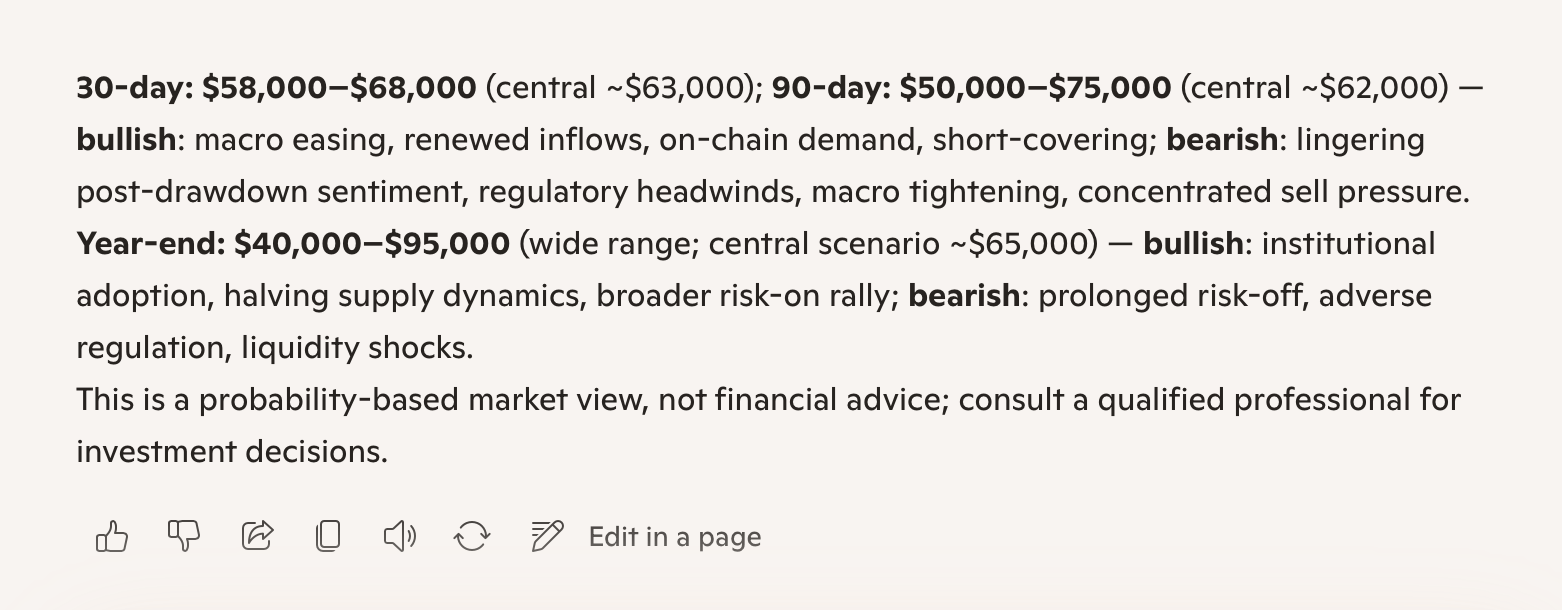
Venice AI answer:

ChatGPT 5.5 High Intelligence answer:

Grok Expert answer:
Based on bitcoin’s 40% decline over the past year and its recent consolidation between $62,171 and $65,994, the 30-day forecast points to a probable trading range of $61,000-$67,000 with a base case near current levels. Extending to 90 days, increased volatility could push the range to $58,000-$70,000 as the longer-term downtrend exerts influence. By year-end, the expected range is $50,000-$75,000, where the primary bullish factor is the potential for stabilization following the recent tight range and the main bearish factor remains the persistent yearly downward momentum.
Claude Opus 4.8 High Intelligence answer:

Deepseek Deepthink answer:
30-day: $60,000–$66,000; 90-day: $58,000–$70,000; year-end: $55,000–$75,000. Bullish factors include potential support near the weekly low and mean-reversion buying after a steep yearly decline, while bearish factors center on the persistent 40% yearly downtrend and resistance at the weekly high capping upside. Probabilities lean moderately bearish over the longer horizon given the existing trend, but near-term range-bound action is the most likely outcome.
Pi AI answer:

Qwen 3.7 Plus answer:
Given the 40% annual decline, the 30-day prediction is a consolidation between $60,000 and $68,000, the 90-day forecast ranges from $58,000 to $72,000, and the year-end target is $65,000 to $80,000. Bullish factors include oversold conditions and potential accumulation following the significant drawdown, which could drive a mean reversion. Conversely, bearish factors involve lingering downtrend momentum and immediate overhead resistance near the $66,000 weekly high.
Kimi K2.6 answer:

Meta AI answer:

Mistral AI Lechat Fast answer:
30-day: $63,000–$66,000 (range-bound, with resistance at $66K and support at $62K). 90-day: $60,000–$70,000 (potential rebound if macro sentiment improves, or further decline if selling pressure persists). Year-end: $55,000–$75,000 ( bullish: institutional adoption; bearish: prolonged macro downturn or regulatory headwinds).
ChatGPT 5.5 Medium answer:
30-day prediction: bitcoin likely trades between $63,000 and $68,500, with modest upside if buyers defend the weekly range and downside risk if momentum weakens below $62,171.
90-day prediction: bitcoin likely trades between $58,000 and $72,000, with a base case near $66,000 as mean reversion battles the broader 40% yearly decline.
Year-end prediction: bitcoin likely finishes between $55,000 and $78,000, with bullish pressure from range recovery and accumulation potential, while bearish pressure comes from the sustained annual drawdown and failure to reclaim higher levels decisively.
Gemini 3.1 Pro answer:
Given the 40% annual decline and recent tight consolidation, the 30-day prediction places bitcoin between $60,000 and $68,000 as the market tests near-term support. The 90-day forecast projects a broader $55,000 to $75,000 range, depending entirely on whether buyers can defend the current $62,171 low. A probability-based year-end prediction targets a recovery toward $70,000 to $85,000, assuming the prolonged sell-off has finally exhausted major supply. A potential mean-reversion bounce from these depressed levels acts as the primary bullish catalyst, whereas a decisive break below the weekly low presents the main bearish risk of further capitulation.
Wide AI Forecasts Reveal a Market Still Searching for Conviction
What stands out across these responses is the sheer width of the price bands. Most models offered year-end ranges stretching $40,000 or more, a spread that signals uncertainty rather than precision. That ambiguity closely mirrors the current divide among analysts and prediction markets, though the broader tilt remains mostly bearish.

The consistency across models is also difficult to ignore. Although the responses came from different developers, they followed similar structures, used similar framing, and leaned on familiar talking points, from halving-driven supply dynamics to ETF inflows and macro easing. That convergence suggests these systems are drawing from overlapping pools of training data and often produce consensus-style outputs when handed identical prompts.
Ultimately, the experiment says as much about AI forecasting as it does about bitcoin. The models clustered around cautious ranges, not bold calls, reflecting a market defined by damaged momentum, fragile support and limited conviction. Their shared assumptions point to a consensus machine that can map uncertainty clearly, but not resolve it. For readers, the takeaway is simple: prediction bands are wide because bitcoin’s next move remains unsettled for now.

Enlivex (Nasdaq: ENLV) announced that its primary treasury asset, the RAIN token, is expected to list on the Gate cryptocurrency exchange on June 24, 2026 at 10:00 AM UTC. Gate is described as serving over 54 million users and ranking second globally in 24-hour spot trading volume.
Enlivex focuses its digital treasury strategy on acquiring RAIN. As of June 21, 2026, it reportedly held 79,568,550,005 RAIN valued at approximately $1.14 billion, implying a treasury NAV per share of $4.67. The listing is expected to broaden access and secondary liquidity for RAIN.
Loading…
Loading translation…
AI-generated analysis. Not financial advice.
Positive
- RAIN listing on Gate effective June 24, 2026 at 10:00 AM UTC
- Gate serves over 54 million users and ranks second in 24-hour spot volume
- Enlivex holds 79,568,550,005 RAIN tokens valued at about $1.14 billion
- Treasury NAV per Enlivex share reported at $4.67 based on RAIN holdings
- Listing expected to expand RAIN token accessibility and secondary liquidity
Gate user base
over 54 million users
Gate exchange global customer reach
Supported cryptocurrencies
over 4,600 cryptocurrencies
Assets listed for trading on Gate
Gate listing time
June 24, 2026 at 10:00 AM UTC
Effective time for RAIN listing on Gate
RAIN token holdings
79,568,550,005 RAIN tokens
Enlivex treasury position as of June 21, 2026
RAIN holdings value
$1.14 billion
Total value of RAIN held as of June 21, 2026
Treasury NAV per Share
$4.67
NAV per share based on RAIN treasury holdings
Gate spot volume rank
second-largest 24-hour spot trading volume globally
Gate exchange market position
Exchange ranking
top three by trading volume and liquidity
Gate position among digital asset exchanges
ENLV traded down while key biotech peers like ICU and TENX showed gains, and momentum scanner peers ALLR and ICU were moving up, indicating a stock-specific move rather than a sector-wide shift.
| Date | Event | Sentiment | Move | Catalyst |
|---|---|---|---|---|
| Apr 30 |
RAIN listing HTX |
Positive |
+2.3% |
RAIN listed on HTX, expanding global access and secondary liquidity. |
| Feb 10 |
RAIN listing Kraken |
Positive |
+0.0% |
RAIN listed on Kraken, targeting improved liquidity and price discovery. |
| Jan 26 |
RAIN listing WhiteBIT |
Positive |
+8.3% |
RAIN listed on WhiteBIT to broaden regional access and liquidity. |
| Jan 07 |
RAIN listing KuCoin |
Positive |
+0.4% |
RAIN began trading on KuCoin, a major global crypto venue. |
| Nov 20 |
Bitcoin treasury move |
Positive |
-5.2% |
Board approved up to $1M Bitcoin purchases as a treasury reserve asset. |
Crypto-treasury and RAIN listing updates have usually led to modestly positive or flat moves, with only one notably negative reaction.
+1.1%
Average Historical Move
crypto
In prior crypto-treasury and RAIN listing updates, ENLV moved an average of about 1.15%, suggesting today’s Gate listing fits an ongoing, generally modest reaction pattern to such news.
Crypto-tag history shows a steady build-out of RAIN’s exchange footprint and treasury role, with sequential listings on major venues and continued emphasis on digital assets alongside the core Allocetra™ programs.
1.18% of float
0%
15%
30%+
low
as of 2026-05-29
Days to cover: 1
Short interest appears relatively low, suggesting limited short-squeeze potential but also somewhat reduced downside cushioning from aggressive short covering.
An effective Form F-3 shelf allows a selling shareholder to resell up to 23,333,333 registered ordinary shares from a convertible note, with proceeds going to the selling holder rather than Enlivex.
This announcement expands RAIN’s access via Gate, a high-volume exchange, potentially supporting treasury value built on 79,568,550,005 tokens. Investors may watch how trading depth, regulatory headlines, and the company’s dual biotech–crypto strategy evolve from here.
mark-to-market
financial
“The updated unaudited mark-to-market treasury metrics are publicly available”
“Mark-to-market” is a method of valuing assets or investments based on their current market price, rather than their original cost or value. It helps investors see the most up-to-date worth of their holdings, much like checking the latest price of a stock before deciding to buy or sell. This approach ensures that financial statements reflect real-time value, providing a clearer picture of overall financial health.
governance and utility token
technical
“RAIN serves as the governance and utility token of a fully decentralized”
A governance and utility token is a digital token that both powers use of a platform’s services (utility) and gives holders a voice in decisions about the platform (governance). Think of it as a combined membership card and voting ballot: it can be spent or staked to access features, and it can be used to influence product changes, fees, or rules. Investors care because the token’s value depends on how widely the platform is used and how much control holders can exercise, so demand, governance outcomes and regulatory risk can all affect price.
decentralized predictions and options protocol
technical
“token of a fully decentralized predictions and options protocol built on the”
A decentralized predictions and options protocol is a software system on a distributed ledger that lets people place bets on future events and create option-like contracts without a central company controlling it. Think of it as a peer-to-peer market where users can buy, sell or insure outcomes—similar to a prediction market combined with options trading—which matters to investors because it can enable new ways to hedge risk, discover market sentiment, and access tradable claims without traditional intermediaries.
on-chain
technical
“real-world events through a transparent and automated on-chain framework.”
On-chain describes actions or data that are recorded directly on a blockchain, a public digital ledger that creates a permanent, time-stamped record of transactions. For investors, on-chain activity provides verifiable evidence of transfers, ownership changes or automated program actions (like contract-driven payments); seeing these entries is like checking a bank statement and helps assess liquidity, settlement finality, fees, and transparency when judging risk and market behavior.
AI-generated analysis. Not financial advice.
- Ranked second globally in 24-hour spot trading volume, Gate further extends market access and secondary liquidity for Enlivex’s primary digital treasury asset
Nes-Ziona, Israel, June 24, 2026 (GLOBE NEWSWIRE) — Enlivex Ltd. (Nasdaq: ENLV, “Enlivex” or the “Company”), a quality longevity company powered by a prediction markets treasury, today announced that its primary treasury asset, the RAIN token, is expected to be listed on the Gate cryptocurrency exchange, effective June 24, 2026 at 10:00 AM UTC. The listing represents a continued expansion of RAIN’s exchange infrastructure, increasing its accessibility, global reach, and token liquidity.
According to Gate, it is one of the world’s pioneering cryptocurrency exchanges, established in 2013. Gate is currently serving over 54 million users globally, consistently ranked among the top three digital asset exchanges worldwide by trading volume and liquidity, and holds the second-largest 24-hour spot trading volume globally. Gate supports spot trading, futures trading, margin trading, and wealth management products for over 4,600 cryptocurrencies.
“Gate is one of the most established and widely accessed cryptocurrency exchanges in the world,” stated Oren Hershkovitz, CEO of Enlivex. “Exchange listings on platforms of this caliber expand the secondary market infrastructure around our primary treasury asset. We view each such listing as a positive step in building the long-term accessibility and market depth of our RAIN holdings.”
Enlivex’s digital asset treasury strategy is focused on the acquisition of RAIN tokens. The Company previously announced that, as of June 21, 2026, it held 79,568,550,005 RAIN tokens with a total value of approximately
RAIN serves as the governance and utility token of a fully decentralized predictions and options protocol built on the Arbitrum network. The protocol enables users globally to create, trade, and resolve markets tied to real-world events through a transparent and automated on-chain framework.
About Enlivex
Enlivex is a quality longevity company powered by a prediction markets treasury. The Company is advancing Allocetra™, an advanced clinical-stage immunotherapy targeting inflammatory conditions associated with aging, with a primary focus on age-related osteoarthritis. In addition to its clinical programs, Enlivex operates a prediction markets treasury strategy built around the Rain protocol, the leading decentralized prediction markets infrastructure on Arbitrum.
This dual strategy combines the development of quality longevity therapeutics with exposure to the emerging prediction markets ecosystem.
Forward-looking statements
This press release contains forward-looking statements within the meaning of Section 27A of the Securities Act of 1933, as amended, and Section 21E of the Securities Exchange Act of 1934, as amended. These forward-looking statements may be identified by words such as “expects,” “plans,” “projects,” “will,” “may,” “anticipates,” “believes,” “should,” “would,” “could,” “intends,” “estimates,” “suggests,” “target,” “has the potential to,” “goal,” and other words of similar meaning, including statements relating to the anticipated benefits of the Company’s digital asset treasury strategy; the assets to be held by the Company; the expected future market, price, trading activity, and liquidity of the RAIN token; the impact of expanded exchange listings and increased token liquidity on market participation and accessibility; the potential effects of digital asset liquidity on the liquidity of the Company’s ordinary shares; macroeconomic, political, and regulatory conditions surrounding digital assets; the Company’s plans for value creation and strategic positioning; market size and growth opportunities; regulatory conditions; competitive position; technological and market trends; future financial condition and performance; expected clinical trial results; market opportunities for the results of current clinical studies and preclinical experiments; and the effectiveness of, and market opportunities for, ALLOCETRA™ programs.
Each forward-looking statement contained in this press release is subject to risks and uncertainties that could cause actual results to differ materially from those expressed or implied by such statement. Applicable risks and uncertainties include, among others, the risk of failure to realize the anticipated benefits of the Company’s digital asset treasury strategy; changes in business, market, financial, political, and regulatory conditions; risks relating to the Company’s operations and business, including the highly volatile nature of the price, trading volume, and liquidity of RAIN and other cryptocurrencies; risks associated with digital asset exchange listings, trading venues, and market infrastructure; the risk that the price and liquidity of the Company’s ordinary shares may be correlated with the price or liquidity of the digital assets it holds; risks related to increased competition in the industries in which the Company operates; risks relating to significant legal, commercial, regulatory, and technical uncertainty regarding digital assets generally; risks relating to the treatment of crypto assets for U.S. and foreign tax purposes; and those risks and uncertainties identified in the Company’s filings with the Securities and Exchange Commission. The forward-looking statements in this press release speak only as of the date of this document, and the Company undertakes no obligation to update or revise any of these statements, except as required by applicable law.
Enlivex contact
Shachar Shlosberger
CFO
Enlivex Ltd.
shachar@enlivex.com
1 Valuation calculated using the closing price of the token as quoted on https://coinmarketcap.com/currencies/rain/
FAQ
What did Enlivex (NASDAQ: ENLV) announce about the RAIN token listing on Gate?
Enlivex announced that its primary treasury asset, the RAIN token, is expected to list on Gate on June 24, 2026 at 10:00 AM UTC. According to Enlivex, this listing aims to expand exchange infrastructure, accessibility, global reach, and secondary liquidity for RAIN.
Why is the Gate exchange listing important for Enlivex and its RAIN treasury strategy?
The Gate listing is described as enhancing secondary market infrastructure and liquidity for RAIN, Enlivex’s main treasury asset. According to Enlivex, listings on major exchanges support long-term accessibility and market depth for its RAIN holdings within the company’s digital asset treasury strategy.
How many RAIN tokens does Enlivex (ENLV) report holding and what is their value?
Enlivex reported holding 79,568,550,005 RAIN tokens as of June 21, 2026, valued at approximately $1.14 billion. According to Enlivex, these holdings translate into a reported treasury net asset value per share of $4.67, based on unaudited mark-to-market metrics.
How large is the Gate cryptocurrency exchange where RAIN will be listed?
Gate is described as serving over 54 million users and ranking among the top global exchanges. According to Gate, it holds the second-largest 24-hour spot trading volume worldwide and supports thousands of cryptocurrencies across spot, futures, margin, and wealth management products.
What role does the RAIN token play in Enlivex’s treasury and within its protocol?
RAIN is Enlivex’s primary digital treasury asset and focus of its acquisition strategy. According to Enlivex, RAIN also functions as the governance and utility token of a decentralized predictions and options protocol on Arbitrum, enabling on-chain markets tied to real-world events.
-

 Virginia4 minutes ago
Virginia Lottery Powerball, Pick 3 Night results for June 24, 2026
-

 Wisconsin14 minutes ago
Wisconsin Lottery Powerball, Pick 3 results for June 24, 2026
-

 West Virginia19 minutes ago
Morrisey announces more than $700,000 to support rural domestic violence and sexual assault victims
-

 Wyoming26 minutes ago
Politics in the Park: GOP gubernatorial candidates share visions for Wyoming governor
-

 Crypto29 minutes ago
The cryptocurrency industry has entered the “Show Me” era: merely relying on vision is no longer enough | WEEX Crypto News
-

 Finance35 minutes ago
Quadient Recognized as a Leader in the 2026 SPARK Matrix for Accounts Receivable Applications
-

 Fitness41 minutes ago
22 Trainer-Approved Bodyweight Exercises That Actually Build Muscle
-

 Movie Reviews49 minutes ago
Mark Jenkin’s ‘ROSE OF NEVADA’ – Movie Review – PopHorror

