Oregon
North America’s only Bornean elephant lives at the Oregon Zoo


Bornean elephant Chendra browsing on bamboo at the Elephant Lands habitat in Oregon Zoo, Portland, Ore., on April 17, 2025.
Kathy Street / Oregon Zoo
Looking out at the herd of Oregon Zoo elephants, it’s easy to spot Chendra. With her petite stature, short trunk, larger ears and long tail, the Bornean elephant is markedly smaller than the rest. She’s also the only one of her kind on the entire North American continent.
Chendra, an elephant from northern Borneo in the Malaysian state of Sabah, arrived at the Oregon Zoo in 1999 and has remained in its care ever since.
Sharon Glaeser, who has a doctorate in animal welfare and conservation science, works as the elephant conservation lead for the Oregon Zoo. She recently appeared on OPB’s “Think Out Loud” to share more about why one of the world’s smallest elephants ended up in Portland.
“The Oregon Zoo Elephant Program was known around the world, and the Sabah Wildlife Department needed to find homes for some of the babies that had been orphaned,” Glaeser said in the interview. “They didn’t have facilities and they contacted the Oregon Zoo.”
Chendra, an elephant from northern Borneo in the Malaysian state of Sabah, arrived at the Oregon Zoo in 1999 and has remained in its care ever since. Borneo, an island in Southeast Asia’s Malay Archipelago, is shared by the Malaysian states of Sabah and Sarawak, Indonesian Kalimantan and the nation of Brunei.
Winston Szeto / OPB

Many Asian elephants are already under serious threat of extinction in their native countries and those in Borneo are especially at risk. Approximately 1,000 Bornean elephants are left in the world, and that number is decreasing, Glaeser noted.
“In our human care, they have their needs met,” Glaeser said. “They get food, they get resources, they have opportunities, they have safety, they have veterinary care, which is not something that wild animals are afforded in general.”
According to the World Wildlife Fund, Bornean elephants are the smallest Asian elephant subspecies and are distinctly smaller than their mainland Asia cousins.
They were determined by WWF to be genetically different from other Asian elephants — DNA evidence shows Bornean elephants were isolated from their cousins on mainland Asia and Sumatra, Indonesia, about 300,000 years ago. As a result, Bornean elephants evolved to have longer tails that sometimes touch the ground, as well as relatively large ears and straighter tusks when compared to other elephant subspecies.
From left to right: Sung-Surin, three month-old calf Tula-Tu, Rose-Tu and Chendra in Elephant Lands, April 28, 2025. Bornean elephants like Chendra are the smallest Asian elephant subspecies and are distinctly smaller than their mainland Asia cousins.
Tarah Bedrossian / Oregon Zoo
These island-dwelling elephants are known to roam large distances, sometimes covering up to 25 miles in a day, according to the International Fund for Animal Welfare.
Deforestation due to logging and palm oil production causes loss of habitat, the Oregon Zoo website says, which is the primary reason Bornean elephants are under threat. Plus, agricultural workers sometimes kill or injure elephants that raid their plantations and those actions can separate young elephants from their herds.
“In the past few years, the Sabah Wildlife Department has rescued 15 baby elephants, each less than a year old,” the zoo says. “All of them were found wandering alone in known human-elephant conflict areas along the east coast of Sabah. Chendra was orphaned this way.”
When Chendra was found, she had injuries to her front legs and left eye, and eventually became blind in that eye, according to the zoo. Since she was so young, the Sabah Wildlife Department couldn’t reunite Chendra with her herd or release her back into the wild, and instead opted to send her to the Oregon Zoo on Nov. 20, 1999.
Asian elephant Chendra, left, greets herdmates Sung-Surin, right, and Rose-Tu, in the background, at the Oregon Zoo on June 13, 2024.
Kathy Street / Oregon Zoo
The zoo currently funds two full-time elephant ranger positions with the Sabah Wildlife Rescue Unit and partners with the unit on several projects to create wildlife corridor habitat and reduce human-elephant conflict.
In 2020, the Oregon Zoo became part of the Bornean Elephant Action Plan, a 10-year-long project led by the Sabah Wildlife Department that is aimed at identifying threats and building strategies to address threats to endangered species. Among the species at risk are elephants, pangolin, sun bears, banteng, orangutans and more.
While the Oregon Zoo is well-known for its elephant program, it is not without criticism. Animal rights group Free the Oregon Zoo Elephants, or FOZE, has for years alleged the Oregon Zoo has an “aggressive elephant breeding program” and mistreats elephants, including Chendra. The zoo has denied these claims.


What to know about the Coffin Butte Landfill expansion proposal
Republic Services has asked Benton County for a conditional use permit to expand the 178-acre landfill.
Seven Oregon counties could join together to build and manage solid waste infrastructure and services, under a proposal being considered by a legislative task force.
The aim is to lower costs, provide stability, and ensure that one or two counties don’t bear the financial and environmental costs of taking the entire region’s garbage, Rep. Sarah Finger McDonald, D-Corvallis, told the 12-member Joint Task Force on Municipal Solid Waste in the Willamette Valley.
The Oregon Legislature created the task force last year, to identify solutions for solid waste disposal in the valley, after the region’s garbage disposal options were thrown into flux.
The Reworld incinerator in Brooks, where most of Marion County’s garbage was burned for four decades, closed at the end of 2024.
And residents in nearby Benton County are fighting an expansion of Coffin Butte Landfill, which takes much of Marion County’s and the region’s waste. Even with an expansion, the landfill is expected to close in little more than a decade.
The task force has met six times since mid-December 2025. It must submit a report to interim legislative committees related to the environment by Dec. 15. The task force sunsets on Dec. 31.
Finger McDonald’s proposal, which is the only one yet considered by the task force, would create a voluntary state and local partnership program designed to help counties, cities and regional governments finance and build garbage, recycling, composting and waste-reduction infrastructure.
It would include Marion, Polk, Yamhill, Linn, Benton, Lincoln and Tillamook counties.
“The cities and counties will come together to make a plan. The cities and the counties in this region know what the problem is,” McDonald Finger said. “Whatever is going to be built is going to be expensive.”
The proposal authorizes local governments and regional authorities to direct waste into approved systems when necessary to support infrastructure financing and long-term system stability.
Marion County is currently the only county in the state with a law giving it control over waste disposal, although Oregon Metro manages garbage and recycling for the three-county Portland Metro area.
The proposal would allow the state to help local governments with bonding assistance, matching grants, technical assistance and more. Local governments could choose to build transfer stations, recycling facilities, composting systems, methane capture projects or other infrastructure projects.
“And then those cities and counties would build that infrastructure they need, and would have the option of establishing a fee,” she said.
The proposal also could allow public-private partnerships and collaboration with private waste operators, Finger McDonald said.
The earliest the legislature could pass a bill authorizing the plan would be 2027, Finger McDonald said, meaning it would not go into effect until 2028.
Tracy Loew covers the environment at the Statesman Journal. Send comments, questions and tips: tloew@statesmanjournal.com or 503-399-6779. Follow her on X at @Tracy_Loew

In the early months of the COVID-19 pandemic, a group of prison inmates sued the state of Oregon, arguing it was failing to protect them from the surging public health threat.
On Wednesday, more than six years later, representatives of those inmates—and the estates of inmates who died of the disease—announced they have settled with the state for a massive $49 million.
In a separate news release, Gov. Tina Kotek’s office framed the deal as a way to efficiently resolve a complex and weighty legal dispute: State officials, her office said, determined that the settlement “was in the best financial interest of the state and would minimize the continued distress of those impacted to settle rather than continue with the litigation.”
The case, Maney v. Oregon, includes two class action suits filed during the pandemic. According to the Oregon Justice Resource Center, which represented plaintiffs in the case, the suit covers about 5,000 people who were in Oregon Department of Corrections custody between Feb. 1, 2020, and May 31, 2022.
One class, which includes those who tested positive for or were diagnosed with COVID-19, would get $15.9 million under the deal. The other, the estates of 38 incarcerated people who died from COVID-19, would receive $33 million.
The settlement awaits approval by a magistrate judge, and most of the payout requires an appropriation by the Oregon Legislature during the coming 2027 session.
The suit emerged out of the dark early days of a still-mysterious pandemic—which posed clear risks in closed spaces like prisons. The OJRC says inmates in Oregon endured prolonged lockdowns, disruptions to prison operations, and suspension of visitation and programming.
They also died of COVID at far greater rates than Oregonians in general. The UCLA Law COVID Behind Bars Data Project tallied 52 deaths in Oregon prisons tied to COVID. By June 2021, according to the Marshall Project, the state’s prisons had one of the highest rates of COVID-related deaths in the country.
“We initiated this suit to protect the lives of some of our society’s most vulnerable people, packed into aging facilities with no ability to social distance from each other or [prison] officers,” said Juan Chavez, director of the OJRC’s Civil Rights Project, in a written statement. “The horrors that then came to pass during the pandemic shocked and saddened us. But we also saw, and were inspired by, the resilience and solidarity held amongst incarcerated people.”
Kotek’s office noted the mitigation measures the Department of Corrections implemented amid the pandemic, and said the agency incorporated lessons from the era into its operations.
“This historical event placed significant demands on our corrections workforce, and I appreciate the dedication DOC employees demonstrated throughout the COVID-19 pandemic,” Kotek said in her statement, adding that it was important to remember the impact on incarcerated people and their families too, especially those who lost loved ones. This settlement, she said, “is an opportunity for people to heal and find closure after such a challenging chapter in Oregon’s history.”
Willamette Week’s reporting has real-life impact that changes laws, forces action by civic leaders, and drives compromised politicians from public office.
Support WW.

PORTLAND, Ore. (KATU) — The Oregon Zoo has welcomed a second red panda to their ranks this month, as 6-year-old Liu gets settled in to the habitat.
Liu comes to Portland from the Toledo Zoo as part of the Association of Zoos and Aquariums’ Species Survival Plan for red pandas.
He arrived just weeks after Enoki, a female red panda, and caregivers will soon introduce the duo in the hopes that they may eventually help add to the population of the endangered species.
PAST COVERAGE | Enoki the red panda joins Oregon Zoo, ‘exploring, snacking & napping’ in new habitat
For those coming to see the pandas, they should be easy to tell apart. Liu has a blonde tail, and Enoki is much smaller with a darker coat.
“He’s very handsome,” said Dr. Carlos Sanchez, the zoo’s director of animal health, who stopped by Liu’s habitat to observe, a red panda plushy tucked under one arm. “His tail is so blond — surfer blond.”
Liu was born on June 28, 2019 at Prospect Park Zoo in Brooklyn. His name means “willow” in Mandarin Chinese, a nod to his mother, whose name is also Willow.
Enoki is nearly three years old, and is of the refulgens subspecies of red panda, known for having darker faces and more prominent tail rings.
“These two represent a species in trouble,” said Kelly Gomez, who oversees the zoo’s red panda area. “In the past 25 years, habitat loss, poaching and the illegal wildlife trade have wiped out nearly half the world’s red panda population. Hopefully, we can help inspire a new chapter in the conservation of this incredible species.”
The duo joins the Oregon Zoo family more than a year after the death of Moshu, the zoo’s previous resident red panda who was dubbed “Sir Snacks-a-Lot.” Moshu was 14 years old.
More info from the Oregon Zoo.
-
 Politics2 minutes ago
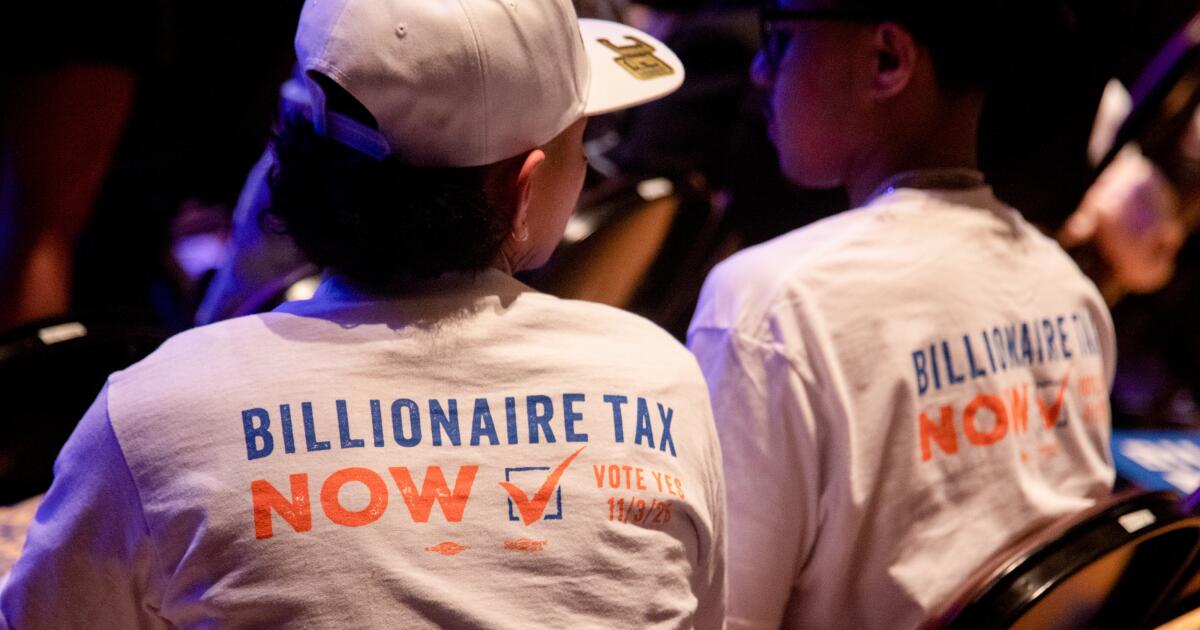
Controversial billionaire tax proposal will appear on November ballot
-
 Sports10 minutes ago
Shohei Ohtani is the first Dodger to be named 2026 All-Star
-

 World20 minutes ago
Who will control Africa’s AI infrastructure and at what cost
-
 News47 minutes ago
The Supreme Court says the U.S. can turn away asylum seekers at the border
-

 Los Angeles, Ca2 hours ago
Jury says it is deadlocked in trial of man accused in Palisades Fire
-

 Detroit, MI2 hours ago
Scene active as police shoot, kill man on Detroit’s west side
-

 San Francisco, CA3 hours ago
Civil grand jury report warns of wildfire risk at SF’s Glen Canyon Park
-

 Dallas, TX3 hours ago
Ivory Coast advances at World Cup, how to buy Ivory Coast tickets

