West
Cutting the 'green tape': Conservation group offers top 10 ways for Dept of Interior to streamline

EXCLUSIVE: A leading conservation group that champions collaboration over regulation is releasing its top 10 recommendations for the Department of the Interior to cut so-called “green tape” – as opposed to “red tape” – which seeks to streamline the agency’s work.
The Montana-based Property and Environment Research Center (PERC), a nonpartisan leader in “market solutions” for conservation, will seek to triple the rate of endangered species’ recovery, double fee revenues for national parks without putting all the onus on visitors and eliminate regulations for Americans who voluntarily want to provide assistance in managing habitat restoration.
PERC CEO Brian Yablonski told Fox News Digital in an exclusive interview that there is a $23 billion backlog in national parks’ infrastructure needs, conservation projects and wastewater management.
As parks grow and visitor numbers hit record levels, the Interior Department needs a responsible way to fund the increased needs without burdening U.S. taxpayers or implementing restrictions, Yablonski said.
AZ SENATE LEADER URGES BURGUM TO REVERSE BIDEN-OBAMA LAND GRAB AT URANIUM SITES
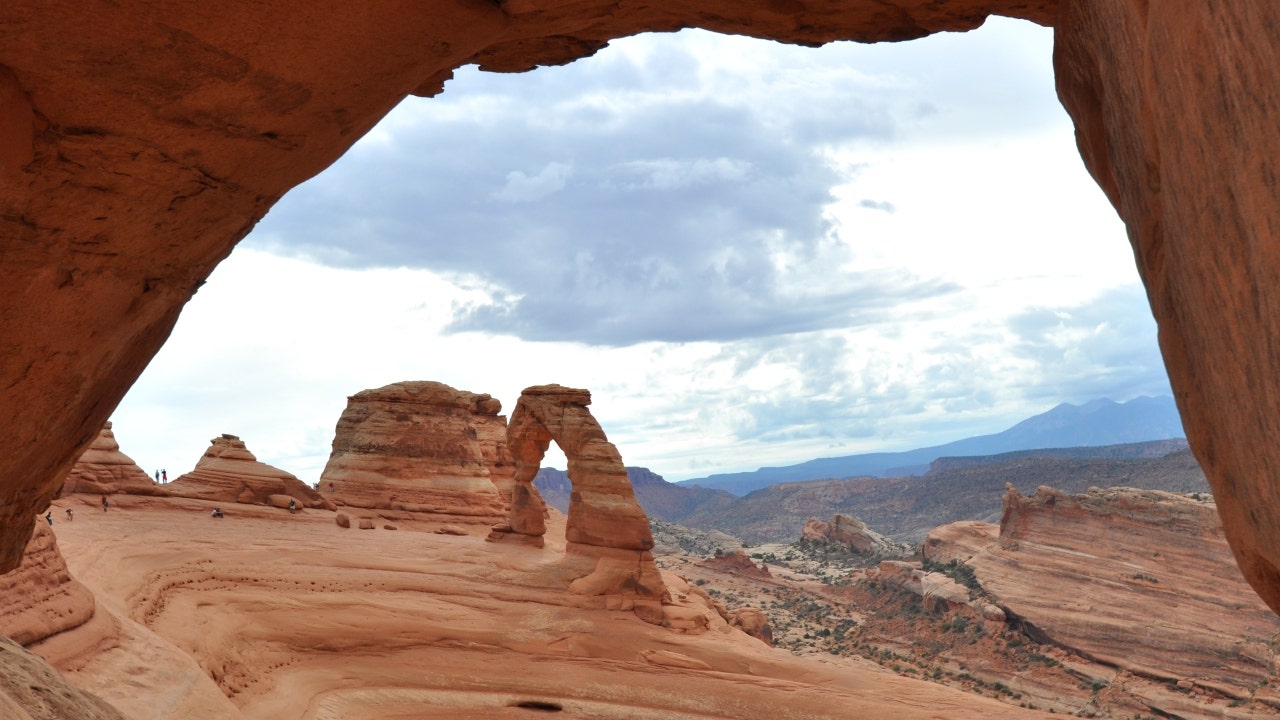
A view of Delicate Arch as seen through Frame Arch in Arches National Park near Moab, Utah. (Photo by Robert Alexander/Archive Photos/Getty Images)
“One way to address the needs of our national parks directly is to connect funding with demand,” Yablonski said.
Doubling fee revenue does not mean doubling fees, he said, noting that in other countries, American visitors often pay a surcharge to that park system because they do not contribute any of the baseline taxes to park conservation.
In that way, a visitor to Skyline Drive who hails from abroad should be charged a little more than a local Virginian going from Staunton to Front Royal who already pays into park coffers through taxation, he said.
However, Yablonski underlined that the national park system is unique in that 80% of fee revenue collected at any particular park stays to support that park specifically. The other 20% goes elsewhere, including supporting parks that do not charge fees. It would also “depoliticize” park funding because fees are collected independently of Congress.
Record increases in park visitors – according to the National Park Service (NPS) – have shown that people are willing to pay to enjoy America’s parkland. Therefore, an increase in the $80 America the Beautiful pass would be one area where there may not be much pain for eager park visitors. NPS reported nearly 332 million visits to parks in 2024, an increase of 6.3 million.
TRUMP INTERIOR PICK FACES SENATE SCRUTINY
The pass gets Americans into many national parks for free, allows entrance to Skyline Drive and also gives the bearer free parking at other park-owned properties, such as the Harpers Ferry, West Virginia, Amtrak station.
Reducing obstacles to voluntary conservation is one of the best ways to cut ‘green tape’,” Yablonski said. Landowners seeking to aid voluntary conservation must currently go through an at-times costly and/or strung-out chronological process before they can formally assist the agency.
“It can take up to a year to get those kind of agreements approved,” Yablonski said. “We just think there’s a way to streamline that and get those agreements approved sooner, especially if a landowner is taking measures to do voluntary conservation on his or her land,” he said.
That “green tape” cut leads into PERC’s recommendations regarding the Endangered Species Act, Yablonski added.
While the act has been effective in preventing extinction, it has not helped recover species listed as endangered.
Only 3% of endangered species have recovered and been taken off the list, while 99% remain extant.
“That’s because the tools needed for both are different. A tool to prevent extinction might be a more regulatory-oriented tool. To actually recover something and proactively improve, it is going to be more of a market-based incentive,” he said.
“The problem is we’re using the regulatory tool when we should be using the incentive-based tool. And so the idea of cutting green tape is actually what are some of the new tools to take in endangered species recovery from a number like 3% and get it to 10%. And I think it’s important to set goals because there are folks that seem to be okay with 3% recovery in the environmental community, which to me is shocking. We should want to try something different, try new things, bring new tools to bear to increase endangered species recovery.”
The full report will be available on PERC’s website on Wednesday.
Fox News Digital reached out to the Interior Department for comment on its communications with PERC thus far.
Read the full article from Here


Watch CBS News

America 250 Baked Alaska
Delmonico’s
In the conversation about the world’s greatest steakhouses, Delmonico’s is always among the shortlist of names.
The Lower Manhattan institution is a destination for New Yorkers and tourists alike, an attraction as much as a restaurant. First opened in 1837, it is widely recognized as America’s first fine-dining restaurant. It was here that dishes that have become cultural symbols of this country as much as they are cuisine were born: the Delmonico Steak, Lobster Newberg, Eggs Benedict, and perhaps most famously, Baked Alaska.
Now, as the United States prepares to celebrate its 250th birthday, Delmonico’s is giving one of its signature creations, a dessert that’s as much a cultural symbol as it is a sweet ending, a patriotic makeover.
On July 4, the restaurant will debut the America 250 Baked Alaska, a reinterpretation of the classic dessert that celebrates both the nation’s history and North America’s native ingredients. The striking red, white, and blue confection has already earned the nickname “America’s Birthday Cake.”
The dessert was created by acclaimed pastry chef Miro Uskokovic of Hani’s Bakery + Cafe in the East Village, who also serves as Delmonico’s consulting pastry chef. While his interpretation is rooted in the original version, he has reimagined it with a distinctly American theme.
Pawpaw, the largest fruit native to North America, becomes a rich ice cream. Wild blueberry lemonade sorbet adds a bright, tart layer, while pecan cake- made with the only major tree nut indigenous to North America- forms the base. Mixed berry jam, toasted meringue, and fresh seasonal berries complete the dessert.
The cone-shaped presentation also pays tribute to history.
The original Baked Alaska dates to 1867, when the legendary French chef Charles Ranhofer, who headed the kitchen at Delmonico’s in the late 19th century, created the dessert to commemorate the United States’ purchase of Alaska from Russia. Epicurean lore goes that Ranhofer originally called the dessert “Alaska, Florida,” highlighting the contrast between frozen ice cream and warm toasted meringue. He later featured elaborate mountain-shaped versions in his 1894 cookbook, “The Epicurean.”
Today, nearly 160 years later, Delmonico’s is revisiting that theatrical presentation while looking ahead to its next chapter.
“This dessert is a piece of American history,” says Dennis Turcinovic, owner and executive culinary partner of Delmonico’s Hospitality Group. “Delmonico’s has never just served food. For nearly 190 years, it has served hope, opportunity, and the American dream. Today, we’re celebrating that with our red, white, and blue Baked Alaska.”
For Uskokovic, it’s both a history lesson and a celebration.
“America’s 250th anniversary presents an opportunity to celebrate not only our nation’s history, but the evolution of American cuisine,” he said in a release announcing the dessert. “We wanted to revisit one of the most important desserts in Delmonico’s history while showcasing ingredients that are uniquely American.”
According to a release, the dessert will be available as a serving for two for $40, with production limited to just 10 each day because of its labor-intensive preparation. Larger versions serving 10 to 12 guests can also be ordered for private celebrations.
The best part? For non-New Yorkers clamoring for a chance to try the dessert, the America 250 Baked Alaska is here to stay as a permanent fixture on the menu. And when Delmonico’s Reserve, the brand’s upcoming Midtown Manhattan restaurant, opens next year, New Yorkers and visitors alike can order it there.

Every morning Marisol Winfrey Herrera’s three-and-a-half-year-old daughter Jo reminds her to turn off the tap while washing her hands and brushing her teeth.
When they leave home, she reminds her mother to keep a bottle of ice with them to offer it to homeless people, who they sometimes find wilting in the Tucson heat. At first, they press the ice-filled bottles on the homeless folks to help them revive, then they offer the water to drink and hydrate. At her daycare, Jo is taught water-saving habits to combat Tucson’s soaring heat.
It is what prompted Herrera to join No Desert Data Center, a residents’ group that opposes two large data centres coming up on either side of Tucson – the $3.6bn project on the city’s southeast edge and a $5bn project on its northwest side in the town of Marana, together known as Project Blue.
The group believes these would consume more water and power than the city set in the Sonoran Desert can afford.
“We are in the middle of a 30-year drought, which is now an extreme drought,” says Lisa Shipek, co-executive director of the Watershed Management Group, a Tucson-based nonprofit.
“Water was a unifying theme in our campaign. The Colorado River cuts are looming, and this project would take water away,” Herrera told Al Jazeera.
Water flows in the Colorado River, which provides much of Tucson’s water through the Central Arizona Project canal system, have dropped by 20 percent since the year 2000 compared with water flows in the 20th century due to climate change, melting snow caps and warmer weather, making water cuts to Tucson imminent as the state could face as much as 77 percent water cuts.
“We say Not One Drop for data centres,” says Herrera, speaking of the campaign’s particularly emotive appeal for residents as water cuts get deeper and temperatures rise, with Tucson recording the warmest weather in 125 years last July and August.
Beale Infrastructure, a San Francisco-based company that is owned by investment management company Blue Owl in New York, had asked the city of Tucson to acquire 290 acres that were outside city limits for Project Blue. That would make it the city’s largest water consumer and among its largest power consumers. Beale did not respond to an emailed request for comment.
But at city council meetings, City Councillor Kevin Dahl began seeing hundreds of residents turn up to express their opposition to the project.
“Not for many issues do we get so much response,” he said. Herrera was among those who went.
Pitting environment against unions
At council meetings, Beale executives proposed that Project Blue could be the economic engine the city needed. It would create a few thousand jobs for construction workers, ironmongers, plumbers and other such workers during the construction of the project and a few hundred after that.
“Sometimes people travel as far as Phoenix for work,” Dahl said about Arizona’s largest city, which is nearly a two-hour drive from Tucson.
The project could bring jobs closer. Beale also expected the project to generate nearly $250m in taxes for the city, county and state in the first 10 years.
This left councillors with a difficult decision to make, weighing the project’s economic benefits against allocating it a share of the city’s increasingly scarce water and power.
Activists also raised concerns about whether Tucson Electric Power (TEP), the power utility, would raise rates for consumers so it could expand capacity to provide power for Project Blue. After raising rates by 10 percent in 2023, TEP proposed a 14 percent rate hike in June 2025 for grid upgrades made in the previous year.
Lee Ziesche, an activist from the Democratic Socialists of America who is campaigning to make TEP a public utility, said Project Blue could “lead to higher temperatures and higher rates” because of the heat island effect of the air conditioners and higher rates for power.
She often hears from residents that a rate hike would make it hard to pay bills or put on air conditioning, even as the number of 100-degree Fahrenheit (37.8 degree-Celsius) days has increased in Tucson, which is among the hottest cities in the United States.
The same concerns of needing ramped-up air conditioning would plague data centres too, experts say.
“The viability of data centres in Arizona will always be subject to climate change and heat risks,” says Kate Gordon, chief executive of California Forward, a think tank that works on a sustainable economy.
“The heat in Arizona makes energy less efficient, and servers heat up, so projects will need higher amounts of water and cooling, which developers have to balance against a possibly lower real estate and labour cost,” she said. “I am always amazed at how climate does not figure in business plans.”
Dahl and Andres Cano, a supervisor in Pima County, in which Tucson is located, had discussions with Beale representatives.
“We thought they would go elsewhere if the city did not acquire the land” for the project, Dahl said. Cano also came away with the same impression.
In August 2025, Tucson councillors voted unanimously not to acquire the land for the project or provide it with water and power. In December, Cano became one of only two supervisors in Pima County to oppose the project, and it was approved for construction in an unincorporated part of the county.
“It will create short-term construction jobs for what will ultimately be a project with few wins,” Cano said. “This pitted the environment and unions, but industry is not for unions. This will have just about 100 jobs when it is done.”
With no access to Tucson’s water supply, Beale decided to cool its servers with air conditioners rather than water and use a closed-loop water system, so it would recycle and reuse water.
But Vivek Bharathan, a spokesperson for the No Desert Data Center, said using air conditioners would increase power usage.
Nearly half of TEP’s power comes from fracking, he says. Data centre demand will only mean “more fracking somewhere else, climate and health consequences all along the way”.
The state’s largest data centre
Even as Project Blue was making its way through a fraught approval process, Beale announced another data centre project in the neighbouring farming town of Marana. It was to be spread over 600 acres (242 hectares), twice the size of Project Blue. The area was spread over two farm plots, one owned by the Mormon church and the other by a family trust of city council member, Herb Kai.
This project, too, is slated to bring thousands of construction jobs to a farming town as well as tax revenues.

But when Jackie McGuire, a mother of three and former Wall Street banker, heard about it, she and other residents launched a campaign to stop the land from being rezoned for a data centre. Residents wanted Marana to stay a farming town.
McGuire, who works as a research analyst, said the data centres’ servers and large air conditioners that would be installed to keep them running would raise the project’s cost and make Marana unbearably hot.
Temperatures rose by up to 2.2F (1.22C) downwind from data centres in the Phoenix area, a study published in May had found.
“The heat generated will be like one to two million space heaters,” McGuire says. “It can go up to 112 degrees [44.4C] here already. The heat island effect could make Marana uninhabitable.”
The Marana data centre will be provided power by TEP and Trico, which announced a 7.23 percent rate hike in January.
McGuire and other residents campaigned to have a referendum on whether the land could be rezoned for a data centre. Their plea was not successful, and the city council approved the rezoning of the land.
But the experience of the campaign had invigorated McGuire, and she decided to run for city council herself. The central issue of her campaign is to bring transparency to the data centre’s functioning.
Even as the campaigns in Pima County and Marana raged on, La Osa, the state’s largest data centre project, took shape in Tucson’s neighbouring Pinal County. The 3,300-acre project by the Vermaland real estate group was expected to house 59 data centres and two of its own natural gas facilities, as well as a utility-scale battery storage system.
But residents worried about noise pollution from protracted project construction and a possible increase in power costs.
“I’m worried about the constituents in that area, about the power bills going up, even though you’re saying that they’re going to pay for it,” Pinal County Supervisor Rich Vitiello said in a board of supervisors meeting on May 27.
In the face of such opposition, a La Osa lawyer spoke at the meeting to say the project had been scaled down and would now house 11 data centres from the 59 planned earlier.
‘A straw to the aquifer’
Sharing limited water has long been an emotive issue in the state, and the looming Colorado River cuts and data centre projects have brought such concerns to a head.
Arizona fought one of the longest-running cases, stretching more than three decades, in the US Supreme Court over the sharing of Colorado River water with California. Eventually, Congress adjudicated to provide California with a greater share of the water, which turbocharged its economic growth.
“No water can flow into Tucson and Phoenix unless California gets its full share,” says Jason Robison, co-director of the Gina Guy Center for Land and Water Law at the University of Wyoming College of Law. “Arizona has always been in a tough spot.”
It strengthened the state’s long-held tradition of conservation.
“Arizona communities have been preparing for the drought conditions we see today since 1980,” a spokesperson for the Arizona Department of Water Resources said in an emailed response.
Authorities have curtailed lawns in Tucson, he said, and educational campaigns of the kind Herrera’s daughter underwent are the norm.
It has meant that groundwater reserves go deep, and homeowners are assured of a water supply before it is given to data centres or farms.
“The use by data centres is low compared to farm use, especially alfalfa and hay,” says Eric Kuhn, retired general manager of the Colorado River Water Conservation District and co-author of Science Be Dammed: How Ignoring Inconvenient Science Drained the Colorado River.
However, “data centres are not under the same rules to replenish water” as other industries, says Sharon Medgal, director of the Water Resources Research Center at the University of Arizona. “So it adds a straw to the aquifer.”
Arizona’s governor, Katie Hobbs, who is up for re-election in November, has represented to the Bureau of Reclamation that the state is home to essential industry, including semiconductors, space and data centres, and so needs a higher share of water from the Colorado River. Water, as well as its use for data centres, has been an important issue in primary races across the state.
Construction began for Project Blue at the end of April. No Desert Data Centers’ activists arrived just after dawn to protest. Within days, they found subcontractors bringing in water to control dust on site from construction. County authorities cited Beale.
Then Beale began digging wells on site after reportedly receiving permits allowing that from the Arizona Department of Water Resources. This is likely for 31,000 gallons (more than 117,000 litres) a year, which is just enough for toilets and kitchens and will likely be recycled for reuse after.
“This may not yet be a winning story,” Bharathan, the spokesperson for the No Desert Data Center, said. “But it is a continuing story.”
-

 San Diego, CA57 seconds ago
Your Produce Man – Great produce at the San Diego Farmers Market! 8am
-

 Milwaukee, WI4 minutes ago
See the corpse flower in bloom this weekend at the Domes
-

 Atlanta, GA9 minutes ago
How to watch DR Congo vs. Uzbekistan today: TV channel, streaming and kickoff time
-

 Minneapolis, MN16 minutes ago
North Minneapolis shooting injures 2 near Logan Avenue
-

 Indianapolis, IN19 minutes ago
Storm chance today, then turning hot and humid through midweek
-

 Pittsburg, PA24 minutes ago
Reunited! Penguins Get the Other Twin Ruck in Round 2
-

 Augusta, GA31 minutes ago
Richmond County elections board seeks dismissal of Myles election challenge
-
Washington, D.C34 minutes ago
Your access has been blocked – The Atlantic

