News
Greenland: JD Vance takes ominous message to Danish territory
ReutersA green shimmer, like a curtain of light being drawn across the night sky, formed beside the impossibly bright stars above Nuuk late on Friday evening.
The appearance of the spectacular northern lights – a common wonder in these parts – seemed to mark the end of a hugely significant day in the arctic, one that brought icebound Greenland’s hopes and challenges into the sharpest relief.
It was a day in which an acquisitive foreign power had sent an uninvited delegation to the world’s largest island with an uncomfortable message.
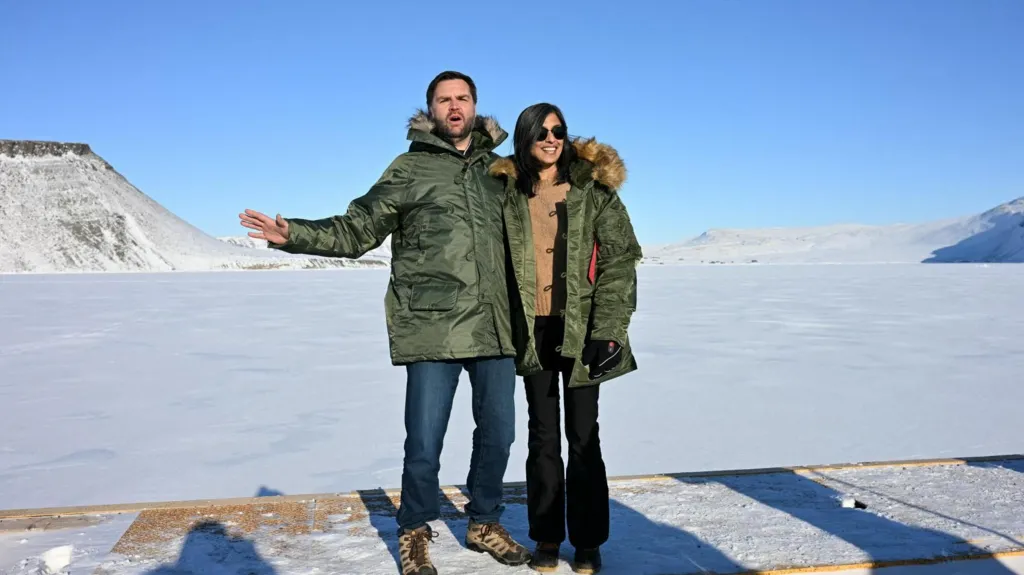
On a brief visit to a remote US military base in the far north of Greenland, US Vice-President JD Vance may have tried at times to soften his boss’s stated aim of simply annexing the autonomous Danish territory.
“We do not think that military force is ever going to be necessary,” Vance said, perhaps attempting to sound reassuring.
But the vice-president’s overarching message remained stark and intimidating: the world, the climate, and the Arctic region are changing fast, and Greenland needs to wake up to threats posed by an expansionist China; long-standing Western security partnerships have run their course; the only way the island can protect itself, its values and its mineral wealth is by abandoning weak and miserly Danish overlords and turning instead to the muscular and protective embrace of the US.
“We need to wake up from a failed, 40-year consensus that said that we could ignore the encroachment of powerful countries as they expand their ambitions.
“We can’t just bury our head in the sand – or, in Greenland, bury our head in the snow – and pretend that the Chinese are not interested in this very large landmass,” Vance told US troops at the Pituffik base.
If you look at a map of the world that has the north pole at its centre, rather than the equator, it is easy to see how Greenland suddenly switches from being a bland, easily overlooked smudge of uninhabited territory and into a key strategic landmass at the heart of what many analysts now accept as an emerging power struggle between China, the US, and Russia, for control of the arctic, its minerals and its shipping lanes.
But the speed and contempt with which the Trump White House has rejected its traditional reliance on Western allies – Nato in particular – has left its partners bewildered.
“Not justifiable,” was the bristling response of Danish Prime Minister Mette Frederiksen after hearing Vance attack her government as he stood on its sovereign territory.
‘Like a threat’
But 1,500km (930 miles) south of America’s Pituffik base, in Greenland’s capital, Nuuk, the American story vied for attention with a very different local event on Friday.
“We will prevail,” a smiling crowd sang, at a ceremony to celebrate the formation of a new coalition government for Greenland.
The mood felt mostly joyful and communal, with people locking arms and swaying gently as a band played inside the town’s house of culture.
It was a powerful reminder of the shared values that bind Greenland’s tiny, and overwhelmingly native Inuit population together – the need for consensus and co-operation in an often hostile natural climate, the desire to protect and celebrate Inuit culture and the wish to be respected by outsiders, be they from familiar but distant Denmark or marginally closer America.
“There are many ways to say things. But I think the way [Trump] is saying it is not the way. It’s like a threat,” said Lisbeth Karline Poulsen, 43, a local artist attending the ceremony.
Her reaction appeared to capture the broader mood here – a recent poll showed just 6% of the population support the idea of being part of the US.
The journey to independence
Under its new government, and with overwhelming public support, Greenland is beginning a slow, very cautious move towards full independence from Denmark.
It’s a process that will likely take many years, and which will involve lengthy dialogue with both Copenhagen and with Washington.
After all, Greenlanders well understand that their economy needs to be far more developed if their bid for independence is to stand any realistic chance of success.
But they need to balance that development against realistic fears of exploitation by powerful outside commercial forces.
Which brings us to the fundamental confusion, in Greenland and beyond, about the Trump administration’s approach towards their territory.
What does America want?
On his visit, Vance mentioned Greenland’s aspirations for independence, and implied that America’s real intention was not a sudden annexation of the island, but something far more patient and long-term.
“Our message is very simple, yes, the people of Greenland are going to have self-determination. We hope that they choose to partner with the United States, because we’re the only nation on earth that will respect their sovereignty and respect their security.”
If that is genuinely the American pitch – Mr Trump’s messaging remains more aggressive than Mr Vance’s – then Greenlanders can surely relax a little and take their time.
There are still large reserves of goodwill towards the US here, and a keen interest in doing more business with American companies.
On the security front, a 74-year-old treaty with Denmark permitting the US to increase its military presence in Greenland at any time – from new bases to submarine harbours – should surely take care of Washington’s concerns about countering the threat from China, just as it did during the Cold War years.
What remains puzzling is Donald Trump’s impatience – the same impatience he’s displayed in attempting to negotiate an end to the war in Ukraine.
Short of owning Greenland, America could get everything it desires and needs from this vast island without much difficulty. Instead, many people in Nuuk feel they’re being bullied.
It’s a deeply counterproductive approach, which has already forced Washington into one humiliating climbdown – cancelling a planned cultural tour by Vance’s wife, Usha, to Nuuk and another town in the face of planned local protests.
A slower, more respectful, behind-the-scenes sort of engagement would, surely, make more sense.
But that’s not to every politician’s taste.
News
Satellite images show Iran school strike hit more buildings than earlier reported
The bombing of an Iranian elementary school that killed some 165 people, many of them schoolgirls, included more targets near the school than has been initially reported, a review of commercial satellite imagery by NPR has found.
The images suggest that the school was hit on Saturday as part of a precision airstrike on a neighboring Iranian military complex — and that it may have been struck as a result of outdated targeting information.
The new images come from the company Planet and are of the city of Minab, located in southeastern Iran. They show that a health clinic and other buildings near the school were also struck. Three independent experts confirmed NPR’s analysis of the additional strike points.
The strike points “look like pretty clean detonation centroids,” said Corey Scher, a postdoctoral researcher at the Conflict Ecology laboratory at Oregon State University.
“These certainly appear like detonation sites,” agreed Scher’s colleague, Oregon State associate professor Jamon Van Den Hoek.
Jeffrey Lewis, a professor at Middlebury College who specializes in satellite imagery, said the imagery was consistent with a precision airstrike.
The images show “very precise targeting,” Lewis told NPR. “Almost all the buildings [in the compound] are hit.”
A satellite image of an Iranian Revolutionary Guard compound taken on March 4, several days after an airstrike destroyed a school on the edge of the compound. The image reveals that half a dozen other buildings in addition to the school were struck.
Planet Labs PBC
hide caption
toggle caption
Planet Labs PBC
Iranian state media said 165 people died in the bombing, which struck a girls’ school. The school was located within less than 100 yards of the perimeter of an Iranian Revolutionary Guard naval base, according to satellite images and publicly available information. The clinic was also located within the base perimeter, although both facilities had been walled off from the base.
Israel has denied involvement. “We are not aware at the moment of any IDF operation in that area,” Israel Defense Forces spokesperson Nadav Shoshani told NPR on Monday. “I don’t know who’s responsible for the bombing.”

At a press conference Wednesday morning, U.S. Defense Secretary Pete Hegseth said that the U.S. is looking into what happened at the school. “All I know, all I can say, is that we’re investigating that,” Hegseth said. “We, of course, never target civilian targets.”
Given Minab’s location in the southeastern part of Iran, Lewis believes it’s more likely the U.S. would have conducted the strike than Israel. As one gets farther south and east in Iran, “a strike is much more likely to be a U.S. strike than an Israeli strike because of the type of munitions and the geographic location,” he said.
Esmail Baghaei, the spokesman for Iran’s Foreign Ministry, called the strike “deliberate” and said that the U.S. and Israel bombed the school in part to tie up Iranian forces in the region with rescue efforts. “To call the attack on the girls school merely a ‘war crime’ does not capture the sheer evil and depravity of such a crime,” he said.
But Lewis said it’s more likely that the strike was the result of an error. Satellite images show that the school and clinic buildings were both once part of the base. The school was separated from the base by a wall between 2013 and 2016. The clinic was walled off between 2022 and 2024.
Lewis believes it’s possible American military planners had not updated their target sets.
“There are thousands of targets across Iran, and so there will be teams in the United States and Israel that are responsible for tracking those targets and updating them,” he said. “It’s possible that the target didn’t get updated.”
The Pentagon did not immediately respond to NPR’s request for additional information about the strike.
NPR’s Arezou Rezvani and NPR’s RAD team contributed to this report.
News
Mojtaba Khamenei, son of former supreme leader, tipped to become Iran’s next head of state
Mojtaba Khamenei, the second son of the assassinated Ali Khamenei, is being heavily tipped to succeed his father as supreme leader of Iran, which would pitch a hardliner into the task of steering the Islamic republic through the most turbulent period in its 48-year history and offer a powerful signal that, for now, it has no intention of changing course.
No official confirmation has been given and the announcement may be delayed until after the funeral of Ali Khamenei, which was on Wednesday postponed.
His son is believed to have been the choice of the Islamic Revolutionary Guard Corps (IRGC), and the Israeli defence minister, Gideon Saar, has warned he will be assassinated.
Ayatollah Seyed Khatani, a member of the Assembly of Experts, the body that chooses the new supreme leader, said the assembly was close to selecting a leader.
Rigid in his anti-western views, Mojtaba Khamenei is not the candidate Donald Trump would have wanted. Marco Rubio, the US secretary of state, said on Tuesday that Iran was run by “religious fanatic lunatics” – and Khamenei’s appointment is hardly likely to dispel that opinion.
The choice of supreme leader is made by the 88-strong Assembly of Experts, who in this case are picking from a field of six possible candidates. His election would be a powerful if unsurprising symbol that the government is not looking to find an accommodation with America.
Trump has said the worst-case scenario would be if Khamenei’s successor was “as bad as the previous person”.
There has been speculation for more than a decade that he would be his father’s successor, which grew when Ebrahim Raisi, the elected president and favourite of Khamenei, was killed in a helicopter crash.
Mojtaba Khamenei was born in 1969 and studied theology after graduating from high school. At the age of 17, he went to serve in the Iran-Iraq war, but it was not until the late 1990s that he came to be recognised as a public figure in his own right.
After the landslide defeat of Khamenei’s preferred candidate, Ali Akbar Nategh Nuri, in the 1997 presidential election, where he won only 25% of the final vote, various conservative Iranian groups realised the need to make changes to their structures and Mojtaba Khamenei was central to that project.
He was also seen as instrumental by reformists in suppressing the protests in 2009 that came after allegations the presidential election had been rigged, with his name chanted in the streets as one of those responsible. Mostafa Tajzadeh, a senior member of Iran’s reformist parties who was imprisoned after the vote, alleged that his and his wife, Fakhr al-Sadat Mohtashamipour’s, legal case was under the direct supervision of Mojtaba Khamenei.
In 2022 he was given the title of ayatollah – essential to his promotion. By then he was a regular figure by his father’s side at political meetings, as well as playing an influential role in the Islamic Republic’s Broadcasting Corporation, the government’s official media outlet often criticised for churning out dull political propaganda that many Iranians reject in favour of overseas satellite channels. He has also played a central role in the administration of his father’s substantial financial empire.
His closest political allies are Ahmad Vahidi, the newly appointed IRGC commander; Hossein Taeb, a former head of the IRGC’s intelligence organisation; and Mohammad Bagher Ghalibaf, the current speaker of the parliament.
His rumoured appointment and its hereditary nature has long been resisted by reformists. The former prime minister Mir Hossein Mousavi, referring to the long history of rumours about Mojtaba Khamenei succeeding his father as leader, wrote in 2022: “News of this conspiracy have been heard for 13 years. If they are not truly pursuing it, why don’t they deny such an intention once and for all?”
The Assembly of Experts, in response, denounced “meaninglessness of doubts” and said the assembly would select only “the most qualified and the most suitable”.
Israel on Tuesday struck the building in the Iranian city of Qom, one of Shia Islam’s main seats of power, where the assembly was scheduled, but the building was empty, according to IRGC-affiliated media.
News
Video: Senators Question Kristi Noem on ICE Immigration Tactics
new video loaded: Senators Question Kristi Noem on ICE Immigration Tactics
transcript
transcript
Senators Question Kristi Noem on ICE Immigration Tactics
Homeland Security Secretary Kristi Noem repeatedly refused to apologize for suggesting that Alex Pretti and Renee Good, two U.S. citizens shot and killed by agents, were domestic terrorists.
-
What we’ve seen is a disaster under your leadership, Ms. Noem. A disaster. What we’ve seen is innocent people getting detained that turn out are American citizens. I could talk about the culture that’s been created here. After the killings of Renee Good and Alex Pretti, when I spoke to Alex’s parents, they told me that you calling him a domestic terrorist — this was directly from them — the day after he was killed, a nurse in our V.A., Alex — one of the most hurtful things they could ever imagine was said by you about their son. Do you have anything you want to say to Alex Pretti’s parents? Ma’am, I did not call him a domestic terrorist. I said It appeared to be an incident of — I think the parents saw it for what it was. In a hearing — recent hearing before the HSGAC committee, C.B.P. and ICE officials testified under oath that their agencies did not inform you that Pretti was a domestic terrorist — during that hearing, stated during that hearing, I was getting reports from the ground, from agents at the scene, and I would say that it was a chaotic scene. How did you think that calling them domestic terrorists at that scene was somehow going to calm the situation? The fact that you can’t admit to a mistake, which looks like under investigation, it’s going to prove that Ms. Good and Mr. Pretti probably should not have been shot in the face and in the back. Law enforcement needs to learn from that. You don’t protect them by not looking after the facts.
By Christina Kelso and Jackeline Luna
March 3, 2026
-
World1 week agoExclusive: DeepSeek withholds latest AI model from US chipmakers including Nvidia, sources say
-
Massachusetts1 week agoMother and daughter injured in Taunton house explosion
-
Wisconsin3 days agoSetting sail on iceboats across a frozen lake in Wisconsin
-
Maryland4 days agoAM showers Sunday in Maryland
-
Denver, CO1 week ago10 acres charred, 5 injured in Thornton grass fire, evacuation orders lifted
-
Florida4 days agoFlorida man rescued after being stuck in shoulder-deep mud for days
-
Oregon6 days ago2026 OSAA Oregon Wrestling State Championship Results And Brackets – FloWrestling
-
Massachusetts2 days agoMassachusetts man awaits word from family in Iran after attacks