Washington, D.C
Trump executive order seeks to 'restore' American history through Smithsonian overhaul


The entry to the Smithsonian Institution’s Smithsonian Castle in Washington, D.C.
Manuel Balce Ceneta/AP
hide caption
toggle caption
Manuel Balce Ceneta/AP
President Donald Trump signed an executive order on Thursday directing Vice President JD Vance to eliminate “divisive race-centered ideology” from Smithsonian museums, educational and research centers, and the National Zoo.
Titled “Restoring Truth and Sanity to American History,” the order states, “Once widely respected as a symbol of American excellence and a global icon of cultural achievement, the Smithsonian Institution has, in recent years, come under the influence of a divisive, race-centered ideology. This shift has promoted narratives that portray American and Western values as inherently harmful and oppressive.” It goes on to say: “Museums in our Nation’s capital should be places where individuals go to learn — not to be subjected to ideological indoctrination or divisive narratives that distort our shared history.”
The order calls for Vance, along with Vince Haley, the assistant to the president for domestic policy and Lindsey Halligan, the special assistant to the president and senior associate staff secretary, to work with Congress to prohibit the Smithsonian from receiving appropriations for exhibitions and programs that, “degrade shared American values, divide Americans based on race, or promote programs or ideologies inconsistent with Federal law and policy.” It also requests that future appropriations “celebrate the achievements of women in the American Women’s History Museum and do not recognize men as women in any respect in the Museum.”
NPR reached out to the Smithsonian for comment but hasn’t heard back.


The executive order further calls for the appointment of citizen members to the Smithsonian Board of Regents committed to advancing the policy of the order.
This is the latest in a series of executive orders issued by the president since he took office in January aimed at rolling back Diversity Equity and Inclusion (DEI) efforts previously promoted by federal agencies – among them the National Endowment for the Arts’ Challenge America program. It primarily supported small non-profits reaching “historically underserved communities that have limited access to the arts relative to geography, ethnicity, economics, and/or disability.”
This latest executive order blames the Biden Administration for advancing a “corrosive ideology” that, it states, sought to revise historical truth. “Over the past decade, Americans have witnessed a concerted and widespread effort to rewrite our Nation’s history, replacing objective facts with a distorted narrative driven by ideology rather than truth,” the order states. “Under this historical revision, our Nation’s unparalleled legacy of advancing liberty, individual rights, and human happiness is reconstructed as inherently racist, sexist, oppressive, or otherwise irredeemably flawed.”
The order includes additional provisions seeking to reinstate public monuments, memorials and statues that were “removed or changed to perpetuate a false reconstruction of American history, inappropriately minimize the value of certain historical events or figures, or include any other improper partisan ideology,” as well as improve the infrastructure of Independence National Historical Park in time for the 250th anniversary of the signing of the Declaration of Independence in 2026.



Washington, D.C
What’s that noise? What you need to know about D.C. flyovers Friday and Saturday – WTOP News

Reagan National Airport will close for America 250 flyover rehearsals Friday and celebrations Saturday featuring the Thunderbirds, Blue Angels and more.

Reagan National Airport will close from 10 a.m. to 1 p.m. Friday for rehearsals ahead of this weekend’s America 250 celebrations, meaning people around D.C., Arlington and Alexandria may hear and see low-flying military aircraft.
According to Freedom 250 event organizers, Friday’s “Wings of Freedom” demonstrations over the National Mall will feature parachute teams, helicopters and military aircraft, including the U.S. Marine Corps’ MV-22 Osprey and F-35B, the Navy’s F-18F and F-35C, the Air Force’s F-22 Raptor, the Thunderbirds and a tri-bomber formation.
On Saturday, the FAA will close the airport from noon to midnight for the full celebration. All arrivals and departures at Reagan National are scheduled to end before noon.
Flyovers and demonstrations are scheduled throughout the afternoon and evening along the National Mall and Washington Monument grounds, including appearances by Air Force One, the Thunderbirds, Blue Angels, military aircraft fleet reviews, parachute demonstrations and B-2 stealth bombers.
Highlights include an Air Force One flyover scheduled for 7:03 p.m., a Thunderbirds demonstration beginning at 6:25 p.m., a tri-bomber formation at 6:02 p.m. and a stealth aircraft flyover at 7:38 p.m.
Friday’s schedule of flyovers and demonstration rehearsals along the National Mall and Washington Monument
- 10 a.m.: Golden Knights, Leap Frogs
- 10:15 a.m.: Army Helo Flyover
- 10:20 a.m.: USMC V-22 Osprey Demo
- 10:35 a.m.: USMC F-35B STOVL Demo
- 10:50 a.m.: USN F-18F Demo
- 11:10 a.m.: USN F-35C Demo Team
- 11:30 a.m.: USAF F-22 Raptor Demo
- 11:50 a.m.: NASA F-5s
- 12 p.m.: HUGE (1) Formation
- 12:05 p.m.: USAF Thunderbirds
- 12:55 p.m.: USAF Tri-Bomber
Saturday’s schedule of flyovers and demonstration along the National Mall and Washington Monument
- 1:14 p.m.: – NASA F-5 Flyover
- 1:24 p.m.: -NASA Fleet Review
- 1:44 p.m.: USCG Helo Flyover
- 1:54 p.m.: USCG Fixed Wing Flyover
- 2:09 p.m.: Golden Knights, Leap Frogs
- 2:29 p.m.: Army Helo Flyover
- 2:44 p.m.: USAF Fleet Review – Wave 1 – Heavies
- 2:54 p.m.: USAF Fleet Review – Wave 2 – AFSOC
- 3:04 p.m.: USAF Fleet Review – Wave 3 – Fighters
- 3:29 p.m.: Executive Rotary Wing Airlift
- 3:39 p.m.: USMC Fleet Review – Wave 1 – Rotary
- 3:49 p.m.: USMC Fleet Review – Wave 2 – Fixed Wing
- 3:59 p.m.: USN Fleet Review – Wave 1 – Rotary
- 4:09 p.m.: USN Fleet Review – Wave 2 – Fixed Wing
- 4:19 p.m.: USN Fleet Review – Wave 3 – Fighters
- 4:21 p.m.: USN F-18F Demonstration
- 4:59 p.m.: USN Blue Angels
- 5:26 p.m.: USMC MV-22 Osprey Demonstration
- 5:44 p.m.: USAF Fleet Review – Fighters
- 6:02 p.m.: USAF Tri-Bomber Formation
- 6:05 p.m.: USN F-35C Demonstration
- 6:25 p.m.: USAF Thunderbirds Demonstration
- 7:03 p.m.: Air Force One Flyover
- 7:07 p.m.: USAF Thunderbirds Delta Break
- 7:17 p.m.: HUGE 1 Flyover Led by the Newly Renovated Air Force One
- 7:38 p.m.: U.S. Stealth Airpower Flyover
- 7:39 p.m.: F-22 Raptor Demo
- 7:53 p.m.: F-22 Raptor in Afterburner
- 7:59 p.m.: B-1 Flyover
- 8:07 p.m.: B-1’s in Afterburner
- 8:11 p.m.: HUGE ONE Fly Over Review
- 8:22 p.m.: Golden Knights Twilight Jump
- 10:36 p.m.: B-1 Afterburner Night Pass
Get breaking news and daily headlines delivered to your email inbox by signing up here.
© 2026 WTOP. All Rights Reserved. This website is not intended for users located within the European Economic Area.

An Air Force major was arrested in uniform on the steps of the Capitol after he called for the impeachment of President Donald Trump.
U.S. Capitol Police arrested Jason Watson, an active-duty service member, on Wednesday afternoon following remarks at a news conference where he said Trump and Vice President JD Vance should be removed from office.
The event was organized by the Removal Coalition, a group that lobbies members of Congress to impeach Trump, and attended by Rep. Al Green, D-Texas, who has repeatedly introduced articles of impeachment against Trump.
“I’m here with him because Rep. Green is the only member of Congress that has demonstrated the courage and conviction to … force a vote on articles of impeachment,” Watson said at the event. “If Congress followed his example, we could remove the entire Trump administration, but Congress remains unconvinced of the urgency and necessity for them to honor their oaths, so we must persuade them with our unrelenting, uncompromising civil resistance.”
Watson said he is not a Democrat and does not share policy positions with Green, who lost his re-election bid this year. Green’s office did not immediately respond to a request for comment on Watson’s arrest.
Capitol Police said in a statement that it “is generally against the law for the public to demonstrate on the House Steps unless they are with a Member of Congress.”
“Yesterday afternoon, a man was escorted to the House Steps by a Member of Congress,” the statement said. “When the Member of Congress left the area, our officers gave the man lawful orders to stop the illegal demonstration or he would be arrested. The man refused our lawful orders.”
Capitol Police identified the man as Watson, adding that he was arrested on charges of “Crowding, Obstructing, and Incommoding” and that it is legal to protest in other spots on the Capitol grounds.
Service members are subject to stricter laws than the average citizen when it comes to protesting. The Uniform Code of Military Justice prohibits officers from “using contemptuous language towards the President, Vice president, the Secretaries of War and of a military department, Congress, and certain other officials,” according to an Air Force memo last year.
An Air Force spokesperson said in a statement Thursday: “Service members must comply with all laws, regulations and policies governing conduct and the wear of the uniform. All Department of the Air Force personnel are expected to uphold the highest standards of discipline and professionalism, both on and off duty.”
All service members, not just members of the Air Force, are prohibited from participating in “political activities” in uniform.
Watson’s criticism of Trump and Vance focused on the administration’s actions in Venezuela and Iran, calling them “an unconstitutional usurpation of Congress’ authority and a violation of the War Powers Clause.”
“These violations resulted in the deaths of 13 service members and injuries of hundreds more,” he said, referring to the number of U.S. military deaths tied to the Iran war. “For this, the president and vice president must be impeached, convicted and removed.”
Watson also called the administration’s immigration policies and tactics unconstitutional.
The Removal Coalition did not immediately respond to a request for comment, and Watson could not be reached.
President Donald Trump responded to criticism of a financial disclosure that listed $1.4 billion in crypto earnings largely driven by meme coins.
Berk Kutay Gökmen
02 July 2026•Update: 02 July 2026
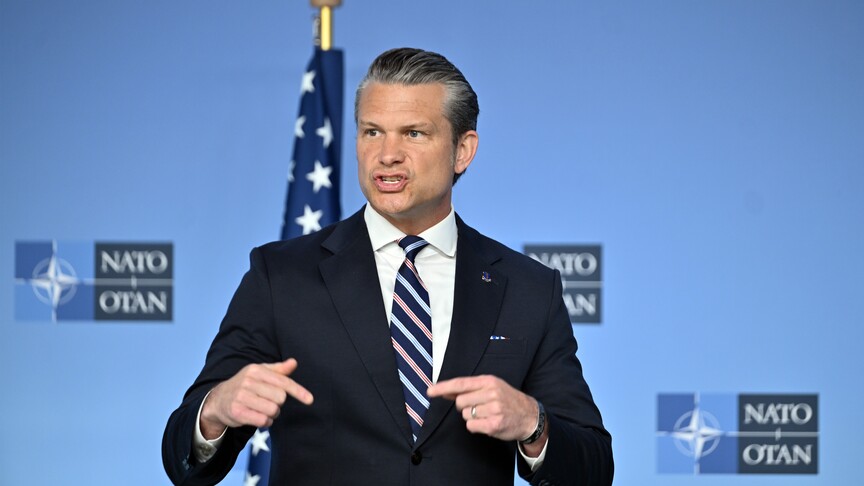
US Defense Secretary Hegseth on Thursday faced protesters while hosting the Trump administration’s DC Safe and Beautiful Task Force ceremony in Washington DC.
During the ceremony at Meridian Hill Park, which saw the gathering of National Guardsmen, dozens of demonstrators gathered near the park to protest Hegseth.
Footage shows the demonstrators chanting a short distance away from where Hegseth and roughly 200 members of the National Guard had gathered in the park
In social media posts, one protester was seen holding a Palestinian flag, while another person was holding a sign that reads “arrest Hegseth.” The protesters want a “Free DC,” according to social media posts.
In his address to the National Guard, Hegseth said that “this background noise is perfect,” referring to the protests.
“It’s the sound of ingrates, of ingratitude—of people who are so blinded by ideology they can’t see law and order and common sense in front of them,” he said.
Meridian Hill Park was repaired by the National Park Service and the Interior Department as part of a larger initiative to restore and enhance federal parks and public spaces throughout the nation’s capital in preparation for America’s 250th anniversary, which falls on this Saturday, July 4.
Though such beautification projects are typically popular with the public, the current initiative has been controversial both for its choice of projects and the use of no-bid contracts to hire firms to do the work, sometimes with disappointing results.
The work aligns with President Donald Trump’s DC Safe and Beautiful Task Force, established by a March 2025 executive order that directs federal agencies to coordinate public safety and beautification efforts across Washington.
-

 West Virginia2 minutes ago
America250 fireworks, events happening this weekend in North Central West Virginia
-

 Wyoming7 minutes ago
14 Wyoming Cowboys make Athlon All-Mountain West preseason team
-

 Crypto14 minutes ago
OKX Announces Direct Crypto Aid for Venezuelans Hit by Devastating Twin Earthquakes
-

 Finance16 minutes ago
Regions expands municipal finance business with acquisition of Montgomery’s Frazer Lanier
-
Fitness22 minutes ago
Huge 30-Year Study Finds Exercise Variety Can Help You Live Longer – Here’s the Ideal Mix
-

 Movie Reviews32 minutes ago
The Kernel: Freshly popped film reviews — Batch #6 – Excalibur
-

 World44 minutes ago
AI ‘Organisms’ Come Alive in Kuala Lumpur as Dutch Artist Unveils Immersive Show
-

 Health1 hour ago
Is Skipping Breakfast Bad? The Weight-Loss Truth May Surprise You

