Entertainment
Review: 'Old Friends' pay tribute to Sondheim in a luxurious pre-Broadway celebration at the Ahmanson

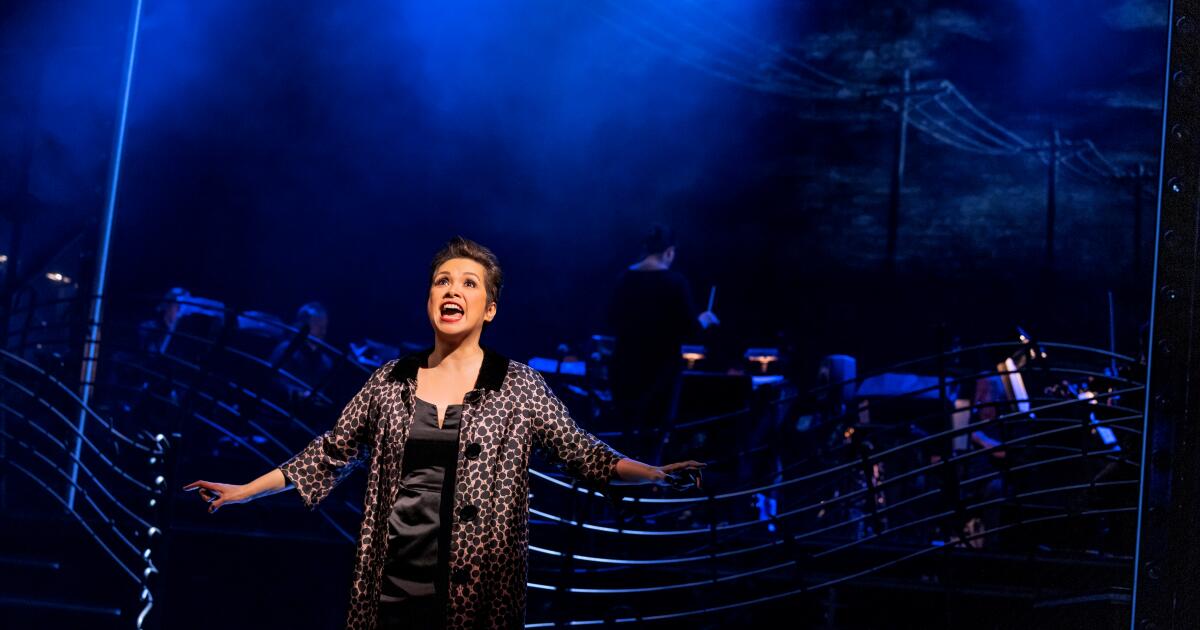
Our love of Stephen Sondheim is approaching the “Beatlemania” phase.
One wonders what the Broadway maestro would have made of “Stephen Sondheim’s Old Friends,” which opened Thursday at the Ahmanson Theatre in preparation for its move to Broadway in the spring. A greatest-hits revue, devised by producer Cameron Mackintosh, the celebratory show is a true embarrassment of riches.
Mackintosh has spared no expense on an extravaganza that seems to have everything but a good editor.
Sondheim, who died in 2021, admitted to me in a 2010 interview that he found these birthday concerts and tribute shows “thrilling and embarrassing.”
“There’s an up- and downside to being venerated,” he said. “You start to believe your own notices, and that’s very dangerous. At the same time, it does feel like it’s gold-watch time. It’s ‘Thanks so much for coming to the party.’ They’re nails in the coffin, is what they are.”
Well, there’s no longer any worry about how all this public fanfare will affect his creativity. But could all this ballyhoo sap interest in his work? It would be an irony worthy of Sondheim if, after a lifetime of being dismissed as too highbrow, his posthumous career suffered from commercial overexposure.
Bernadette Peters and Lea Salonga in Stephen Sondheim’s “Old Friends.”
(Matthew Murphy)
Lea Salonga, who headlines “Stephen Sondheim’s Old Friends” alongside fellow Tony winner Bernadette Peters, is the brightest star of a production overloaded with majestic singing talent. There’s a purity to Salonga’s lyric soprano, which fills the Ahmanson with the distinctive glow not just of the song she happens to be singing but of the musical from which it derives.
In “Loving You” from “Passion,” a medley from “Sweeney Todd,” “Somewhere” from “West Side Story” and most unforgettably, “Everything’s Coming Up Roses” from “Gypsy,” Salonga allows us to momentarily inhabit the space of each show, intuitively conveying what I can only describe as the spiritual architecture of these musical landmarks.
The format of moving from one number to the next in TikTok fashion encourages some of the performers to overplay their hands. There’s a little too much mugging, italicizing and elbow-nudging, as if we might not be able to enjoy Sondheim’s unsparing wit on our own.
Salonga, however, is a model of restraint, allowing the lyrics to speak through her careful attention to Sondheim’s scores. Matthew Bourne seems to have lavished all his genius as a director on the elegant musical staging, leaving the actors to their own devices. But Salonga proves that less is indeed more when backed by trust in the material and guided by the artistic precision of a naturally gifted wonder.

Jacob Dickey and Bernadette Peters perform “Hello, Little Girl” in Stephen Sondheim’s “Old Friends.”
(Matthew Murphy)
Peters wasn’t in strong voice at the opening-night performance, and I wondered if she might be struggling with a cold. When she came out at the top of the show with Salonga, the two elegantly decked in the deep red of a Broadway stage curtain, the connection with the audience was instantaneous. The ovation that erupted threatened to derail the show.
Part of the original Broadway casts of “Sunday in the Park With George” and “Into the Woods,” Peters is one of the great Sondheim interpreters. (I still rank her performance in “Gypsy” up there with the best.) There’s no one like this kewpie triple threat, and even at half-mast she was able to summon some of the old magic.
“Into the Woods” occasioned Peters’ best work, including a duet with Salonga of “Children Will Listen” and a coup de théâtre involving Little Red Riding Hood’s costume. A clumsily set-up “Broadway Baby” from “Follies,” in which Peters cheekily name-checks herself, eventually was redeemed when she was joined by other veteran troupers in leggy kick-line.
“Old Friends,” which was originally produced in London by Mackintosh, has a title that shouldn’t be taken too literally. The company brings together different generations united by their devotion to Sondheim. But the more seasoned pros get two of the biggest showstoppers. Beth Leavel delivers a defiantly louche rendition of “The Ladies Who Lunch” from “Company” and Bonnie Langford leaves it all out on the stage in a gorgeously guttural “I’m Still Here” from “Follies.”
The banquet of beautiful singing is too abundant for a complete inventory. But Jeremy Secomb and Jacob Dickey’s exquisite rendition of “Pretty Women,” a lilting melody amid the murderous machinations of “Sweeney Todd,” deserves special commendation. Jason Pennycooke makes a memorable impression in “Live Alone and Like It,” a song Sondheim wrote for the film “Dick Tracy” that was the only one I didn’t know all the lyrics to.
There were a few disappointments along the way. Peters had only intermittent success with “Send in the Clowns” from “A Little Night Music” and “Losing My Mind” from “Follies.” Her flickers of brilliance fell short of a flame.

Beth Leavel, Bernadette Peters, Joanna Riding perform “You Gotta Get a Gimmick” in Stephen Sondheim’s “Old Friends.”
(Matthew Murphy)
Mackintosh, who made his greatest-hits selection favoring those shows he had a hand in producing, goes heavy on the comic numbers. The second act begins to drag with slapdash vaudeville showcases that seem like sops to the performers.
Sondheim always insisted that his book writers be given equal due. Songwriting for him was an act of collaborative playwriting. His harping on this point could come across as doctrinaire. But as “Stephen Sondheim’s Old Friends” unwittingly betrays, songs taken out of their context don’t have the same power as when dramatically embedded.
Mackintosh and Bourne mitigate the damage by grouping some songs together and presenting them in an ingeniously suggestive dramatic fashion. Matt Kinley’s shapeshifting scenic design, combined with Warren Letton’s hypnotic lighting and Jill Parker’s swank costumes, allow scenes to emerge like an impresario’s dreamscapes.
The irreplaceable Barbara Cook put her interpretive stamp on Sondheim’s songbook in her concert tributes, reanimating musical treasures through her own introspective moonlight. The cast of “Old Friends” is too numerous for that level of personal intimacy, so we’re left in a kind of limbo that’s neither cabaret nor full-scale revival.
But in addition to Salonga’s radiant example, there are group numbers that bring us closer to the sublime heights that Sondheim reached. “Sunday,” the culminating hymn of “Sunday in the Park With George,” closes Act 1 to magisterial effect. And “Being Alive” from “Company,” led by Dickey with soaring vocal accompaniment, takes us into the production’s rousing final stretch.
There are glimpses of Sondheim onscreen, but this isn’t another biographical show. It’s an overstuffed yet always stylish homage. While no substitute for the musicals themselves, the production will be cherished by those fans who need to worship regularly at the altar of their Broadway god.
‘Stephen Sondheim’s Old Friends’
Where: Ahmanson Theatre, 135 N. Grand Avenue, L.A.
When: 8 p.m. Tuesdays-Fridays, 2 and 8 p.m. Saturdays, 1 and 6:30 p.m. Sundays. Ends March 9.
Tickets: Start at $52
Info: (213) 628-2772 or centertheatregroup.org
Running time: 2 hours, 30 minutes

Movie Reviews
‘Night Nurse’ Review: A Caretaker Explores Her Kink for Elder Abuse in the Year’s Strangest Erotic Thriller

There are any number of erotic thrillers in which rich old men are robbed blind and/or left for dead, but Georgia Bernstein’s admirably bizarre “Night Nurse” might be the first movie of its kind where elder abuse is the source — and possible subject— of its erotic thrills. If there are others, I’m not sure I want to know.
But this woozy debut feature doesn’t rely on its audience being turned on by the relationship between a nubile caretaker and her dementia-addled patient. Their psychosexual bond, meanwhile, hinges on cold-calling vulnerable old people under the guise of a grandchild in financial distress. (“I’m in trouble, nana, send me $10,000 or I’ll be left to rot in jail!” That sort of thing). With its slim wisp of a premise stretched into a Strickland-esque dreamscape that substitutes kink for conflict, the film itself hardly seems convinced by its own wrinkled lust — all desperate kisses and non-touching poses of subservience. More important to Bernstein is what that lust reveals about her characters’ deepest needs, specifically how their need to care and be cared for can be as easily perverted as any other form of desire.

As moody and weightless as the noir-accented score that blows through the movie like a curlicue gust of wind in an old cartoon (credit to musicians Sam Clapp and Steven Jackson), “Night Nurse” lacks the pulse required for its stray feelings to come alive. Still, the film ambiently taps into the latent eroticism of teasing out the distance between how you see yourself and who you really are. Bernstein plays with that distance like a telephone cord wrapped around her fingers, and Eleni — played by the excellent newcomer Cemre Paksoy, powerfully helpless — only frays even more as the receiver is brought near the hook. “Everything I did before today wasn’t me,” the nurse tells co-worker Mona (Eleonore Hendricks) after starting a new job at an Illinois retirement home. “It was somebody else.”
What she did before today remains unexplored (specifically, what she did to get herself fired from her last gig), but I’m guessing she’s probably changed less than she thought. There’s a faraway flicker in her eyes the moment she catches the vibe between Mona and Douglas (a ribald and elusive Bruce McKenzie), a white-haired seventysomething who shows early signs of dementia but still commands an undiminished sexual energy. “I’m not an invalid,” he coos as Mona bathes him in the tub, to which she replies, “yes, you are,” in a supplicant tone that hints at a rich history of power games between them.
Later that same night, Douglas will force Eleni to call a stranger, pretend that she’s their granddaughter, and ask for money — he’ll wrap the phone cord around the nurse’s body as she talks and shove her against the wall as they kiss. She’s into it. So into it that he has to clarify the terms of his whole deal: “If you’re looking for a pogo stick, I’m really not your guy.” But Eleni isn’t looking for anything to bounce on. She just wants to be needed, and maybe to need someone in return. Someone who will see her for who she really is and allow her the fantasy of pretending she isn’t being herself when she cons vulnerable strangers out of their money — when she exploits how enthralled those strangers are by the care they have for their loved ones.
“Night Nurse” doesn’t belabor the psychology, as Bernstein prefers to express her story through heavy-lidded suggestion. Somnambulating from the moment it starts, the film moves through a series of beautifully arranged poses that stretch their latent meaning thin across the surface (Lidia Nikonova’s cinematography lacquers every shot with a seductive dreaminess). We see Douglas smoking in a lawn chair with Mona and Eleni curled around his feet. Eleni riding in the backseat of a convertible as the wind blows through her curls. The full staff of nurses — all of them under Douglas’ sway — stumbling around his condo in a state of zonked out bliss as they roll on the prescription drugs they’ve stolen from the residents.
Once you’ve seen one shot of this movie, you’ve practically seen them all, at least until things escalate during a rushed and unsatisfying third act that forces Eleni into an honest confrontation with herself. People will do just about anything to feel needed — they’ll give whatever degree of care allows them to receive it in return. “Night Nurse” understands that desire, but remains far too numb to treat it.
Grade: C+
The Independent Film Company will relase “Night Nurse” in theaters on Friday, July 10.
Entertainment
Lucas Museum to give free annual passes to South L.A. neighbors, host community preview day

The Lucas Museum of Narrative Art, which is moving at light speed toward its Sept. 22 opening, announced Thursday that it will give free annual passes to its South L.A. neighbors living in the 90037 ZIP Code. The 300,000-square-foot, $1-billion museum located in Exposition Park will also host a special community preview day on Sept. 13, more than a week before the general public gets to step inside.
The 90037 ZIP Code has a population of more than 65,000 and is bordered roughly by the 110 Freeway to the west, Slauson Avenue to the south, Central Avenue to the east and Martin Luther King Jr. Boulevard to the north. Residents can register for passes at lucasmuseum.org/lm37 and will be alerted in August when the program launches. Pass holders can reserve tickets for themselves and one guest.
Tickets for non-pass holders go on sale July 21. They cost $25 for adults and $21 for seniors. Kids 17 and under are free.
“Storytelling has the power to bring people together and create a sense of community,” said Lucas Museum Chief Executive Tracey Bates in a news release about the program. “Through LM37, we are inviting our South Los Angeles neighbors to make the museum part of their lives and take their own path of discovery through the art, programs and experiences that will help shape this new cultural hub for Los Angeles.”
The community preview day is designed to give local business owners, community partners, civic leaders and registered LM37 pass holders a sneak peak of the 10,000 square feet of exhibition space, as well as the expansive gardens with 11 acres of park space.
The opening programming, curated by co-founder George Lucas, features 20 inaugural exhibitions across more than 30 galleries, including one titled “Star Wars in Motion,” containing vehicle designs, high-speed racers, flying vessels, props, costumes and illustrations from the first six films in the beloved franchise.
More than 1,200 objects will be on display from Lucas’ personal collection of narrative art. Highlights include work by Norman Rockwell and Dorothea Lange, as well as a variety of manga, children’s book illustrations and comics.

Last year’s “Superman” ended with Iggy Pop singing “Because I’m a punk rocker, yes I am” — an ironic coda for a superlatively square hero. But it rings straightforwardly true for Superman’s cousin.
Milly Alcock’s Kara Zor-El, or Supergirl, sports not a spandex suit but a Blondie T-shirt. When we meet her in Craig Gillespie’s “Supergirl,” she’s been on an interstellar bender for days. She’s more Courtney Love than Clark Kent.
Nonchalant and sarcastic, Kara is also a little Han Solo-ish, you might say, given that she moves capriciously through the galaxy in her junky spaceship while getting in fights in extraterrestrial bars. She’s a welcome, jagged riff on more buttoned-up superheroes, and Alcock is terrific in the role. If only “Supergirl” was as good as she is.
While the latest DC release, and second under James Gunn’s stewardship, has its moments, “Supergirl” struggles to match Kara’s punk-rock energy with an equally spirited supporting cast and story.
Skepticism seems to have gathered for “Supergirl” ahead of its release. Many fans have argued it wasn’t the right next step for DC Universe. But I’m not so sure. Alcock’s breezy cameo in “Superman” was one of that movie’s highlights. Handing the follow-up to her, and her faithful floating dog Krypto, strikes me as an extremely natural next step. When in doubt, follow the dog.
And much of “Supergirl” is winning. It resides almost entirely in space, touching down only momentarily on Earth. In its consistently creative production design, clever needle drops and underdog story arc, “Supergirl” resides a little closer to Gunn’s “Guardians of the Galaxy” movies than other DC entries. Its outer space is filled with cosmic detritus, mean characters and cute critters. Seth Rogen as the voice of a tiny alien co-piloting a space bus is an inspired concoction, as is a shabbier sci-fi realm with rest stops along the intergalactic highway.
-

 Milwaukee, WI4 minutes ago
Milwaukee leaders condemn ICE arrests as agency ignores City mask ordinance
-

 Atlanta, GA7 minutes ago
Georgia Secretary of State opens investigation into voter registration mailers sent to deceased residents
-

 Minneapolis, MN12 minutes ago
Minneapolis chief communications officer Adam Fetcher out amid possible criminal charges
-

 Indianapolis, IN19 minutes ago
Indiana Workforce Pell Grant options limited so far
-

 Pittsburg, PA22 minutes ago
Pennsylvania leaders take new approach to cracking down on robocalls
-

 Augusta, GA27 minutes ago
Augusta domestic violence shelter faces shortfall after Georgia funding veto
-

 Washington, D.C34 minutes ago
Why Gov. Kim Reynolds turned down previous request to send National Guard to D.C.
-

 Cleveland, OH37 minutes ago
LGBTQ+ Ohio Nonprofit Guide

