Washington, D.C
The Southern Group launches federal presence with TSG Advocates in Washington, D.C.


A new chapter begins as The Southern Group takes its trusted advocacy model to the heart of the nation’s capital and launches TSG Advocates, a new federal lobbying practice.
With a deep-rooted presence across the Southeast, The Southern Group is now making its mark in Washington, D.C. The firm’s latest expansion, led by seasoned political experts Daniel Diaz-Balart and Chase Kroll, brings a dedicated federal lobbying arm. TSG Advocates combines its subject-matter expertise with a broad national network to offer a unique, relationship-driven approach to federal advocacy.
This move marks the next step in a 25-year journey for The Southern Group, as it transitions from its Florida roots to becoming a national influence network.
Diaz-Balart and Kroll are two distinguished government-relations professionals with a wealth of experience spanning foreign affairs, political strategy and policy advocacy. Their combined expertise in industries like defense, energy, health care, tax and financial services positions TSG Advocates to stand out as a trusted advocate for businesses navigating the complex federal landscape.
“Businesses will need strong representation in D.C. to take advantage of unprecedented opportunities in the coming years,” said Diaz-Balart, founding member of TSG Advocates. “With TSG Advocates’ connections in Florida and on the ground in Washington, D.C., I can’t think of a firm better positioned to help clients capture those opportunities.”
TSG Advocates’ launch is part of The Southern Group’s strategy to broaden its footprint at the federal level. With many prominent Florida leaders stepping into key roles in the new administration, the firm is poised to leverage its robust network and longstanding relationships in Florida to influence policy at the national stage.
“We’re building our federal practice with an eye on success over the next century, not just the next administration,” said TSG Senior Managing Partner for Growth, Rachel Cone. “Having well-connected leaders like Daniel and Chase at the helm in D.C. ensures we’re positioned to deliver high-level results for our clients over the long-term.”
Diaz-Balart’s career has spanned foreign policy, defense contracting, and governmental affairs, all while leading his own legal practice in south Florida. With years of experience advocating for foreign governments like Taiwan and the Dominican Republic, Daniel has played a critical role in policy strategy across multiple sectors, including space exploration, defense, and more.
“Daniel is an effective and knowledgeable advocate who couples his approach with an infectious optimism,” said U.S. Rep. Carlos Giménez of Florida. “He stands out for his professionalism and is a true pleasure to work with.”
Kroll, an accomplished political strategist with more than 14 years of experience in federal policy and international relations, also joins TSG Advocates. With a background in digital media, communications and traditional lobbying, Kroll’s expertise lies in crafting effective, multifaceted campaigns that combine strategic political insight with innovative outreach tactics.

“Chase is an exceptional advocate and strategist, bridging the gap between policy goals and legislative realities,” said Norm Coleman, former U.S. Senator from Minnesota, Chair of the Congressional Leadership Fund Super PAC, and Senior Counsel at Hogan Lovells. “Chase’s knowledge of Washington, his knack for building bipartisan relationships, and his commitment to delivering client results make him a tremendous asset to TSG Advocates.”
His lobbying experience on behalf of defense contractors, municipal clients, and foreign governments — including the Kingdom of Saudi Arabia — further strengthens TSG Advocates’ capabilities.
TSG Advocates will continue to grow in the coming months, adding to the firm’s federal influence. The firm plans to hire additional subject-matter experts in emerging industries such as artificial intelligence and cryptocurrency.
Post Views: 0



Former Federal Reserve Chair Alan Greenspan delivers the keynote address at the IMF Statistical Forum/Statistics for Policy Making in Washington, D.C., on Nov. 18, 2014. Greenspan died on Monday at age 100.
Paul J. Richards/AFP via Getty Images
hide caption
toggle caption
Paul J. Richards/AFP via Getty Images
Former Federal Reserve Chair Alan Greenspan delivers the keynote address at the IMF Statistical Forum/Statistics for Policy Making in Washington, D.C., on Nov. 18, 2014. Greenspan died on Monday at age 100.
Paul J. Richards/AFP via Getty Images
Sign up for the Planet Money newsletter. The world is confusing. Economics can help.
Alan Greenspan, who steered the Federal Reserve for nearly two decades, through some of the longest economic booms in U.S. history, has died. Greenspan died Monday at his home in Washington. He was 100.
Greenspan was the rare celebrity among central bankers, lionized for his economic stewardship in the 1990s. At a time when it seemed every barbershop had a television tuned to the stock market channel, ordinary Americans hung on the Fed chairman’s every word.
His reputation was tarnished, however, by the global financial crisis which struck a decade later.


Greenspan liked to write speeches in the bathtub, but it was his listeners who were sometimes left feeling underwater by the unfamiliar dialect known as “Fedspeak.”
Greenspan later acknowledged that he would deliberately garble his syntax to avoid saying anything that might move financial markets.
A notorious exception came in 1996, when Greenspan seemed to suggest that stock prices might be getting ahead of themselves.
“How do we know when irrational exuberance has unduly escalated asset prices,” he asked during a speech at the American Enterprise Institute.
The warning that exuberant investors might not be quite rational sent temporary shivers through global stock markets. But Greenspan’s own stock continued to climb.
Fed Chair Alan Greenspan testifies before the Joint Economic Committee in Congress in Washington, D.C., on June 17, 1999.
Tim Sloan/AFP via Getty Images
hide caption
toggle caption
Tim Sloan/AFP via Getty Images
Fed Chair Alan Greenspan testifies before the Joint Economic Committee in Congress in Washington, D.C., on June 17, 1999.
Tim Sloan/AFP via Getty Images
Greenspan dabbled in jazz
He was married to NBC news anchor Andrea Mitchell, who anounced his death in a statement, and the two made a somewhat unlikely power couple. Comedian Jay Leno once joked during a White House Correspondents Association dinner that Mitchell, not then-First Lady Hillary Clinton, was married to “the most powerful man in the world.”
Greenspan was a talented jazz musician who studied clarinet and saxophone at Juilliard. But it was economics that made him a rock star and a symbol of the widely-shared prosperity at the end of the 20th century.
A master of monetary policy, Greenspan led the central bank under four different presidents, beginning in 1987.
Much of his tenure was marked by falling unemployment. Traditionally, central bankers respond to low unemployment by raising interest rates to ward off inflation. But Greenspan broke with that tradition and kept borrowing costs low.
“He was willing to watch and wait as the unemployment rate drifted lower and lower and lower and lower, and we still had no inflation,” recalled Princeton economist Alan Blinder, who served under Greenspan on the Fed’s governing board.
Former Fed Chair Alan Greenspan and his wife television journalist Andrea Mitchell attend a reception with Japanese Prime Minister Yoshihiko Noda at the Japanese embassy in Washington, D.C., on April 29, 2012.
Nicholas Kamm/AFP via Getty Images
hide caption
toggle caption
Nicholas Kamm/AFP via Getty Images
Former Fed Chair Alan Greenspan and his wife television journalist Andrea Mitchell attend a reception with Japanese Prime Minister Yoshihiko Noda at the Japanese embassy in Washington, D.C., on April 29, 2012.
Nicholas Kamm/AFP via Getty Images
Greenspan oversaw an economic boom
Greenspan’s gamble with low rates paid off, and the economy kept booming for a decade, although critics argue his easy-money policies also helped inflate the dot-com bubble and later fueled the subprime mortgage meltdown.


In addition to low interest rates, Greenspan pursued a light touch on regulation, refusing to use the Fed’s powers to crack down on risky lending. His libertarian philosophy was shaped in part by the novelist Ayn Rand.
Greenspan had been a member of Rand’s inner circle, contributing chapters to her book, Capitalism: The Unknown Ideal. When Greenspan joined the Ford administration as an economic adviser, Rand attended his swearing-in ceremony.
“Greenspan said that Ayn Rand put the moral foundation under capitalism for him,” said Rand’s biographer, Anne Heller.
Greenspan believed bankers didn’t need heavy-handed regulation because their own self-interest would prevent them from taking undue risks. Only after risky banking helped trigger the global financial crisis in 2008 — two years after he left the Fed — would Greenspan sheepishly admit that he’d been wrong.
“I was shocked because I had going for 40 years or more with very considerable evidence that it was working exceptionally well,” Greenspan told a congressional committee investigating the financial meltdown.
Then-President Bill Clinton talks with then-Fed Chair Greenspan during the receiving line at the White House in Washington, D.C., on Dec. 31, 1999.
Tim Sloan/AFP via Getty Images
hide caption
toggle caption
Tim Sloan/AFP via Getty Images
Then-President Bill Clinton talks with then-Fed Chair Greenspan during the receiving line at the White House in Washington, D.C., on Dec. 31, 1999.
Tim Sloan/AFP via Getty Images
Greenspan long advocated for a light regulatory touch
The idea that bankers will sometimes take dangerous risks if they’re allowed to should not have come as a surprise to Greenspan, however.
Decades earlier, he’d played a bit part in the savings-and-loan crisis, which was a kind of dress rehearsal for the 2008 financial crisis.
As a private economist in the 1980s, Greenspan provided a testimonial for what he called “seasoned and expert” management at Lincoln Savings and Loan, in an effort to ward of regulation of the thrift.
Lincoln later collapsed, costing taxpayers billions. And its boss, Charles Keating, went to prison for fraud.
Economist Vincent Reinhart said it took courage for Greenspan to acknowledge, however belatedly, that self-interest is not always enough to protect taxpayers and investors from the risky behavior of bankers.
“For Alan Greenspan to say, ‘Well, maybe markets don’t always get it right,’ is a reflection on his entire career, not just his tenure at the Fed,” Reinhart said.
Ultimately, Greenspan’s will be remembered as both a maestro of monetary policy and a reluctant regulator. His legacy is shaped by the boom he fostered, and by the bust he failed to prevent.
John Ydstie contributed to this report.

Felony warning issued as arrests reported at Reflecting Pool
Federal officials are warning visitors that taking paint chips, debris or other materials from the Lincoln Memorial Reflecting Pool could lead to felony charges as crews continue cleaning up a major algae bloom that has turned the landmark’s water bright green.
WASHINGTON – Federal officials are warning visitors that taking paint chips, debris or other materials from the Lincoln Memorial Reflecting Pool could lead to felony charges as crews continue cleaning up a major algae bloom that has turned the landmark’s water bright green.
The warning comes after authorities reported multiple arrests Saturday involving people accused of removing material from the Reflecting Pool.
Algae, paint problems plague Reflecting Pool
What we know:
While officials have not released the exact number of arrests or identified those taken into custody, law enforcement agencies said anyone caught taking paint chips or debris from the site could face serious criminal penalties.
Visitors have reported seeing blue paint chips floating in the water as cleanup crews use mobile draining machines to remove algae and restore the pool. The unusual appearance of the Reflecting Pool has attracted large crowds to the National Mall in recent days, according to previous FOX 5 D.C. reporting.
President Donald Trump said on Truth Social that work on the Reflecting Pool would begin immediately and claimed several arrests had been made in connection with what he described as deliberate sabotage of the site.
Authorities have not publicly detailed the specific charges filed in the reported arrests. However, federal officials warned that removing government property from the Reflecting Pool could result in felony charges, and prosecutors could pursue more serious offenses if evidence shows anyone intentionally contaminated the water or caused additional damage.
READ MORE: Reflecting Pool looks ‘like vomit,’ visitors say; crews continue cleaning job
“If there are more serious products that are put into the Reflecting Pool to create more algae or a bigger problem, then we’ll consider more serious charges,” U.S. Attorney Jeanine Pirro told Fox News. “But make no mistake, making D.C. beautiful is a priority and if you damage, vandalize or do anything to impact something like the Reflecting Pool, you can be prosecuted.”
What’s next:
The Reflecting Pool remains under active cleanup as officials investigate the cause of the algae bloom, according to the president.
According to federal contract data, a more extensive renovation, including potentially draining the pool again, could cost more than $14 million.
The Source: Information from FOX 5 D.C. reporting, President Donald Trump, U.S. Attorney Jeanine Pirro and other federal officials.
Washington, D.C
Jeanine Pirro vows DC Reflecting Pool vandals will be ‘prosecuted to the fullest extent’ | Fox News Video

U.S. Attorney for Washington, D.C., Jeanine Pirro joins ‘The Sunday Briefing’ to discuss vandalism at the Lincoln Memorial Reflecting Pool and the broader issue of crime in the nation’s capital.
: U.S. Attorney for D.C. Jeanine Pirro joins Peter Doocy to discuss the Lincoln Memorial Reflecting Pool vandalism after a $14 million renovation. Pirro addresses President Trump’s accusations against ABC reporter Jonathan Karl for tampering with the pool. She emphasizes Trump’s commitment to making D.C. safe and beautiful by prosecuting all violations of law, including minor crimes, to foster respect.
-
 Sports4 minutes ago
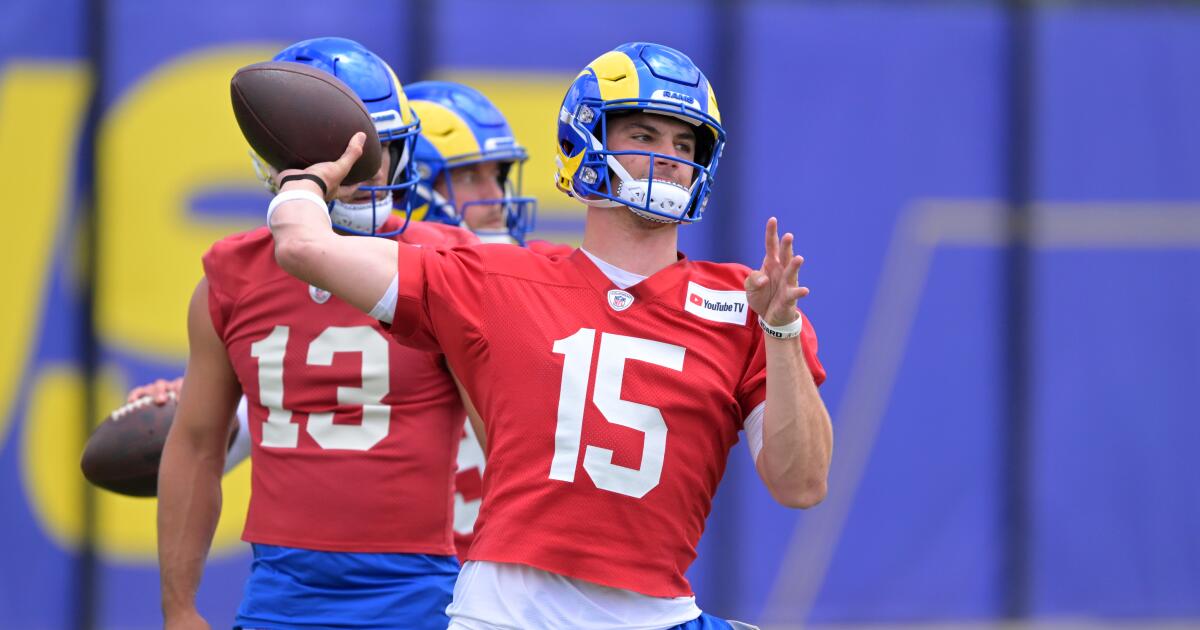
Rams QB Ty Simpson embracing an unusual bedtime routine to spur his development
-

 World14 minutes ago
Lebanon Latest: Israeli attacks surge despite ceasefire efforts
-
 News41 minutes ago
Supreme Court allows a ruling that ends a tool to protect minority voters in 7 states
-

 New York2 hours ago
How a Security Guard Lives on $46,000 a Year in the East Bronx
-

 Los Angeles, Ca2 hours ago
L.A. Tenants Union trying to save business owner given eviction notice ‘without reason or discussion’
-

 Detroit, MI2 hours ago
Grace Hanke crowned Miss Michigan 2026
-

 San Francisco, CA2 hours ago
The U.S. Government Secretly Tested Biological Weapons. The Citizens of San Francisco Paid the Price.
-

 Dallas, TX2 hours ago
3 Cowboys Entering Training Camp With Plummeting Stock

