Business
They lost their home insurance policies. Then came the fires

Last year, Francis Bischetti said he learned that the annual cost of the homeowners policy he buys from Farmers Insurance for his Pacific Palisades home was going to soar from $4,500 to $18,000 — an amount he could not possibly afford.
Neither could he get onto California FAIR Plan, which provides fewer benefits, because he said he would have to cut down 10 trees around his roof line to lower the fire risk — something else the 55-year-old personal assistant found too costly to manage.
So he decided he would do what’s called “going bare” — not buying any coverage on his home in the community’s El Medio neighborhood. He figured if he watered his property year round, that might be protection enough given its location south of Sunset Boulevard.
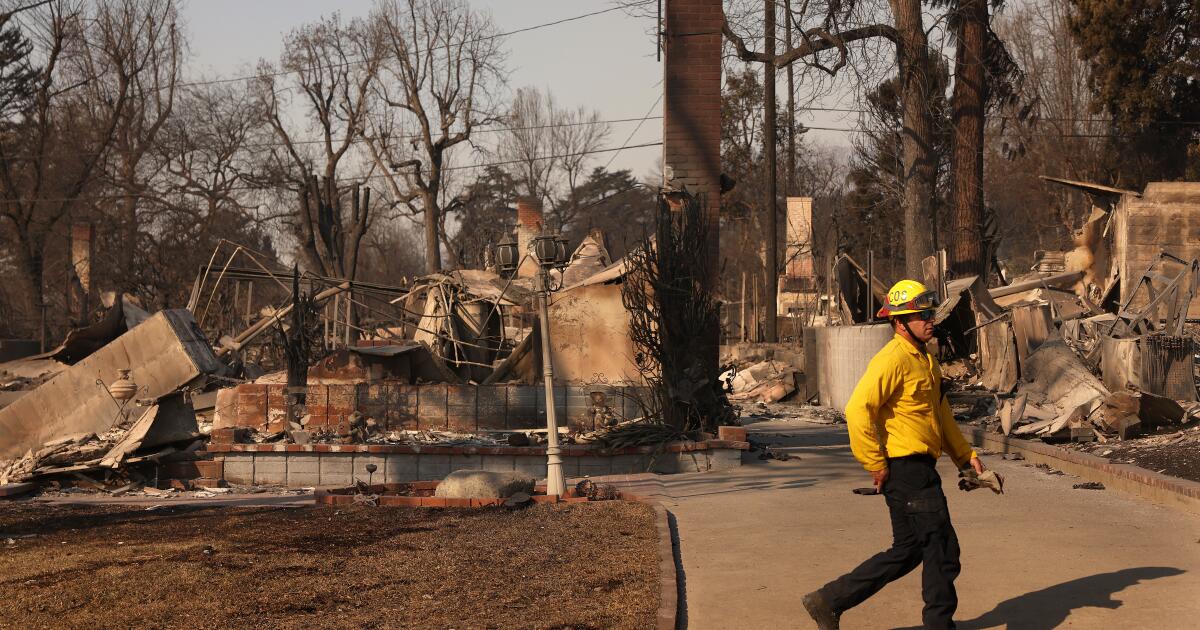
It wasn’t. The home he lived in for nearly all his life burned down Tuesday along with more than 10,000 other homes and structures damaged or destroyed in the worst fire event in the history of Los Angeles. Sixteen deaths have been confirmed countywide.
“It was surrealistic,” he said. “I’ve grown up and lived here off and on for 50 years. I’ve never in my entire time here experienced this.”
Farmers Insurance declined to comment, saying it does not discuss individual policyholders.
‘A train wreck coming down the track’
Bischetti was far from the only homeowner living in Pacific Palisades, Altadena or other fire-prone hillside neighborhoods who struggled to maintain their insurance amid sharply rising costs and the decision by many insurers to reduce their exposure to catastrophic wildfire claims by not renewing the policies of even longtime customers. Many fire victims reported that insurers had dropped their policies last year.
The fires — expected to be among the costliest natural disasters in U.S. history — have deepened a crisis in the state’s home insurance market that was already reeling before the devastation came.
The state’s largest home insurer, State Farm General, announced in March it would not renew 30,000 homeowner and condominium policies — including 1,626 in Pacific Palisades — when they expired.
Chubb and its subsidiaries stopped writing new policies for high-value homes with higher wildfire risk. Allstate has stopped writing new policies, and Tokio Marine America Insurance Co. and Trans Pacific Insurance Co. pulled out of the state, though Mercury Insurance offered to take their customers.
Liberty Mutual was sued last month by a homeowner who accused the insurer of dropping her over a bogus claim that her roof had mold damage.
“Driven by a desire to maximize profits, property casualty insurance companies … have engaged in a troubling trend of dropping California homeowners’ insurance policies like flies,” said the complaint, filed in San Diego County Superior Court. A spokesperson for Liberty Mutual declined to comment on the litigation.
The inability to get coverage is reflected in the number of policies picked up by California FAIR Plan, which as of September had about 452,000 policies, up from a little over 203,000 four years ago. FAIR Plan’s website says its claims exposure is nearly $6 billion in Pacific Palisades alone.
“The situation has been a train wreck coming down the track for a while,” said Rick Dinger, president of Crescenta Valley Insurance, an independent brokerage in Glendale.
Not enough insurance money to rebuild
Peggy Holter spent decades as a television journalist, a peripatetic career that took her all over the world, but there was one place she called home and always returned to: the Pacific Palisades condo she moved into on Jan. 1, 1978. That all changed after Tuesday’s firestorm, when her condo burned to the ground along with the rest of the 36 units in the Palisades Drive complex.
Holter, 83, who only retired last year, is now facing uncertainty after she said State Farm didn’t renew her individual condo insurance, citing the condition of her roof.
But with the loss of her documents she isn’t sure if and when the policy lapsed — and she hadn’t yet secured a new carrier. The insurance typically covers personal belongings and a unit’s interior and provides benefits such as living expenses if a condo becomes unusable.
“I’m not a big keeper of things, but what I did have was a whole wall of pictures and albums of all the places I had been, family photos. I had a picture of my mother on a camel when she was 52 in front of the Sphinx,” Holter recalled. “The only thing I am concerned about is the future, because that is what you have to do.”
Her biggest question is whether she can rebuild. The homeowners association had a master policy from FAIR Plan, which totaled only $20 million. That would pay out only about $550,000 per unit if the complex were not rebuilt — far below the $1 million-plus the condos commanded in recent sales. The land could be sold off to a developer.
Holter, who is now living with her son in the Hollywood Hills, had paid off her condo.
She went back to the complex after the fires died down to get a closer look at the damage. There was nothing left of her unit, but the complex’s koi pond survived, along with the fish.
State Farm has declined to comment on its non-renewals, saying in a recent statement: “Our number one priority right now is the safety of our customers, agents and employees impacted by the fires and assisting our customers in the midst of this tragedy.”
‘We don’t cover anything in California’
Matt Knight considers himself fortunate: He and his family could have lost it all in the Eaton fire, just like Bischetti and Holter in the Palisades fire.
The trouble started last year he said when he received a notice from Safeco Insurance that the policy on his Sonoma Drive home in Altadena, where he lives with his wife and three children, would not be renewed due to a tree overhanging his garage.
The 45-year-old Covina elementary school teacher said he dutifully trimmed the tree only to be told the ivy growing on the garage also was a problem. After removing that, he said he was told he had to fix his damaged stucco, which forced him to paint his house and in the process replace his old roof. Yet he said he still couldn’t get insurance after spending $30,000 on the repairs.
A spokesperson for Safeco, a subsidiary of Liberty Mutual, said the carrier does not comment on individual policyholders.
“So we went looking company after company after company, and some of them would say, ‘No, we don’t cover anything in California.’ Some said, ‘We’re not doing any new policies.’ Some said, ‘No, we don’t do 91001 because it’s in a fire zone, and we were were like, ‘That’s crazy.’”
Just a day before his policy was set to expire last summer, Knight said he finally managed to secure similar coverage with Aegis Insurance. But in the haste to get the policy in force, the home he has lived in for 16 years was left wildly under-insured for less than $300,000. The home is valued at $1.13 million on Zillow.
The ferocious winds that fanned the Eaton fire started a power outage Tuesday evening, so Knight decided to drive his children over to his parents’ home on the other side of Altadena where they could do their homework. From there, he saw the fire start on a street hugging the mountains near what appeared to be a power line.
“Within minutes it was taken up the hillside. It was unbelievable,” he said.
His parents’ home on Roosevelt Avenue escaped the devastation, and throughout the night he drove over to check on his home. By 6 a.m., he had joined a brigade of homeowners to fight the encroaching flames on Sonoma Drive. “The whole neighborhood was there grabbing hoses and fighting fires,” he said.
In the late afternoon, he said, the water ran out for the homeowners and firefighters alike, forcing him and his neighbors to pack up and go. He was sure he would lose his home, but the winds died down.
“I think that was the ultimate good fortune,” he said, though some other neighbors were not so lucky.
Bischetti was not so lucky either.
On Tuesday, when the fires started in the hills and all of his Palisades neighbors started to pack their cars, Bischetti stayed behind to keep hosing down his property, including his lawn, roof, rafters and walls.
“I thought everything would be relatively safe,” he said. “I was sticking around trying to protect the house with water.”
He gradually started packing his car with a change of clothes, one of his guitars, tax papers, property deeds and hard drives from his computer. He left his computer itself back in the house, along with his amps, music equipment and tools.
His entire street was a ghost town by 5 p.m. By then, Bischetti had already watered down his property multiple times. It was dusty and smoky, and a voice in his head told him it was time to go. “I’m going to come back for this tomorrow,” he recalled thinking. “I don’t want to weigh down my car.”
It didn’t work out that way.
Bischetti drove near Palisades High School and saw a house on the corner of the street start to burn down. He then tried going on El Medio Avenue and drove into black smoke, with flames on both sides of his car. He started panicking and realized he couldn’t get through.
After making it to his sister’s home in Mar Vista, he found out from a neighbor that all of the homes on his block had been leveled.
Bischetti said his siblings lost family mementos and photos and he lost thousands of dollars’ worth of tools and musical instruments. They also had spent nearly $4,000 fixing up the home in order to rent out some of the rooms.
Bischetti and his family have signed up for Federal Emergency Management Agency disaster relief funds and are trying to get help with cleaning up the property, which he said could cost at least $10,000.
“I was getting ready for this,” he said of his one-man firefighting efforts. “That was the last hurrah.”


The luxury shopping center in Pacific Palisades will reopen next month after more than $100 million in renovations forced by the January 2025 wildfire that devastated the Los Angeles neighborhood.
Palisades Village will reopen Aug. 15, owner Rick Caruso announced Wednesday. The outdoor center survived the blaze that destroyed homes and other businesses but needed refurbishment to eliminate contaminants that the fire could have spread.
Crews are putting finishing touches on mall buildings after tearing them down to the studs, treating the wood and rebuilding the walls, Caruso said.
“Everybody’s working, and stores are moving their products in,” he said. “It’s a really cool feeling that people have really locked arms and are working together.”
An electrician installs lighting for a restaurant at Rick Caruso’s Palisades Village on Thursday. The shopping center is scheduled to reopen mid-August.
(Myung J. Chun / Los Angeles Times)
Pacific Palisades resident Allison Polhill, who is rebuilding the home of 30 years that her family lost in the blaze, said she is “thrilled” at the prospect of returning to the mall she used to frequent. Its comeback is a boost for the community, she said.
“Every single step that we make to reopen our commercial corridors is going to bring more people back into the Palisades,” said Polhill, who expects to move back into her home at the end of August.
A total of 6,822 structures were destroyed in the Palisades fire, including more than 5,500 residences and 100 commercial businesses, according to the California Department of Forestry and Fire Protection.
Caruso previously attributed the mall’s survival to the hard work of private firefighters and the fire-resistant materials used in the mall’s construction.
The $200-million shopping and dining center opened in 2018 with a movie theater and a roster of upmarket tenants, including Erewhon, which may be the only grocer in the heart of the fire-ravaged neighborhood when it opens.
Caruso’s company was able to fill the mall with tenants despite the long shutdown.
Palisades Village is 99% leased, with the majority of tenants returning, said Jackie Levy, chief financial and revenue officer. Nearly one-third of the shops and restaurants are new to the property.
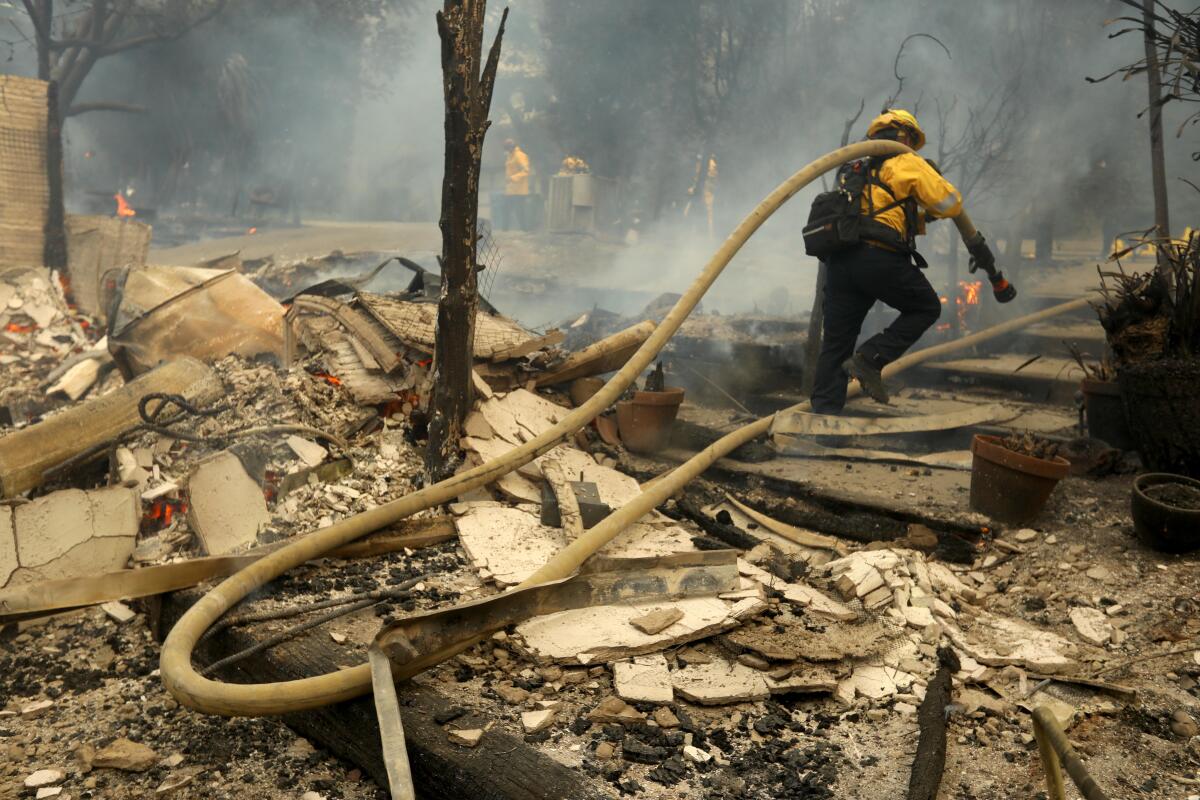
A firefighter carries a hose back to his rig while walking through a destroyed home from the Palisades fire in Pacific Palisades on Jan. 7, 2025.
(Genaro Molina / Los Angeles Times)
Last year, Pacific Palisades-based fashion designer Elyse Walker said she would reopen her eponymous store in Palisades Village after losing her 25-year flagship location on Antioch Street to the inferno.
Other neighborhood shops destroyed in the fire that are reopening at the mall include K Bakery and Loomey’s Toys, which caters to children up to age 12 and used to be across the street from Palisades Elementary Charter School.
“It’s been a journey and I’m excited because I wasn’t sure that there was going to be a place to come back to,” said toy store owner Amanda Rastegar. “Hopefully we can bring some of that magic back.”
Rastegar’s home in the Palisades survived but was damaged by the fire. The family returned about eight weeks ago. Her last memory of the fire was a burning supermarket.
“I just couldn’t wrap my brain around what was happening,” she said. “By the time I left, Gelson’s was on fire.”
Among the returning tenants is Angelini Ristorante & Bar. Well-known Los Angeles chef Gino Angelini said he will be in the kitchen next month for a return of the Italian restaurant.
“We won’t do a big celebrity open,” he said. “We want to have a very soft opening and see our customers come back.”

Construction takes place at Rick Caruso’s Palisades Village on Thursday. The shopping center is scheduled to reopen mid-August.
(Myung J. Chun / Los Angeles Times)
An elaborate celebration would not feel “correct for me,” Angelini said, because the devastation has been “very sad” for so many.
Other new tenants include local chef Nancy Silverton, who has agreed to move in with a new Italian steakhouse called Spacca Tutto. Women’s activewear retailer LESET will open its first West Coast location.
Caruso said he is optimistic that customers will return to the center, even though many Pacific Palisades residents are still dispersed. One tracking system estimated that about 30% of the Village’s customer base was impacted by the fire, he said.
“That means 70% did not get impacted, so there’s a lot of customers still left out there,” Caruso said. Historically, the center drew customers from as far away as Beverly Hills and Calabasas, as well as Malibu, Brentwood and Santa Monica.
He also hopes many will be inspired to visit the revived mall.
“I believe in the goodness of people and I believe that people are going to want to support the Palisades,” he said. “They’re going to want to be there and support the businesses that have had the courage and the heart to reopen.”

Walmart is rapidly expanding its network of electric vehicle chargers designed for customers to use while they shop.
The network could help fill gaps in EV infrastructure in states with greater need for chargers. Walmart, which has more than 5,000 locations in the U.S. and hundreds in California, says more than 90% of Americans live within 10 miles of one of its stores.
The chargers also offer an incentive for customers to choose Walmart — Walmart Plus members will receive a 10% discount off an average price of $0.46 per kilowatt-hour of energy at the company’s chargers.
Walmart chargers are already available at more than 75 locations in 17 states, with Texas boasting the most charging stations, followed by Florida and Arizona.
Matthew Nelson, Walmart’s director of energy policy, said last week on LinkedIn that the network will soon reach 29 states, including California.
“We are delivering on the promise of affordable, reliable and convenient charging,” Nelson said in his post.
According to Walmart’s website, six charging stations are coming to California soon, though the company did not offer a specific timeline.
The chargers will be installed at stores in Antelope, Brea, Fresno, Stockton, Suisun City and Vallejo.
Most charging sites in California will include eight to 16 fast-charging stalls, said Walmart spokesperson Kelsey Bohl.
The company first announced plans in April 2023 to install its own EV chargers at Walmart and Sam’s Club stores, with a goal of installing thousands of chargers by 2030. Partnering with ABB E-Mobility and Alpitronic, it added 25 new charging sites this past May and six more in June.
“Walmart is building a leading retail-integrated EV fast-charging network, focused on delivering an affordable, reliable and convenient charging experience where customers already shop,” Bohl said in an emailed statement. “Customers can charge while they shop, access stations through the Walmart app they already use, and benefit from affordable pricing.”
The charging stations already available include 612 individual charging stalls using 400-kilowatt chargers. Each stall has a dual charging cord with both Combined Charging System and North American Charging Standard connectors. The standard connectors, designed by Tesla, are smaller and lighter than the combined systems.
The primary way to pay for the chargers is through the Walmart app, but the company is also experimenting with built-in credit card readers to allow those without the app to use the stations.
Customers can check charger availability on the Walmart app. The company said the chargers will be available 24 hours a day.

Robotaxis could be turning into robocops.
A self-driving Waymo reported two teens to San Mateo, Calif., police on Monday after they were found drinking alcohol and shooting toy guns in the back of the vehicle.
According to a social media post from the San Mateo Police Department, officers detained two 15-year-olds after the Waymo they were riding in contacted the department and stopped in a parking lot until law enforcement arrived.
“Parents do you know where your teens are?” the San Mateo Police Department wrote on Facebook following the incident. “Waymo does!”
Officers removed both teens from the vehicle and determined they were using toy guns to shoot Orbeez out the windows. Orbeez are small, water-absorbing beads sold at toy stores.
“Toy guns, water guns, and BB guns all pose real dangers, especially to an untrained eye,” the Police Department said. “The simple handling of them can cause fear in [passersby].” “
A video posted on Facebook shows at least five officers and a police dog responding to the scene and approaching the Waymo with their weapons raised.
Waymo did not immediately respond to a request for comment.
Waymo vehicles have internal cameras and microphones that may be used in an emergency or to “promote safety and security,” according to Waymo’s online support page.
The cameras are also used to ensure the vehicles are clean and to help find lost items, according to the support page.
The company said it does not use facial recognition or other biometric identification technologies to identify individuals.
“In more urgent circumstances, support may access live video during a trip,” the Waymo page said.
The San Mateo Police Department’s Facebook post has garnered nearly 60 comments, with one user accusing Waymo of “snitching.”
“At least they got a designated driver?!” one user commented.
-

 Alaska2 minutes ago
Outmigration, inflation, choice schools: Alaska school closures likely to continue without changes
-
 Arizona5 minutes ago
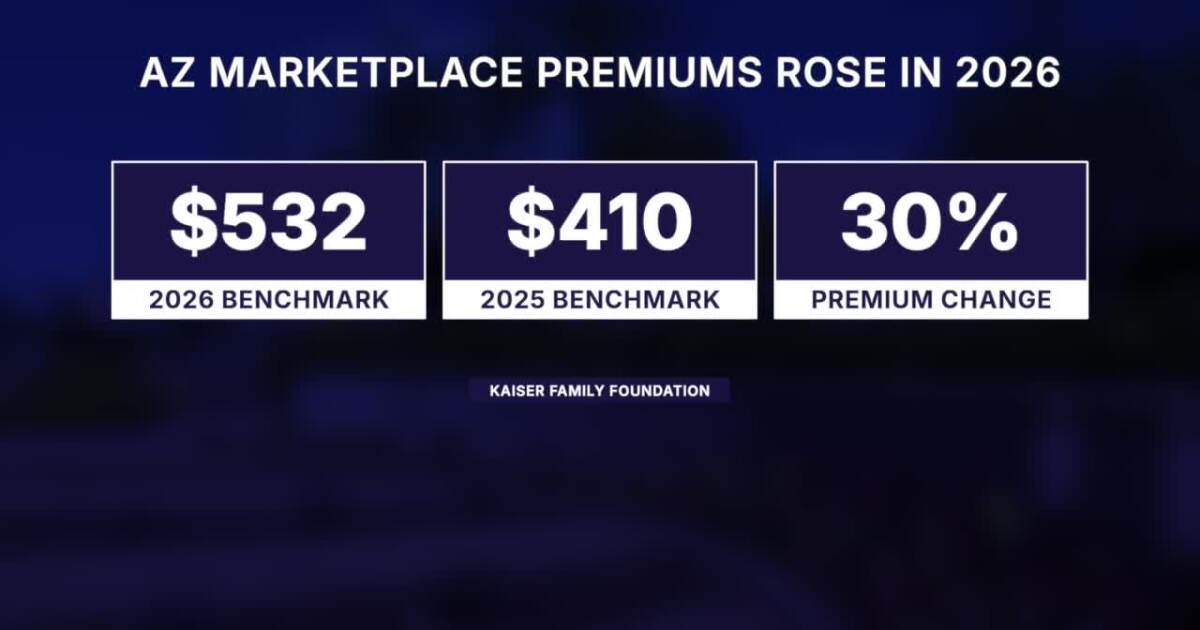
WATCH: Arizona’s health insurance marketplace is seeing dropping enrollment
-

 Arkansas10 minutes ago
ARKANSAS SIGHTSEEING: Randolph County can claim many firsts in Arkansas | Northwest Arkansas Democrat-Gazette
-

 California17 minutes ago
Toddler sustains brain injury in fall after California childcare worker threw him into the air, lawsuit says
-

 Colorado20 minutes ago
‘Saleabration’ comes back to Colorado Springs for third year
-

 Connecticut25 minutes ago
‘It’s a neighborhood effort’: Improvements made to Quinnipiac River Park
-

 Delaware32 minutes ago
Kids get hands-on learning during summer camp at Delaware County Technical School
-

 Florida35 minutes ago
Iranian drones in Cuba could threaten South Florida, officials warn

