Connect with us

Business

Column: Trump-friendly billionaires are taking aim at the federal agencies that protect workers and consumers

Published

on

Column: Trump-friendly billionaires are taking aim at the federal agencies that protect workers and consumers

“If the law is against you, talk about the evidence. If the evidence is against you, talk about the law, and, … if the law and the evidence are both against you, then pound on the table and yell like hell.”

Thus the poet Carl Sandburg’s version of an ancient lawyer’s adage in his epic poem, “The People, Yes.” It isn’t his fault that his rendering is incomplete, since he was writing in 1936 and the modern legal mind has cooked up a further advisory, applicable when the entity against you is a government agency: If pounding the table and yelling won’t succeed, then get your adversary declared unconstitutional.

That’s the weapon being wielded at this moment against the National Labor Relations Board and the Consumer Financial Protection Bureau. The first was created by Congress in 1935 to protect workers’ organizing and bargaining rights, the second in 2010 to protect consumers from ripoffs by financial service firms.

The NLRB and the courts have recognized for years that delay to a union certification and the bargaining process causes irreparable loss of support among employees.

— Teamster attorney Julie Gutman Dickinson

Advertisement

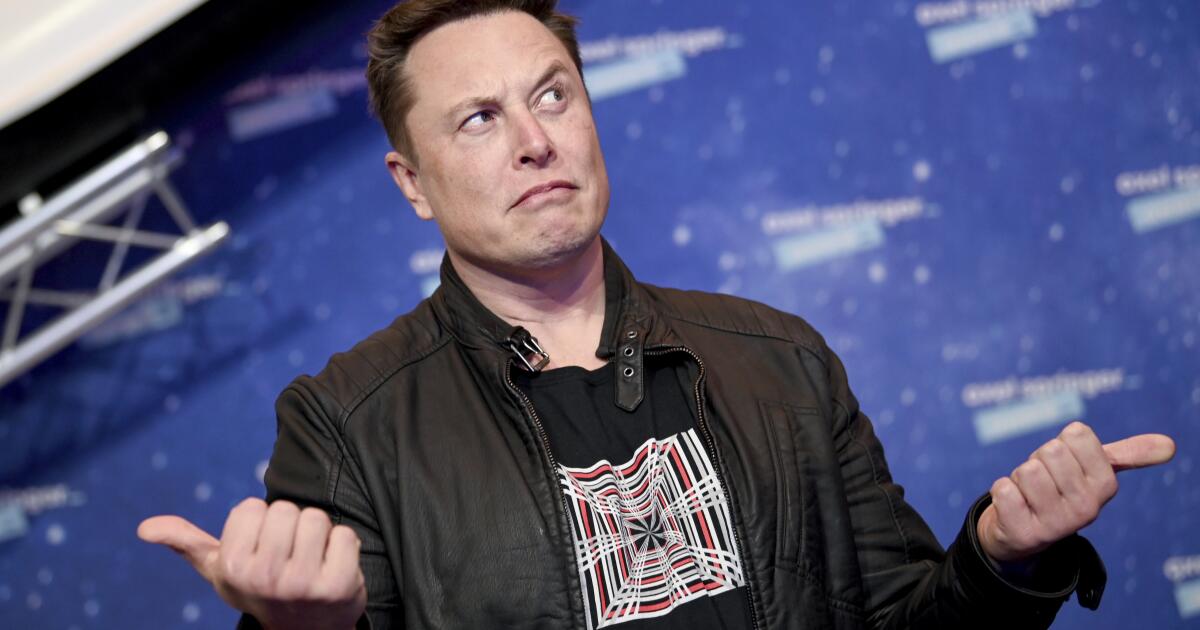
Those agencies are under assault by two of the richest men in the world: Elon Musk, who controls Tesla and SpaceX, among other enterprises, and Jeff Bezos, the founder and executive chair of Amazon. To put it succinctly, these are agencies devoted to serving the little guy by fighting battles against Big Business. Is there any mystery about why they’re targeted by billionaires?

I reported in January on the effort by SpaceX to persuade a federal judge to declare the NLRB unconstitutional.

Amazon is pursuing the same goal in its own fight with the NLRB, in which it’s trying to stave off an order that it enter into contract negotiations with 8,000 workers at a warehouse in Staten Island, N.Y. Amazon is also trying to overturn the victory in the workers’ 2022 vote by a union that subsequently affiliated with the Teamsters.

As for the CFPB, Musk on Nov. 26 tweeted, “Delete CFPB…. There are too many duplicative regulatory agencies.” He was responding to a fatuous spiel by venture investor Marc Andreessen, who in an appearance on Joe Rogan’s webcast called the CFPB “Elizabeth Warren’s personal agency, which she gets to control.” Sen. Warren (D-Mass.) conceived of the agency and pushed for its creation after the recession of 2008, but she has zero “control” over it.

Advertisement

As Helaine Olen of the American Economic Liberties Project has observed, what really sticks in Andreessen’s craw about the CFPB is that it has worked to protect consumers from financial services outfits, including fintech firms in which Andreessen, along with other Silicon Valley bros, has invested. (I asked Andreessen via his substack column to expand on his claims, but haven’t heard back.) Rogan, wearing his persona as a babe-in-the-woods naif, listened to this nonsense in slack-jawed stupefaction.

“Duplicative”? What makes the CFPB so important is that it’s virtually unique among federal agencies in possessing the explicit responsibility to protect ordinary Americans from the depredations of financial snake-oil sales forces.

In its more than 13 years of existence, the bureau has secured more than $17.5 billion in compensation and other relief for consumers mulcted by the financial services industry and built up a victims relief fund worth more than $4 billion.

Musk’s campaign against these two agencies warrants notice because of his elevated role within the coming Trump administration. Along with Vivek Ramaswamy, another right-wing activist, he has been anointed as head of a Department of Government Efficiency, with the goal of rooting out supposed sources of government waste. If Musk uses that perch to wage his personal campaign against the NLRB, that could make things, um, complicated for Trump’s nominee for Secretary of Labor, the pro-union Lori Chavez-DeRemer.

That brings us to the claims that the agencies are unconstitutional. I asked SpaceX and Amazon to comment on their lawsuits. SpaceX hasn’t replied. Amazon, through spokesperson Eileen Hards, said it filed its lawsuit raising the issue “because we believe the NLRB is acting beyond its mandate, including by having its Members serving as both prosecutors and judges on the same case. This is a clear violation of separation of powers, and furthermore, they feel emboldened to do so because they are unconstitutionally insulated from removal.”

Advertisement

The company said further that it doesn’t believe the “election process was fair, legitimate, or representative of what the majority of our team wants…. We’ll continue to use all legal avenues available to us as we believe the decision will be overturned when it’s reviewed by an unbiased court.”

The unconstitutionality charge was laid against the CFPB by payday lending firms, supported by credit unions, the U.S. Chamber of Commerce and a passel of right-wing legal organizations, which based their case on the fact that the bureau’s funding comes from the Federal Reserve rather than the U.S. Treasury.

The Supreme Court rejected that argument by a 7-2 vote in May.

The claims against the National Labor Relations Board are different. In separate lawsuits, SpaceX and Amazon assert that because the board members and the board’s administrative law judges are insulated from at-will removal by the president, it’s in violation of several constitutional principles and provisions.

SpaceX’s case arose from an NLRB accusation that it improperly fired nine employees in 2022 for publishing an open letter complaining about safety provisions at the company’s plants. union organizing activities, among other illegal acts. Its lawsuit has had a complicated procedural history.

Advertisement

SpaceX originally filed its lawsuit in federal court in Brownsville, Texas, where it had a 50-50 chance of drawing a Trump-appointed judge but where appeals go to the notably conservative 5th Circuit Court of Appeals, in what appeared to be a flagrant example of forum-shopping.

As it happened, the case came before Rolando Olvera, an Obama appointee. He didn’t think much of a Hawthorne-based company suing the NLRB, which is located in Washington, D.C., over the firings of employees who mostly worked in California. (The lone exception was an employee located in Washington but whose supervisors were in California.)

“It is undisputed that no party resides in the Southern District of Texas,” Olvera ruled. He ordered the case transferred to federal court in Los Angeles. SpaceX appealed to the 5th Circuit Court, which obligingly ordered the case returned to Texas. The case is currently held in abeyance while the appeals court ponders various issues.

Amazon filed its case against the NLRB in September in San Antonio federal court, where three of the five judges are Republican-appointees but appeals also go to the 5th Circuit, even though the company’s dispute with the NLRB involves Teamster-represented workers in Staten Island, N.Y. It was assigned to Xavier Rodriguez, an appointee of George W. Bush.

One can’t overstate the stakes in this battle for the company and the union. The Staten Island warehouse was the first Amazon facility to win a union representation campaign.

Advertisement

Amazon is seeking an injunction blocking the NLRB from “pursuing unconstitutional administrative proceedings,” asserting that the board members are “insulated from removal in contravention of Article II of the Constitution.” The NLRB’s structure, the company argues, “violates the constitutionally mandated separation of powers and Amazon’s due process rights.”

The Teamsters, which represents the Staten Island workers, sees the quest for an injunction as nothing but an effort to use the courts to delay the company’s obligation to meet the workers at the bargaining table.

“Granting the injunction would send the message to all these workers that it’s irrelevant that their bargaining representatives have been certified by the NLRB,” which creates a duty to start bargaining, Julie Gutman Dickinson, the Los Angeles labor attorney representing the Teamsters, told me.

“The NLRB and the courts have recognized for years that delay to a union certification and the bargaining process causes irreparable loss of support among employees,” Dickinson says. “The chilling effect goes far beyond the Amazon employees in the New York facility but extends to hundreds of thousands of employees across the country, many of whom are involved in organizing campaigns to seek union representation, who will see that the NLRB’s legal process is completely futile.”

Oral arguments in a second case, involving unionized drivers and dispatchers at a warehouse in Palmdale that the workers maintain is jointly operated by Amazon and a labor subcontractor, are scheduled for Dec. 18 in Los Angeles federal court.

Advertisement

The Teamsters argues that Amazon appears to be a recent convert to the idea that the NLRB is unconstitutional. For more than two years, or since the Staten island election, Amazon pursued the NLRB’s administrative process to overturn the vote.

“At no time did Amazon assert any constitutional claims or allege the NLRB or its processes were constitutionally deficient,” the union said in a legal filing. Not until September, when it was facing an order to explain why it hadn’t bargained with the union, did the company raise the constitutional question.

It’s worth noting that the constitutionality of the NLRB has already been reviewed by the Supreme Court. That happened in 1937, with a 5-4 vote (the minority votes came from the cadre of reactionary justices known then as the Four Horsemen).

The majority opinion by Chief Justice Charles Evans Hughes didn’t explicitly address the president’s authority to remove the board members at will, but he did find that the “procedural provisions” of the National Labor Relations Act, which created the NLRB, met constitutional muster.

Amazon may be right to believe that it will prevail before what it calls “an unbiased court.” If it’s referring to the Supreme Court, it’s in with a chance, given the overt hostility the current court majority has shown toward organized labor. But declaring the NLRB to be unconstitutional, some 90 years since it was created by Congress, would be a big step indeed.

Advertisement

Business

President Trump Wants to Be Everywhere, All the Time

Published

on

President Trump Wants to Be Everywhere, All the Time

To understand how Mr. Trump has achieved this omnipresence, The New York Times reviewed the first 329 days of his second term, finding at least one instance each day when he attracted the public’s attention to himself and his actions.

The review encompassed more than 250 media appearances, more than 320 official appearances, and more than 5,000 Truth Social posts or reposts. The analysis shows that while Mr. Trump has lagged his predecessors in his number of official appearances, he has pursued a raft of innovative methods to force himself into the public consciousness on a daily, and sometimes even hourly, basis.

Advertisement

The battery of activity started from the moment he was inaugurated, when he traveled from the Capitol Building to the Capital One Arena to publicly sign a flurry of executive orders.

Advertisement

Since then, he has stayed in the public eye in part by doing things no president has ever done. High-stakes Oval Office meetings, like his negotiations with President Volodymyr Zelensky of Ukraine, are held on-camera and broadcast live on global news networks. His Q.-and-A. sessions with reporters frequently last an hour or more.

Advertisement

He regularly airs his opinions – on social media, in discursive asides at rallies – about idiosyncratic subjects that range widely across the zeitgeist, from Sydney Sweeney’s sexy denim ads to the redesigned logo of the Cracker Barrel restaurant chain to the mysterious fate of the aviator Amelia Earhart, who vanished over the Pacific Ocean in 1937.

And his engagement with the news media has soared well beyond the start of his first administration.

Advertisement

Through Dec. 14, Mr. Trump took reporters’ questions on 449 occasions, compared with 223 during the same period of his first term. On average, Mr. Trump has interacted with journalists roughly twice a day, doubling his rate from 2017, according to Martha Joynt Kumar, a Towson University political scientist who tracks presidential press interactions. Mr. Trump limits which news outlets can ask questions at small events, but in sheer volume, he is the most media-accessible modern president, and far outpaces his predecessor, Joseph R. Biden Jr.

“Reporters will be in my office asking me for the president’s reaction to a breaking news story,” Karoline Leavitt, the White House press secretary, said in an interview. “And I’ll just say to them, ‘I don’t know, why don’t you ask him yourself in 30 minutes?’”

Advertisement

Finding the Cameras

President Trump’s media appearances have soared this year, more than doubling both the Biden administration’s and those of his own first term.

Advertisement

Note: Media appearances include interviews, opinion pieces, position papers, press conferences and informal Q.-and-A.s. Source: Roll Call Factbase. The New York Times

Many of his public moments go viral online, like his diatribe about restoring the name of the Washington Redskins, or the A.I.-generated video meme he posted of himself dribbling a soccer ball with Cristiano Ronaldo in the Oval Office. They take on a life of their own, rippling across social media and dissected and amplified by influencers and mass media platforms alike.

Advertisement

The result is a president whose not-so-inner monologue is injected into our daily lives in myriad ways, when we are watching TV on the weekends or idly scrolling the web – a Greek chorus for our national narrative.

“He’s the most ubiquitous president ever,” said Douglas Brinkley, the presidential historian.

The media strategy aligns with his political strategy.

Advertisement

Dating back to his years as an outspoken real estate developer and reality TV star, Mr. Trump has relished being unavoidable for comment. But at age 79, he has been outdoing his younger self. And there is a logic to his logorrhea.

Mr. Trump’s allies often speak of the political benefits of flooding the zone: pursuing so many policies, ideas, and dramatic restructurings of the normal ways of governance as to overwhelm the system. “All pedal, no brake,” as Stephen K. Bannon, Mr. Trump’s one-time adviser, has called it.

Advertisement

“We joke internally that he is our ultimate director of communications,” Ms. Leavitt said. “He has incredible media instincts, and he is the final decision maker on all policy, and he has been in a ‘flood the zone,’ ‘do as much as possible’ mindset since he walked into the Oval Office on Jan. 20.”

All presidents benefit from the awesome news-making powers of the office, with its agenda-setting influence over a dedicated global press corps. But Mr. Trump has outstripped his predecessors in whipsawing the public’s attention onto matters small and large – and limiting the level of scrutiny that any one shocking remark or policy proposal receives.

“People can really only focus on a handful of things a day,” said Bill Burton, a deputy White House press secretary under former President Barack Obama. “This attention flood is working for Trump because he is able to do an extraordinary amount of executive actions and very little of it can get attention.”

Advertisement

Or as Mr. Brinkley put it: “He plays to win the day, every day, around the clock.”

Advertisement

Advertisement

Advertisement

Advertisement

His commentary takes on a life of its own.

One of Mr. Trump’s political assets is his instinct for virality.

With a natural feel for the web, Mr. Trump has a knack for amplifying wacky memes and pop culture curios that can drive days of online discourse. Sometimes, coverage of his offhand remarks or late-night social media posts can crowd out the more significant, norm-shattering changes he is making to American governance.

Advertisement

Late one Friday night in May, the president posted an obviously A.I.-generated image of himself as the pope. It struck a nerve.

Advertisement

Mr. Trump had already courted controversy days earlier, after the death of Pope Francis on April 21.

Advertisement

“I’d like to be pope,” the president told reporters who asked about who should become the next pontiff. “That would be my number one choice.”

The comment disturbed some Catholics, who said the notion was crude and insensitive. That reaction seemed only to prompt Mr. Trump to double down, posting the A.I.-generated image to his Truth Social account days later. By the weekend it had become a cultural phenomenon, mocked on “Saturday Night Live” and called out by experts as an example of misleading A.I. content.

Advertisement

After Mr. Trump posts the A.I. image …

Advertisement
Advertisement

May 2

Trump posts A.I. image of himself as Pope

Advertisement

… some Catholics were outraged, prompting a news cycle focused on the controversy …

Advertisement

There is nothing clever or funny about this image, Mr. President. We just buried our beloved Pope Francis and the cardinals are about to enter a solemn conclave to elect a new successor of St. Peter. Do not mock us.

Advertisement

May 3

NYS Catholic Conference says “do not mock us”

Advertisement

May 3

“Saturday Night Live” covers fake image

May 3

Advertisement

Vatican asked about image, declines to comment

May 4

Advertisement

Cardinal Joseph Tobin of New Jersey criticizes image as “not good”

May 4

JD Vance defends Trump on X, calling it a joke

Advertisement

… before Mr. Trump suggested he had nothing to do with it.

Advertisement

Advertisement

5

Says “the Catholics loved it”

Advertisement

Mr. Trump, who is not Catholic, had plenty of defenders, too. They said his commentary and the A.I. image were simply jokes, part of the president’s unique comedic style.

“As a general rule, I’m fine with people telling jokes and not fine with people starting stupid wars that kill thousands of my countrymen,” Vice President JD Vance, who is Catholic, wrote on X.

Advertisement

In his quest for attention, the president is often aided by a cottage industry of right-wing influencers and activists who are primed to syndicate, reinforce and defend whatever content he pushes out each day. For this conservative media ecosystem, Mr. Trump’s messaging and commentary are the raw fuel that drives clicks, shares and views.

Advertisement

On June 7, the president’s visit to a raucous U.F.C. fight – complete with a “Trump dance” entrance into the arena – generated an immediate spike in online interest, including about 50,000 posts on X. Five days later, when he promoted a “Trump gold card” visa, his announcement led to roughly 30,000 posts on X.

A barrage that distracts from bad news.

One pattern in Mr. Trump’s behavior: When his administration is faced with bad news, he launches a fusillade of distraction.

Advertisement

This can take the form of outlandish, out-of-left-field claims about political opponents. Or he might weigh in on a pop culture subject far afield from Washington politics – from the ratings of late-night hosts like Seth Meyers to the physical appearance of a megastar like Taylor Swift.

The events of July 2025 offer a case in point.

Advertisement

Advertisement

As the Jeffrey Epstein files returned to the news – along with speculation that Mr. Trump might appear in them – the president embarked on a breathtaking series of tangents. Mr. Trump claimed without evidence that former President Bill Clinton had bankrolled an effort by senior intelligence officials to frame him for a crime, mused about stripping the actress Rosie O’Donnell of her U.S. citizenship, and accused the singer Beyoncé of accepting millions of dollars to endorse his erstwhile rival, former Vice President Kamala Harris.

Advertisement

On July 8, the F.B.I. said it would not declassify more Epstein files.

Advertisement

July 8

F.B.I. publishes memo about Epstein files

Advertisement

Over the following days, Mr. Trump seemed to lash out in every direction.

Advertisement

Advertisement

10

Claimed intelligence officials tried to frame him

Advertisement

10

Pushed to defund NPR and PBS

10

Advertisement

Directed ICE to arrest protesters

12

Advertisement

Threatened Rosie O’Donnell’s citizenship

15

Claimed Adam Schiff engaged in mortgage fraud

Advertisement

On July 18, the Justice Department filed a request to unseal grand jury testimony about Mr. Epstein, again raising questions about Mr. Trump’s involvement. The president promptly lobbed insults at late-night talk show hosts, dismissed the Epstein affair as “fake news” and shared fresh claims about a supposed Obama administration plot to undermine him after the 2016 election.

Advertisement

On July 18, the Department of Justice filed a request — later denied — to unseal grand jury testimony.

Advertisement

July 18

Advertisement

Request filed to unseal grand jury testimony

Advertisement

Over the following days, Mr. Trump bounced from topic to topic.

Advertisement

20

Criticized Washington Commanders name

Advertisement

Obama himself manufactured the Russia, Russia, Russia HOAX. Crooked Hillary, Sleepy Joe, and numerous others participated in this, THE CRIME OF THE CENTURY!. Irrefutable EVIDENCE. A major threat to our Country!!!

21

Called the “Russia hoax” the “crime of the century”

Advertisement

22

Called Epstein controversy “fake news”

Advertisement

22

Criticized Kimmel and Fallon

24

Advertisement

Criticized Federal Reserve chairman

On July 25, The Wall Street Journal published a major scoop: The paper had unearthed a risqué birthday letter that Mr. Trump had apparently written to Mr. Epstein in 2003. Mr. Trump responded with his attack on Beyoncé and revived his threat to revoke the broadcast licenses of TV networks. Then he announced the imminent construction of an enormous gilded ballroom at the White House, at a cost of $200 million. (He has since revised the cost upward to $400 million.)

Advertisement

Asked if there was a deliberate strategy to distract from negative news, Ms. Leavitt noted that every administration seeks to minimize unhelpful headlines.

“Yes, there have been times in which we’ve tried to do that, but also often it just happens naturally, because the president is willing to weigh in on so many subjects,” she said. “Sometimes it’s really not deliberate. It’s just him speaking his mind on whatever news cycle or news story is brought to him in that moment.”

He has added tricks to his arsenal.

Advertisement

Mr. Trump’s devotion to Truth Social mirrors the hair-trigger Twitter habit of his first term; on one recent December evening, he posted 158 times between 9 p.m. and midnight. And he has continued to appear on Fox News with certain preferred hosts.

But this year, he has added to his media arsenal by appearing in many more public spaces that fall outside of a president’s typical itinerary.

Advertisement

Mr. Trump has stopped by a Washington Commanders N.F.L. game, popped up in the New York Yankees locker room, attended the Ryder Cup golf tournament and the men’s tennis final at the U.S. Open, sat ringside at numerous U.F.C. fights, and traveled to the Daytona 500. He is the first sitting president to attend a Super Bowl. When FIFA staged the Club World Cup final in New Jersey, Mr. Trump not only attended, but joined the winning team onstage for the trophy ceremony.

The net effect is a sense of inescapability, that no corner of American life remains Trump-free – which itself amounts to a potent expression of presidential authority and command. “His power, in part,” said Mr. Burton, the former Obama aide, “comes from the attention that people give him, or that he forces on them.”

Advertisement

Advertisement

Can it ever be too much?

In the fall of 2009, President Barack Obama appeared on David Letterman’s talk show, gave interviews to CNBC and Men’s Health magazine, and made the rounds of all five major network Sunday shows. Washington was abuzz about whether he was overexposed.

Advertisement

That debate sounds quaint today. But the question of whether a president can be too visible remains open.

“The public is being desensitized” to Mr. Trump’s omnipresence, argued Mr. Brinkley, the historian. “It starts becoming blather. The enemy for Trump isn’t Democrats; it’s the public being bored with the show.”

Ms. Leavitt said that if there was a risk to his ubiquity, “President Trump would not be president right now.” She added: “He is a businessman who speaks his mind and tells it like it is, and sometimes people don’t like that. But obviously the vast majority of our country does, or else he wouldn’t be in this office.”

Advertisement

Advertisement

Advertisement

Advertisement

During Mr. Trump’s first term, the public eventually tired of his frenzied pace. And in some ways, Mr. Trump appears to be slowing down physically as he approaches his 80th birthday in June (which he will celebrate in part by staging a nationally broadcast U.F.C. fight on the White House lawn). He has appeared to doze at some Oval Office meetings, and he is holding fewer formal public events than he did at this point in 2017.

Advertisement

Still, Mr. Trump and his team have embraced the everywhere-all-at-once nature of modern media. Average Americans, busy with work and family, do not tune in for daytime news conferences or Cabinet meetings. And 6:30 p.m. newscasts and local newspapers are no longer the primary vessels by which Americans learn about their commander-in-chief.

Instead, politics now suffuses our lives as a kind of ambient noise – via TikTok videos, social media posts, YouTube talk shows and family Facebook messages – never fully separate from our leisure pursuits. “Right now the game is attention, in terms of what’s culturally breaking through,” Mr. Burton said. “The fact that so much message exists is the point.”

Advertisement

Mr. Trump has both propelled this merging of culture and politics, and continues to strategically exploit it. In December, he became the first president to personally host the Kennedy Center Honors, comparing himself onstage to Johnny Carson and musing that he would do a better job than Jimmy Kimmel.

“This is the greatest evening in the history of the Kennedy Center,” Mr. Trump told the crowd. “Not even a contest. There has never been anything like it.”

His performance will air in prime time on CBS on Dec. 23.

Advertisement

Advertisement

Photo and video sources: Graham Dickie/The New York TimesDoug Mills/The New York TimesRoll Call Factba.sePBSMauro Pimentel/Agence France-Presse — Getty ImagesKenny Holston/The New York TimesThe New York TimesAnnabelle Gordon/ReutersEric Lee/The New York TimesFoxCheriss May for The New York TimesWilfredo Lee/Associated PressMargo Martin, via StoryfulMark Abramson for The New York TimesGlobal NewsAl Drago/Getty ImagesFox NewsDave Sanders for The New York TimesPete Marovich for The New York TimesTed Shaffrey/Associated Press Show all

Continue Reading

Business

Why is Trump’s media company getting involved with nuclear power?

Published

on

Why is Trump’s media company getting involved with nuclear power?

President Trump’s media company is merging with a nuclear fusion energy firm in a $6-billion deal aimed at generating more power amid growing demand from power-hungry artificial intelligence data centers.

The merger between Trump Media & Technology and TAE Technologies could lead to one of the world’s first publicly traded fusion energy companies, the two companies said Thursday.

What is TAE Technologies?

TAE Technologies is a private company based in Foothill Ranch, Calif. It has been raising funds for commercial-scale nuclear fusion, a method of energy production that supporters say could revolutionize access to electricity. Founded in 1998, the company has built and operated five fusion reactors and raised more than $1.3 billion.

Fusion uses the same process that powers the sun to produce potentially limitless energy. Experts say it hasn’t been achieved on a large scale because the process is volatile and expensive. TAE is trying to develop the technology needed to reduce the size, cost and complexity of fusion reactors.

“Our talented team, through its commitment and dedication to science, is poised to solve the immense global challenge of energy scarcity,” TAE Chief Executive Michl Binderbauer said in a statement. “Recent breakthroughs have prepared us to… commercialize our fusion technology.”

Advertisement

What is the political history of Truth Social?

Truth Social was launched in 2022 as Trump created an alternative to mainstream social media, which was increasingly restricting and blocking his posts and profiles, as well as those of his allies and supporters. It began trading on the Nasdaq stock exchange through a 2024 merger with a special purpose acquisition company.

While most social media platforms have lifted restrictions on Trump’s posts, he still primarily posts on his own platform.

Though Trump and companies he is associated with control more than a 40% stake in the company, much of his investment is managed by others to avoid a conflict of interest during his term as president. Some analysts suggest his indirect association with a new company in a highly regulated industry could also lead to issues.

TAE will need significant investment and regulation to advance, which makes Trump’s ties a major conflict, Richard Painter, a former White House ethics lawyer in the George W. Bush administration, told the Associated Press.

“He’s jumping into this industry just like he jumped into cryptocurrency a couple of years ago,” Painter said. “Just as the United States government is gonna get all involved in it. And it’s so obvious that there’s a huge conflict of interest.”

Advertisement

Trump Media shares, which had fallen more than 80% from their 2024 peak, have skyrocketed around 50% since the deal was announced.

The company now has a market value of more than $4.5 billion.

Why are the companies merging?

The parent company of Trump’s social media site, Truth Social, Trump Media & Technology, previously had little to do with energy production. The company agreed to merge with Alphabet-backed TAE Technologies, with the aim of paving the way for easier access to abundant electricity.

The merger aims to help both companies diversify and raise more money.

It is an attempt to combine Trump Media’s “significant access to capital” with TAE’s “leading fusion technology,” the companies said in a release.

Advertisement

They plan to begin construction in 2026 on the first-ever utility-scale fusion power plant.

“Fusion power plants are expected to provide economic, abundant and dependable electricity that would help America win the AI revolution,” the release said.

The boom in popularity of AI chatbots such as ChatGPT has created a seemingly insatiable new demand for power.

The Georgia Institute of Technology says modern AI data centers use as much electricity as a small city. As AI models grow, they demand even more power.

What are the terms of the deal?

The all-stock transaction announced this week values each share of TAE Technologies at $53.89, although it is a private company. Trump Media has agreed to provide $200 million in cash to TAE upon closing, expected in mid-2026.

Advertisement

When the merger is complete, TAE and Trump Media shareholders will each own about 50% of the combined company.

Trump Media will be the holding company for TAE, TAE Power Solutions and TAE Life Sciences.

Continue Reading

Business

U.S. Space Force awards $1.6 billion in contracts to South Bay satellite builders

Published

on

U.S. Space Force awards .6 billion in contracts to South Bay satellite builders

The U.S. Space Force announced Friday it has awarded satellite contracts with a combined value of about $1.6 billion to Rocket Lab in Long Beach and to the Redondo Beach Space Park campus of Northrop Grumman.

The contracts by the Space Development Agency will fund the construction by each company of 18 satellites for a network in development that will provide warning of advanced threats such as hypersonic missiles.

Northrop Grumman has been awarded contracts for prior phases of the Proliferated Warfighter Space Architecture, a planned network of missile defense and communications satellites in low Earth orbit.

The contract announced Friday is valued at $764 million, and the company is now set to deliver a total of 150 satellites for the network.

Advertisement

The $805-million contract awarded to Rocket Lab is its largest to date. It had previously been awarded a $515 million contract to deliver 18 communications satellites for the network.

Founded in 2006 in New Zealand, the company builds satellites and provides small-satellite launch services for commercial and government customers with its Electron rocket. It moved to Long Beach in 2020 from Huntington Beach and is developing a larger rocket.

“This is more than just a contract. It’s a resounding affirmation of our evolution from simply a trusted launch provider to a leading vertically integrated space prime contractor,” said Rocket Labs founder and chief executive Peter Beck in online remarks.

The company said it could eventually earn up to $1 billion due to the contract by supplying components to other builders of the satellite network.

Also awarded contracts announced Friday were a Lockheed Martin group in Sunnyvalle, Calif., and L3Harris Technologies of Fort Wayne, Ind. Those contracts for 36 satellites were valued at nearly $2 billion.

Advertisement

Gurpartap “GP” Sandhoo, acting director of the Space Development Agency, said the contracts awarded “will achieve near-continuous global coverage for missile warning and tracking” in addition to other capabilities.

Northrop Grumman said the missiles are being built to respond to the rise of hypersonic missiles, which maneuver in flight and require infrared tracking and speedy data transmission to protect U.S. troops.

Beck said that the contracts reflects Rocket Labs growth into an “industry disruptor” and growing space prime contractor.

Advertisement
Continue Reading
Advertisement

Trending
