Connecticut
YNHH tops off largest healthcare construction project in Connecticut history


Yale New Haven Health celebrates the construction milestone on Adams Neurosciences Center.
Janice Hur & Carlos Salcerio
Staff Reporters
Janice Hur, Contributing Photographer
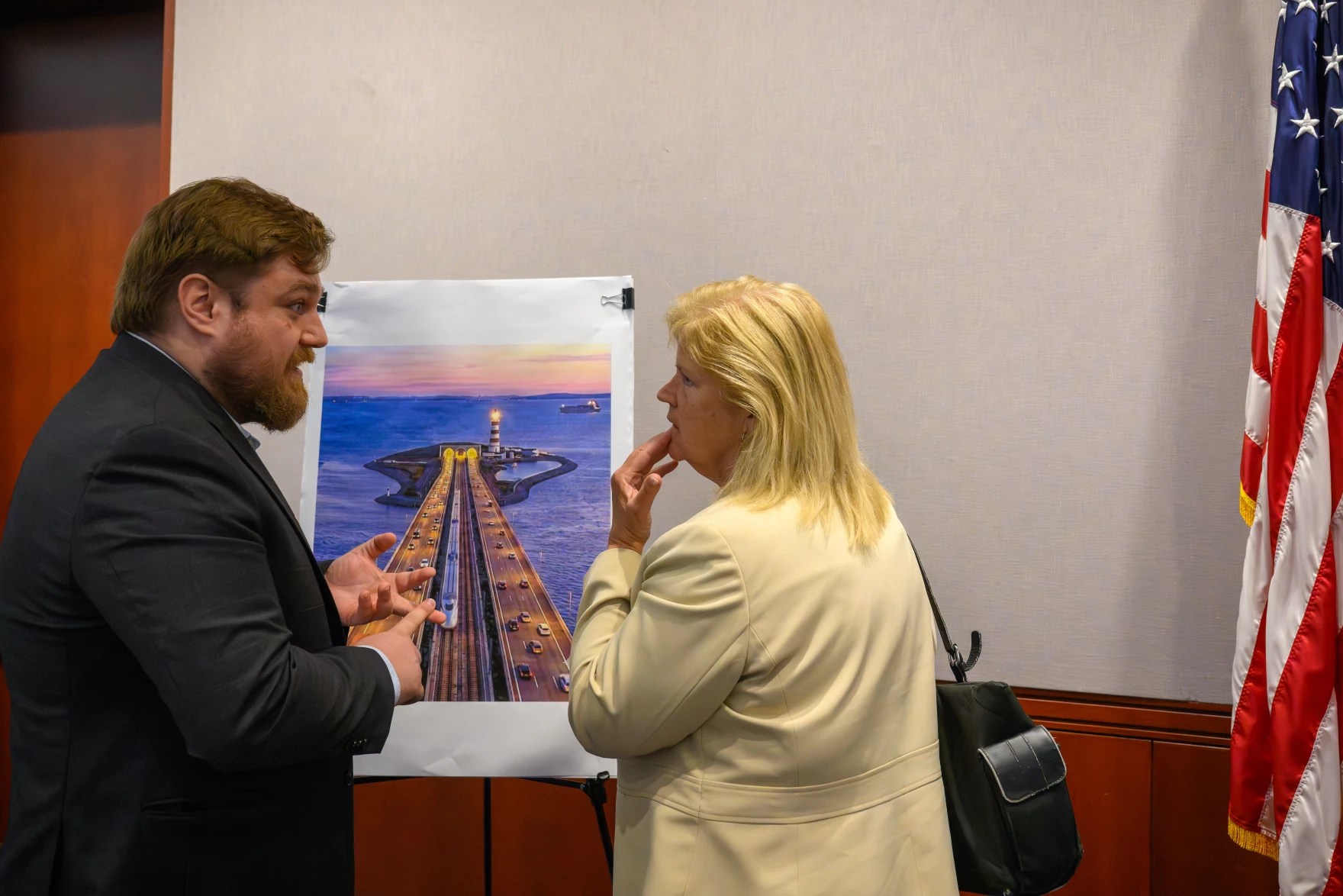
This Wednesday, Yale New Haven Health, or YNHH, ceremoniously placed the final pillar on the Adams Neurosciences Center, the largest healthcare construction project in Connecticut’s history.
The $838 million, 500,000-square-foot center, located on the Saint Raphael Campus, is scheduled to open in 2027. It will include the Neurosciences Intensive Care Unit, Neuro Rehabilitation Area and Epilepsy Center and will house 184 inpatient beds and single-patient rooms.
“Today symbolizes Yale New Haven Health’s continued commitment and investment to provide exceptional, advanced destination, neurosciences care, to serve the health needs of the communities we serve,” Dr. Katherine Heilpern, president of Yale New Haven Hospital said at the ceremony.
The new center will consist of two towers, the Sherman Tower adjacent to Sherman Avenue and the McGivney Tower built atop the existing McGivney Center. The towers will share spaces on the first through third floors.
The center will provide physicians and experts with access to next-generation technology, equipment and programs designed to help patients overcome neurological deficits.
According to Dr. Murat Günel, chief of neurosurgery at YNHH and professor of neurosurgery, the center is designed to advance the treatment of neurological ailments.
“What we’re looking to do is map individual brains [to] give really cutting-edge, precision treatment and personalized approaches to each patient for their complex neurological disorders,” Günel told the News. “So that’s the idea that, of course, starts with the infrastructure.”
According to Günel, the building was constructed with two goals in mind. One is providing holistic care for neurological disorders. The second is advancing a fundamental understanding of neurological disorders to develop treatments and harnessing the engineering insights at Yale to transform patient care.
The new center aligns with YNHH’s increased investment in the Saint Raphael Campus.
“There were a number of folks that were commenting that this would just be a peripheral campus … and it wouldn’t have a level of service that York Street has been known for,” YNHH CEO Christopher O’Connor said. “Wow, if they could see it now, a billion dollars in additional investments going on right now on this campus.”
O’Connor cited doubling the emergency department size, investing in heart and vascular technology to support the care in the tower and building a large new parking garage.
A significant part of the funding for the center came from its namesakes, Stephen and Denise Adams. As Mr. Adams struggled with Parkinson’s, he and Mrs. Adams decided to support efforts to improve care for patients with neurological conditions.
Drawing from their personal experiences, they envisioned a center to bridge the gap between research and clinic care.
New Haven Mayor Justin Elicker described the Adams Neurosciences Center as having both economic and healthcare benefits for the community.
The center promises to create hundreds of jobs in New Haven. The construction phase has already generated jobs and building permit revenue for the city. Once operational, the center is expected to create more permanent positions in healthcare and research.
In addition to economic contributions, Elicker explained, the center may also establish New Haven as a regional hub for advanced neurological care and research, reflecting broader investments in the city’s healthcare infrastructure.
“With this building, not only will you begin expanding the amount of love and care that you give to our community,” Elicker said, “but you will be researching and developing cutting-edge research to help so many more people live more fulfilled lives, and for that, we are grateful.”
The Adams Neurosciences Center will be located at 659 George St.



BRIDGEPORT — Bridgeport City Hall was closed Monday due to a power outage, officials said.
Mayor Joseph Ganim said services at City Hall, located at 45 Lyon Terrace, would be closed for the day and would reopen as soon as power was restored. The building contains many city departments, including the Town Clerk, Tax Collector, Building Department, Licensing and Permits and the Board of Education.
United Illuminating, which serves Bridgeport and more than a dozen other towns in southern Connecticut, reported 15 power outages in Bridgeport Monday morning. The outage reportedly began around 4 a.m.
The city said any residents who have payment deadlines for Monday will have an extension contingent on the reopening of City Hall.
Connecticut
Water safety expert warns of fast-changing tides as Fairfield police search for missing fisherman

Fairfield police have shifted their search for a missing fisherman into a recovery effort after he disappeared off the coast over the weekend when rising tides stranded two men on a reef near Penfield Beach.
Police identified the missing man as 34-year-old Kwahiwi Edwards of Queens, New York.
Investigators said two fishermen were on a reef off Penfield Beach on Saturday when an incoming tide quickly surrounded them, leaving them stranded. A witness saw the men in distress and helped one of them reach safety. Edwards remains missing.
As crews continue searching, a water safety expert is reminding beachgoers and fishermen to be aware of changing tide conditions along Connecticut’s shoreline.
Ben Rayner, who runs the nonprofit Water Emergency Training Incorporated, said the state’s coastline can create unpredictable water conditions.
“Because of the jagged nature and kind of irregular nature of the Connecticut coastline, you can get eddies and swirls that form with different tides,” he said.
Rayner said conditions can change rapidly, leaving people stranded in areas that were accessible only a short time earlier.
“You’re not going to be able to find your way back to the beach, which a half hour earlier looked like dry land,” he said.
According to Rayner, anyone heading to a sandbar, reef or other areas affected by tides should wear a life jacket and check tide conditions before going out.
He said several apps can help people monitor tide changes.
“There’s all sorts of apps you can download that’ll show you exactly where high tide and low tide is for where you’re at and try to time that,” he said.
-

 Technology5 minutes ago
Smart street sensors could be watching your city next
-
 Business12 minutes ago
Meet the Beverly Hills jeweler who crafted the Seattle Seahawks’ Super Bowl ring
-
Entertainment14 minutes ago
Jelly Roll and Bunnie XO are calling it quits: Country star files for divorce
-
 Lifestyle20 minutes ago
Her water bill was ‘insane.’ So she tore out her lawn and planted a ‘wabi-sabi’ wonderland
-
 Politics27 minutes ago
Commentary: Trump goes after Newsom’s wife? Unsurprising, but also a new level of authoritarianism
-
 Science30 minutes ago
Californian is infected with rare tick-borne illness. What to know about the deadly bacteria
-
 Sports35 minutes ago
Miguel Rojas’ tiebreaking homer propels Dodgers to series-opening win over Rays
-

 World45 minutes ago
Video. WATCH: Bolton says Trump played like violin by Iran

