The stars of the Latvian animated movie ‘Flow.’
Sideshow/Janus Films


And a pussycat shall lead them! Flow, the animated film that’s Latvia’s submission for the Best International Feature Oscar, kicks off with a beautiful moment of tranquility: A small, black feline, staring wide-eyed at itself in a rippling puddle. It’s somewhere in a forest, surrounded by foliage, and the ambient sounds of nature fill the soundtrack. A rabbit runs by, momentarily startling the cat. It’s soon followed by a pack of dogs, chasing the bunny and barely registering the meowing bystander’s existence. The creature will eventually amble up to a house with a cracked attic window, slipping inside for an early afternoon nap.
It’s all very soothing, giving you the sense that you’re watching the animation equivalent of ASMR. Then, after some business involving a stolen fish, our furry little friend finds itself in the same patch of green earth as before. Once again, the dogs sprint past it. This time, however, they’re followed by a thundering herd of deer. The animals appear to be running away from something. In the background, the trees begin to violently sway back and forth. And then, a huge wave rushes through and washes away everything in its path, including the cat. It eventually gets back to dry land, but then the water keeps rising. And rising. And rising….
A survivalist thriller that’s designed to appeal equally to animal lovers, avant-garde-cartoon aficionados and environmental doomsayers, Flow will spend the next 80 minutes following this feline and his fellow interspecific travelers as they try to navigate the end of the world as we know it. Eventually, the Golden Retriever who’d been part of that roving gang of doggy miscreants will join the freaked-out kitty on a boat they happen to spy passing by. So will a capybara, a lemur and a secretarybird. When the cat falls overboard and can’t paw its way back to the surface, it’s rescued from drowning by the opportune passing of a mammoth humpback, who catches the animal on its nose and breaches just in time. Saved by the whale! One life down, eight to go — although given the obstacles it will continually face, you worry that this resourceful lil’ buddy will eventually run through all of them before the day is over.
Director Gints Zilbalodis may be gathering an admittedly adorable posse of all creatures bright and beautiful, each of them rendered in a gorgeous, sometimes crude style of animation that would be best characterized as Early PlayStation Cut-Scene Chic. But in terms of storytelling, he’s going a specifically anti-Disney route here, and this road less traveled makes all of the difference. There’s no dialogue, at least none decipherable to human ears — everything is a symphony of meows, woofs, squawks, grunts, squeaks, squeals and simian cries. With the possible exception of one act of heroism late in the film, none of the animals are anthropomorphized. They more or less act in accordance with their IRL counterparts. There is no identification regarding where this is taking place — some of the stunningly detailed backgrounds suggest Angkor Wat, others bear a striking resemblance to Venice — though the predominance of both medium-sized and massive cat statues suggest it’s some sort of SPCA-sponsored sanctuary city. No explanation is given as to where the humans have gone. No explanation is given as to why a biblical flood is threatening to destroy it all, though for anyone who’s cared to keep their eyes open and their heads out of the sand, no explanation is necessary.
The stars of the Latvian animated movie ‘Flow.’
Sideshow/Janus Films
There’s little to no hand-holding — and/or paw-, talon-, or hoof-holding — in Flow. There’s simply making sure you keep your nose above water. There’s another enigmatic sequence that occurs as Zilbalodis ushers us into the third act, in which some sort of cosmic force grants one of these critters what appears to be a last-minute reprieve from terra firma. But the real takeaway is that we have to rely on each other for salvation. And it’s here where this experiential experiment in empathy, eco-activism and elation over the creative possibilities of a medium too often hijacked to sell toys truly hits its marks. Most of these animals either show up with or encounter a group of their fellow species (monkeys, dogs, birds). Most of them are abandoned or rejected by their peer groups, thanks to tribalism or simple self-preservation. The one moment in which these four-legged beasts resemble their furless, featherless two-legged neighbors is when several of them abandon a rescue mission midway through because of a passing distraction. Ain’t that just like a Homo sapien?
Yet this disparate band somehow manages to endure, and though you can’t accuse Flow of having a happily-ever-after ending, it somehow does go out on a optimistic note — a water-logged Planet Earth half empty, rather than half-fully ruined. There is a reprise of that lovely opening shot, basking in a calm before the inevitable storm to come. The movie ends as it begins, with no easy solution in sight. Only now we see a makeshift community staring back at themselves, no one alone, everyone companions in the apocalypse. It’s a timeless moral. And yet, at this particular moment, for many of us staring down the next four years, the idea that a community can come together to take on the rising tides couldn’t be more welcome or needed.


Speaking about the abortion storylines of the 2010s, a media researcher remarks on how “divorced” Hollywood seemed from the “political reality” of the era.
On our shows, from Parenthood to Private Practice to Better Things, characters were freely exercising their right to choose, with support from sympathetic loved ones and reassuring medical professionals. Meanwhile, out in the real world, the rising Tea Party were passing a “tidal wave” of ever-tightening restrictions, turning those same scenes into increasingly inaccessible fantasies.
Hollywood Does Abortion
The Bottom Line A galvanizing start to a long-overdue conversation.
Venue: Tribeca Festival (Spotlight Documentary)
Directors: Barbara Attie, Janet Goldwater, Mike Attie
Screenwriter: Jamie Boyle
1 hour 36 minutes
Hollywood Does Abortion, premiering at Tribeca, aims to close that gap. Combining news footage, expert interviews and a dizzying array of film and TV clips, the documentary makes the case for the inextricable relationship between pop culture and politics, each side shaping the other. If it necessarily prioritizes breadth over depth, its sharp insights make for a galvanizing start to a long-overdue conversation.
It helps that despite the often dispiriting subject matter, Hollywood Does Abortion, directed by Janet Goldwater, Barbara Attie and Mike Attie, is a surprisingly easy watch. The pacing is brisk but never hurried, and its leaps between eras or topics never feels difficult to follow, thanks to writer-editor Jamie Boyle’s well-organized narrative flow. Statistics are trotted out judiciously to make a clear statement, rather than thrown at us willy-nilly.
The talking heads include academics and activists as well as creatives like Crazy Ex-Girlfriend creator Rachel Bloom and Dirty Dancing writer Eleanor Bernstein, and the film allows both their expert knowledge and their personal perspectives to shine through. (In a pointed touch, nearly all of them are women.) In one minute, they might be thoughtfully pushing back against former President Bill Clinton’s “safe, legal and rare” line, which stigmatized the choice even as it argued for the right to make it. In another, they might be laughing at their own irritated responses to a particularly irresponsible bit of storytelling.
If abortion is often regarded as a topic so complex and controversial that even the most powerful institutions and ambitious politicians are loath to go near it, Hollywood Does Abortion makes a point of presenting it as digestible and approachable.
Covering half a century’s worth of storytelling about reproductive rights — from a Maude episode that aired shortly before Roe v. Wade to Blonde, which released shortly after its overturn in 2022, and beyond — it lays out in clear and cogent detail how real-world conversations are reflected in our pop culture. Which, in turn, has the power to influence public thinking and even actual legislation around certain issues, à la the Will & Grace effect.
Like how Dirty Dancing taught the generation who came up after Roe what they stood to lose if those rights were repealed, by smuggling a back-alley abortion storyline into an irresistible teen romance. Or, on the flip side, how a particularly nasty episode of Law & Order inspired by George Tiller helped to justify his murder in retrospect, by turning the fictionalized version of him into the specter of every fervent pro-lifer’s nightmares.
And even within its limited run time, the film allows for nuance: The same Dirty Dancing clips that served as a necessary reminder of an uglier past resurface in another segment discussing how the frequent depiction of abortion as physically and emotionally traumatic helped portray it as something evil.
Hollywood Does Abortion’s biggest issue, insofar as it can even be fairly described as one, is simply the overabundance of worthy topics. The filmmakers are admirable in their ambition, touching on everything from the way male characters are depicted in these storylines (often furious at not having been allowed more say) to which types of stories remain underrepresented (basically anything that isn’t about a pretty young white woman getting a medical procedure) to Hollywood’s favorite wishy-washy plot cheats (like Cristina’s ectopic pregnancy on Grey’s Anatomy, the result of ABC refusing to let Shonda Rimes depict her going through with an abortion).
However, the doc’s wide-ranging view also means touching on things is all it has time to do. Though entire essays can and have been written about some of the individual storylines mentioned here (indeed, Slate critic Dana Stevens, who wrote one about Knocked Up’s “shmashmortion” approach, gets to reiterate some of her points here), the vast majority of referenced shows and movies appear only as out-of-context clips, and even the ones subject to more thorough discussion are allowed just a few minutes at most.
But such restraint is more a virtue than a drawback of the movie, which works precisely because it’s so judicious about recognizing what fits into its scope and what doesn’t. It’s plugged in enough to bring up, say, trad wife content on TikTok — a very modern form of pop culture — but smart enough to recognize that it’s another discussion for another day. It shows enough clips of conservative commentators spewing hateful rhetoric or prominent politicians like J.D. Vance demanding “more babies” to provoke justified fury, but leaves the hardcore history lessons for other books or docs to handle.
Very consciously, Hollywood Does Abortion positions itself as part of a larger discussion rather than its entirety. And while it can be devastatingly candid about the terror of the times we live in, it offers itself up as a call to fight rather than a concession of defeat.

In 1776 South Carolina, widower and legendary war hero Benjamin Martin (Mel Gibson) finds himself thrust into the midst of the American Revolutionary War as he helplessly watches his family torn apart by the savage forces of the British Redcoats. Unable to remain silent, he recruits a band of reluctant volunteers, including his idealistic patriot son, Gabriel (Heath Ledger), to take up arms against the British. Fighting to protect his family’s freedom and his country’s independence, Martin discovers the pain of betrayal, the redemption of revenge and the passion of love.
For thoughts on The Patriot, please check out my thoughts on No Streaming Required:
The new 4K UHD Blu-Ray SteelBook of The Patriot offers a significant improvement in quality over the older Blu-Ray released in 2007, but no Blu-Ray copies of the movie are included in this package. The film was already released on 4K UHD Blu-Ray back in 2018, which I have and used to compare to this newer release. The implementation of Dolby Vision versus the strictly HDR10 of the previous release yields some incremental improvements, but the major selling point of this release is the inclusion of the Extended Cut in 4K UHD at long last, as opposed to the HD presentation in the last set. While it was believed that the unique footage in this cut could not properly be scaled up to meet 4K UHD standards, Sony has worked its magic by providing it along with the Theatrical Cut on 4K UHD, each version with its own disc.
These transfers invite a proper amount of film grain that resolves exceedingly well without being clumpy, splotchy, or unnatural. Even in the most challenging conditions, such as the smoky battlefield, the picture does not stumble with loose grain or banding, leaving you astounded by its complexity. Sony has not had any digital manipulation done to this transfer, so this disc is clear of DNR, compression artifacts, and other encoding shortcomings. The period production design is presented with tremendous clarity and depth. Skin tones appear more natural than the previous Blu-Ray with a world of fine detail apparent, especially as wounds compound on the battlefield. The costumes and other background textures within the environment are key to making this transfer feel so alive. Even the unique footage of the Extended Cut blends seamlessly with the theatrical footage, so you are in good shape no matter which version you watch.
The benefits of Dolby Vision are readily apparent, as it refines the color spectrum to achieve a more pinpoint execution of the intended hue. The black levels are a beast, always staying deep and flawless with great detail. Highlights in the film are just as brilliant, with the whites pure and balanced with no signs of blooming to be found. This is helpful with characters out under the blazing sun. There is a fair share of eye-popping colors to behold, especially within the foliage and other environmental flourishes. The rich shades within the foliage are quite impressive on all fronts. The colors are complex and completely accurate to what was intended by the creative team. Sony has come through with a pair of impeccable transfers for fans, and even those who own the previous 4K UHD might want to upgrade for the extended cut.
This 4K UHD Blu-Ray ports over the previous Dolby Atmos track, which gives the film a stellar audio experience necessary for a period epic. The disc also provides the original DTS-HD 5.1 Master Audio track that still impressive in its own right. Those who choose to utilize the original track may not engage every speaker you have, but you will be treated to an ideal experience without any obvious age-related flaws. Dialogue is nice and clear without ever getting overpowered by the music or sound effects. The score from John Williams is deeply emotional and adds so much to the experience as it flows out with peerless fidelity.
With the Atmos track, you will find the front channels commanding most of the dialogue and other primary sounds, but subtle elements consistently expand to the surrounds, rears, and overhead speakers to make things feel more three-dimensional. The sounds up above do not steal focus unnecessarily, rather allowing the world to feel more expansive. Atmospheric sound effects are precisely rendered within the mix so that directionality is never in question. The low-end effects from the subwoofer are astounding due to the intense battle sequences. Sony has not set a foot wrong with this release. Optional English, English SDH, and a plethora of other subtitles are provided.

Sony has provided The Patriot with a sleek new SteelBook featuring artwork that is truly lovely in person. Video of the SteelBook can be found at the top of this review.
Disc 1 (4K UHD – Theatrical Cut)
Disc 2 (4K UHD – Unrated Version)
The Patriot is one of the ultimate examples of pure “dad movie” bliss. You get an epic historical story that sands down any nuances to a strict moral binary that plays well for a broad audience. If you are looking for historical accuracy, you should stay far away, as this feature has strictly different goals. This movie mostly accomplishes what director Roland Emmerich strives to do with all of his movies—to entertain a mass audience. This does not always result in the most artistically rewarding endeavors, but they can be satisfying. Even with a runtime nearing three hours, the film moves along at a great pace, and the ensemble delivers in all the ways it needs to. It’s American history through a shiny Hollywood lens, but that is what you want sometimes when you rather rest your brain for a few hours. Sony Pictures has released a sterling new Limited Edition 4K UHD Blu-Ray SteelBook featuring a top-notch A/V presentation as well as a welcome assortment of special features. For the Extended Cut in 4K UHD alone, this is worth an upgrade for fans. Recommended
The Patriot is currently available to purchase on 4K UHD Blu-Ray SteelBook and Digital.
Note: Images presented in this review are not reflective of the image quality of the 4K UHD Blu-Ray.
Disclaimer: Sony Pictures Home Entertainment has supplied a copy of this disc free of charge for review purposes. All opinions in this review are the honest reactions of the author.

At the start of first-time feature director Ryuya Suzuki’s animated film Jinsei, our protagonist reveals the last time he was called by his birth name. The circumstances are tragic but in Suzuki’s unique visual style, they’re also a little funny, a little weird, and a lot interesting. Thus begins the 10-chapter tale of a man called by many names over nearly 100 years – all portrayed through truly out-of-this-world animation.
To explain in detail the film’s plot would do little to explain its appeal. Suzuki, who animated the film by himself over 18 months, told The Japan Times that there was no script to guide him, only a theme of identity. While this sort of surprise-based storytelling meant as a viewer I couldn’t predict what happened next, it made any themes other than the main overarching one impossible to parse. Jinsei’s multi-named protagonist – at times called Kuro, Se-chan, and even God (all voiced by Japanese rapper Ace Cool) – is also very aloof in tone, his cool demeanor only broken by sudden acts of violence. By the film’s midway point, there’s little concrete to hold onto within the story and there’s always a risk of floating away from the onscreen action entirely.
But that’s where the beauty of Suzuki’s animation saves what otherwise is a pretty jumbled narrative. Japanese animation, or anime, has become a staple of the international cinematic landscape, especially after OVA screenings (original video animations, usually based on manga or episodic anime shows) proved incredibly profitable for theatres post-lockdown. Yet Jinsei looks nothing like the visual explosion of a Demon Slayer The Movie: Mugen Train. Its muted color palette of gray, darker gray, and navy blue keep even the most cosmic scenes grounded in the personal interactions between characters.
Here, the inspiration Suzuki claims of live-action classics like Battle Royale, The Worst Person in the World, and Scarface shines through. The language he develops is playful yet deliberate, and most of how we emotionally engage with the protagonist and surrounding players is through striking images: a swan flying to show a dream of true freedom or bloody underwear to reveal a deeply tragic decision. Most notable, though, is how time passing is portrayed across the film’s multi-decade spanning runtime. When we’re first introduced to our protagonist in 2008, scenes luxuriate in childhood slowness – everything feels like forever even when it’s only six months – but as he grows older, time picks up the pace until at last shown as a captivating montage going too fast to ever fully appreciate.
There are many films where formulating a star “rating” feels at odds with my personal experience of the picture. How can I rate a movie where I was both dazzled and frustrated, often in the same scenes? Maybe this is just the rub when an obviously talented director has mastered one skill but hasn’t quite figured out the whole tool belt. I see so much potential in Suzuki’s skill as an image-creator, and his process with Jinsei where he created the scenes over an 18-month crunch makes for an exciting behind-the-scenes story. Is a beautiful vision enough to overwhelm the fragmented foundation its narrative stands on? Every viewer’s answer will be different. Personally? I’m interested to see where Suzuki goes next – hopefully with a script in hand.
2026, NR, 93 min. Directed by Ryuya Suzuki. Starring Ace Cool, Taketo Tanaka, Shohei Uno, Tsubaki Nekoze, Remi Tyon.
Find movie times.
This article appears in June 12 • 2026.


Stolen iPhones fuel scary passcode scam
AI is cutting hours of office work, but also creating a new kind of busywork

Review: ‘The Little Sister’ finds a young Muslim woman taking risks to show her true self

L.A. Affairs: Dating an L.A. braggart taught me a lesson in positive self-talk

House Democrats ask new ICE director to roll back policy limiting oversight visits

Warning of cuts to medical services, L.A. health officials ask state for emergency funds
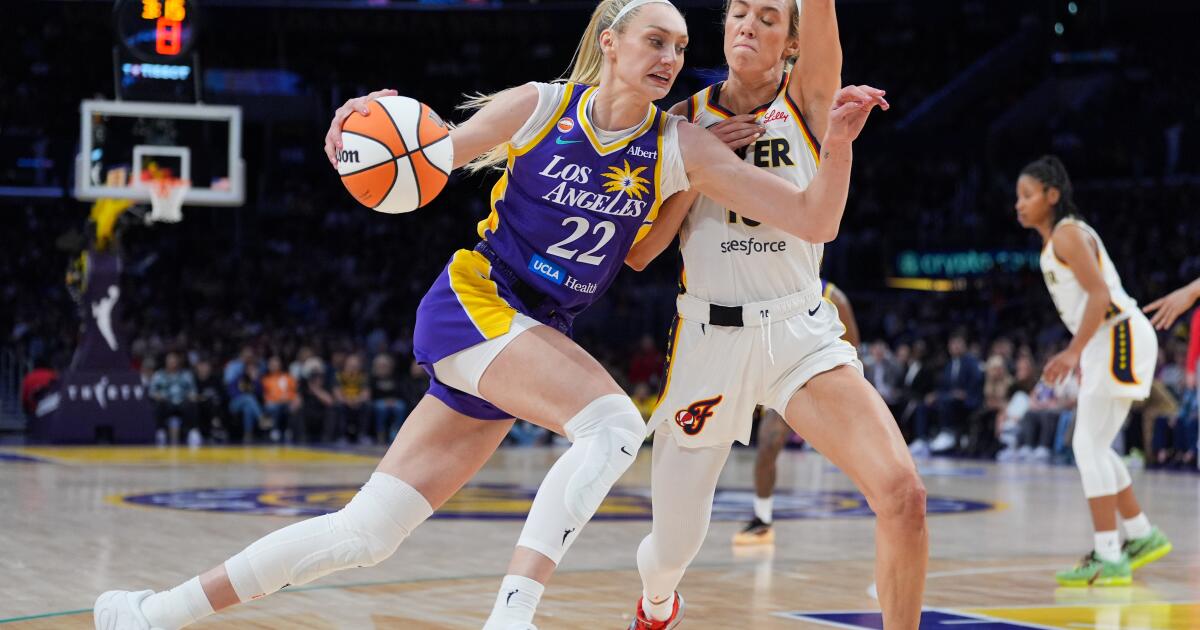
Commentary: Cameron Brink is trying to navigate a fouled-up situation


Nigeria killed more than 13,000 ‘terrorists’ in past year, president says


