Seattle, WA
Seattle Seahawks starting center Connor Williams has reportedly decided to retire immediately mid season | NFL News – Times of India


A new starting center for the Seattle Seahawks is sorely needed after Connor Williams retired from the NFL mid-season to recover from a severe knee injury he suffered playing in 2023 for the Miami Dolphins. Williams entered the league in 2018 as the No. 50 overall pick in the 2018 NFL Draft for the Dallas Cowboys, but initially started there at left guard before being benched after eight weeks. He eventually became a starting left guard after an injury to Zach Martin. Williams has played for the biggest teams in the NFL.
Connor Williams retired from the NFL mid-season to recover from a severe knee injury
Seattle Seahawks starting center Connor Williams has reportedly decided to retire immediately, the team’s coach, Mike Macdonald, told reporters on Friday. He also stated that he feels Williams will not reverse the decision and return for the Seahawks to play out this season.
Williams was drafted by Dallas Cowboys with the 50th overall pick in the second round of 2018 NFL Draft with the hope of allowing him to play guard. The Cowboys began tabbing him as the starting left guard before benching him during the first eight games in Week 10 and giving way to Xavier Su’a-Filo. He then played the next two games at right guard because of Zack Martin’s injury.
He signed a two-year deal valued at $14 million on March 17, 2022, to the Miami Dolphins. He quickly became the center and officially named a starter over Michael Deiter as the offseason program began. He played all 17 games, giving up 3 sacks and 6 penalties. He was the one player to play 100 percent of the offensive snaps with 1,057 snaps for the team.
Williams was tabbed the number one center on the depth chart coming into the 2023 NFL season; the season had officially opened on August 8. On August 29 Dan Feeney was traded to the Chicago Bears and Alama Uluave was assigned to the practice squad, so Williams came into the season as the Dolphins’ first-string center. In the Week 14 game against the Titans, he tore his ACL and was placed on injured reserve on December 13, 2023.
Also Read: NFL commissioner Roger Goodell aims to expand the NFL season to 18 games within five years
Head coach Pete McDonald said Olu Oluwatimi will take over starting center responsibilities. Seattle selected Oluwatimi in the fifth round of the 2023 NFL draft. He played one game last year and has played four snaps this season.



I caught this neighbor red-handed cleaning up the beach at Lincoln Park after last night’s … festivities…
She�…

SEATTLE, WA – JULY 4: Dominique Malonga #14 of the Seattle Storm drives to the basket during the game against the Portland Fire on July 4, 2026 at Climate Pledge Arena in Seattle, Washington. (David Ryder / NBAE / Getty Images)
SEATTLE – Carla Leite scored 20 points to lead the Portland Fire to a 77-72 victory over the Seattle Storm on Saturday night.
Leite made 4 of 8 shots and all 12 of her free throws, adding four assists for Portland (9-12). Bridget Carleton totaled 14 points and seven rebounds, while Megan Gustafson added 10 points and nine boards.
Dominique Malonga had 22 points to pace Seattle (5-17) and Natisha Hiedeman scored 15. Awa Fam had 12 points, while fellow rookie Flau’jae Johnson was held to a season-low one point.
Leite had two three-point plays to start the third quarter and Frieda Buhner came off the bench to score all nine of her points over a six-minute span as Portland turned a 32-30 halftime lead into a 54-47 advantage. Gustafson sank a 3-pointer for a 41-38 lead and the Fire never trailed again.
Emily Engstler had all nine of her points and six of her eight rebounds by halftime, helping Portland outscore Seattle 22-10 in the second period for a two-point lead at the break.
Hiedeman had nine points in the first quarter and Seattle used a 13-2 run over the final 5:27 to take a 20-10 lead before falling to 0-12 against Western Conference opponents this season.
Portland went 1-3 on a four-game trip.
Up next
Seattle: At Los Angeles Sparks on Monday.
Portland: Hosts Las Vegas Aces on Thursday.
The Source: Information in this story came from The Associated Press.
MORE STORM NEWS FROM FOX 13 SEATTLE
Kahleah Copper’s 23 points leads Mercury to 90-67 win over Seattle Storm
Flau’jae Johnson, Awa Fam lead Seattle Storm 105-90 over Dream
Flau’jae Johnson scores career-high 28 as Seattle Storm end losing streak with 99-88 win over Liberty
Seattle Storm losing streak reaches 10 with 93-73 loss to Mercury
Dominique Malonga scores career-high 28 points, but Seattle Storm lose ninth-straight 94-89 to Fire
To get the best local news, weather and sports in Seattle for free, sign up for the daily FOX Seattle Newsletter.
Download the free FOX LOCAL app for mobile in the Apple App Store or Google Play Store for live Seattle news, top stories, weather updates and more local and national news.

An exciting cross-conference WNBA matchup takes center stage on Independence Day as the Portland Fire travel north to the Emerald City to clash with the Seattle Storm at Climate Pledge Arena on Saturday, July 4, 2026, at 6:00 PM PT.
The home-standing Storm look to assert their dominance behind a balanced offensive attack led by dynamic playmaker Dominique Malonga and veteran guard Naty Hiedeman. The visiting Fire will try to play the ultimate holiday spoiler, counting on a heavy scoring punch from Carla Leite to disrupt Seattle’s defensive rhythm. To help you locate the sharpest analytical angles before tip-off, we cross-referenced our advanced game simulations with live, crowd-sourced contract data from Polymarket, the world’s largest decentralized prediction platform.
Fire vs. Storm: Matchup Overview
- Teams: Portland Fire vs. Seattle Storm
- Date: Saturday, July 4, 2026
- Time: 6:00 PM PT
- Venue: Climate Pledge Arena (Seattle, WA)
Current Betting Odds
- Spread: Storm -4.5 (+100), Fire +4.5 (-106)
- Total (Over/Under): 171.5 Points
- Moneyline: Fire +170, Storm -174
The odds and lines featured in this article are the best available from selected sports betting sites like Novig and BetMGM at the time of publication and are subject to change.
Polymarket Prediction Market Insights:
Polymarket’s liquid wagering pools offer real-time tracking of public and sharp sentiment, where contract share prices adjust fluidly to represent precise market-implied probabilities:
- Seattle Storm Moneyline (To Win): 63¢ (63% implied probability)
- Portland Fire Moneyline (To Win): 38¢ (38% implied probability)
- Storm Spread (-4.5): 50¢ (50% implied probability)
- Fire Spread (+4.5): 52¢ (52% implied probability)
- Total Points Over 171.5: 51¢ (51% implied probability)
- Total Points Under 171.5: 50¢ (50% implied probability)
(Note: Prediction market participants on Polymarket are trading the game notably closer than standard sportsbooks, pricing Seattle as a more modest 63% moneyline favorite).
Deep Betting Market Analysis & Projections
By routing raw roster efficiency matrices, player matchup data, and home-court advantages through 10,000 algorithmic simulations, our predictive engine has mapped out the highest-probability vectors for Saturday’s showdown:
1. Outright Moneyline: Seattle Storm (73.7% Win Probability)
- The Data: Our machine-learning model gives Seattle a commanding 73.7% probability to win straight up.
- The Angle: This represents a massive value gap on the prediction exchanges. While sportsbooks have priced the Storm heavily at -174, Polymarket traders are valuing Seattle shares at just 63¢. Backing the Storm moneyline contract on Polymarket provides exceptional statistical leverage over standard bookmaker juice.
2. The Point Spread: Storm -4.5 (+100)
- The Data: Simulations indicate a strong 58.0% probability that Seattle covers the -4.5 spread.
- The Angle: Our model projects a final score of Storm 88, Fire 81, indicating a seven-point victory for the hosts. Laying the 4.5 points with Seattle at even money (+100) on Novig represents an analytical edge over public sentiment.
3. Game Total: Under 171.5 Points (+106)
- The Data: The simulation baseline shows a clear 58.6% lean toward the Under.
- The Angle: Our projected combined score sits at 169 points. With Novig offering a plus-money premium of +106 on the Under, fading a high-scoring track meet provides a very comfortable mathematical cushion compared to public expectations.
WNBA Player Props: Projected Box Scores
To evaluate how the individual stars will impact the floor at Climate Pledge Arena, here is the statistical breakdown from our game simulations:
Seattle Storm Projection
- Dominique Malonga: 18 PTS, 9 REB, 2 AST
- Naty Hiedeman: 14 PTS, 2 REB, 4 AST
- Awak Kuier Fam: 13 PTS, 5 REB, 2 AST
- Flau’jae Johnson: 12 PTS, 4 REB, 2 AST
- Jordan Horston: 6 PTS, 3 REB, 2 AST
Portland Fire Projection
- Carla Leite: 15 PTS, 3 REB, 5 AST
- Brack Carleton: 10 PTS, 4 REB, 2 AST
- Megan Gustafson: 9 PTS, 3 REB, 1 AST
- Luisa Geiselsoder: 9 PTS, 5 REB, 2 AST
- Emily Engstler: 8 PTS, 5 REB, 2 AST
Fire vs. Storm Summary:
The data signals a celebratory night for Seattle fans, as the Storm are structurally positioned to handle their Pacific Northwest rivals. While backing Seattle on the flat moneyline via Polymarket yields the highest pure value, locking in Under 171.5 points (+106) provides an excellent statistical fallback play.
Remember to bet responsibly and within your financial limits. For additional resources and advice on responsible gambling, please call 1-800-GAMBLER.
Learn more about our gaming editorial staff.
If you or a loved one has questions or needs to talk to a professional about gambling, call 1-800-GAMBLER or visit 1800gambler.net for more information.
If you purchase a product or register for an account through a link on our site, we may receive compensation. By using this site, you consent to our User Agreement and agree that your clicks, interactions, and personal information may be collected, recorded, and/or stored by us and social media and other third-party partners in accordance with our Privacy Policy.
-

 Technology7 minutes ago
Mr. Lif’s Emergency Rations EP is post-9/11 hip hop at its most daring
-

 World12 minutes ago
Australian healing with ‘beautiful messages’ after losing arm to shark attack
-

 Politics19 minutes ago
Michigan Democrat Mallory McMorrow drops out of Senate race weeks before primary
-

 Health22 minutes ago
‘Tanmaxxing’ trend could come at a dangerous cost, skin cancer experts warn
-

 Sports27 minutes ago
Belgium ‘considering all possible options’ after FIFA clears Team USA’s Folarin Balogun
-

 Technology34 minutes ago
Hi Mom text scam: How to spot fake emergency texts
-
 Business37 minutes ago
‘Minions & Monsters’ tops the box office, but with a lower-than-expected haul
-
 Entertainment42 minutes ago
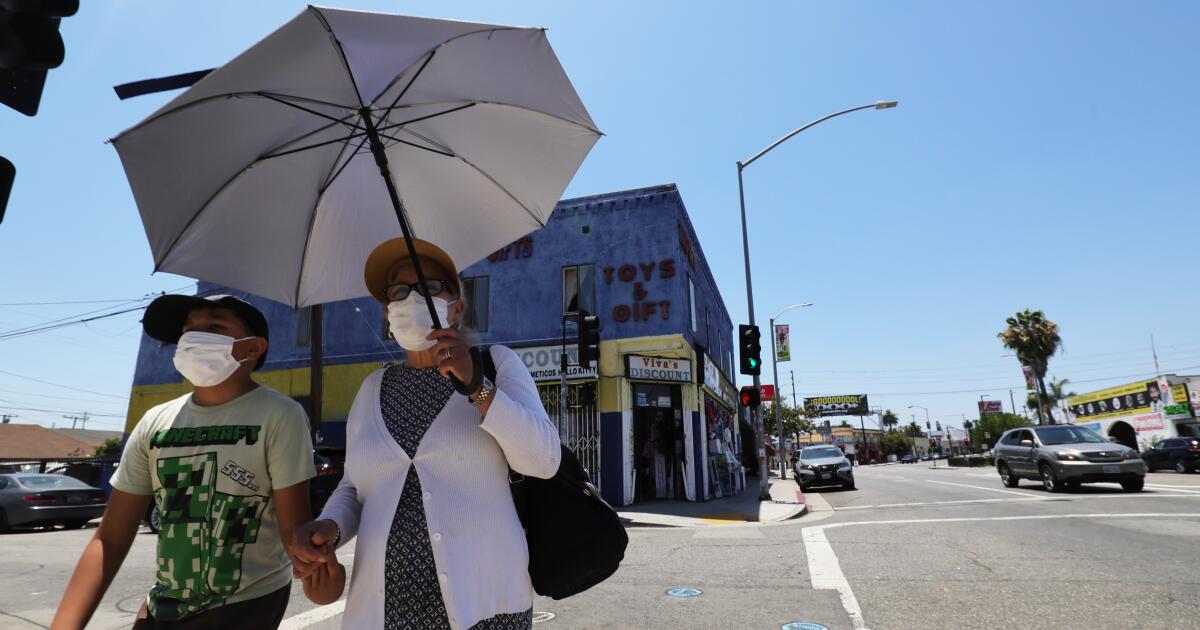
L.A. County heat advisory: When will high temperatures peak in SoCal?

