Lifestyle
Everything you need to know about the radical feminist movement that preaches 'no sex'


SEOUL — The election of Donald Trump has sparked a surge of interest in the United States in South Korea’s 4B movement, a radical feminist crusade that preaches the four B’s: bi-hon (no marriage), bi-yeonae (no dating), bi-sekseu (no sex) and bi-chulsan (no childbirth).
Since Nov. 5, there have been more than 500,000 Google searches for “4b movement,” while on TikTok, Instagram and X, support for the cause has been trending among young women voters who are vowing to swear off men.
“Ladies, we need to start considering the 4B movement like the women in South Korea and give America a severely sharp birth rate decline,” read one post on X with over 450,000 likes.
“We can’t let these men have the last laugh… we need to bite back”
“Reminder that the 4B movement, and the separatist movement in general, isn’t just about avoiding men—it’s also about supporting and investing in women,” read another.
Here’s what to know about the movement and its impact in South Korea:
What is the 4B movement and when did it come about?
While its exact origins or founder is unknown, scholars and activists agree that the 4B movement began in South Korea sometime after 2015, as part of a wider wave of youth-led radical feminism popularized through online forums.
Its emergence coincided with several major events that have fueled a wider reckoning of South Korea’s gender inequalities in the workplace and violence against women.
One of these events was the murder of a young woman in a public toilet in Seoul’s wealthy Gangnam district in 2016. The assailant, a 34-year-old male with a history of mental illness, later testified to police that he had stabbed the woman — whom he did not know — because he had been shunned by women in the past.
A woman enters a booth to cast her early vote for a presidential election at a local polling station in Seoul in March 2022.
(Ahn Young-joon/Associated Press)
The movement was spurred further by the #MeToo movement’s arrival in South Korea in 2018, the year that also saw mass public protests against the widespread circulation of nonconsensual pornography.
“For women, love, dating, marriage and childbirth were no longer perceived as refuges of peace and safety, but the site of exposure to male violence and subordination,” feminist scholar Yoon-kim Ji-young wrote in 2020, describing the 4B movement as “the complete severing of any emotional, mental, financial or physical dependence on men.”
In recent years, some adherents have expanded the movement into a variant known as 6B, which also calls for bi-sobi (no consumption of products that endorse misogyny or engage in sexist marketing) and bi-dop-bi — solidarity between unmarried women.
Despite bursts of virality and media coverage, the movement is still far from mainstream, and given its decentralized online existence, there is no concrete data on how many South Korean women actively identify as “4B.”
One of the most common ways for adherents to signal their commitment is to share social media posts with 4B-related hashtags, such as investment tips for women’s financial independence and photographs showcasing happily unmarried lives.
Some cities, Daejeon and Gwangju among them, also have 4B-themed offline communities where followers can socialize through sports, book clubs or skills-building workshops.
Some feminist scholars and activists in South Korea have criticized these lifestyle-oriented aspects of the 4B movement, arguing that individual acts of opting out ultimately do little to meaningfully advance women’s sex and reproductive rights in society at large. “At the center of young women’s commitment to 4B is the desire to focus on themselves,” feminist scholar Cho Joo-hyun wrote in 2020.
“The logical endpoint of that is becoming a successful individual in neoliberal society,”
Where does South Korea stand on gender equality?
By many gender equality metrics, South Korea lags behind much of the industrialized world.
The wage gap between men and women is the largest among the 38-member Organization for Economic Cooperation and Development (OECD), a group of wealthy countries, with South Korean women paid on average a third less than their male counterparts. In the World Economic Forum’s 2023 Global Gender Gap Index, which measures gender parity across economic opportunities, education, health and political leadership in 146 countries, South Korea is ranked 105th.
Disparities remain stark in the home as well. In households where both spouses work, women spend an average of 187 minutes a day on domestic work while men spend just under one-third of that — 54 minutes — according to government data from 2019.
Violence against women has also been criticized as an area of long neglect. Dating violence has seen a sharp increase in the country of 51 million, rising from 49,225 reported cases in 2020 to 77,150 last year, according to police. In addition, women in the country are victimized by deep-fake pornography at the highest rates in the world, according to an analysis of online content between July and August last year by U.S.-based cyber-security firm Security Hero.
In South Korea’s last election, conservative President Yoon Suk Yeol’s campaign was widely criticized for making misogynist appeals to young male voters, with Yoon denying that structural sexism exists and promising to raise penalties for false rape accusations.
Has the 4B movement managed to pull down South Korea’s birthrate?
Despite claims on social media that the 4B movement is behind South Korea’s dismal fertility rate, there is little evidence to back this up.
South Korea’s fertility rate — the average number of children a woman has in her lifetime — currently sits at 0.72, the lowest in the world and far below the 2.1 needed to maintain a stable population. Like most advanced economies, South Korea’s fertility rate has steadily been falling since 1980. Researchers have attributed its first significant dip in 2001 — to “lowest-low” levels of under 1.3 — to the labor market shocks caused by the 1997 Asian Financial Crisis.
In more recent years, rising housing and child-rearing costs as well as workplace pressures forcing women to choose between motherhood and their careers have driven the figure down even further.
And while it is true that young South Koreans are increasingly disillusioned with marriage in favor of childless or single lifestyles, these changes are not exclusive to women. Today, just 28% of South Korean women and 42% of men in their 20s see marriage as necessary, dropping from around 50% and 70% in 2008, according to government data.

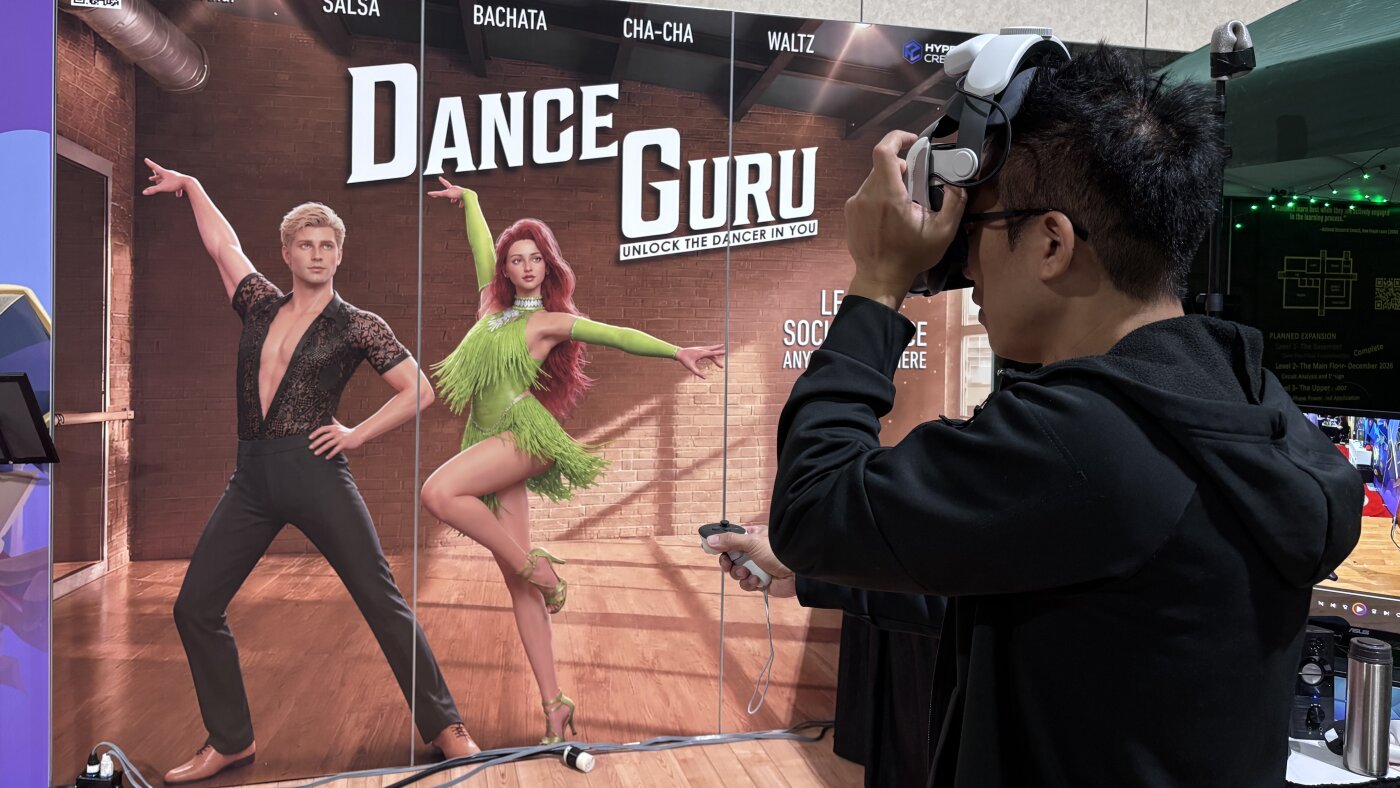
Entrepreneur David Huang tests out a VR headset while conducting demonstrations of the social dance lesson app Dance Guru at the Augmented World Expo in Long Beach, Calif., June 17, 2026.
Chloe Veltman/NPR
hide caption
toggle caption
Chloe Veltman/NPR
Wedding season is in full swing, bringing with it a familiar sense of dread for anyone who fears the dance floor.
But relief may finally be at hand with the help of a new app, Dance Guru, and a virtual reality (VR) headset.
The social dance instruction app transports users to a spacious, digital dance studio. Waiting inside is a computer-generated coach: a handsome, male avatar wearing a shirt open to his navel. He speaks with a slightly gravelly English accent.
“Watch me now,” he instructs at the start of a waltz lesson — which NPR tried out at the Augmented World Expo in Long Beach, Calif., an annual conference showcasing the latest developments in virtual and augmented reality.
The avatar then demonstrates a basic box step.

From there, the lesson becomes interactive. The coach tells the user to hold his hand while an electric pinging sound tracks the student’s foot placement.
“One, two, three, four, five, six,” the virtual teacher counts down.
When the user stumbles, he remains remarkably patient. “Do not worry, foundations take time. Let’s try that again. Work on grounding your steps more intentionally.”
Solving the beginner’s dilemma
Dance Guru creator David Huang said he came up with the idea for the app a couple of years ago out of frustration.
“I always wanted to learn to dance and I was always terrible at it,” Huang said. “And I always ended up stopping midway through the lessons.”
He soon realized that many beginners hit the exact same roadblocks.

“Private lessons are too expensive, and you feel like you’re always forgetting the dance steps,” Huang said. “You cannot find a partner to dance with. So I figured maybe I can create something like this.”
The Dance Guru platform currently offers tutorials in salsa, bachata, waltz, and cha-cha, in both lead and follow modes. To make the digital instruction feel authentic, Huang used motion-capture technology to record the movements of real-life dance teachers — with their permission.
Building on the legacy of online tutorials and video games
Dance Guru belongs to a small but growing wave of apps using VR to demystify social dance. At a nearby booth, conference attendee Victor Chen is testing out a competing app called Trip the Light. It currently offers salsa lessons, as well as freestyle options, where a user can dance with a partner without having to learn specific steps.

Trip the Light’s booth at the Augmented World Expo included posters of the app’s virtual instructors. Real-life performers, who gave Trip the Light permission to motion capture their movements, were used as a basis for these avatars.
Chloe Veltman/NPR
hide caption
toggle caption
Chloe Veltman/NPR
“A lot of times when you’re trying to learn a choreography, it’s watching a YouTube video and you have to pause it, rewind, and play it,” Chen said. “If you were to have a virtual avatar dancing in front of you and correcting for any parts that you missed, it might be a lot easier.”
Interactive video games like Dance Dance Revolution and Just Dance, and YouTube tutorials have been helping people improve their skills in private for years. But those games are mostly aimed at solo players. Unlike the new generation of immersive VR apps, they cannot simulate the mechanics or confidence required for partner dancing on a live dance floor.
The reality check
But this kind of app won’t work for every dancer.
“Everyone learns a little bit differently. And so unless you have a game that has lots of different ways of teaching, you’re going to have things that work for some people and don’t work for others,” said Ariana Katana, a trained contemporary dancer and dance content creator who’s active on YouTube, Twitch and other platforms. “Also, it’s hard to dance with a headset on.”
And then there’s the issue of not being able to physically feel a virtual partner’s hand or shoulder while dancing with them. Patrick Ascolese, the creator of Trip the Light, said the experience could become more tactile in the future. “Haptic suits and wearables will be coming, but I think we’re a little away from that,” he said.
Ascolese said even with their limitations, immersive tools like Trip the Light have immense potential as judgment-free training grounds — giving reluctant dancers the baseline confidence they need to eventually step onto the dance floor with real partners in the real world, including at weddings.
“Just like anything else, practice makes perfect,” said Ascolese. “So the more time you spend in VR with a virtual partner, it works towards helping you get over that social hurdle. We are teaching you the moves that you have to do in order to go out and have fun.”
Jennifer Vanasco edited the broadcast and digital versions of this story. Chloee Weiner mixed the audio.




For half a century, Deidre Hall has taken on every kind of disaster in the drama-packed town of Salem, Ill., as a star of “Days of Our Lives.”
There was the time — actually, it happened twice — when her character, Dr. Marlena Evans, was famously possessed by the devil and even levitated.

In Sunday Funday, L.A. people give us a play-by-play of their ideal Sunday around town. Find ideas and inspiration on where to go, what to eat and how to enjoy life on the weekends.
Or the time a serial killer, who was actually Marlena under hypnosis, seemed to kill several beloved characters. The long-running show’s storylines have become legendary, and in March, while promoting “Hail Mary,” actor Ryan Gosling even gave Hall a shout-out, admitting he was a fan, praising the hard work of soap opera actors and calling her an “OG acting inspiration.”
But Hall’s real life in Santa Monica is much quieter than her character’s, and she likes it that way.
“When I bought my house in Santa Monica, I didn’t realize how great it would be to live near Montana Avenue,” says Hall, 78, about the popular shopping spot. Every day, she walks to the main street with her golden retriever, Riley, and enjoys Pilates, art and good food along the way. “The owners of the Farms Market even keep dog biscuits, so guess where the dog wants to go every time we walk — the Farms, of course,” she says, laughing.
When she isn’t filming the daily soap opera, which airs on Peacock, Hall enjoys raising monarch butterflies, exploring the shops and restaurants on Montana, and hosting movie nights at home with her two sons.
Here’s what a perfect day in L.A. looks like for her.
This interview has been lightly edited and condensed for length and clarity.

7 a.m.: Breakfast and dog walk
I usually kick off my day with a protein shake, feed our golden retriever and take her out for a walk. She’s a phenomenal girl. When we adopted her, her name was Riley, but I did think about naming her after Mrs. Hughes from “Downton Abbey.”

10 a.m.: Church and garden time
After I walk the dog and go to church, I like to spend some time in my yard. I’m not a natural gardener, but I really enjoy it. I started raising monarch butterflies because my identical twin sister, who played my twin on the show, planted a butterfly garden. Monarchs are amazing because they are transitional. Every year, they travel from Mexico to southern New England, but it’s getting harder for them. Their numbers have dropped by about 80%. To help, I plant milkweed, which is what they need to survive. I buy my milkweed from the Staghorn Garden on Wilshire Boulevard in Santa Monica. Julie, who owns the nursery, is delightful and has a wide variety of milkweed. The monarchs always seem to find my garden. Julie was raising some caterpillars too, and she cared a lot about them. We talked about how important it is to help the butterflies. That’s why I do this. Sometimes I get milkweed with eggs already on it, and Julie knows her butterflies are going to a good home.

1 p.m.: Walk to Montana Avenue for some lunch
I live near Montana and love taking long walks, going to Pilates and trying out the great restaurants nearby, like R+D Kitchen and La La Land. I’m a big fan of the waffles at the Courtyard Kitchen. Just a few days ago, I had a chicken salad on raisin bread with an Arnold Palmer, and it was delicious. It is right on Montana and has a nice outdoor seating area. It’s one of my favorite spots. La La Land always has a long line in the morning, which is perfect if you want coffee. They serve coffee, doughnuts, croissants and avocado toast. There’s plenty of outdoor seating, and you can even bring your dog.

2 p.m.: Peek inside a clock shop
There’s a small clock shop on Montana Avenue that’s closed on Sundays, but if you walk by, you’ll see all kinds of clocks — standing, table and wall clocks. The owner is great at fixing them. Once, I bought a wall clock from MacKenzie-Childs, but it didn’t work. And I was really upset because it matched everything else on my countertop. I brought it to the owner and said, “I love this, but I can’t make it work.” He fixed it right away. His name is John, but I call him Geppetto. And we all know why. He really does have a magic touch.

2:30 p.m.: Visit a neighborhood art gallery
Ten Women Gallery is run by 10 artists, all of whom show their work there. I was drawn to some watercolors there, bought a few cards and spoke with one of the artists. She told me, “You seem to love watercolors,” and mentioned that the artist who painted them, Pamela Harnois, lives in Los Angeles and teaches nearby. I got Pamela’s name and found out she taught at the Brentwood Art School. I was so inspired by her gift that I started taking private lessons with her on Saturdays. That gallery is where I discovered my love for watercolor painting.

3 p.m.: Grab some ice cream at Rori’s
The other day, my longtime girlfriend wanted to get ice cream and told me, “We are walking to Rori’s Artisanal Creamery.” It’s a small shop on Montana near Lincoln. They make everything themselves, using local ingredients from grass-fed cows with no added hormones. The place is family-owned and probably has the healthiest ice cream you’ll find. They switch up their flavors often, but my favorite is the salted caramel.

6 p.m.: Family dinner and movie night at home
R+D Kitchen is always packed, so my sons, who are 31 and 33, do the cooking. They come over, and together we make salads and cook dinner. There’s a neighborhood grocery store called the Farms, off Montana, a small family-run place that has everything we need. Everyone knows each other there, and people bring their dogs. We try to have movie night every Sunday. Sometimes the day changes, but we always make sure to have one night a week where we cook a meal and sit down as a family. Keeping that tradition has become really important to us. My sons are great cooks, which is funny because they definitely didn’t get that from me. [Laughs]
9 p.m.: Take Riley for one last walk and visit neighbors
After dinner, I take my dog for a walk. It’s a great way to meet neighbors. We always go around the same block. We’ve met so many people, and since she’s a golden retriever, she loves meeting everyone.

10 p.m.: News, knitting and bedtime
I am a news junkie, so I usually watch whatever is on the news before I go to bed. I have a long-standing passion for knitting. Lately, though, the news would make me drop a stitch.
For Iris van Herpen, couture is a laboratory as much as a runway. Our chief fashion critic, Vanessa Friedman, takes us inside this Dutch designer’s latest Paris show — from sci-fi-inspired gowns to an audacious attempt at a dress made of charged plasma.
-

 Ohio6 minutes ago
Has there been an explosion of chipmunks this year? Yes. Here’s why
-

 Oklahoma8 minutes ago
How Will Oklahoma Softball Benefit From SEC Revenue Distribution?
-

 Oregon14 minutes ago
Razor clam harvesting set to close soon on north Oregon Coast
-

 Pennsylvania21 minutes ago
Pennsylvania Wins “Best in Show” at The Great American State Fair – Tri-State Alert
-

 Rhode Island24 minutes ago
How Federal Hill became Rhode Island’s iconic Little Italy food hub
-

 South-Carolina29 minutes ago
Editorial: SC Legislature left DUI and THC bills for dead; DUI restrictions can be revived
-

 South Dakota36 minutes ago
South Dakota GFP Commission Holds July Meeting
-

 Tennessee38 minutes ago
Forward Chris Washington Talks First Month With Tennessee Basketball | Rocky Top Insider

