West
San Jose State trans volleyball player gets 250th kill of season as team faces safety and competition concerns

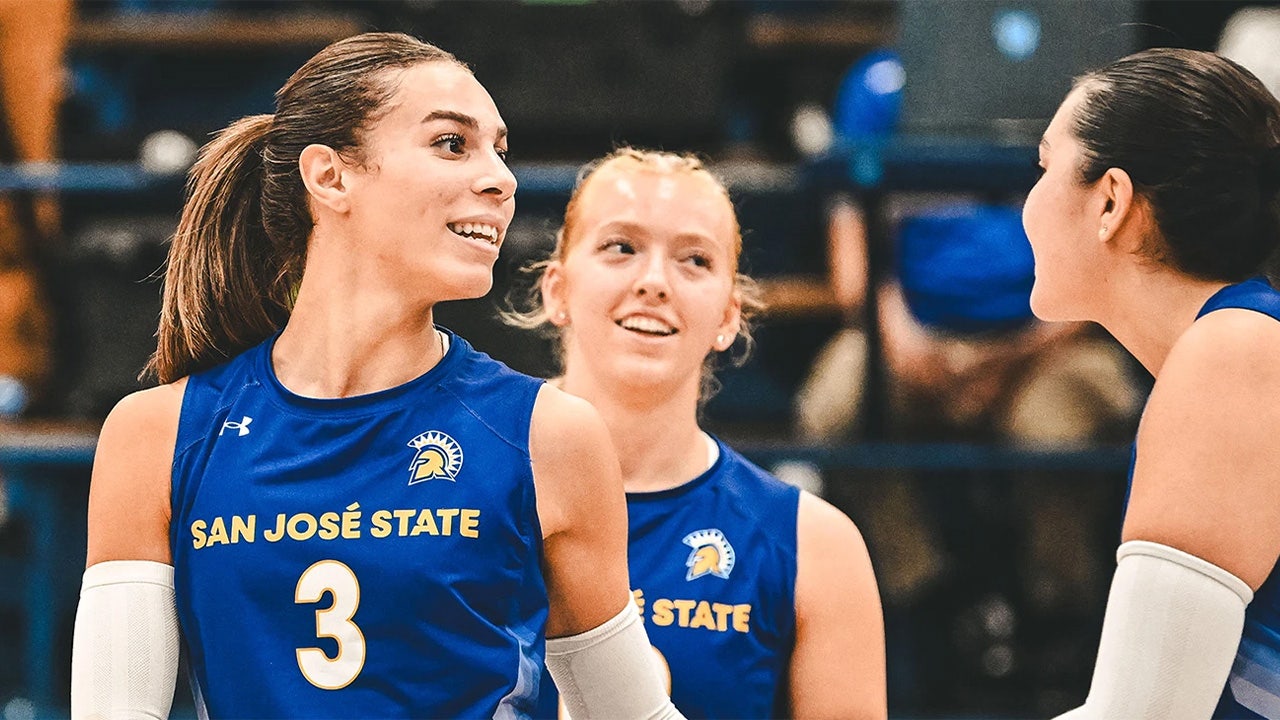
San Jose State’s women’s volleyball team lost 3-1 to San Diego State on Saturday amid an ongoing national controversy surrounding a trans athlete on the team.
Redshirt senior Blaire Fleming led the game in kills with 15, raising an individual season total to 252. It is the second 250+ kill season of Fleming’s career. Fleming previously recorded a staggering 311 kills in a debut season at San Jose State in 2022, after transferring from Coastal Carolina.
Fleming went into Saturday’s game with the third-best kills-per-serve percentage in the entire Mountain West conference with 3.76, but still well behind the conference’s leader in Colorado State’s Malaya Jones.
Fleming has racked up these numbers despite the fact that a total of seven of San Jose State’s matches have been forfeited amid the ongoing controversy. And yet, anchored by Fleming’s production, the entire team is third in the conference in kills-per-serve average and first in hitting percentage across the Mountain West.
But it is Fleming’s teammate Brooke Slusser who is anchoring the team’s top hitting percentage ranking. Slusser leads the team and is currently fourth in the entire conference with a .377 hitting percentage.
Slusser is also currently engaged in a lawsuit against the NCAA over Fleming’s presence on the team. Slusser has alleged that the university hid Fleming’s biological sex from her and teammates over the last two years since their arrival at San Jose State. Slusser also alleges that Fleming’s spikes traveled at 80 miles per hour during practice.
“Brooke estimates that Fleming’s spikes were traveling upward of 80 mph, which was faster than she had ever seen a woman hit a volleyball,” Slusser’s complaint read. “The girls were doing everything they could to dodge Fleming’s spikes but still could not fully protect themselves.”
Fleming previously set a single-game record at John Champe High School with 30 kills in a match and a single-season record of 266 kills for the school’s girls’ volleyball team.
Footage from the athlete’s Hudl page of the school-record 30-kill match in September 2019 shows how hard and fast Fleming’s spikes came down at the high school level against girl opponents.
President Trump even went out of his way to comment about footage of one of Fleming’s plays in which the player spiked a ball at San Diego State player Keira Herron in a match earlier this season.
“I saw the slam, it was a slam. I never saw a ball hit so hard,” Trump said during a Fox News town hall. “But other people, even in volleyball, they’ve been permanently — I mean, they’ve been really hurt badly. Women playing men.”
In another match against New Mexico on October 18, one of Fleming’s spikes knocked an opposing player to the ground.
The National Collegiate Athletics Association (NCAA) requires transgender women to submit documentation including testosterone levels before a decision is made on their eligibility to play. San José State has said the program is in full compliance with NCAA rules, in a statement to Fox News Digital.
Still, Fleming’s participation has brought about questions over legality at the state level and whether female athletes should share the same court and locker rooms.
Five programs have already forfeited their games against San Jose State this season, with Southern Utah, Boise State, Utah State, Wyoming and Nevada all declining to face the Spartans. Boise State and Wyoming forfeited two matches each, taking multiple loss to avoid competition against Fleming.
Questions have arisen over the potential conflict that could erupt when San Jose State competes in the Mountain West tournament at the end of November. It’s possible the Spartans would get paired up to play a team that has already forfeited against them in the regular season in that tournament.
INSIDE SAN JOSE STATE’S POLICE BATTLE TO PROTECT WOMEN’S ATHLETES THREATENED BY A TRANSGENDER CULTURE WAR
Slusser told Fox News Digital in an exclusive interview that she and her teammates are in limbo about what a potential postseason run might look like as they navigate a demoralized locker room.
“We’re just mostly wondering, are teams even gonna play us, period if we go there? Because of just everything that’s happened this season,” Slusser said. “It seems like every few days it looks like It’ll be a fine day and everything’s normal and then something else happens. So I truly do think everyone’s just kind of taking things day by day and taking the punches as they come.”
Slusser and her teammates are reeling from the recent suspension of assistant coach Melissa Batie-Smoose, who was put on leave after it was revealed she filed a Title IX complaint against the school. Batie-Smoose’s complaint alleged favoritism by the university toward Fleming over Slusser throughout the controversy.
“I feel like not just me but a lot of people are just kind of fed up and over the whole situation. And so I do think it’s caused tension in the locker room and on the court just because one person is causing all these issues,” Slusser said.
Colorado State University police behind the San Jose State University Spartans bench monitor Moby Arena during an NCAA Mountain West women’s volleyball game between the Spartans and the Colorado State Rams in Fort Collins, Colo., on Thursday, Oct. 03, 2024. (Santiago Mejia/San Francisco Chronicle via Getty Images)
The dismissal of Batie-Smoose has been a particularly jarring development for the players, as Slusser claims that she and her teammates now feel unsafe.
“After we found out that she was released, a lot of the team just kind of broke down and was kind of freaking out, and even one of my teammates was like, ‘I don’t feel safe anymore,’ because there’s no one now that we feel like we can go and talk to about our concerns or our actual feelings and can actually speak freely in front of,” Slusser said.
Slusser says she does not feel safe speaking with anyone else involved in the program, not even head coach Todd Kress.
“You can’t truly voice how you’re feeling without them just trying to cover it up or act like it’s all OK. With Melissa, you could voice how you felt, and she could comfort you and validate your feelings and at least make you feel heard compared to the other coaches,” Slusser said.
Slusser says she has not spoken with Fleming at all since joining the lawsuit. When reflecting on interactions with Fleming prior to knowing the player’s natural birth gender, Slusser admits she regrets “opening up” with the trans player in ways that she wouldn’t have had she known Fleming was a biological male.
Still, when the two players took the court on Saturday, as they have all season, they played as normal teammates would. They walked into the huddle together and patted each other on the back in between plays.
On multiple occasions in recent games, Slusser has even set Fleming up for one of Fleming’s signature spikes.
With their previously-scheduled games against Wyoming and Boise State now canceled, San Jose State only has two matches left. With a 13-4 record, Slusser and Fleming will play against Colorado State and Fresno State at home in their final two matches of the regular season.
Then their fate will rest in the Mountain West Tournament.
Follow Fox News Digital’s sports coverage on X and subscribe to the Fox News Sports Huddle newsletter.
Read the full article from Here


State and federal prosecutors in Alaska are investigating whether the campaign for a U.S. Senate candidate who has the same name as the Republican incumbent could be part of a conspiracy to confuse voters, two people with knowledge of the investigations told NBC News.
Dan J. Sullivan, a former teacher, announced his campaign in May and recently registered as a Republican. He has said he’s mounting a legitimate effort to unseat the other Sullivan, Dan S. Sullivan, who has been in office since 2015.
But Sen. Dan S. Sullivan and Republicans have alleged that the newcomer launched the campaign in an attempt to confuse voters and that he’s working with the Democratic challenger Mary Peltola.

Just this week, the Alaska Supreme Court ruled that Dan J. Sullivan can stay on the state’s August primary ballot. The state’s elections division had initially disqualified the challenger from the ballot, with Elections Director Carol Beecher alleging that the challenger filed to run “with a purpose to confuse or mislead” voters.
Now, NBC News has learned, the FBI, the Alaska attorney general and the U.S. attorney’s office in Alaska are all investigating whether two or more people conspired to create the Sullivan challenger’s campaign with the intention to confuse voters, hurt the incumbent and boost votes for Peltola.
It is possible that both the Sullivans and Peltola could all be on the November ballot, since the top four vote-getters in the Aug. 18 primary advance to the general election, regardless of party affiliation. The general election contest is then decided by ranked-choice voting.
Alaska’s Senate race will be key to the fight for Senate control in November’s midterm elections, with Democrats looking to net four seats to take control of the chamber. And Democrats have held up Peltola as a strong recruit, saying Alaska is a prime pickup opportunity, even though President Donald Trump won the state by 13 points in 2024.
One of the people familiar with the investigations said the Alaska attorney general’s office began its investigation into whether any state laws were violated before federal investigators began their probe. The federal investigation is looking for possible wire fraud or a conspiracy to deprive Alaska voters of a free and fair elections process, which could be a civil rights violation, the people said.
Sam Curtis, a spokesperson for the Alaska attorney general’s office, declined to comment on whether such an investigation exists.
“The Department of Law generally will neither confirm or deny the existence of a criminal investigation,” Curtis said in a statement. “That said, the Alaska Attorney General’s Office is not an investigating agency. Any allegations of criminal conduct is referred to federal, state, or local law enforcement.”
The people familiar with the investigation said it wasn’t clear yet who could face potential charges in either state or federal investigations, or whether that might affect the upcoming election.
U.S. Attorney Michael Hyman was appointed by the Trump administration, and acting Alaska Attorney General Cori Mills was appointed by Republican Gov. Mike Dunleavy.
In a statement, Harry Child, a spokesperson for Peltola, denied her campaign had anything to do with the rival Dan Sullivan.
“Our campaign has no involvement with either Sullivan campaign. Mary is focused on lowering costs for Alaskans, and our campaign will be connecting with Alaskans across the state to ensure their voices are heard on Election Day,” Child told NBC News.
Sen. Sullivan’s campaign declined to comment, while the challenger Sullivan’s campaign did not respond to a request for comment.
In a recent interview with The Associated Press, Sullivan, the political newcomer, denied any coordination or contact with the Peltola campaign, the state Democratic Party or any national Democratic strategists.
Spokespeople with the U.S. attorney’s office in Alaska did not respond to requests for comment.

TEMPE, AZ — The Arizona Department of Public Safety is investigating a fiery crash on the Loop 202 in Tempe on Sunday evening.
Around 5:30 p.m., DPS officials say they were called to the freeway just west of McClintock Drive for an “unknown injury collision.”
The Arizona Department of Transportation confirmed that at least one vehicle had caught fire. The westbound lanes of the freeway have been closed because of the crash.
The smoke was also impacting eastbound Loop 202 traffic.
It’s not yet clear if anyone was hurt in the crash and how severe the injuries are.
How long the traffic restrictions in the area will last is not yet known.
Want more news in your community? Add ABC15 as a preferred source on Google below:

California
Jackie and Shadow fled during Big Bear fireworks but returned to nest and eaglets the next day

Fireworks can frighten animals and send them scattering, but Jackie and Shadow’s eaglets apparently are made of sterner stuff.
Chicks Luna and Sandy were seen safe and sound Sunday morning around 6 a.m. on the popular livestream nest cam aimed at their Big Bear pine tree, snacking on fish in the family aerie.
Mom and Dad did fly off when the nearby Fourth of July holiday show promoted by tourism organization Visit Big Bear began on Saturday night, Big Bear Valley media and website manager Jennifer Voisard told the Orange County Register on Sunday morning.
But both bald eagles flew back to their nest Sunday morning to care for their eaglets, who had remained around the nest during the show.
The fireworks show has faced controversy regarding the famous avians, spawning a Change.org petition to move the festivities farther away or switch to an environmentally friendlier drone show.
More than 45,000 people signed the petition. But the show went on for the sake of the local economy.
There was particular anxiety this year among environmental advocates as the eaglets were on the cusp of flying as the event was planned. The pair took their first flights just days beforehand. They had been spotted in nearby trees but didn’t immediately return to the nest.
The nonprofit that operates the webcam, Friends of Big Bear Valley, wrote a letter to officials warning that, “whether they are still in the nest or newly fledged, they will depend on Jackie and Shadow to care for them.”
“If, as in the past, Jackie and Shadow were to flee the habitat area for a few days, this could put the eaglets in danger at this important time of their lives.”
To the relief of their fans, the parents did return.
The fireworks event is an important economic driver in a year when Big Bear saw less snow than usual during its peak winter months, the travel organization said.
“The fireworks show is a long-standing community tradition and an important economic driver for Big Bear’s local businesses, workers, restaurants, lodging properties, recreation providers, and families. That context is especially important this year after another low-to-no snow winter, which directly impacted many of our neighbors, employees, and small businesses,” Visit Big Bear said in a statement.
It said the show happens about two miles away from Jackie and Shadow’s nest and lasted only about 30 minutes.
The eagles — and occasionally their chicks — could be seen on Friends of Big Bear Valley’s livestream heading into Sunday evening.
-

 Atlanta, GA1 minute ago
Big Tigger leaving radio show after Sandy Springs arrest
-

 Minneapolis, MN8 minutes ago
Teen In Critical Condition After Water Rescue At Minnehaha Falls
-

 Indianapolis, IN11 minutes ago
Rolling Deep With Some Of Indy’s Local Motorcycle Clubs
-

 Pittsburg, PA16 minutes ago
Sinkhole closes portion of road near UPMC Passavant hospital
-

 Augusta, GA23 minutes ago
Coroner investigating inmate death from Charles B. Webster Detention Center
-

 Washington, D.C26 minutes ago
Celebration to suffocation: Washington’s air turns world’s worst after July 4 fireworks extravaganza
-

 Cleveland, OH31 minutes ago
White Sox vs. Guardians game delayed due to rain Sunday 7/05/26
-

 Austin, TX38 minutes ago
Two found dead as deputies investigate double homicide at Travis County gentlemen’s club

