Tennessee
PFF Grades: Tennessee vs. Mississippi State | Rocky Top Insider


Tennessee football took care of business with a 33-14 victory over Mississippi State on Saturday night at Neyland Stadium, overcoming a number of offensive injuries to remain at one loss on the season.
If you need a reminder on how Pro Football Focus works, read the opening of the Chattanooga grades.
Let’s see how the Vols graded out.
Elite grade = 90-100, All-Conference = 85-89, Starter = 70-84, Backup = 60-69, Replaceable = 60 >
Offensive Grades (minimum 16 plays — 20% of offensive plays)
WR Dont’e Thornton — 84.1 (35 plays)
QB Nico Iamaleava — 81.4 (41 plays)
WR Squirrel White — 78.9 (26 plays)
RB Dylan Sampson — 75.4 (55 plays)
LT Lance Heard — 63.4 (84 plays)
WR Chris Brazzell — 61.7 (55 plays)
RB Peyton Lewis — 60.3 (20 plays)
RG Javontez Spraggins — 59.8 (72 plays)
LG Jackson Lampley — 59.7 (66 plays)
TE Miles Kitselman — 58.6 (64 plays)
C Cooper Mays — 57.6 (84 plays)
WR Mike Matthews — 56.5 (16 plays)
LG Andrej Karic — 55.5 (21 plays)
WR Bru McCoy — 54.8 (59 plays)
TE Ethan Davis — 54.5 (19 plays)
QB Gaston Moore — 52.9 (43 plays)
TE Holden Staes — 52.8 (62 plays)
RT Dayne Davis — 51.9 (56 plays)
RT John Campbell Jr — 49.5 (28 plays)
It feels like a really fitting representation of this game that three of Tennessee’s four highest graded offensive players exited the game with injuries at some point. The fourth player has been banged up over the last month.
Peyton Lewis has fully passed Cam Seldon and is Tennessee’s third running back behind Dylan Sampson and DeSean Bishop. Lewis had a nice night against Mississippi State and keeps getting better.
Moore was fine in the second half and his numbers indicate that. He wasn’t great but he ran the offense at a solid rate against a bad Mississippi State defense.
More From RTI: Buckle Up, The Tennessee-Georgia Game Just Got Even Bigger on Saturday
Defensive Grades (13 plays — 20% of defensive plays)
DE Jayson Jenkins — 91.1 (26 plays)
STAR Boo Carter — 79.9 (35 plays)
LEO James Pearce — 79.7 (45 plays)
CB Jalen McMurray — 76.9 (22 plays)
S Jakobe Thomas — 76.8 (18 plays)
LB Arion Carter — 75.2 (51 plays)
CB Rickey Gibson III — 75.1 (50 plays)
DT Jaxson Moi — 74.9 (17 plays)
LB Jeremiah Telander — 72.7 (41 plays)
DE Dominic Bailey — 71.5 (42 plays)
S Andre Turrentine — 71.1 (49 plays)
S Christian Charles — 70.7 (24 plays)
LEO Josh Josephs — 68.9 (29 plays)
DT Omari Thomas — 66.6 (25 plays)
S Will Brooks — 64.2 (43 plays)
STAR Christian Harrison — 63.7 (36 plays)
DT Daevin Hobbs — 63.2 (19 plays)
CB Jermod McCoy — 61.7 (55 plays)
DT Bryson Eason — 58.5 (30 plays)
DT Omarr Norman-Lott — 56.4 (21 plays)
LB Jalen Smith — 46.8 (28 plays)
Shoutout to both Jayson Jenkins and Jalen McMurray. Two under the radar players on Tennessee’s defense who were fantastic against the Bulldogs. Jenkins strip sack early in the second half was one of the biggest plays in the entire game.
Strangely, Tennessee’s top defensive back Jermod McCoy and Will Brooks both turned in poor performances in the Vols win. It’s particularly odd given what little success Mississippi State had throwing the football in this game.
But others stepped up including freshman Boo Carter who bad the best performance of his young career against Mississippi State.



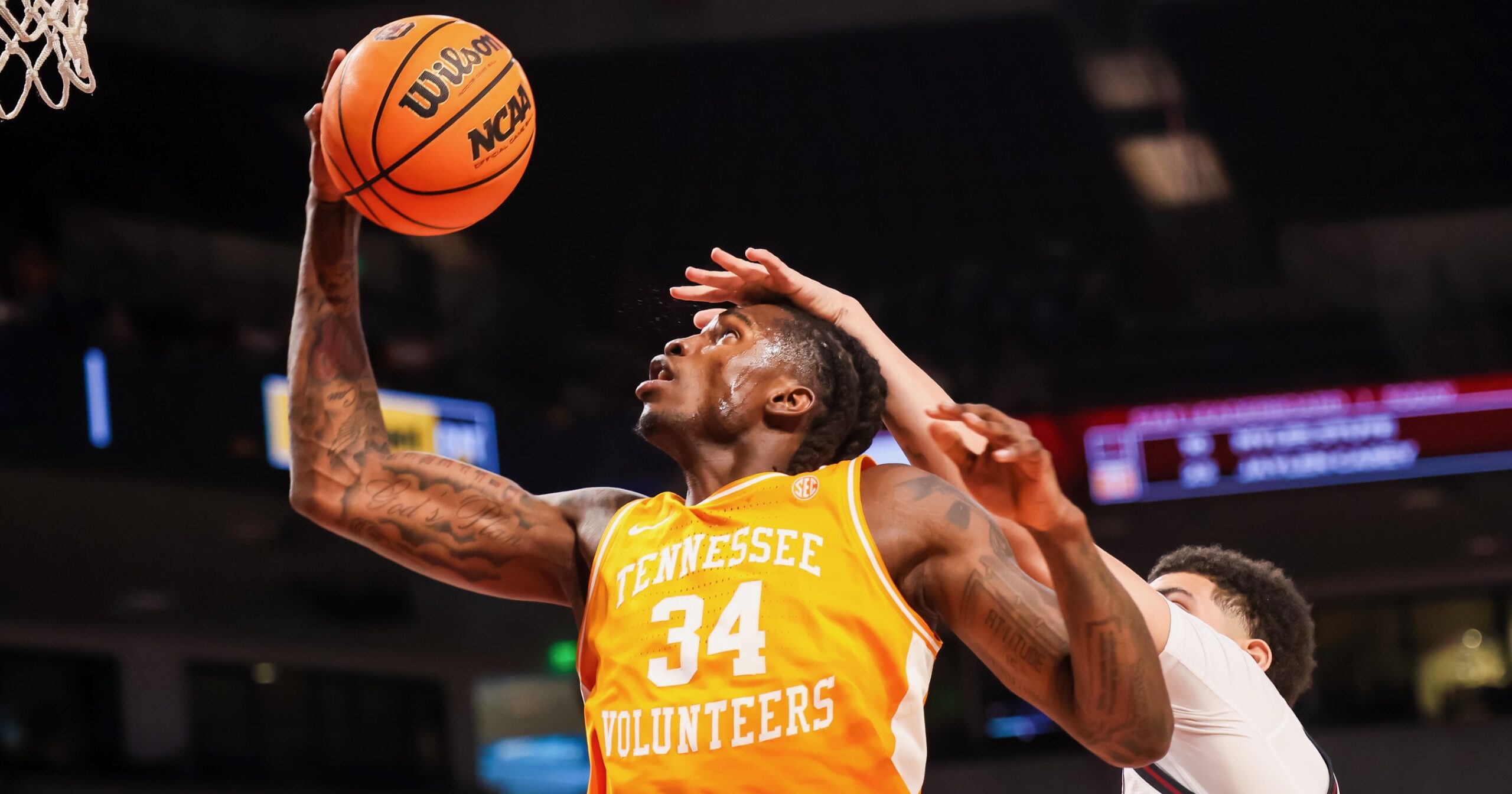
ESPN projects Tennessee basketball’s Felix Okpara and Ja’Kobi Gillespie to be picked back to back in the second round of the NBA Draft on Wednesday night. ESPN’s updated mock draft has Okpara at No. 41 overall to the Miami Heat and Gillespie at No. 42 to the San Antonio Spurs.
Nate Ament was the No. 13 overall pick in the first round to the Milwaukee Bucks on Tuesday. Tennessee, which has now had players picked in six straight NBA Drafts, could have three players drafted for just the second time in the modern era of the draft, since it went to two rounds in 1989.
Grant Williams was a first-round pick in 2019, ahead of Admiral Schofield and Jordan Bone being picked in the second round.
Where ESPN ranks Felix Okpara, Ja’Kobi Gillespie in NBA Draft
Entering the second round, ESPN has Okpara ranked as the 12th-best player available in the draft. Gillespie is ranked No. 14.
Duke guard Isaiah Evans is ESPN’s No. 1 prospect to start the second round, ahead of North Carolina center Henri Veesaar, Arkansas guard Meleek Thomas, Cincinnati forward Baba Miller, Louisville guard Ryan Conwell and German guard Jack Kayil.
Also ranked ahead of Okpara is BYU guard Richie Saunders, Houston guard Emanuel Sharp, Purdue guard Braden Smith, St. John’s forward Dillon Mitchell and Arkansas forward Trevon Brazile. Ranked between Okpara and Gillespie is Arizona guard Jaden Bradley.
Felix Okpara ‘played his way into the two-way contract mix’
Okpara averaged 8.0 points, 6.3 rebounds and 1.5 blocks in 26.9 minutes per game this season, starting 34 of 35 games. He shot 59.7% from the field, 61.1% on 2-point shots and 63.5% at the foul line.
He played two seasons at Ohio State before transferring to Tennessee and anchoring the Vols on defense, serving as the rim protector defensively and a rim runner on offense.
Okpara had the fourth-highest standing reach at the NBA Draft Combine in May at 9-foot-4. He was measured at 6-foot-10 without shoes, weighed 237.4 pounds and had a 7-2 wingspan.
“Okpara had a good predraft process,” ESPN wrote, “and played his way into the two-way contract mix as a dependable big man who chips in a little bit of value on both ends.”
Ja’Kobi Gillespie ‘profiles as a potential bench option’ in NBA
Gillespie averaged 18.4 points, 5.4 assists and 2.8 rebounds in 34.8 minutes per game while starting all 37 games in his one and only season at Tennessee.
The Greeneville, Tenn., native started his career with two seasons at Belmont, then transferred to Maryland before his homecoming with the Vols as a senior last season.
“After starting his college career at Belmont,” ESPN wrote on Wednesday, “Gillespie had good years at Maryland and Tennessee while playing his way into the NBA picture. He profiles as a potential bench option if his scoring ability can outweigh his size concerns.”

Nate Ament on Tuesday night became Tennessee basketball’s highest NBA Draft pick since Marcus Haislip in 2002 when Ament, the former one-and-done five-star freshman wing for the Vols, was the No. 13 overall pick in the first round when he was selected by the Milwaukee Bucks.
Haislip also was taken No. 13 by the Bucks.
Ament is the 13th first-round pick in Tennessee program history and the fifth under Rick Barnes. Dalton Knecht was the No. 17 overall pick to the Los Angeles Lakers in 2024, Grant Williams was the No. 22 overall pick to the Boston Celtics in 2019 and both Keon Johnson and Jaden Springer were first-round picks in 2021, with Johnson at No. 21 to the Los Angeles Clippers and Springer at No. 28 to the Philadelphia 76ers.
The Vols have had three players in program history picked in the top 10, but none since 1983.
Tennessee in the NBA Draft’s 1st Round
| Pick | Player | Draft Year | Team |
| No. 4 | Tom Boerwinkle | 1968 | Chicago Bulls |
| No. 7 | Bernard King | 1977 | New York Nets |
| No. 9 | Dale Ellis | 1983 | Dallas Mavericks |
| No. 11 | Ernie Grunfeld | 1977 | Milwaukee Bucks |
| No. 11 | Allan Houston | 1993 | Detroit Pistons |
| No. 13 | Marcus Haislip | 2002 | Milwaukee Bucks |
| No. 15 | Reggie Johnson | 1980 | San Antonio Spurs |
| No. 17 | Dalton Knecht | 2024 | LA Lakers |
| No. 19 | Tobias Harris | 2011 | Milwaukee Bucks |
| No. 21 | Keon Johnson | 2021 | LA Clippers |
| No. 22 | Grant Williams | 2019 | Boston Celtics |
| No. 28 | Jaden Springer | 2021 | Philadelphia 76ers |
Nate Ament was ranked as a top-10 prospect in the NBA Draft
Ament entered draft week ranked as both a top-10 prospect in the draft and a projected top-10 pick.
He moved up one spot in ESPN’s final NBA mock draft on Monday, going from No. 10 to the Milwaukee Bucks to No. 9 to the Dallas Mavericks. He was No. 9 overall on ESPN’s ranking of the best players available entering the draft.
“The Nets at No. 6 are seen as the high end,” Woo wrote, “but scenarios are also in play in which he falls into the second half of the lottery. Teams say he has been selective about scheduling workouts, declining to visit multiple teams in the top 10.
“The Mavericks and Bucks are two possible landing spots. If those teams go a different direction, he could slide.”
Nate Ament’s one-and-done season at Tennessee
Ament averaged 16.7 points, 6.3 rebounds and 2.3 assists in 35 games during his lone season with the Vols. He started in all 35 games he played and averaged 29.7 minutes per game while shooting 39.9% from the field and 33.3% from the 3-point line.
He was the No. 3 overall player in the 2025 class in the On3 recruiting rankings and was the No. 2 small forward in the country and the No. 1 overall player in the state of Virginia.
Ament is the highest-ranked prospect that Rick Barnes has added during his tenure at Tennessee and is believed to one of the highest-ranked recruits to sign with the Vols, alongside Tobias Harris and Allan Houston.

CHATTANOOGA, Tenn. — Chattanooga baseball fans got a different kind of scouting report during a recent night at AT&T Field, where the Tennessee Aquarium teamed up with the Chattanooga Lookouts to connect sports with conservation.
The partnership, billed as Conservation Night, brought the Aquarium’s “Animal Athletes” program to the ballpark to teach fans about wildlife and the importance of keeping trash out of waterways.
The event included live animals, interactive games and hands-on activities that highlighted how animals use specialized skills in nature.
“We know that they are here and they are passionate about sports, so let’s get them passionate about nature as well,” said Shawn Brim, community program supervisor at the Tennessee Aquarium.
Visitors learned about animals including tiger salamanders and leopard geckos, while also taking part in challenges inspired by animal behavior.

Brim said the goal was to make conservation approachable by meeting people where they are.
“The primary goal of this event is to connect people with nature, plain and simple. Here we are connecting the sports world to the animal world, highlighting those animal athletes and those special skills in nature.”
Aquarium leaders say they hope a fun experience at a game can lead to lasting conservation habits.
“We’re looking to just spark that curiosity to hopefully spark that change down the road,” Brim said.
Brim said that change matters as environmental challenges continue to affect the Tennessee Valley, with pollution and microplastics among the major concerns for local waterways and wildlife.
“As plastics enter water streams, they end up in tiny pieces, and they do end up in the stomachs of freshwater animals like catfish and sturgeons,” Brim said.
Organizers emphasized that protecting rivers and ecosystems benefits more than wildlife, supporting cleaner water, healthier communities and a stronger quality of life across the region. They also said conservation efforts can start small.
“Figure out where you can have the most impact and where you can have a consistent impact from where you are,” Brim said.
Aquarium staff say they hope fans left with more than memories of the game, taking home a deeper appreciation for the animals and ecosystems that call Tennessee home.
-
World8 minutes ago
FACT FOCUS: Norway brought its own food to the World Cup. But not because it distrusts US products
-

 Health31 minutes ago
Does Metformin Help With Weight Loss? How To Maximize Your Results
-
 Lifestyle46 minutes ago
A judge says the Kennedy Center must update him on its plans — and address that tarp
-

 Technology56 minutes ago
A new paper argues Microsoft exaggerated its quantum claims a year ago
-

 World1 hour ago
Colombia’s ‘El Tigre’ secures presidency as leftist rival finally concedes defeat
-

 Politics1 hour ago
Comer probes alleged Biden collusion with gun control activists in Glock lawsuit
-

 Sports1 hour ago
2026 World Cup Third-Place Standings: Who’s In, Who’s On The Bubble
-

 Technology1 hour ago
FCC phone ID plan could end burner phones


