Entertainment
Phil Lesh, bassist for Grateful Dead, dies at 84


Phil Lesh, the bassist for the Grateful Dead who propelled many of its wildest musical explorations yet also composed and sang one of its loveliest songs, “Box of Rain,” has died. He was 84.
An announcement on Lesh’s instagram account went out on Friday: “Phil Lesh, bassist and founding member of The Grateful Dead, passed peacefully this morning. He was surrounded by his family and full of love. Phil brought immense joy to everyone around him and leaves behind a legacy of music and love. We request that you respect the Lesh family’s privacy at this time.” No cause of death has been reported at this time.
Just this week, Lesh and the Dead’s other founders were announced as the 2025 recipients of the Recording Academy’s prestigious MusiCares Persons of the Year award in recognition of the band’s philanthropy and cultural impact. An all-star tribute concert is planned for Jan. 31 at the Los Angeles Convention Center.
A classically trained musician who harbored an affection for jazz and the avant-garde, Lesh was something of an outlier within the Grateful Dead, a group whose two lead vocalists, Jerry Garcia and Bob Weir, were grounded in folk, bluegrass and blues. A rock ’n’ roll novice when he joined the nascent Dead in 1964, Lesh helped shape the band’s psychedelic aesthetic, especially during its early days when members devoted a portion of their time to exploring the possibilities of the recording studio. Although Lesh never lost his appetite for experimentation, he also honed his skills as a songwriter as the group re-embraced its folk roots on its pivotal early-1970s albums, “Workingman’s Dead” and “American Beauty.” “Box of Rain,” a tribute to Lesh’s late father that marked the bassist’s first lead vocal on a Grateful Dead record, was the pinnacle of this period, but he also had co-writing credits on “Truckin’,” “Cumberland Blues,” “St. Stephen” and “New Potato Caboose,” all crucial parts of the Dead’s songbook.
Grateful Dead biographer David Browne wrote of Lesh, “Beneath that affable exterior lay a taskmaster and perfectionist.” During the band’s first decade of fame, those tendencies manifested in the studio — he sculpted large segments of the aural collages on their second album, “Anthem of the Sun” — and on the stage, where he was one of the vocal advocates for their Wall of Sound, an innovative concert PA system that helped set the standard for arena rock, and also drove the band toward an extended hiatus from the road in 1975. Lesh later claimed that the Dead “was wildly successful for me until we took the break from touring [in 1975]. When we came back, it was never quite the same. Even though it was great and we played fantastic music, something was missing.”
Lesh remained with the Dead through their unexpected upswing in popularity in the late 1980s and early ’90s, a revival partially fueled by the band’s only Top 40 hit, “Touch of Grey.” He nevertheless was a bit of a diminished presence in the group’s later years, and neither wrote nor sang on the group’s final two studio albums. After the Dead disbanded following Garcia’s death in 1995 — a passing that came a year after their induction into the Rock & Roll Hall of Fame — Lesh kept the group’s adventurous spirit alive through a series of musical offshoots, alternating between explicitly solo projects like Phil Lesh and Friends and teaming up with his former bandmates in the Other Ones, Furthur and the Dead. Throughout these excursions, he attempted to stay true to the band’s initial guiding spirit: “The major factor with the Grateful Dead doing what they did and what we’re trying to do still is the Group Mind. When nobody’s really there, there’s only the music. It’s not as if we’re playing the music … the music is playing us.”
Phillip Chapman Lesh was born on March 15, 1940, in Berkeley. Raised in the Bay Area by working parents, he spent many hours with his grandmother. Hearing broadcasts of the New York Philharmonic drift out of his grandmother’s room sparked a love for music. Lesh persuaded his parents to let him learn to play the violin, eventually abandoning the instrument in his early teens. He switched to trumpet, developing such an intense interest in playing that his parents moved the family back to Berkeley so he could take advantage of the city’s high school music program.
Growing up in Berkeley at the peak of the Beat era, Lesh spent time at bohemian hot spots such as the bookstore City Lights and the Co-Existence Bagel Shop. Initially, college was a bit of a struggle. He dropped out halfway through his first semester at San Francisco State, moving back home to attend the College of San Mateo, and soon transferred to the University of California, Berkeley. His interest in the Beats deepened, complemented by an interest in experimental music, a passion he shared with his friend, keyboardist Tom Constanten. Enamored by the works of Thomas Wolfe in college, Lesh briefly considered pursuing literature academically but he was drawn back to music. Stravinsky’s “Rite of Spring” opened a door, as did the improvisational adventures of John Coltrane. He drew further inspiration from composer Charles Ives, claiming, “The music of Ives contains the world. … It sounds like the inside of your head when you’re day dreaming.”

The Grateful Dead’s Jerry Garcia, left, and Phil Lesh onstage at San Francisco’s Orpheum Theater in 1976 .
(Ed Perlstein/Redferns via Getty Images)
Volunteering as a recording engineer at the noncommercial radio station KPFA, Lesh also spent time attending folk cafes, entering social circles that led him toward Garcia, a folk guitarist with a flair for bluegrass. After Lesh heard Garcia sing the ballad “Matty Groves” at a party in 1962, the pair became fast friends, leading Lesh to record a tape of Garcia that aired on KPFA. It would take a while before the pair chose to collaborate. Lesh dropped out of UC Berkeley and headed to Las Vegas in the summer of 1962, living with Constanten’s family until they’d had enough of the bohemian in their midst. Taking a Greyhound bus back to Palo Alto, Lesh whiled away a few years rooming with Constanten and working at the post office as he composed classical music. Early in 1965, he went to see the Warlocks — the folk-rock group Garcia formed with guitarist Bob Weir, drummer Bill Kreutzmann and keyboardist Ron “Pigpen” McKernan. Garcia wound up asking Lesh to join the Warlocks as bassist. The fact that Lesh didn’t know how to play bass and only recently had developed an interest in rock ’n’ roll, let alone shown an inclination to play it, caused no concern.
While learning to play bass in the Warlocks, Lesh developed an elastic, melodic style that became as much a Dead signature as Garcia’s winding guitar leads. Once Lesh discovered a single credited to another band called the Warlocks, he had the group and selected associates convene at his apartment to decide upon a new name — a process that came to a standstill until Garcia plucked “the Grateful Dead” from a dictionary.
The Grateful Dead made its debut at one of Ken Kesey’s Acid Tests in 1965. Over the next year, the band would be a fixture at these psychedelic events, cultivating relationships with such figures as their manager Rock Scully and Owsley Stanley, a manufacturer of LSD who helped keep the Dead afloat during their early years; under the moniker “Bear,” he’d become the band’s sound engineer, a passion he shared with Lesh.
By the fall of 1966, the Dead signed with Warner Bros. Records, the label giving the group artistic control as well as unlimited studio time. After quickly cutting the Dead’s eponymous debut album in 1967, Lesh and Garcia soon would take advantage of this clause, spending an inordinate amount of time experimenting in the studio for “Anthem of the Sun” — the first record to feature the Dead’s second drummer, Mickey Hart, as well as Lesh’s college friend Constanten, whose time with the band was brief — and “Aoxomoxoa,” an album they wound up recording twice as they adapted to a new 16-track recorder they acquired. Faced with mounting debt, the band took that 16-track recorder to capture live performances at the Fillmore West and the Avalon, making “Live/Dead,” the album that righted them financially with Warner while also capturing the open-ended improvisations the band played onstage.

The Grateful Dead in 1970, clockwise from top left: Bob Weir, Phil Lesh, Bill Kreutzmann, Ron “Pigpen” McKernan, Mickey Hart and Jerry Garcia.
(Chris Walter/WireImage via Getty Images)
Despite the promise of “Live/Dead,” the Grateful Dead remained on rocky ground in the early 1970s. Nineteen members of their entourage were arrested for drug possession in New Orleans in January 1970 — the event became part of Dead lore when lyricist Robert Hunter immortalized the bust on “Truckin’” — and they’d discover by the end of the year that Lenny Hart, father of Mickey, who was brought aboard in a management role, embezzled much of their money. During all this, the band was able to record two pivotal studio albums: “Workingman’s Dead” and “American Beauty,” lively, folk-inflected rock ’n’ roll records that contained many of the band’s enduring songs, including “Uncle John’s Band,” “Casey Jones,” “Friend of the Devil,” “Sugar Magnolia” and Lesh and Hunter’s “Box of Rain.”
The inner workings of the Grateful Dead remained fluid in the early 1970s, as the band sustained membership turnover — Mickey Hart returned to the group after an absence, Pigpen retired from the band a year before his 1973 death; his time overlapped with his replacement, Keith Godchaux, who brought along his wife, Donna, as a backing vocalist — and failed business ventures, such as running their own record label. Despite this turmoil, the Dead stabilized in some senses after the twin successes of “Workingman’s Dead” and “American Beauty” established the band’s parallel paths: Onstage they’d chart the outer limits of their sound while attempting to focus on songcraft in the studio.
During the first half of the 1970s, the two avenues proved equally fruitful, but after the triple-live album “Europe 72,” the scales started to tip toward the group’s stage work, at least for their legion of fans known as Deadheads. Deadheads traded amateur recordings of Dead concerts in a practice endorsed by the band. These recordings helped build their fan base throughout the 1970s and ’80s and sustained their popularity long after the band was an active concern. These live recordings had an appeal beyond Deadheads: The group’s May 8, 1977, concert at Cornell University was placed into the National Recording Registry of the Library of Congress in 2011.
The band’s success as a road act eventually caused strain on its members, especially after the cumbersome, expensive tour of 1974, where their music was piped through their custom-made “Wall of Sound,” consisting of more than 600 speakers standing 40 feet high and 70 feet wide. Lesh wrote in his memoir “Searching for the Sound” that “this period (about forty gigs) remains to this day the most generally satisfying performance experience of my life with the band,” but the costs of touring with the system were prohibitive. Once the tour wound down, the Grateful Dead decided to stop performing for the foreseeable future.
As Garcia busied himself with “The Grateful Dead Movie,” hoping a theatrical release of October 1974 shows at the Winterland would satisfy audiences wanting to see live Dead, Lesh entered an aimless period. After collaborating with electronic composer Ned Lagin on the 1975 album “Seastones,” he started to drift and consume too much alcohol. He later remembered, “I didn’t know whether (the band) was ever going to start up again. I’ll be honest with you — that drove me to drink. That fear. I didn’t have a future. I didn’t have any side bands. The Grateful Dead was my band. I helped create it.”
Although the hiatus didn’t last long, it was enough to shift the momentum for Lesh. No longer singing high harmonies — he’d damaged his vocal cords, a condition exacerbated by his alcoholism — Lesh also receded from songwriting, gradually feeling disconnected from the AOR-oriented albums the band made for Arista. He told Dead biographer Browne, “I wasn’t deeply involved in those records. I felt like a sideman.”
Lesh’s fog started to lift in 1982 when he met a waitress named Jill Johnson. Two years later, they married, eventually raising two sons. Family life suited Lesh: He stopped drinking and took his boys on the road. Lesh hadn’t been the only member of the Grateful Dead to battle substance abuse, but in the late 1980s, the entire group had a moment of collective clarity that coincided with the sunny, celebratory “Touch of Grey” becoming an unexpected hit in 1987.

The Grateful Dead in the mid-’80s: Jerry Garcia, from left, Bob Weir, Phil Lesh, Brent Midland (seated), Bill Kreutzman and Mickey Hart.
(AP)
“Touch of Grey” introduced a new generation of fans to the Grateful Dead, many much rowdier than the Deadheads who had followed the group through the years. “Its effects were dramatic,” recalled Lesh. “It brought in a number of young people who didn’t really have a feel for the scene and the ethos surrounding it, which was considerable after two decades. We were thrilled with the interest in the band, but it just stood everything on its head. More people wanted to see us, so we had to play larger venues. Playing in front of larger crowds resulted in a loss of intimacy, and for me the experience was all downhill from there.”
Garcia reacted to the increased attention on the Grateful Dead by retreating to the heroin addiction that led to his death from a heart attack on Aug. 9, 1995. The Dead disbanded in the wake of Garcia’s passing. Lesh quickly faced his own health problems: In 1998, he had a successful liver transplant after having a chronic hepatitis C infection. Lesh crept back into action with Phil Lesh and Friends, a collective built on Bay Area musicians that initially played benefit concerts. By 1999, he rejoined Bob Weir, Mickey Hart and latter-day Dead associate Bruce Hornsby in the Other Ones, but his tenure in the group was brief. He and drummer John Molo left in 2000 to concentrate on Phil Lesh and Friends. Warren Haynes, the Allman Brothers Band guitarist who played often with Friends around this time, said, “Phil faced down death and came out the other side and has basically decided to do exactly what he wants with no compromise. That means a band which maintains the Dead’s improvisational quality, while also being more structured.”
Phil Lesh and Friends proved to be successful, eventually outdrawing Weir’s band Ratdog early in the 2000s. Lesh led the band through one studio album — 2002’s “There and Back Again,” featuring songs co-written by Robert Hunter — but that wound up being his last collection of original songs. He returned to the Grateful Dead fold in 2003 as part of the Dead, a touring entity featuring all four surviving members of the original band. The Dead drifted apart after a 2004 tour, so Lesh turned his attention to “Searching for the Sound: My Life With the Grateful Dead,” an autobiography published in 2005. He spent 2006 successfully battling prostate cancer.

Phil Lesh of The Dead performing in 2004.
(Tim Mosenfelder/Getty Images)
After receiving a Lifetime Achievement Award from the Grammys in 2007, the Dead reunited to play a pair of benefit shows for Barack Obama’s presidential campaign in 2008. Lesh and Weir continued with Furthur, which reconnected to the adventurous improvisations of the Grateful Dead’s spacier excursions. Furthur stayed together for five years, during which time Lesh and his family opened up a performing venue and restaurant called Terrapin Crossroads in San Rafael. Inspired by Levon Helm’s Midnight Ramble shows in Woodstock, Terrapin Crossroads featured many informal jam sessions headed by Lesh, who often played with his now grown sons as the Terrapin Family Band; he also brought incarnations of Phil Lesh and Friends to the venue.
Lesh decided to retire from touring after the disbandment of Furthur but he agreed to participate in “Fare Thee Well: Celebrating 50 Years of the Grateful Dead,” a collection of three concerts touted as the last time the four original surviving members of the Grateful Dead would perform together. Although Weir, Kreutzmann and Hart decided to soldier on as Dead & Company, Lesh opted out; this year, Dead & Company played an acclaimed 30-date residency at the state-of-the-art Sphere venue just off the Las Vegas Strip. Lesh kept Terrapin Crossroads as his performing home base through its closure in 2021, stepping aside for various festival appearances with Phil Lesh and Friends, notably joining Wilco’s Jeff Tweedy and Nels Cline to play a set as Philco at the Sacred Rose Festival in 2022.
Lesh is survived by his wife, Jill, sons Grahame and Brian and grandson Levon.


Comedy is a matter of taste and preference — it’s a deeply personal thing. Which makes it hard for a critic to give a blanket assessment of a specific kind of comedy, especially if it didn’t work for them, but clearly worked for others (the laughter or lack thereof is the indication). “It’s not funny,” the critic says, “well I had fun,” someone else can reply, and then we’re at an impasse.
Which is the dilemma one finds oneself in with “Gail Daughtry and the Celebrity Sex Pass,” a very strange and shaggy Hollywood satire of sorts from David Wain and The State crew, still riding the goodwill of “Wet Hot American Summer” after all these years. If only this were as funny.
“Gail Daughtry” lives in the same world as that iconic summer camp spoof, as well as Wain’s 2014 rom-com parody, “They Came Together,” in that he’s playing with genre convention and expectation, taking well-known norms to the goofiest extremes. But those films hewed more closely to their respective genres, while “Gail Daughtry” is totally scattered, combining crime and spy movie tropes with a fish-out-of-water comedy and a Hollywood send-up. It has far too many ideas for its own good, and yet no ideas that are good enough to sustain this bizarre curio of a comedy.
What’s ironic is that one of the problems driving this wacky plot forward is the characters have to come up with a movie idea to pitch to star Jon Hamm (playing himself of course), leading them to do some pretty inane and shockingly violent things. It’s almost as if Wain and co-writer and co-star Ken Marino had no idea for a movie, then baked their search for an idea into their script, and then turned it into a madcap adventure about a woman on a quest to have sex with Jon Hamm. What an ouroboros!
OK, about the sex quest. Gail Daughtry (Zoey Deutch) is a chipper hairdresser from Kansas born without the part of the brain that recognizes sarcasm or irony. She’s a cheerful, Pollyanna-ish naïf whose literal-mindedness is almost as extreme as Amelia Bedelia. Her childhood sweetheart and fiancé Tom (Michael Cassidy) is the same. She tells him about the concept of the “celebrity sex pass” as a joke, and he promptly boinks Jennifer Aniston at local book reading.
(Nitpicky aside: why didn’t they use the common nomenclature “hall pass”? Is it copyrighted? “Celebrity sex pass” is clunky and sounds like an off-brand version of the well-known slang.)
That infidelity crisis is how Gail ends up in Los Angeles determined to bang Hamm, collecting a motley crew of similarly clueless helpers along the way. There’s her best friend Otto (Miles Guttierez-Riley), her salon bestie; Caleb (Ben Wang), an overly ambitious intern at Creative Artists Agency; Vince (Marino), a screenwriter turned paparazzo with a heart of gold; and John Slattery, as John Slattery, down on his luck. An accidental briefcase swap has a pair of thugs on their tail, in a forgettable and underdeveloped B-plot.
With a parade of celebrity cameos and collaborators in bit parts, “Gail Daughtry” at times feels like an excuse for Wain and co. to make something at home with all of their friends. Fair enough, it’s great to see all these people employed, but what about what we’re watching? Behold, the Los Angeles of the middle-aged working comedian: the CAA lobby, the Chateau Marmont, Griffith Park, etc. And the plot is as half-baked as the pitch they present to Hamm.
What’s actually interesting about this comedy is the distinct streak of despair and even resentment that reveals itself at the climax, a feeling of helplessness and uselessness. Everyone’s been striving to make it in this crazy town: the intern, the actor, the paparazzo. But not even Jon Hamm can help them get a movie made; even he feels inherently powerless. There’s an unexplored anxiety vibrating there that feels the most thematically fruitful, about what it means, some 25 years after bursting onto the scene with a generation-defining comedy, about maintaining the work, the drive, a sense of purpose, after years of strikes, and in the face of a constricting industry. Do they still have it? Is the dream still alive?
Maybe that’s why Wain and Marino need to invent a dreamer stand-in with Gail, a guileless eternal optimist who knows nothing of the craven Los Angeles and accepts everything at face value (though she is filled with a scary bit of rage too). She might behave like she has a head injury, but she’s going to achieve her goal, dammit. “Gail Daughtry and the Celebrity Sex Pass” might not be as funny as “Wet Hot American Summer” (for this critic), but reframed, it serves as a fascinating status update on life in La La Land for this troupe.
‘Gail Daughtry and the Celebrity Sex Pass’
2 stars (out of 4)
MPA rating: R (for sexual content, violence/bloody images and language)
Running time: 1:33
How to watch: In theaters July 10
Entertainment
Emily Ratajkowski’s viral essay on sex life as a single mom scores her a seven-figure book deal
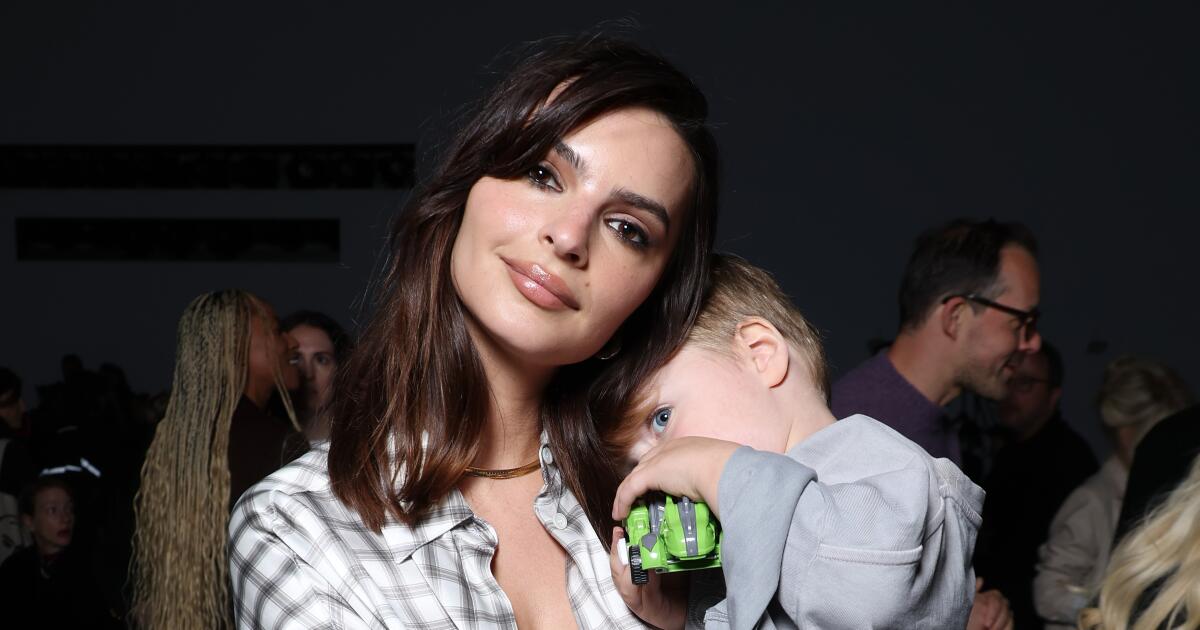
Emily Ratajkowski’s viral essay detailing her sex life as a single mom just landed her a seven-figure book deal.
According to Page Six, the model’s essay in the Cut had publishers champing at the bit in a 12-way bidding war that culminated in the hefty pay day. Editor Helen Rouner at Penguin Press — who also edited Lauren Christensen’s memoir “Firstborn” and Michael W. Clune’s novel “Pan” — reportedly landed the deal.
Penguin Press did not immediately respond to The Times’ request for comment Friday.
Publishers Marketplace announced the forthcoming memoir, describing it as “an examination of modern female identity through the story of the author’s own efforts as a newly single mother in New York City to discover what really constitutes a good life for a woman.”
The essay, which dropped a month ago and quickly broke the internet, drops the veil on EmRata’s sexual adventures (or maybe misadventures) since she and her former husband, Sebastian Bear-McClard, split in 2022.
“It was a violent transition into a new reality of screaming baby on my aching tit and ring on my swollen finger,” Ratajkowski writes of new motherhood. “And then, in a time period that felt both instant and excruciatingly slow, my marriage collapsed. Six months after my son was born, my husband and I stopped having sex. Less than a year later, we separated.”
In the missive, the model interrogates her sexuality — is she a Madonna or a whore? — while untangling bigger questions around gender, power and self-actualization. If Carrie Bradshaw wrote about “Sex and the City,” then Ratajkowski is writing about sex, the city and single motherhood. And naturally, her fleeting paramours have vague monikers: “Vegan Graffiti Artist,” “Spanish Gen-Zer” and “Son of a Billionaire.”
“And then there was the Elder Millennial: obsessed with dental hygiene, psychedelics, and dirty talk,” she writes. “He had approached the subject coyly at first, like it was something he was kind of embarrassed about — the way a kid will test you to see if you’ll talk to them about their dorky obsession of the moment. Do you like Godzilla? What about Star Wars?”
Would-be sleuths with Ratajkowski’s essay and a gossip rag handy will have their work cut out for them.
This will be Ratajkowski’s second book. The first, “My Body,” dropped in 2021 and was a bestselling collection of essays exploring gender, power dynamics, sexuality and the commodification of female beauty in the modeling and entertainment industries.
Ratajkowski’s foray into the spotlight came more than a decade ago when Robin Thicke’s controversial “Blurred Lines” music video made the model an overnight star. She was cast in David Fincher’s adaptation of “Gone Girl,” which hit theaters the following year, and catapulted to top fashion runways — Marc Jacobs, Versace, Victoria’s Secret and Dolce & Gabbana, to name a few. She she’s been romantically linked to Harry Styles, Eric Andre, Shaboozey, Brad Pitt and Pete Davidson, among others.
In 2023, she moonlighted as the host of the “High Low With EmRata” podcast, where she interviewed sex workers, investigated ethical nonmonogamy and pondered the etymology of the word “toxic.” The same year, she told The Times that she was coming into herself post-divorce, “Being able to assert what I want — that feels like it just started: My life as a creator and not as a muse.”

Wainheads will be delighted to see his alums in cameos: Kerri Kenney-Silver, Michael Ian Black, Thomas Lennon, and supporting roles for Zickel and Truglio. A large portion of the cast are his homies. But with Deutch, Gutierrez-Riley, Wang, Slattery, Impacciatore, and yes, Hamm, it’s as if they’re being inducted into a new mad family. Wain and Marino are basically catching Pokémon and hoping they can hold onto the roster (by that logic, yes, Paul Rudd is a legendary Pokémon). The film is anchored by Zoey — everything everywhere all this summer with Voicemails From Isabelle to Minions & Monsters — Deutch in the Dorothy Gale role, exuding a high level of perkiness consistent with the character’s can-do, wide-eyed, midwestern charm and heart.
A major standout, Ben Wang finally gets to show off his comedic abilities, portraying a self-assured, quick-witted agent who makes me laugh every time he reveals his sheltered upbringing in snappy whines at every inconvenience. Sabrina Impacciatore, who has proven to be a comedic juggernaut in The Paper, is having so much fun hamming it up as the mob boss-esque wicked witch counterpart, torturing her henchmen and deliciously chewing up the scenery whenever onscreen. I don’t think they use her to the height of her comedic prowess, but she’s a delight nonetheless. John Slattery is the film’s comedic MVP. The way the writers use his over-the-top character for comedy is downright hilarious every time. They use him as either a punchline or a force of nature, and he’s great. This movie is like Mad Men propaganda, and by God, it works. As someone who’s never seen it, Gail allowed me a better appreciation for Slattery and Hamm.
Man, we don’t deserve Jon Hamm. This is the second time I’ve seen him play a silly, fictionalized version of himself this year (the other being the SXSW crowd-pleasing rom-com Wishful Thinking, which Gail distributor Sony Pictures Classics acquired), and he also voice-acted in his comedic Mayor Jerry role in Hoppers. Maybe working with Wain in 2007’s The Ten was the canon event, but I consider his weird little sex scene with Kristen Wiig in Bridesmaids his awakening. Since then, I’ve only seen him as unserious, and it’s delightful. Oz-like in appearance, he’s funny and befitting the film’s overall light, joyful nature.
LAST STATEMENT
Ultimately, Gail Daughtry and the Celebrity Sex Pass is a campy, delightful romp that succeeds as both a distinctive Hollywood‑centric riff and a Wizard of Oz reimagining, retaining a loving, twisted, demented charm. It’s a weird description, but it’s so high‑spirited and light‑hearted despite being strangely ultraviolent. It might as well be a live‑action episode of Smiling Friends (RIP), yet it’s everything the theatrical market needs today. Ten years ago, this would’ve been a studio production rather than an indie Sundance acquisition, but thank God it exists for the big screen. More absurdist Gail Daughtrys for cinemas (not streaming), please, because this is the most fun to be had in a theater all summer, if not the year thus far.
-

 New York1 hour ago
How ‘The Wire’ Star Jamie Hector Spends a Hot Day in Brooklyn
-

 Los Angeles, Ca1 hour ago
Burglars ransack Sherman Oaks condo building during fumigation
-

 Detroit, MI2 hours ago
Metro Detroit weather forecast, July 10, 2026 — 11 p.m. Update
-

 San Francisco, CA2 hours ago
Classical music series helps reconnect downtown San Francisco community
-

 Dallas, TX2 hours ago
Dallas police officers, paramedics recall saving woman stuck in a ravine for days;
-

 Boston, MA2 hours ago
Red Sox win 7th straight game just hours after landing in New York
-
 Denver, CO2 hours ago
One tree at a time: Denver nonprofit works to close shade gap as heat dome threatens neighborhoods
-

 Seattle, WA2 hours ago
VIDEO: West Seattle Summer Fest 2026 day 1, evening report

