Lifestyle
This horror genre is scary as folk – and perfect October viewing


In 1973’s The Wicker Man, British policeman (Edward Woodward) visits a remote Scottish island to find that the locals have embraced a form of paganism.
Archive Photos/Getty Images
hide caption
toggle caption
Archive Photos/Getty Images
It’s October. Some of your neighbors will spend this, the official first weekend of spooky season, going all-out with inflatable yard skeletons and ghosts. They will embark upon the annual attempt to make candy corn, aka high-fructose ear wax, a thing. They’ll adorn their front porches with those cotton spider webs that look nothing like real spider webs and instead just make it look like they went and ritually murdered a white sweater so they could hang its dismembered corpse across their doorway as a grisly warning to all other knitwear.
For me, it’s a more simple, elemental formula: Hot cider, cider donuts, folk horror.
The appeal of cider and donuts is universal, but folk horror might need some defining. Essentially, it’s horror set in remote, isolated areas where nature still holds sway. Well, nature paired with the superstitious beliefs of the locals, who tend to treat unwary outsiders with suspicion (if the outsiders are lucky) or malice (if they’re not).

The classic example is 1973’s The Wicker Man, in which an uptight, devout, and veddy veddy British policeman (Edward Woodward) visits a remote Scottish island to investigate the disappearance of a young girl. Turns out the locals have embraced a form of Celtic paganism, which doesn’t sit right with him. He says as much to the island’s aristocratic leader, a mysterious and charismatic sort played by Christopher Lee. Things don’t end well for our poor British bobby – though presumably the island will enjoy a bountiful harvest, so, you know: Big picture, it’s still a win.
Other founding classics of the genre include 1968’s The Witchfinder General and 1971’s The Blood on Satan’s Claw, which of the three films has the least going for it, apart from its title, which is, all reasonable people can agree, metal AF.
I love me some folk horror, and am never happier than when I can while away a damp, foggy (and thus obligingly atmospheric) October afternoon mainlining new and old examples of the form like Kill List, You Won’t Be Alone, Viy, The Ritual, Häxan, The Medium, Apostle, Midsommar, The Witch, Hereditary, Night of the Demon, A Field in England, Robin Redbreast, and Men. (Looking for more examples? Check out the documentary Woodlands Dark and Days Bewitched: A History of Folk Horror.)

Florence Pugh in Midsommar.
Gabor Kotschy/A24
hide caption
toggle caption
Gabor Kotschy/A24
Some folk horror involves supernatural elements, but I confess a particular fondness for those stories that don’t – stories where it’s the folk themselves (read: the locals, and their beliefs) who are the true and only source of the horror. (I won’t spoil which of the above films traffic in human vs. supernatural evil, in case you haven’t seen them.)
Talismans and turtlenecks
The Wicker Man was the first folk horror film I saw as a kid, which is maybe why I harbor a deep love of folk horror set in ’70s Britain, a time and place when an interest in the occult became faddish, inspiring a wave of folk horror specifically inflected with Satanic panic. Many of these films were set in the past, but those like The Wicker Man were set in the then-present, a time when men wore wavy hair and tight bell bottoms. Christopher Lee’s Lord Summerisle, for example, sported a kicky tweed leisure suit topped off by a burnt-orange sweater.
It’s why I think of this very specific subgenre of ‘70s folk horror as Talismans and Turtlenecks.
I just came across a new-to-me example of T & T last Sunday afternoon, which was suitably cold and wet and misty: 1970’s The Dunwich Horror. A stiff-haired Sandra Dee, desperately attempting to shake her goody-goody image, plays a woman who falls under the sway of a young and hilariously intense, wide-eyed Dean Stockwell. (Seriously, you keep waiting for his character to blink, but instead he just keeps goggling fixedly at the world around him. At one point he makes a pot of tea, staring at it so fiercely through every stage of the process you start to wonder if he’s trying to convince it to hop into bed with him.)
Don’t get me wrong: It’s a cheesy film, filled with crummy dialogue and hammy acting and cheap sets and one fight scene so wildly inept that has to be seen to be disbelieved. I won’t reveal if the threat hanging over the film is human or supernatural (though the fact that it’s based on an H.P. Lovecraft short story should tip you off). But I will say that Stockwell sports a thick, curly hairdo, a cravat, two count-em two pinky rings, and a huge mustache that curls under itself at either end, in the process effectively turning my guy’s mouth into a parenthetical statement.
You can watch it for free, with commercials, on Pluto TV, which I swear is a real streaming service and not something I made up. The Dunwich Horror is not remotely scary, but it does have something to say, I suppose, about the madness of crowds and what, back in grad school, we used to call “othering.” (The Stockwell character is the scion of an eccentric family that the local community has shunned for generations, you see.)
And that, of course, is the abiding appeal of folk horror: It takes those universal feelings of alienation and isolation that make us all feel like outsiders in our own communities and gives them flesh. When the supernatural is involved, sometimes that flesh pulses and oozes. Sometimes it’s furry and clawed.
But whenever the story is about our collective tendency to cling to belief in the supernatural, the flesh involved is all too human, and probably gets stabbed with a sacrificial dagger in the final reel. Happy spooky season, y’all.
This piece also appeared in NPR’s Pop Culture Happy Hour newsletter. Sign up for the newsletter so you don’t miss the next one, plus get weekly recommendations about what’s making us happy.
Listen to Pop Culture Happy Hour on Apple Podcasts and Spotify.



Lifestyle
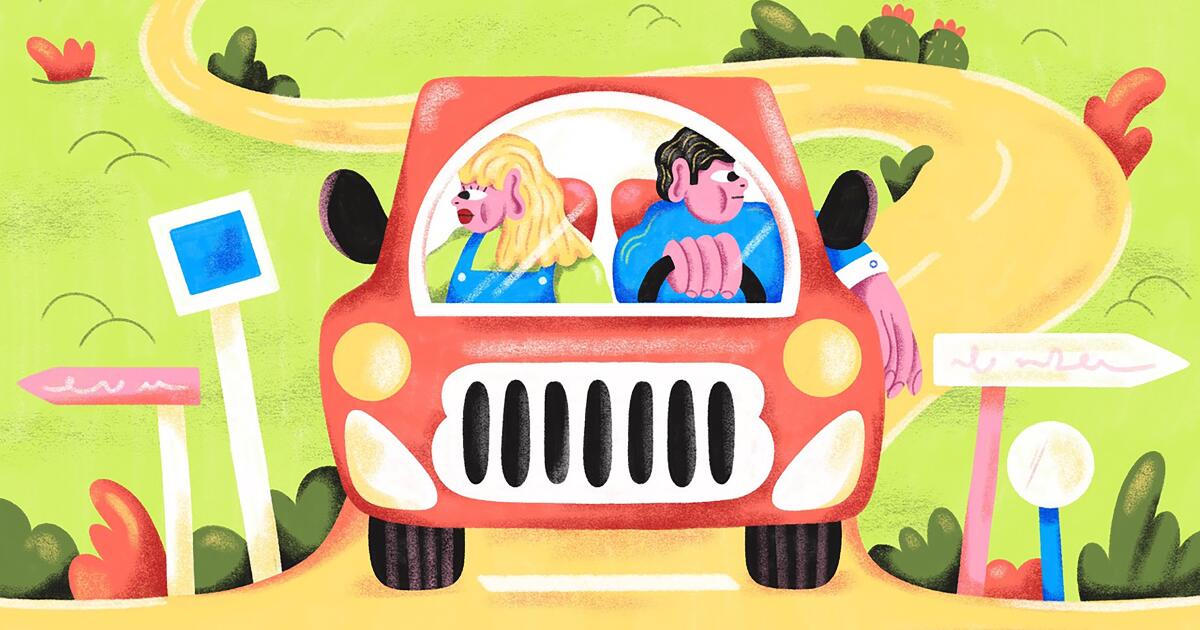
L.A. Affairs: It’s hot when a man drives to me. But would this new guy make the trek from the Valley?
I met Dan on Hinge.
He lives in Woodland Hills, and I live in Venice. In Los Angeles, this is considered a long-distance relationship. In another city it might be nothing. Here, it’s a factor.
But I believe that with the right person, you can make anything work, so I stay open. I’m a native New Yorker, and if I were living in Brooklyn and a guy lived on the Upper West Side, that would be a 45-minute subway ride, which is truly nothing in New York. So with that same logic, I try to have flexibility with men in L.A.
When we started planning our first date, Dan suggested three options: a hike on mushrooms, a wine tasting or a walk on the beach.
A hike on mushrooms is something I’d only do with someone I already trust, not someone I just met online. I don’t do first-date hikes because I don’t like feeling trapped if the guy’s a dud. So I chose the wine tasting.
Then I learned the wine tasting was in West Hills.
On a Friday night, driving there from Venice would be insane. So I said I didn’t want to meet there because of the traffic. He suggested Malibu. That was also not ideal on a Friday.
I was getting annoyed — this was a pink flag because in my dating world, the guy is supposed to come to the woman’s neighborhood in the early days. I’ve gone out with plenty of men from the Valley who effortlessly suggested they come to me. It’s not rare or impossible.
I suggested he come to the Westside. I didn’t specifically say Venice, and in hindsight, I probably should have. He landed on Brentwood, which was manageable for both of us. On our first date, we met at an Irish pub on Wilshire Boulevard. He was cuter and more interesting than I had expected, and with the Guinness flowing, we had fun.
When I got home, he texted me: “Well, I like you 🙂 Less the tik tok and the lack of rock music in your life, but it’s not a deal breaker — there are other qualities 🙂 What are your thoughts?”
I noticed the slight negativity but was mostly dazzled that a man texted immediately after the date to say he liked me. In the modern dating economy, this felt rare.
The next day, both of our evening plans fell through, so we made a last-minute date. The wine tasting he originally suggested still sounded like fun, and although it meant me driving to the Valley, I was up for it now that we’d met.
We sipped flights at Malibu Wines & Beer Garden in its airy, romantic courtyard and played a flirty version of Truth or Dare. Halfway through, he dared me to kiss him.
We ended with sushi on Ventura Boulevard and a short make-out session in his car. He invited me to Thanksgiving at his uncle’s, which felt too soon, but also sweet.
After the second date, he texted and said he had his kids that week and was also hosting an event on Thursday, so his only day to meet was Wednesday. I said great.
On Tuesday night, he checked if we were still on, and I said yes.
Then he texted: “I’m flexible on time but not on location. I have a big event on Thursday, hopefully you can come to me again.”
My stomach tightened. This again?
So I texted back: “I drove to you last time, which was a bit of an exception for me especially in the early days, but the wine tasting location sounded special. Usually guys come to my area. How about we switch it up this time?”
He replied: “I appreciate the effort! Because of my event, I’d rather be close to a computer just if needed … Here is what i offer:
— I’ll come to your area anytime next week/end
— Lunch/dinner on me
I want to continue where we stopped last time 😉 No pressure of course, but let’s snuggle”
I responded: “Ok let’s meet next week. Snuggles sound nice … let’s see what happens …”
Then he wrote: “So I won’t see you tomorrow?”
I replied: “Unless you wanna come to me and bring your laptop along, let’s rain check until you have more flexibility.”
He said: “Dang, you are hard. I’ll let you know tomorrow around midday if it’s ok.”
And then — surprise — he decided to come.
He drove to Venice for a 5 p.m. date. He said his ETA was 5 p.m., and it ended up being 5:25 p.m., typical 405 Freeway.
When he showed up, he was in a cranky mood. On our way to KazuNori in Marina del Rey, I thanked him for picking me up and told him I think it’s hot when the guy comes to the girl.
“You’re just saying that because you want me to come to you more,” he said, not playfully, but aggressively.
That was basically the end for me. But there I was, in his car, heading to dinner. So I stayed pleasant and tried to make the best of it.
I shared that in the early stages of dating, I find it’s good etiquette for the guy to come to the woman’s neighborhood. He immediately disagreed and started ranting about how dating rules are ridiculous and how they swing in women’s favor. He resented paying for dates and declared he wasn’t looking to “sponsor a woman’s life.”
“If women want equality and equal rights,” he said, “then it should apply all across the board, including dating, and the man shouldn’t have to pay.”
I said women don’t actually have equal rights because we get paid less than men and often receive lower salaries than men in the same position.
I tried to change the subject and reset the mood, but he insisted we keep hashing it out.
I tried to explain masculine/feminine dynamics: providing and protecting, giving and receiving.
“What does the man get out of this arrangement?” he asked.
It was like watching someone’s personality warp into Mr. Hyde. Then he brought up another point: He’s a single dad of two kids, so he gets tired; and because I don’t have kids, that should factor into who drives where.
At this point, I was barely engaging and focused on eating my hand rolls, and I couldn’t wait to get home.
The check came, and I happily split it, wanting nothing further from him.
In the car back to my place, he remarked: “It’s obvious we’re never gonna see each other again.”
Obvious, but did it need to be stated?
Then he showed me a Spotify playlist he’d made for me of his favorite electronic music, because he knows I like EDM.
“Oh, that’s sweet,” I said.
“Yeah, that’s how I show interest. Through things like this, not who drives to who,” he replied.
When I got out of the car, we wished each other luck, and I headed inside and shut the door.
Two hours later, he sent me the playlist. I’ve yet to listen to it.
It wasn’t the distance that ruined it. It was the resentment. I’m not looking for a man who feels burdened by the effort. I’m looking for a man who sees the value of courting a woman in the first place.
The author is a writer, comedian and former psychologist who lives in Venice. She is the creator of the new vertical series “Manfari.” She’s on Instagram: @solange_neue and @manfari.show.
L.A. Affairs chronicles the search for romantic love in all its glorious expressions in the L.A. area, and we want to hear your true story. We pay $400 for a published essay. Email LAAffairs@latimes.com. You can find submission guidelines here. You can find past columns here.

Lonnie Bunch III is the 14th Secretary of the Smithsonian. He’s pictured above in September 2017.
J. Scott Applewhite/AP
hide caption
toggle caption
J. Scott Applewhite/AP
In a memo addressed to staffers sent Tuesday, the secretary of the Smithsonian, Lonnie G. Bunch III, defended the institution after the White House issued a 162-page report that characterizes the National Museum of American History as a place which has become “subject to institutional capture by a radical, activist ideology that is fundamentally opposed to telling the noble, honest story of the great country we know and love.”
In his email, which NPR has obtained, Bunch wrote in part: “While there will always be room for improvement, this report is not a fair characterization of the work and totality of the National Museum of American History. At the Smithsonian, our work is driven by scholarship, accuracy and an uncompromising commitment to tell the fullness of America’s story. As public servants and the keepers of this institution, we are charged with helping a nation find understanding, hope and clarity and as part of that duty, we are dedicated to excellence, reflection and growth.”

He continued: “We remain focused on what grounds us: a steadfast commitment to scholarship, nonpartisanship, independence, accuracy and integrity. For nearly 180 years, the Smithsonian has worked alongside partners across government — from the White House to Congress to our governing Board of Regents — guided by our enduring mission to increase and diffuse knowledge. That purpose remains: to pursue knowledge with rigor and to serve the American public with clarity and care.”
The White House report was issued on July 4 by the Domestic Policy Council under the title “Saving America’s Story: How Ideological Capture at the Smithsonian Institution’s National Museum of American History Erases Our Heritage.”

The council faults the National Museum of American History on a multitude of fronts, saying it underemphasized the Founding Fathers and early colonial and Revolutionary history; was not sufficiently celebratory of the country’s 250th anniversary; and that it engaged in “anti-white,” “illegal alien” and transgender activism.
It also accuses the museum of trying to “indoctrinate” teachers and students through its exhibitions, programming and teaching resources.
In the report, the council also specifically criticizes museum director Anthea Hartig, who has led the National Museum of American History since 2019 and is concurrently the president of the Organization of American Historians, calling her “an activist advancing an ideological agenda contradictory to the museum’s founding purpose of fostering patriotism.”

The Trump administration has made the Smithsonian museums one of its primary targets in its efforts to reshape cultural narratives to align with its viewpoints. In August 2025, the White House requested a “comprehensive internal review” of eight Smithsonian museums, including the National Museum of American History, following an executive order issued by President Trump in March 2025 in which he called for the removal of “improper ideology” from the Smithsonian’s offerings.
According to the Smithsonian’s charter, all of its 21 museums, 14 education and research centers, and the National Zoo are meant to be run independently of the federal government. The Smithsonian is overseen by Bunch and a board of regents, which includes Vice President Vance, Supreme Court Chief Justice John Roberts and other members appointed by Congress.
In an interview with NBC’s Meet the Press on Sunday, Bunch spoke about the Smithsonian’s 250th anniversary special exhibition at the Smithsonian Castle, which is called “American Aspirations.”
He told NBC: “It’s really important for people to understand that America is much an ideal as it is a place, that it’s a series of aspirations that have really shaped who this country is. And so for me, what is so powerful is to say, ‘Let us honor the words of Thomas Jefferson and the founders, but let us use those to challenge us to be better.’”
Jennifer Vanasco edited this story.

-

 Boston, MA5 minutes ago
Red Sox face lengthy travel issues ahead of series vs. Mets
-

 Denver, CO12 minutes ago
What’s going on with the Nuggets? Unpacking an NBA offseason on hold
-

 Seattle, WA15 minutes ago
Seattle Kraken Sign Goaltender Victor Östman and Defenseman Ville Ottavainen to One-Year Deals | Seattle Kraken
-

 San Diego, CA20 minutes ago
An executive shuffle at San Diego’s Sempra
-
Milwaukee, WI27 minutes ago
Survey finds less than half of Jews in Milwaukee identify as Zionists | The Jerusalem Post
-

 Atlanta, GA30 minutes ago
Atlanta Hawks Showing Interest In Denver’s Peyton Watson, But Is The Price Too High?
-

 Minneapolis, MN35 minutes ago
Uptown businesses push to delay Lyndale Avenue project
-

 Indianapolis, IN42 minutes ago
Data center moratorium proposed by Indianapolis City-County Council president

