News
Man charged after four shot dead on Chicago train


A 30-year-old man from Chicago has been charged with murder after four people were fatally shot on a train, authorities said.
The suspect, identified by Forest Park Police as Rhanni Davis, is accused of four counts of first-degree murder.
The victims all appeared to be asleep on a Blue Line train in the Chicago suburb of Forest Park when they were shot just before 05:30 local time (10:30 GMT) on Monday, police said.
Three of the victims were found dead at the scene, while the fourth died later in hospital, according to police.
Two of the victims have been identified by the authorities as Simeon Bihesi 28, and Adrian Collins, 60.
The Cook County Medical Examiner’s Office later said one of the other two victims was a 64-year-old woman named Margaret Miller. The fourth victim has been identified as a man but his name has not yet been released.
Deputy Chief for the Forest Park Police Department Christopher Chin said the shooting appeared to be a “random act of violence”, saying the gunman “shot and killed four victims when literally they were sleeping on the train”.
“This wasn’t a robbery. It didn’t appear that he was in a fight with anybody else,” he said.
On Tuesday, prosecutor Kim Foxx described the shooting as “inexplicable” as she announced the charges.
“It is horrific,” she said. “We want answers.”
Police said surveillance footage showed the attacker walking through the train, and shooting four passengers who appeared to be asleep in two different carriages. The four victims were not sitting together.
The suspect is due to appear in court on Wednesday.
The Blue Line train runs 24 hours a day between Forest Park and Chicago’s O’Hare International Airport and is run by the Chicago Transit Authority, the United States’ second largest public transportation system.
Gun violence is common in the United States, where there are more firearms than people.
Earlier on Tuesday, police in Louisiana arrested an 11-year-old boy who is accused of fatally shooting the city’s former mayor and his daughter.

News
Family-owned company prepares to put on the largest fireworks display in history: “It is the biggest show that we’ve ever done”

Washington — There are fireworks, and then there’s what’s in store for Saturday in Washington, D.C.
When the sun goes down on Independence Day, the skies of Washington are expected to fill with a record-setting 850,000 individual fireworks for a 40-minute spectacle like no one has seen before.
A company called Pyrotecnico will attempt the biggest fireworks show in history, using five generations of family know-how and a background in Super Bowls and large musical acts to help America celebrate its 250th birthday with a bang.
“I mean, it is the biggest show that we’ve done,” Rocco Vitale, president of Pyrotecnico, told CBS News. “…My earliest memories of fireworks displays and doing the Fourth of July was here.”
Pyrotecnico has been planning this year’s show since January, using computers to simulate the display. But now it’s time for the real thing.
Vitale gave CBS News an exclusive look at his not-so-secret weapons: eight barges out on the Potomac River, each one ready to light up the night sky.
“Each firing location has a communication device, and its all set on GPS. And once the time of the show is put into the system, it goes at that time,” Vitale explained.
According to Freedom 250, the organizer of the “Salute to America 250 Celebration & Fireworks” on the National Mall, President Trump will deliver remarks at 9:45 p.m. Eastern Time, and the fireworks display will get underway at 10:45 p.m. The event is expected to draw hundreds of thousands of people.
Join CBS for “The Great American Block Party 250,” a primetime special on Saturday, July 4, hosted by CBS Evening News anchor Tony Dokoupil and Entertainment Tonight’s Nischelle Turner, featuring live musical performances, celebrations around the country, and the largest fireworks show in history in the skies over the nation’s capital. Tune in July 4 at 8 p.m. ET on CBS and stream it on Paramount+ and CBS News 24/7.

A national physician staffing firm tried to take over the contract held by Eugene Emergency Physicians to work in local hospitals. The local physicians used a new state law to oppose the move.
sorbetto/Digital Vision Vectors/Getty Images
hide caption
toggle caption
sorbetto/Digital Vision Vectors/Getty Images
For the latest stories on the science of healthy living, subscribe to NPR’s Health newsletter.
In between shifts in the emergency room, Dr. Dan McGee was in an Oregon courtroom. He was fighting for his practice — Eugene Emergency Physicians (EEP). The group of more than 40 doctors and physician assistants work at multiple emergency departments; it was being replaced by a national company.
“This was big time, David and Goliath stuff,” McGee said. “You see 14 of their lawyers sitting there and you see three of ours.”
Those lawyers argued that ApolloMD, the national company, violated Oregon’s corporate practice of medicine law. The 2025 law bans corporations from taking control of a medical practice’s operations and finances.
The case garnered national interest because Oregon’s new law targets the loopholes large staffing firms have been employing to circumvent state corporate medicine laws.

Money for control
Most states have laws requiring that doctors own medical practices, not corporations. These rules aim to put patient interests ahead of profit motives. Over the last several years, companies have used a model where a doctor technically owns the local practice, but as Erin Fuse Brown, a professor at Brown University, explains, those physician owners are often not involved in care and cede hiring, firing and other operational functions to the corporation.
Fuse Brown said these arrangements are attractive to hospitals because these companies often promise more revenue and take over the responsibilities that come with running an ER.
“There’s worry that these investors or these corporate management companies should not be totally controlling the operations and the clinical decisions of those who are trained to deliver patient care,” Fuse Brown said.
The connection to patient care concerned Dr. Jonas Pologe, who works for Eugene Emergency Physicians, in the Eugene, Ore., area. ApolloMD offered local doctors jobs, but Pologe worried that if he pushed back on decisions ApolloMD made, he could lose work hours.
“There’s certainly a chance that if you make enough of a stink, you think that something needs to change, they can just stop giving you shifts,” said Pologe.

ApolloMD’s CEO, Dr. Yogin Patel, said the group doesn’t infringe on the way its doctors practice. He says the company is being unfairly lumped in with broader concerns over physicians’ feelings of disempowerment at the hands of corporate medical takeovers.
A closely watched experiment
Fuse Brown, policy experts and independent physicians theorized that updating state corporate medicine laws could be a fix to limit the control management companies can exert over medical doctors.
Oregon’s the first state to try this, and the case brought by the Eugene doctors group is the first test of that law. McGee, who leads the Eugene physicians group, says colleagues at other hospitals around the state were literally tuning in to their case.
“You could hear it almost like background music on an elevator,” McGee says he was told. “At key moments, all of a sudden the nurses would break out in a cheer.”
Before any ruling, the hospital system dropped its plan to work with ApolloMD and struck a deal to stick with McGee’s local group of doctors.
“This is a big victory for independent physician groups over corporate medicine,” McGee said. “This is a game changer.”
The American Academy of Emergency Medicine (AAEM) supported the Eugene doctors as part of the organization’s strategy to protect independent practices. The AAEM president, Dr. Vicki Norton, said Oregon has the strongest law in the country.
“This signals that that law works and we need it replicated in other states to really strengthen their corporate practice laws,” said Norton.
California and Vermont have passed similar legislation to Oregon, and lawmakers in other states, including Rhode Island and New Mexico, are considering related bills.
In Virginia, an independent group of ER doctors who were replaced by a large staffing firm is meeting with state legislators to try to change their laws.
Impact on Oregon physicians
Back in Oregon, the open question is about how the law may impact the physician practice market.
A few of the largest companies, Envision Healthcare, TeamHealth and USACS, declined to answer NPR’s questions about whether this case or the new law changed their outlook on investing in Oregon practices.
Opponents of the legislation warned lawmakers that many physician groups depend on outside investment to survive.

In an exclusive interview with CBS News on Thursday, Treasury Secretary Scott Bessent said he doesn’t believe the recent disclosure of President Trump’s billions in crypto earnings is problematic for the president.
“I don’t think there’s an appearance problem,” Bessent told CBS News anchor and MoneyWatch correspondent Kelly O’Grady regarding Mr. Trump’s earnings.
According to a financial disclosure released earlier this week, Mr. Trump has earned approximately $1.4 billion from his crypto ventures since beginning his second term. Those include his “meme coin” $TRUMP and earnings from World Liberty Financial, a cryptocurrency company backed by the president and his family.
Congressional Democrats have criticized Mr. Trump’s crypto windfall, arguing it presents a conflict of interest since his administration has sought to loosen regulations on cryptocurrency.
“This is an innovation presidency,” Bessent told CBS News. “So whether it’s digital access, whether it’s AI, whether it’s everything that is going on in the tech ecosystem that, you know, all Americans are benefiting from that.”
White House spokesperson Anna Kelly told CBS News on Tuesday that “there are no conflicts of interest” in the disclosure.
In his interview with CBS News, Bessent also touched on the latest developments with the tax-deferred Trump Accounts and his outlook for the U.S. economy as it grapples with the impacts of the Iran war.
Economic relief is coming for American families, Bessent believes
The Treasury secretary said his message to Americans who are experiencing strain at the grocery store and at the pump wrought by the Iran war is that “we’re going to get to the other side of this.”
Since the war began in late February, halts to shipping traffic in the critical Strait of Hormuz, which handles roughly 20% of the world’s global oil supply, have led to rising gas prices, which have in turn accelerated inflation and raised costs more broadly. In May, the annual inflation rate rose to 4.2%, according to the Labor Department, its highest level since April 2023.
The average price of a gallon of regular gasoline on Thursday was $3.83, according to AAA. At the height of the war, gas prices topped $4.50 a gallon, but have steadily declined in recent weeks as oil prices return to near prewar levels and the U.S. and Iran negotiate over a more permanent end to the war.
Bessent said he is hopeful that the average drops to $3 a gallon by Labor Day.
“Gasoline prices are a little stickier on the way down,” Bessent said. “We’re trying to give the gasoline retailers a little bit of a nudge. We’re telling them we’re watching them. We’ve had some good uptake from some of the bigger retailers from some of the bigger retailers in terms of what they want to do for consumers.”
Thursday’s jobs report from the Bureau of Labor Statistics showed that U.S. employers added 57,000 jobs in June, far below what economists had predicted, but the unemployment rate held steady, dipping slightly to 4.2% from 4.3% the month before. However, the report found that annual wage growth was 3.5%, below the rate of inflation.
Bessent described the discrepancy between wage gains and inflation as a “short-term spike,” and said he expects to see oil and energy prices continue to drop.
“I would expect, perhaps, as soon as this month, we’re going to see real wage gains,” Bessent said.
Asked whether the stock market’s strong performance in recent months, or the real-world pressure facing many Americans, is a more realistic view of the state of the U.S. economy, Bessent said he believes the market’s strong performance will be predictive of the direction the economy takes.
“The stock market lives in the future. So what the stock market is telling us is, presumably, what I am saying today, that we’ll get to the other side of this,” Bessent said. “Rates will come down and then we will be back up to real wage gain. So both can be true.”
Trump Accounts a tool to create “financial literacy,” Bessent says
The White House announced this week that beginning on July 4, Americans can begin contributing to Trump Accounts, a federal program launched earlier this year designed to help children under 18 invest money in the stock market and build savings before they reach adulthood, similar to how adults save for retirement.
“Thirty-eight percent of American households have no investment in our great equity markets, and we want everyone to share, you know, in the bounty that is the U.S.,” Bessent said. “In our innovation and our capital markets, and, you know, the economic engine, greatest in the history of the world. So, you know, over time, I would think that that 38% number would move toward zero. And then the other thing too is financial literacy.”
According to Bessent, more than 6 million Trump Accounts have been opened so far, and there are approximately 70 million children in the U.S. eligible for them.
On July 4, the federal government will begin contributing $1,000 to accounts for eligible children who are born between Jan. 1, 2025, and Dec. 31, 2028. The Trump Accounts were part of the White House’s “big, beautiful bill” legislation passed last year.
Bessent noted how wealthy philanthropists, organizations and states can also donate to the accounts, even by contributing public stock. Last year, Michael Dell, who founded Dell Technologies, and his wife Susan Dell announced they would donate $6.25 billion to the accounts, or $250 per person.
“I would expect that we are going to see, again from these philanthropic families and institutions and companies, I would expect that we would see the lower-income profile families, actually the accounts will be topped up more,” Bessent said.
Bessent said the accounts could also build throughout adulthood and be rolled into an individual retirement account.
“We want them to really understand the power of long-term compounding,” Bessent said of the families who take part in the program. “That you’ll own a share of a company, that many people have – bank deposits. They’re used to getting interest, they’re used to paying interest. So what we want them to understand is, what does a piece of the action feel like?”
-

 World7 minutes ago
Conservative Keiko Fujimori officially declared winner of Peru’s presidential runoff election
-

 Politics9 minutes ago
Trump hails America as ‘most exceptional nation ever to exist’ in Mount Rushmore speech
-

 Health15 minutes ago
Scientists discover possible link between 9/11 and accelerated aging
-

 Sports22 minutes ago
Messi, Argentina avoid a shocking upset in wild knockout stage match against Cape Verde
-

 Technology25 minutes ago
Zoox robotaxi redesign brings big rider upgrades
-
 Business30 minutes ago
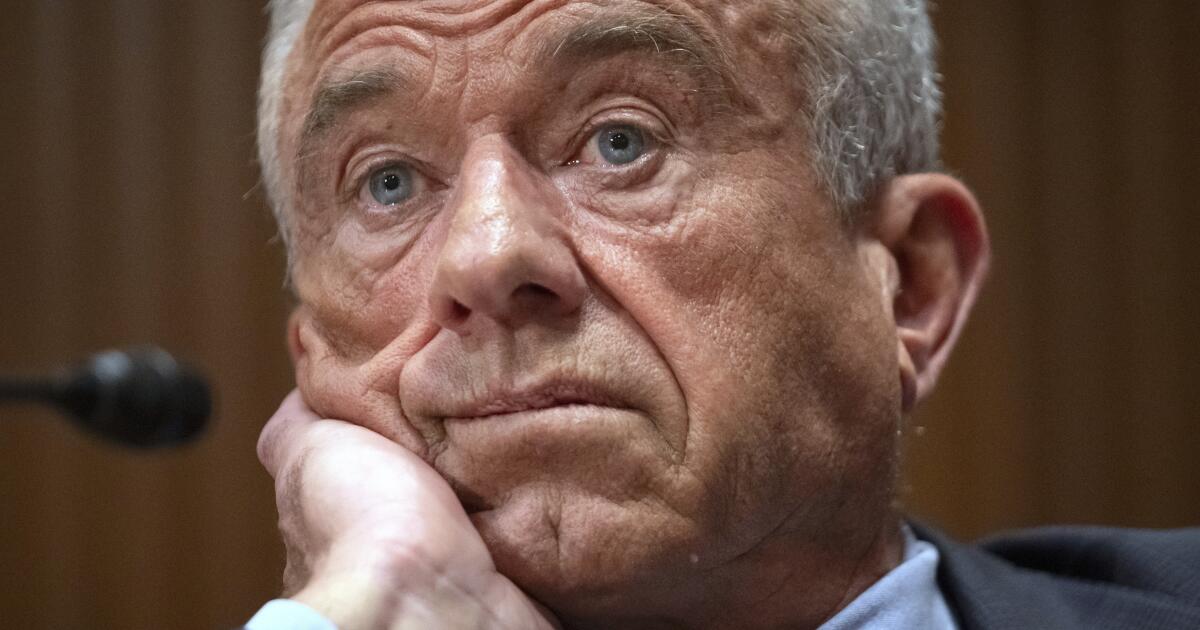
Commentary: It’s not just vaccines — from infancy to adolescence, Republicans are waging war on children’s health
-
 Entertainment37 minutes ago
Taylor Swift, Travis Kelce married at lavish Madison Square Garden wedding
-
 Lifestyle39 minutes ago
How to have the best Sunday in L.A., according to Ken Marino

