Politics
Hollywood showed up in force for Kamala Harris at DNC, even if Beyoncé and Taylor were absent

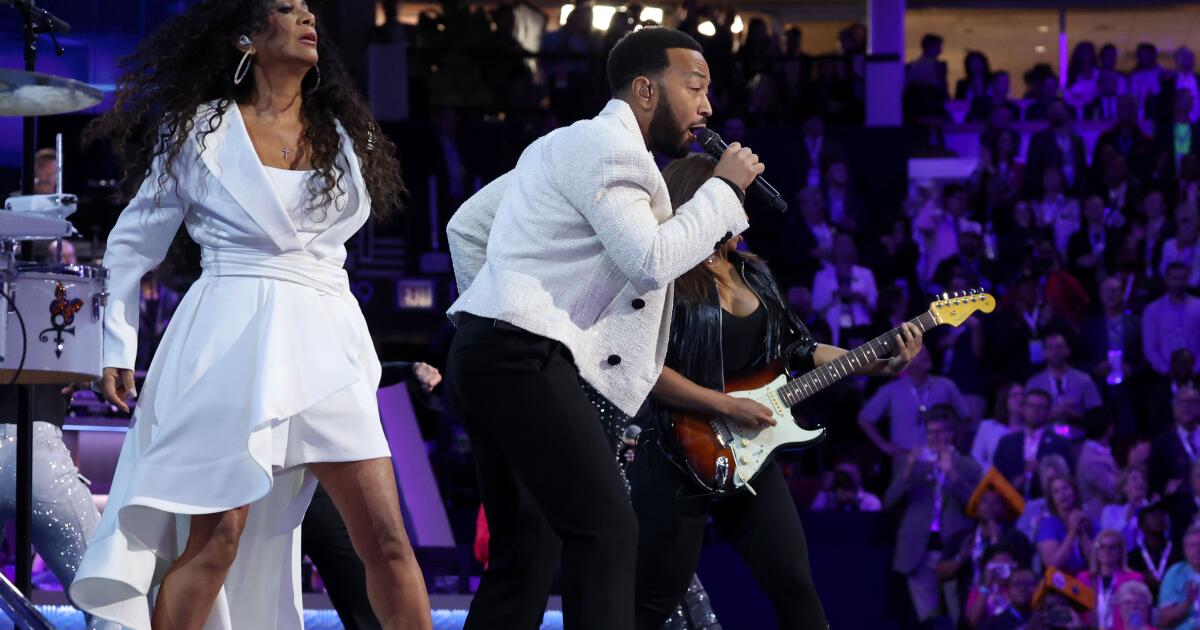
Anyone who tuned in to the Democratic National Convention on Thursday night expecting to watch Beyoncé make a surprise appearance onstage was likely disappointed to see former Secretary of Defense Leon Panetta standing there instead, not a rhinestone to be found on his staid blue suit.
For weeks, ever since Queen Bey gave Kamala Harris’ campaign permission to use her stirring anthem “Freedom” as its theme song, speculation had mounted that she would perform at the convention — and that maybe she would even team up with fellow pop supernova, Taylor Swift, to send a woman to the White House. On Thursday, the theories shifted into overdrive on social media, thanks largely to a single tweet from a random X user teasing a surprise appearance on the final night of the event.
If the unchecked, unfounded Bey-Tay rumors now feel like a moment of virtual mass hysteria, it’s also easy to understand why so many of us got carried away with the showbiz wish-casting. The star power across the four nights of the Democratic National Convention was so potent, the mood so buoyant, it made sense that two of the only figures whose fame and influence transcends an increasingly fractured cultural landscape, would be there, too.
Organizers of the event — which was hastily revamped in a matter of weeks after President Biden dropped out of the race — pulled off a feat that seems impossible in 2024: turning the convention into must-see TV.
“For a celebrity, an athlete, a musician, to lend their name, their influence to a candidate, they are risking a lot — starting with some amount of trolling in the comment section. It’s not without its sacrifices, so you have to really be motivated to do it on behalf of a candidate,” said Genevieve Roth, founder and president of Invisible Hand, a culture change and strategy agency, who also served as director of creative engagement on Hillary Clinton’s 2016 campaign. “Kamala Harris seems to have inspired a tremendous amount of devotion from this community,”
Lil Jon, right, with Sen. Raphael Warnock of Georgia. The rapper led the state’s roll call Tuesday.
(Paul Sancya / Associated Press)
The DNC was a big tent, culturally speaking, offering a little something for virtually every taste, except, perhaps fans of aging professional wrestlers. There were musical performances by Jason Isbell, Pink (and her adorable daughter, Willow Sage Hart), Patti LaBelle, Sheila E., Stevie Wonder and — who could forget? — Lil Jon, who helped turn the once-tedious state roll call into an exuberant dance party. Celebrity hosts anchored each evening’s lineup, with Mindy Kaling cracking jokes about the demise of Bennifer 2.0, and Kerry Washington staging a reunion with her “Scandal” co-star, Tony Goldwyn. Kenan Thompson, the longest-tenured “SNL” cast member in history, did a funny-but-scary bit about Project 2025.
Golden State Warrior Steph Curry offered his endorsement as did his coach, Steve Kerr. The first three nights of the convention drew in around 20 million viewers each, while Thursday night attracted 26 million — outpacing the Republican National Convention last month. Similar to the Oscars, some of the best moments came not from the big celebrities, but the normal people being themselves, like Gov. Tim Walz’s teenage son, Gus, who wept with joy at the sight of his father onstage.
In the absence of Beyoncé, the biggest celebrity moment was Wednesday‘s surprise appearance by media mogul Oprah Winfrey, who returned to Chicago, the city where she built her empire, to enthusiastically endorse Harris as “the best of America.” Winfrey has played the role of political kingmaker before: According to one study, her endorsement of Barack Obama in 2007 translated to a million votes for the candidate.
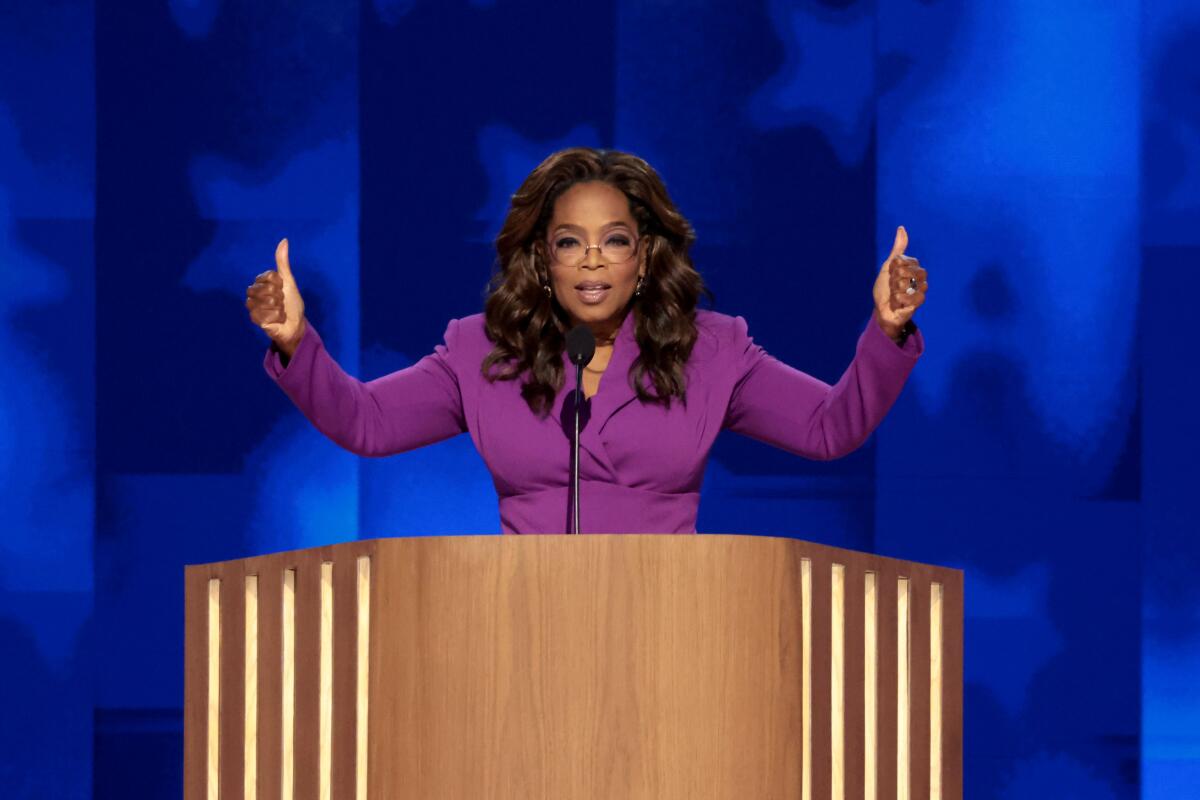
Media mogul Oprah Winfrey made a surprise appearance during the Democratic National Convention on Wednesday.
(Myung J. Chun/Los Angeles Times)
And while few stars these days wield her kind of influence, they can still have a potent voice.
“When a trusted source communicates about participating in our democracy in an authentic way, people are responsive,” said Ashley Spillane, who was author of a study by the Ash Center for Governance at Harvard University, which looked at efforts by celebrities like Billie Eilish and Washington to mobilize voters. It found that celebrities can have a powerful influence on the electorate — if the conditions are right. “The most important thing was that they were delivering a message to their community of fans in a way that felt on brand and authentic. As long as you are talking to people in your community in a way that is transparent and relatable, you can have a very significant impact,” Spillane said.
The Kamala-mania on display ever since Biden dropped out of the race last month, and especially over the last four days, has invited comparisons to Obama, who remains beloved by Hollywood and, since leaving the White House, has launched a successful Oscar-winning production company with his wife, Michelle, the former first lady.
The DNC offered a stark contrast with the Republican National Convention, where a scant handful of celebrities, most of whom peaked in the last millennium and have been mired in controversy, were supporting players in an event that was all about lavish displays of loyalty to one person: Donald Trump. There was Hulk Hogan, a man known for using the N-word in a sex tape; musician Kid Rock, who once flew the Confederate flags at his concerts, even though he is from Michigan; and Ultimate Fighting Championship President Dana White, who was caught on video slapping his wife last year. If speeches by Republicans other than Trump were memorable at all, it was for how shamelessly his former critics kissed the ring.
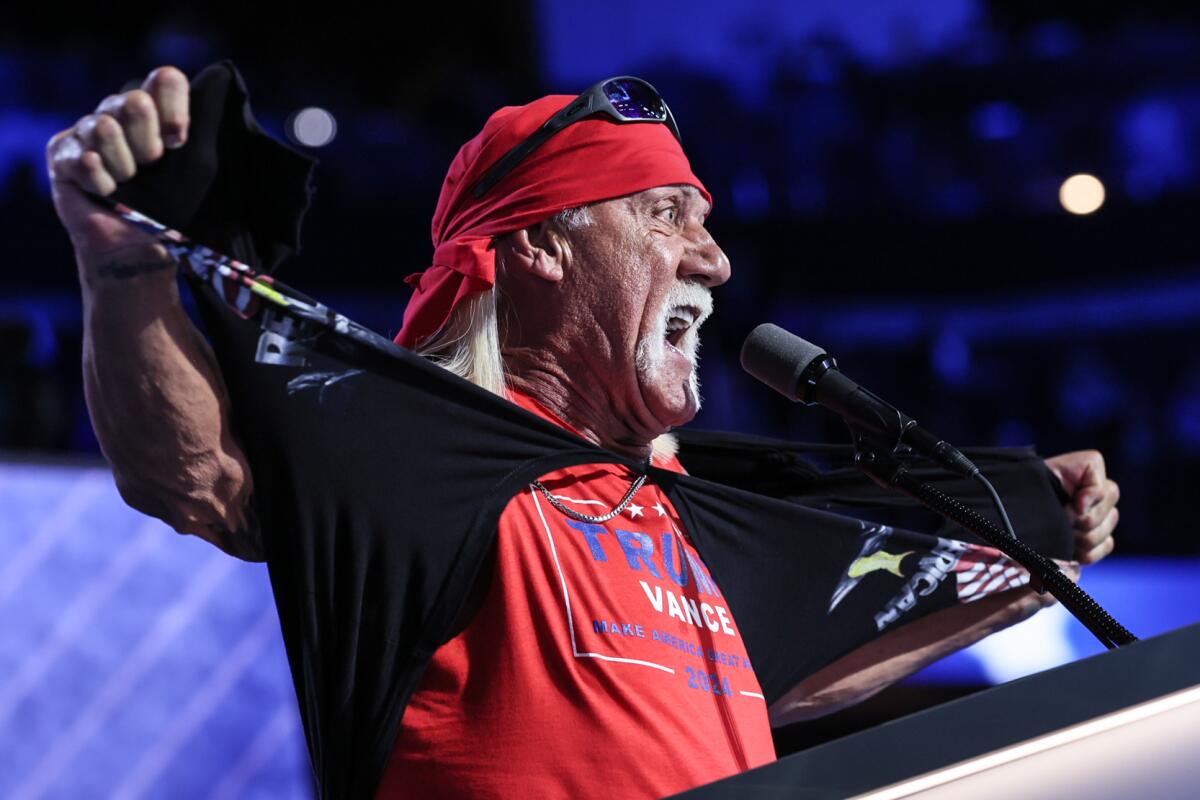
Hulk Hogan on the final day of the Republican National Convention in Milwaukee last month.
(Robert Gauthier/Los Angeles Times)
For all their professed disdain for “Hollywood liberals,” it is often the Republicans who appear to be more enthralled by celebrities, no matter how culturally irrelevant or low-wattage they might be. As long as they are willing to voice support for their party — and Trump in particular — any semi-famous person will do. The 2016 convention featured a cavalcade of names from a “where are they now?” special, including “Charles in Charge” star Scott Baio, “General Hospital” actor Antonio Sabato Jr. and former “Real World” cast member Rachel Campos-Duffy.
It’s telling that Trump and his running mate, JD Vance, were both reportedly motivated to take a hard right turn into politics after facing rejection from Hollywood and the liberal establishment. Trump, who resented how “The Apprentice” was snubbed at the Emmys and was known to exaggerate the show’s ratings — even to TV journalists — spent years teasing a presidential run. According to Roger Stone, he finally decided to get serious about a White House bid after getting brutally roasted by Obama and Seth Meyers at the 2011 White House Correspondents Dinner. Vance first made his name as a Never-Trump Republican who wrote a bestselling memoir, “Hillbilly Elegy,” that liberals read to understand the frustrations of rural white voters. But when the film adaptation, directed by Ron Howard, received a critical drubbing, it reportedly represented the “last straw” for Vance, who soon refashioned himself as a MAGA warrior and successfully ran for the Senate in Ohio.
Democrats have long had an edge when it comes to corralling big-name celebrities to their cause, said Roth. “If you look throughout history and election cycles, they’re doing a heck of a lot better than anyone on the other side is.”
Bill Clinton won the White House in 1992, fueled in part by his masterful use of pop culture, including a saxophone-playing appearance on “The Arsenio Hall Show.” Such was his power that Fleetwood Mac reunited for the first time in years to perform at his inauguration in 1993, a feat comparable to getting Beyoncé and Taylor Swift to sing together in public.
But there’s an inherent danger, particularly in a party criticized for elitism, in giving too much ground to big-name actors or musicians who may not exactly scream “salt of the earth.”
“I think it is a mistake to think about it as proximity to razzle-dazzle,” said Roth. Instead, the animating questions, she said, should be: “How can you deploy people for their incredible storytelling ability? How can you make sure that you’re connecting them to the issues and the people on the ground living the issues?”
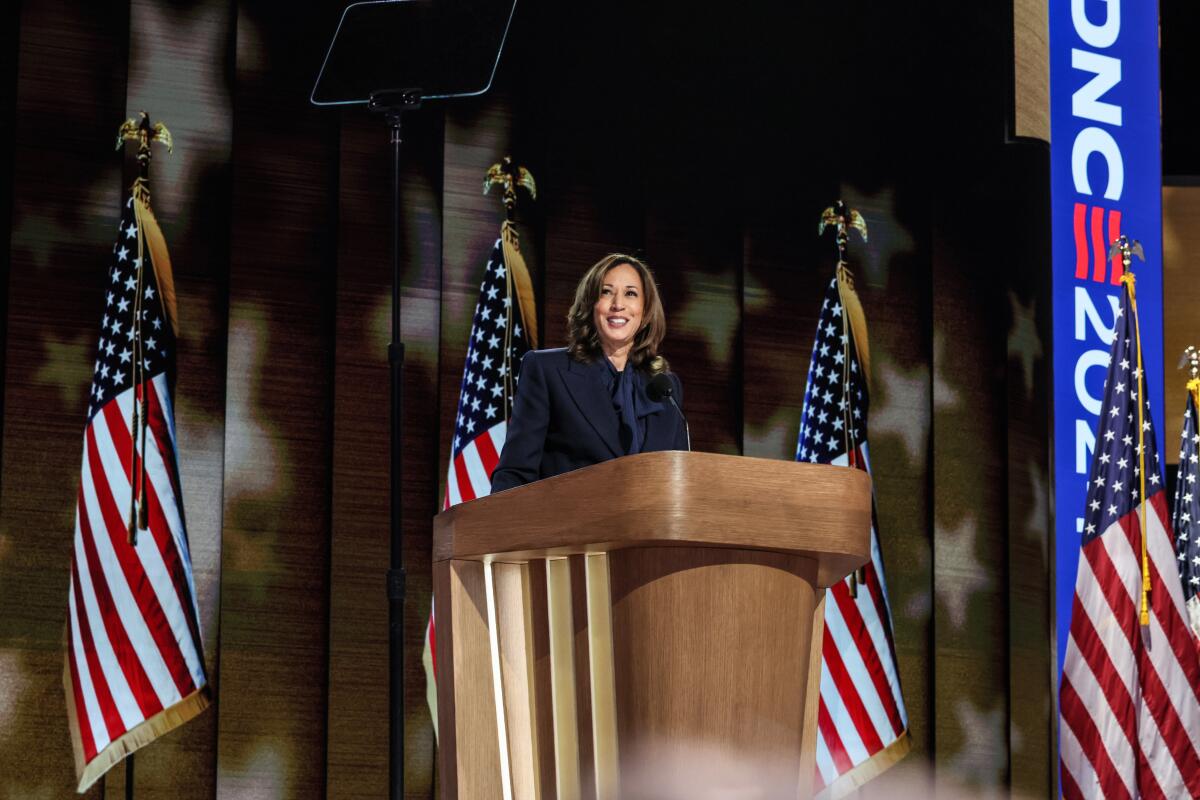
Vice President Kamala Harris on Thursday accepting the party’s nomination for president at the Democratic National Convention.
(Robert Gauthier/Los Angeles Times)
Biden had the support of Hollywood, at least behind closed doors at fundraising events, until the first debate in June when he delivered a performance so disastrous that showbiz allies like George Clooney called for him to drop out. When he eventually did July 21, the party quickly consolidated around Harris — and so did the stars, who have flocked to her candidacy with enthusiasm not seen since Obama‘s campaign in 2008.
Hours after Biden’s announcement, British pop star Charli XCX tweeted, “Kamala IS brat,” an apparent endorsement that triggered a flood of memes that delighted Gen Z while confusing their parents. And Harris’ first rally as the presumptive nominee, in Georgia, featured an appearance by Megan Thee Stallion. While stopping short of an explicit endorsement, Beyoncé provided the campaign not only with a theme song, but an inclusive slogan that sums up its stance on issues as diverse as abortion and gun violence.
The perceived value of an endorsement from Swift, who supported Biden in 2020 but has not yet weighed in on this year’s election, is so high that Trump shared fake images of the singer, dressed as Uncle Sam, with the message, “Taylor wants you to vote for Donald Trump.”
“Taylor Swift and Beyoncé have huge followings and fans who really enjoy being in community with one another. It’s natural to look for the places that and the people who can help you organize,” said Spillane, who is also founder and president of Impactual, a social impact agency.
DNC organizers didn’t let the bold-faced names overshadow the rising stars in the party — or its nominee. Now that the convention is over, it seems obvious why they wouldn’t have wanted Beyoncé or Taylor Swift to perform, even if the musicians had made themselves available: It would have undercut the air of normalcy and relatability the campaign fought so hard to cultivate. And instead of talking about Harris’ speech, fans would have been obsessing over Swift’s outfit and whether Travis Kelce was there, too.
The convention was in many ways less a showcase for celebrity activists than for the deep bench of talent in the Democratic Party, names like Rep. Alexandria Ocasio-Cortez of New York, Gov. Gretchen Whitmer of Michigan; Gov. Wes Moore of Maryland; and “Slayer Pete” himself, Secretary of Transportation Pete Buttigieg, whose speeches were all highly anticipated like top acts at a music festival.
“People are just happy to have a candidate that they can really get behind, and they’re happy to have the things that they care about articulated so clearly on stage,” Roth said.

The Supreme Court ruled 6-3 that President Trump could fire independent regulators for any reason. But the justices carved out an exception for the Federal Reserve, preventing the immediate removal of Lisa D. Cook, a Federal Reserve governor.
Politics
Emotion and feelings: How Democratic Socialists’ congressional insurgency could come back to bite them

NEWYou can now listen to Fox News articles!
Democratic Socialists of America are on the charge, running hot off their wins in the New York Democratic primaries last week. Their victories in multiple Congressional seats – felling both Reps. Adriano Espaillat, D-N.Y., and Dan Goldman, D-N.Y. – signals that the party is ready to move on from the same old, same old.
Espaillat chaired the Congressional Hispanic Caucus. Goldman was a key House staffer during the first impeachment of President Donald Trump.
“Even Dan Goldman’s not good enough for them,” said House Judiciary Committee Chairman Jim Jordan, R-Ohio, on Fox. “That is how radical it’s become.”
Some moderate Democrats are trying to distance themselves from the left.
MAMDANI-BACKED SOCIALISTS LOOK TO TAKE NEW YORK PLAYBOOK NATIONWIDE AFTER PRIMARY VICTORIES
The left flank of the Democratic Party has surged to the top of the nation’s most hotly-contested primaries. (Michael M. Santiago/Getty Images)
“That’s not the same brand of politics that we have. We’re not those type of Democrats,” said Rep. Tom Suozzi, D-N.Y., who represents a battleground district.
“There’s a new group of Democratic Socialists who are socialists who are not commonsense Democrats. Who are not interested in getting things done. They’re interested in throwing bombs. Not actually solving problems,” said Rep. Josh Gottheimer, D-N.J.
LURCHING LEFT: MAMDANI-BACKED CANDIDATES OUST ESTABLISHMENT DEMOCRATS
Some Democrats are worried how far left candidates command more attention than those in the middle. Rep. Kristen McDonald Rivet, D-Mich., worries that the outsized attention garnered by the left sends the wrong impression to voters.
“What they don’t want is divisiveness. They don’t want screaming and yelling,” said McDonald Rivet.
Mainstream Democrats feel trapped in the middle as the left – specifically the New York City left – wields an outsized media and political megaphone.
“Those candidates would not have won in Virginia where I live,” said Rep. Suhas Subramanyam, D-Va.
Rep. Tom Suozzi, D-N.Y., is among the moderate Democrats trying to distance themselves from the party’s insurgent wing. (Nathan Posner/Anadolu via Getty Images)
Republicans believe they are primed to nationalize the midterms. Republicans can do that by highlighting the extreme views of Democratic Socialists who captured primary victories in New York City. The GOP wants to portray their opponents as veering left.
“These are board-certified communists, right?” asked Sen. Roger Marshall, R-Kan. “They want no police. They want no private property.”
President Trump capitalized on the Democratic outcomes in his home city.
“The Democrat party is in big trouble because this isn’t stopping with New York,” he forecast.
VICTORIES BY MAMDANI-BACKED CONGRESSIONAL CANDIDATES SPOTLIGHTS GROWING RIFT IN DEMOCRATIC PARTY
This shakeup has progressive leaders demanding transformation at the top.
“You’re going to see, I think, people voting for new leadership and to change their representation,” said Rep. Alexandria Ocasio-Cortez, D-N.Y.
The Democratic Party tapped Sen. Elissa Slotkin, D-Mich., to deliver their official response to President Trump’s 2025 State of the Union speech. Slotkin is a moderate who won in a battleground race in 2024 – even as the President prevailed in the Wolverine State. But during an appearance on SiriusXM, Slotkin insists on a Democratic Party management switch.
“If people can’t understand that the game has fundamentally changed and they can’t adapt, then they need to let others,” said Slotkin. “The old models do not work for people.”
House Minority Leader Hakeem Jeffries, D-N.Y., is perceived by Republicans as vulnerable after his preferred candidates failed in their congressional primaries. (Roberto Schmidt/Getty Images)
Republicans believe House Minority Leader Hakeem Jeffries, D-N.Y., is vulnerable after the DSA elected their candidates over his preferred picks in New York City.
“I think Hakeem Jeffries’ friends and neighbors gave him a big middle finger,” said House Oversight Chairman James Comer, R-Ky. “If you lose three elections in your hometown, that’s a pretty big slap in the face.”
He added that Democrats “are going further and further to the left to the point where they are full-blown, card-carrying socialists.”
And then there is the anti-Israel, anti-Jewish, and in some cases, antisemitic take by some of these candidates. Rep. Greg Landsman, D-Ohio, is a moderate Democrat from a swing district. He’s Jewish and one of the most pro-Israel Democrats in the House.
“There are some on the left who use Israel the way that some on the right use immigrants or trans kids as a way to divide. And I think it’s terrible. It’s also just not what voters want us talking about,” said Landsman.
HOUSE DEMOCRAT LASHES OUT WHEN GRILLED ON WHETHER SOCIALIST VICTORIES WOULD THREATEN DEM UNITY
Yours truly tangled with Rep. John Larson, D-Conn. – who once chaired the House Democratic Caucus. I pressed him about what the party would do about some candidates “who are too far to the left.”
“What does that mean? That’s your statement. Did the people of New York vote?” queried Larson.
I assured him that they did.
“Is that democracy?” asked Larson.
“But if some of them are antisemitic,” I countered.
“Is that a democracy?” continued Larson.
“Will you stand by people if they have antisemitic views?” I followed up.
Larson finally addressed my inquiry. His answer crystallized the schism the Democratic Party now faces.
“I’m against antisemitism, if that’s your question,” Larson declared.
Rep. John Larson, D-Conn., got into a heated exchange with Fox News’ Chad Pergram over the views of some likely members of his party’s next freshman class. (Bill Clark/CQ-Roll Call, Inc via Getty Images)
The fact that Democrats are now facing this debate robs them of valuable time on economic issues.
Landsman argued that voters would prefer candidates to stick to groceries and the price of gas.
Gottheimer echoed Landsman on kitchen table subjects.
“We should be focused on ways to actually solve problems like that. Not coming in here and using tea party tactics and trying to divide up the country and pray to socialist ideals,” said Gottheimer.
So what is the party to do?
DEMOCRACY ’26: STAY UP TO DATE WITH THE FOX NEWS ELECTION HUB
“They’re our nominees. We’re going to support them. We’re going to welcome them. They’re going to be part of our caucus and we’re going to unite behind Leader Jeffries,” said Rep. Robert Garcia, D-Calif., the top Democrat on the Oversight panel.
But that doesn’t address the fissures. It doesn’t address how voters may perceive the party. And it doesn’t establish if these new Democratic nominees will work on behalf of the party to raise money and advocate for Democrats across the board. Or, will they become professional bomb throwers – ala what the right has endured for a while.
“It’s going to be a lot harder to get things done when you get more and more extreme candidates who are here because they’re interested in political celebrity. They are interested in fighting. They’re interested in making points,” asserted Rep. Dusty Johnson, R-S.D.
Republicans have had an abysmal week themselves – President Donald Trump and Sen. Bill Cassidy, R-La., for instance, got into a shouting match over Iran. (Chip Somodevilla/Getty Images; Tyler Kaufman/Getty Images)
Republicans suffered through an absolutely abysmal week. House GOP leaders had to yank multiple bills off the floor and send lawmakers home early because of internal disputes. President Trump and Sen. Bill Cassidy, R-La., got into a shouting match about Iran. And the president even threatened to veto a bipartisan housing bill. President Trump then refused to sign the bill at the Capitol, despite his aides touting the bill and House Republicans tricking out Statuary Hall for a signing ceremony.
The President characterized the housing bill as “a yawn.”
But the Democrats’ internal fractures may have superseded any internecine fighting among Republicans.
“While it’s not been a great week for Republicans, I think it’s been a much worse week for Democrats because of these primary elections,” observed Rep. Mario Diaz-Balart, R-Fla.
CLICK HERE TO DOWNLOAD THE FOX NEWS APP
Democrats will certainly run on economic issues and capitalize on statements by the President about basic issues like housing. But will a genuine policy debate outweigh fears about progressives nationwide?
Emotion and feelings rule in politics. And it could be a problem for Democrats if Republicans appropriate what happened in New York and Xerox it onto battleground districts across the country.

Anthropic teamed up with California to get more state workers to use its artificial intelligence assistant Claude as part of an effort to leverage technology to make the government more efficient.
Gov. Gavin Newsom, who announced the partnership on Monday, said state agencies will be able to access Claude at a 50% discount. Free training and other assistance will also be available to the workers. California’s local governments will also get the same discount under the agreement.
Government workers can use Claude to draft and summarize documents, analyze information and do other tasks.
Anthropic, an AI company based in San Francisco, has a version of its AI assistant for government clients that provides more security than what it provides other consumers.
The new partnership shows how AI is playing a bigger role at work as tech companies market their tools as ways to complete tasks more quickly. Last year, San Francisco made Microsoft 365 Copilot Chat, which is powered by OpenAI’s model, available to nearly 30,000 city employees.
Still, the rise of automation at work has heightened concerns that people will lose their jobs. There are also worries that there are not yet adequate guardrails in place to mitigate data privacy and security risks.
Anthropic and the governor said that they’re focused on the responsible use of AI.
“AI should not replace the human work of government; it should help our workers move faster, solve problems more effectively, and deliver better results for Californians,” Newsom said in a statement.
The remarks didn’t appear to comfort union leaders.
“Wow. Look local government, the Gov is giving you a 50% off coupon to give up your residents’ private data, outsource your jobs to big tech. Isn’t that cool? Because California basically invented AI slop!” said Lorena Gonzalez Fletcher, president of the California Federation of Labor Unions, AFL-CIO, in a post on X.
Anthropic has faced political hurdles as it pushes to get more companies and government agencies to use its products.
Most notable, it’s sparred publicly with the Trump administration, which ordered the company to cut off foreign access to its most powerful AI systems this month.
The Trump administration cited potential national security risks, but Anthropic disagreed with the findings. Last week, tensions decreased after the U.S. government gave Anthropic permission to restore access to its AI model Mythos to certain clients.
Valued at nearly $1 trillion, Anthropic has also signaled it plans to become a publicly traded company.
California has already started using Claude more in state government to develop tools to get the public to engage more in AI policy discussions and assist state workers, the governor’s office said in its news release.
State agencies, including the Department of Motor Vehicles, are also using AI to reduce wait times and improve customer service.
“As state employees, our goal is to provide our fellow Californians with the best possible service,” Government Operations Agency Secretary Nick Maduros said in a statement. “To do that, we need to make sure our teams have access to the best modern tools, including Claude and other emerging technologies.”
-

 New York1 hour ago
Metropolitan Diary Challenge Day 2: How to Write Your N.Y. Story
-

 Los Angeles, Ca1 hour ago
Company has weeks to complete cleanup of Boyle Heights warehouse fire, officials announce
-

 Detroit, MI2 hours ago
18 New Kid-Friendly Places That Opened in Metro Detroit in 2026 (So Far!)
-

 San Francisco, CA2 hours ago
Anza expedition celebrates 250th anniversary in San Francisco
-

 Dallas, TX2 hours ago
Preston Hollow residents oppose proposed $800 million mixed-use development in Dallas, survey reveals
-

 Miami, FL2 hours ago
Bradley Beal to Miami Heat rumors draw skepticism
-

 Boston, MA2 hours ago
Boston Pops surprise travelers at Logan Airport with July 4th preview performance
-

 Denver, CO2 hours ago
Denver Broncos Crack Top 10 in NFL Uniform Rankings

