News
Newly released video shows chaos and confusion after Trump assassination attempt


Law enforcement at former President Donald Trump’s Butler, Pennsylvania rally on July 13 are captured on body camera footage carrying out one of the wounded victims from the assassination attempt on Trump.
Butler Township Police Department
hide caption
toggle caption
Butler Township Police Department
Newly released body camera video reveals the chaotic law enforcement response to the assassination attempt on former President Trump last month.
The footage obtained by NPR shows what was seen by the local officer who encountered the gunman moments before the shooter opened fire at the July 13 rally in Butler, Penn.
The video shows the officer’s point of view as he runs toward the building where the gunman had taken position on the roof. A fellow officer hoists him up, and the officer peeks over the roof.
The encounter lasts just a split second, then the officer immediately drops back down, hits the ground and runs to the other side of the building.

One officer gestures to his colleague to hoist him up so he can gain access to the roof. It’s there that he encounters the gunman.
Butler Township Police Department
hide caption
toggle caption
Butler Township Police Department
The video has no audio, because the officer, at this point, didn’t activate his body cam and it was only recovered after the fact, the Butler Township Police Department said.
A timeline from law enforcement indicates that moments following this encounter the gunman began shooting.
About a minute passes while the officer runs from his encounter with the shooter, to the side of the building and back to his car to load a long gun he has in his back seat. At this point the officer hits record on his body camera and audio begins. The officer, whose name was not released, then directs other arriving officers on the scene.

The officer who encountered the shooter recounts to arriving law enforcement: “This close. Bro, dude, he turned around on me.”
Another officer asks where the shooter is. The officer who saw him says, “He’s straight up! Right where you picked me up, bro? He was on that left side.”
He describes the gunman having “glasses, long hair. He’s got a book bag, he’s got mad s***.”
As he is doing this his body camera captures a number of law enforcement officers attempting to reach the roof. Shouts for a ladder can be heard while other officers are trying to hoist each other onto the rooftop.
Officers continue to shout over each other for several minutes and some officers make it onto the rooftop.

A number of law enforcement officers converge on the building where the gunman is shooting from the roof.
Butler Township Police Department
hide caption
toggle caption
Butler Township Police Department
A 50-year-old former fire chief, Corey Comperatore, was killed and two other rally-goers were seriously wounded in the attack. Trump was struck in the ear.
The shooter was killed by the Secret Service.
In the aftermath, one video captures another local police officer wondering out loud why no law enforcement had been stationed on that roof.
That question is still unanswered as law enforcement, including the Secret Service, cite an ongoing investigation. In late July, the director of the U.S. Secret Service Kimberly Cheatle resigned from her post following criticism of the agency’s handling of the incident from members of Congress.
Footage shows the immediate aftermath of the gunman’s killing

Law enforcement officers attempt to reach the rooftop where the gunman was shooting from.
hide caption
toggle caption
The officer who first encountered the gunman on the roof volunteers to be lifted back up there by other officers struggling to get up, according to the footage.
On the rooftop, he joins three police officers — at least two of whom are heavily armed wearing camouflage, vests, boots and long guns — who surround the shooter’s body. One officer keeps his gun trained on the body.
A long trail of what appears to be blood can be seen.
One officer handcuffs the gunman and turns him over as they wait for more officers to arrive.
A backpack can be seen near the body.
One of the officers in camo says near the end of the 26 minute long video, “So much for a picture with Trump.”
Other videos capture confusion at different points
Additional footage released by the Butler Township Police capture officers at different points across the fairgrounds and during the aftermath of the shooting.
A nearly 22 minute long video shows the vantage point from the back of the rally grandstands, just behind where Trump was speaking. The video has no audio, but the footage offers a hauntingly silent look at the chaos that unfolded once the shooting began.
The officer takes cover and does not run to respond to the shooting. It’s unclear what his orders were or what he says to other officers around him also milling about with their guns drawn.
About six and a half minutes into the video, a group of officers carry an injured person by each limb and disappear into a white tent behind the grandstands.
A separate video from an officer outside the building where the gunman fire from underscores the confusion even among law enforcement early on.
One officer says, “I thought it was you! I thought you guys were on the roof!” He swears seemingly in frustration and asks, “Why are we not on the roof?”
Later he laments, “Whenever they saw him … they should have called us earlier.”




BOSTON (AP) — A federal judge on Thursday halted President Donald Trump’s executive order that sought to create a federal voter list and limit who can receive a mail ballot.
U.S. District Court Judge Indira Talwani, who was nominated by Democratic President Barack Obama, sided with a coalition of nearly two dozen states that challenged the Republican president’s order in granting a summary judgment. Her ruling applies to this year’s midterm election cycle.
Plaintiffs argued in two lawsuits, both filed in federal court in Boston, that Trump’s order should be found unconstitutional because the states and Congress, not the president, have the power to set election rules. The judge agreed, noting in her ruling that the provisions of Trump’s order “unconstitutionally violate the separation of powers.”
It was the second ruling in as many days against executive orders Trump has signed seeking oversight of the nation’s elections. A separate ruling Wednesday prohibited an executive order he had signed last year that would have required people to show documents proving their citizenship when registering to vote.
The administration, in its motions to dismiss the lawsuits challenging the order seeking to establish a federal voter list, argued that the motions are premature and that plaintiffs lacked the legal basis to bring their claim based on the Administrative Procedure Act, which governs how federal agencies develop and issue regulations.
But in an interim order before Thursday’s ruling, Talwani said the motions pertaining to this year’s election cycle were relevant: “In light of the EO’s specific deadlines over the next three months, and the reality that elections will be occurring throughout this period with the November 3, 2026 midterm occurring in just five months, postponing judicial review is impracticable and may inflict significant hardship on Plaintiffs,” she wrote. That order denied the Trump administration’s motion to dismiss the challenges.
Trump’s executive order, the second one aimed at elections during his second term, comes as he continues to raise the specter of widespread voting by noncitizens as a reason to change election rules. But states already have detailed processes aimed at keeping their voter rolls accurate, and voting by noncitizens has been shown to be rare. It also is a felony that can be punishable by deportation.
Trump issued his second order in March after a bill he supported to overhaul voting stalled in Congress. The order would have had the federal government create a list of eligible voters and then directed the U.S. Postal Service to deliver mail ballots only to those on the list. Election officials argued that it was ripe for abuse and could cause chaos, and the postal union has objected to the idea of mail carriers policing ballots.
The Postal Service has published a proposed rule required by Trump’s executive order in the Federal Register. Among other things, the rule would not apply to primary elections or overseas ballots.
The lawsuit seeking summary judgment was filed by Democratic attorneys general representing 22 states and the District of Columbia. Also signing on were attorneys representing Democratic Gov. Josh Shapiro of Pennsylvania, which has a Republican attorney general.
The states also told the court that the move imposes a costly burden on election officials to comply and would spread fear about the possibility of prosecution. Stephen Pezzi, a lawyer for the Trump administration, had argued that no one would be prosecuted for violating the order.
In a separate lawsuit filed against the executive order, a federal judge in Washington, D.C., in May agreed with the Trump administration that it was too early to block the order because it had yet to be implemented. That lawsuit was brought by Democratic and civil rights groups, who have appealed.
Since his 2020 presidential election loss to Democrat Joe Biden, Trump has groundlessly claimed mail voting is rife with fraud and has launched a federal investigation into that year’s vote, even though repeated audits and investigations, including ones run by Republicans, found it was free of widespread fraud. Trump also has said he wants to “take over” election administration in Democratic areas.
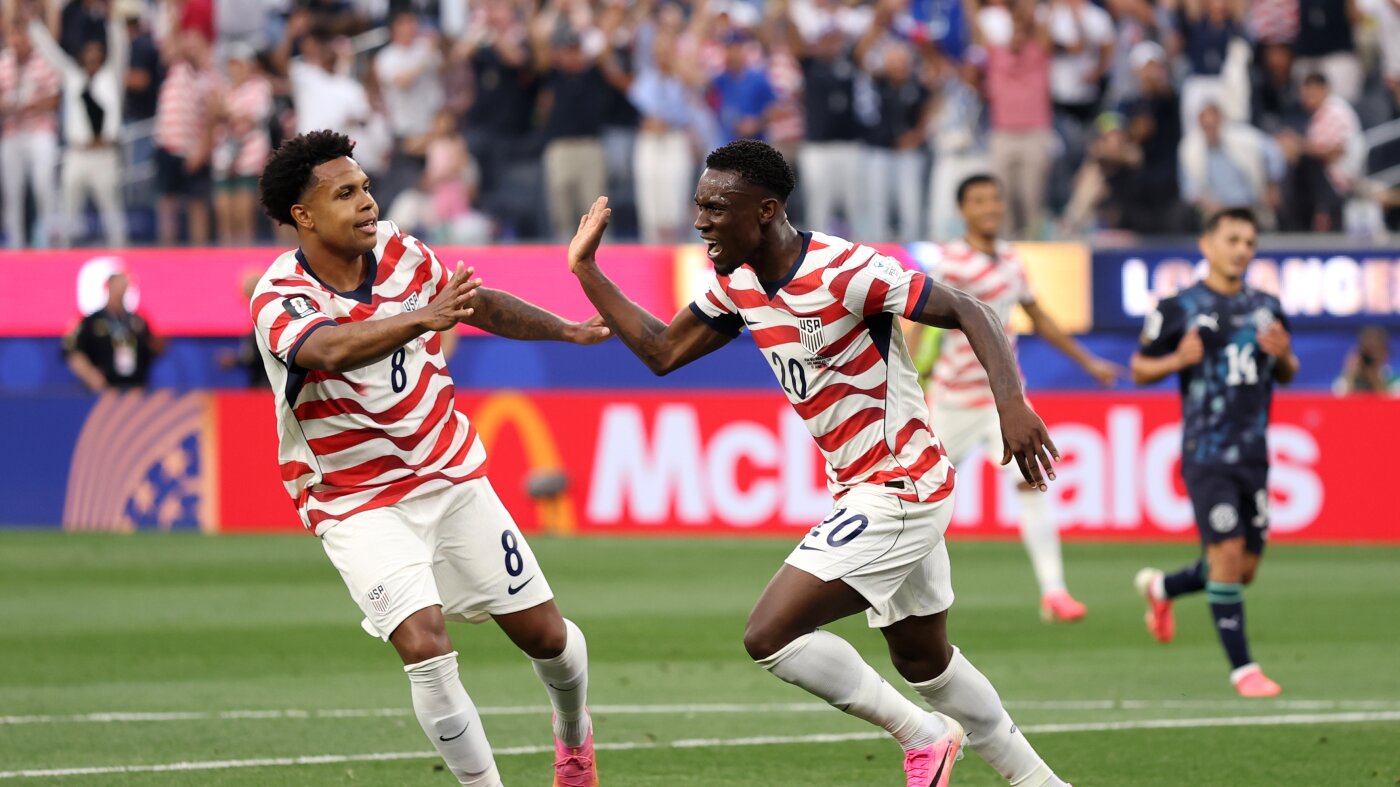
Folarin Balogun (r) of the U.S. celebrates scoring his team’s second goal with Weston McKennie during their World Cup match against Paraguay on June 12 in Inglewood, Calif. The U.S. defeated Paraguay and, later, Australia. The U.S. wraps up group play against Turkey on Thursday evening. Win, lose or draw, the U.S. has already won its group and will advance to the knockout round.
Richard Heathcote/Getty Images
hide caption
toggle caption
Richard Heathcote/Getty Images
INGLEWOOD, Calif. — For the U.S. men’s national soccer team, a loss in Thursday night’s FIFA World Cup game against Turkey wouldn’t change anything.
A win, though, would be history.

The squad’s earlier wins over Paraguay and Australia, plus two losses by Turkey to the same teams, mean the Americans have already won their group and clinched a favorable path in the knockout round, no matter the outcome of Thursday’s game.
But the American men have never won more than two games in a single World Cup. A third win would be new territory for this team, which has not been shy about its aspirations in this tournament and its confidence about living up to them.
“The group stage is not done yet. We want to end it the right way. We want to end it the way we came into it and continue to build off of the momentum that we’ve been creating,” said defender Mark McKenzie, speaking to reporters Wednesday.

Because the outcome of the game does not affect knockout-round placement, the U.S. can rest key starters who will enter the match with a yellow card. For those players — defenders Antonee Robinson and Chris Richards, midfielder Tyler Adams and forward Folarin Balogun — picking up a second yellow card against Turkey would result in a suspension in the Round of 32. (Any single yellow cards will be cleared after the group stage concludes.)
The team could also choose to ease in forward Christian Pulisic, who is expected to be available for the game after sitting out the U.S.-Australia game with a minor calf injury.
Turkey had come into the World Cup with high expectations. With talented young stars like the 21-year-old attackers Arda Güler of Real Madrid and Kenan Yildiz of Juventus, the team was thought by many — from analysts to the players themselves — to be a dark horse capable of a deep run.
Instead, they were eliminated last week when their loss to Paraguay followed the U.S. win over Australia, prompting apologies from Turkey’s despondent players to their fans after the game.
On Wednesday, Yildiz echoed that apology and promised to “give our best” in Thursday’s game against the U.S. “We had high expectations. I know because all of our country was supporting us and thought we will come very far,” Yildiz said. “Hopefully for the next game we can make a good result and go out with pride.”
The U.S. and Turkey last faced each other in an international friendly in June 2025, which Turkey won 2-1. The U.S. roster for that game was missing several key players, including Pulisic, Robinson, Balogun and midfielder Weston McKennie.
“We had a really young team, but we went out there and put in a good performance. I don’t think the result necessarily reflected how we played,” Richards said. “Whoever’s on the field, I know we’re going to go out there and give 110 percent.”

A federal judge on Wednesday permanently barred President Donald Trump’s administration from implementing most of his first executive order on elections, part of which sought to require people to show documentary proof of citizenship when they register to vote.
The ruling by U.S. District Court Judge Denise Casper in Boston effectively converts a preliminary injunction she issued a year ago, in which she temporarily blocked many of Trump’s efforts to overhaul elections, into a permanent ban.
Casper rejected the Republican administration’s argument that the lawsuit to block the changes brought by Democratic state attorneys general was premature because the rules had yet to be put in place. Instead, she agreed that the Constitution gives states and Congress the authority to regulate elections, and that Trump’s requirements violated the separation of powers.
The Constitution “does not grant the President any specific powers over elections,” wrote Casper.
Among other proposed changes, Trump’s order would have required people to provide documentary proof of citizenship when registering to vote, prevented mail ballots from being counted if they arrive after Election Day, even if they were postmarked by then, and punished states that failed to comply by withholding certain federal money.
In a statement, New York Attorney General Letitia James said she was grateful the court had blocked Trump’s “unconstitutional attempt to seize control of our elections” and would continue to defend voting rights in this year’s midterm elections.
“Generations of Americans fought tirelessly for the right to vote, and we honor their legacy by protecting that right against anyone who tries to undermine it,” said James, a Democrat.
A voter casts a ballot during New York’s primary election on Tuesday, June 23, 2026, in New York. (AP Photo/Ryan Murphy)
California Attorney General Rob Bonta, whose state was the lead plaintiff in the case, said the ruling reaffirmed the constitutional principle that it s up to the states and Congress to set election rules.
“While we are proud of this result, we are clear-eyed that President Trump’s attacks on voting rights and our elections show no signs of slowing down,” Bonta, a Democrat, said in a statement. “So let me be clear: we will keep fighting back every step of the way.”
Requests for comment sent to the White House and he U.S. Department of Justice were not immediately returned.
The ruling was the latest in a series against the elections executive order Trump signed just months after taking office for his second term. The Republican president has since signed another executive order on elections that seeks to create a national voter list and limit mail balloting. That directive also faces multiple legal challenges.
Last fall, a federal judge in Washington, D.C., overseeing a separate challenge to the first election executive order by civil rights and Democratic Party-aligned groups blocked the government from taking steps to include the proof-of-citizenship requirement on the federal voter registration form. That judge later barred Trump’s defense secretary from requiring documentary proof of citizenship when military personnel register to vote or request ballots.
In an apparent nod to the difficulty of implementing a proof-of-citizen requirement by executive order, Trump is pushing legislation in the Republican-controlled Congress to create such a mandate. The SAVE America Act has passed the House but has stalled in the Senate, leading Trump to advocate for eliminating the filibuster that is blocking the legislation.
On Wednesday, he abruptly canceled the expected signing of a bipartisan housing bill, saying he would not sign legislation until Congress passes his proof of citizenship requirement for voting.
The president and many of his Republican allies have been promoting the narrative that voting by noncitizens is a major problem, when in fact it’s quite rare. The federal voter registration form already requires people to attest that they are U.S. citizens. Violating that is punishable as a felony that can lead to prison or deportation.
In another major voting case, the U.S. Supreme Court is due to issue an opinion soon on whether mail ballots must arrive by Election Day. That could immediately change the rules in 14 states that allow grace periods ranging from days to weeks if the ballots are postmarked by Election Day.
Casper, who was nominated by Democratic President Barack Obama, is the chief judge for the U.S. District Court for the District of Massachusetts.
-

 Michigan1 minute ago
Michigan president has strong words for college sports after Dusty May exit
-

 Massachusetts8 minutes ago
Mass. lawmakers prioritizing 100 high-risk locations to implement wrong-way driving prevention measures – Boston News, Weather, Sports | WHDH 7News
-

 Minnesota11 minutes ago
Rationalizing Charlotte’s Shocking Decision to Trade LaMelo Ball to Minnesota
-

 Mississippi16 minutes ago
Mississippi Legislature will talk school choice, redistricting in 2027
-

 Missouri23 minutes ago
Missouri Highway Patrol investigating KCPD officer involved shooting
-
Montana26 minutes ago
Montana DEQ works toward impairment designation for Big Hole River
-

 Nebraska31 minutes ago
Tunnel Talk: 5-for-5 impact on Nebraska volleyball, reseat update
-

 Nevada38 minutes ago
Terrible’s takeover of Primm gets Nevada regulatory approval

