ROCKLAND, Maine — Noah Barnes can’t sell bunks aboard his schooner fast enough. The ones unoccupied by his staff, anyway.
Barnes, the owner and captain of the 153-year-old Stephen Taber, said demand for multiday voyages off Rockland has been “as good as the Clinton years.”
“Typically in election years and times of uncertainty, we see a little bit of a dip” as people hesitate to plan vacations, he said in late June as the turbulent presidential race ramped up. “We haven’t seen any of that.”
rockland maine vacationland (Michael G. Seamans for NBC News)
Even so, several bunks on the 115-foot-long ship, with room for 22 guests and up to six crew members, double as housing for employees like Grey Litaker. Litaker, 40, cooks in restaurants during the rest of the year but works and lives rent-free on the vessel in the summer because onshore rentals are “phenomenally expensive.”
Advertisement
“Staying on the boat just made economic sense,” Litaker said.
Barnes, who’s putting up two other workers aboard the Stephen Taber full time this summer, said finding onshore housing for seasonal staff members used to be easier.
He’d love to keep his best employees on the payroll year-round for “continuity,” but it feels out of reach: “A lot of that has to do with how difficult it is to find a place to live that you can afford in this ‘Vacationland’” — the nickname emblazoned on state license plates.
rockland maine vacationland (Michael G. Seamans for NBC News)
A market squeezed at both ends
Maine’s housing crunch isn’t new, and it’s hardly unique in the U.S. Affordable housing shortages are crimping hiring in South Florida and Nashville, Tennessee, Atlanta Fed researchers said this summer. And many outdoorsy travel spots have grown so popular that service workers and wealthy homebuyers alike have been priced out.
But Maine encapsulates a dilemma at the heart of the U.S. economy, months from an election that may hinge on it. A massive wave of consumer spending — especially on leisure — has powered the pandemic rebound, yet surging shelter costs continue to prop up inflation, weighing down growth along with households’ economic outlooks.
Advertisement
“Even prior to the pandemic — where we’ve seen this influx of individuals coming to Maine and prices really, really driving up — we were on an upward trajectory of housing costs,” said Kelsi Hobbs, an assistant professor of economics at the University of Maine.
rockland maine vacationland (Michael G. Seamans for NBC News)
State home values rose more slowly than in the rest of the country from 2017 to 2022, and Maine’s nearly 74% homeownership rate outstrips the nation’s at 65%, the latest Maine housing data show.
But the state’s distinct challenges ramped up “really in the last decade,” Hobbs said, as its residential market got squeezed from both ends, with strong demand vying for tight supply.
Just 1.6% of Maine homes were available to rent or buy as of 2022, lower than the 2.5% national average, and Vacationland is packed with vacation pads — both seasonal rentals and privately owned properties. The state data shows 16% of its homes sit empty for parts of the year, compared with 3.5% nationwide.
Advertisement
Maine’s housing stock, like its population, also skews old. Just 6% was built from 2010 to 2019, compared to 9% nationally, while 60% predates 1980, well above the 48% U.S. average, and Hobbs said much of it is in disrepair.
rockland maine vacationland no trespassing sign abandoned house (Michael G. Seamans for NBC News)
Some of that is changing. A recent homebuilding spurt has helped boost inventories, TD Bank analysts said in June, but Maine still has “lower than average supply levels, which we expect will lead to above average price gains in 2024.” The state’s rental availability has lagged the nation’s since 2019, and nearly half of tenants are “cost burdened,” spending at least 30% of their income on housing.
“It’s a really big worry,” Hobbs said. “You cannot have a strong and prosperous economy without affordable housing.”
Unlike other parts of Maine, where populations swing sharply with seasonal tourism, the state’s Midcoast region, which includes Rockland, has plenty of full-time residents, said Shannon Landwehr, who leads the Penobscot Bay Regional Chamber of Commerce.
“There are people who want to work, who want to be here — want to live here, want to be part of the businesses that are here — who are struggling to find the housing,” she said.
Advertisement
Landwehr worries about sustaining the “diversity of the population” needed to power the economy and keep the area desirable for both residents and visitors if the problem deepens: “We’ll start to see kind of a division, if you will, of who’s here.”
rockland maine vacationland deckhand worker (Michael G. Seamans for NBC News)
Housing as a hiring problem
Maine hosted 8.5 million visitors last year, netting an estimated $16 billion in economic impact. Already, frustrations around wealthy vacationers’ driving up local living costs are colliding with opposition to workforce housing projects — tensions that could deepen political divides.
Maine and Nebraska are the only states that can apportion their Electoral College votes to multiple presidential candidates. Vacationland has delivered a split only twice — in 2016 and 2020, with its rural upstate district backing Donald Trump both times and the more affluent coastal one supporting first Hillary Clinton and then Joe Biden.
Service-sector employers like Barnes say they’re focused on keeping prices affordable for customers. Among the Stephen Taber’s guest bookings this year, “we’ve got pilots, and we’ve got lab techs, and we’ve got plumbers, and we’ve got cable installers,” he said. “It’s everybody.”
Eleven miles south of Rockland, nightly rates at the Craignair Inn by the Sea start at around $200, little more than $40 above the national average. Like Barnes, owner Greg Soutiea said business has been good — even though he’s also housing some of his workers.
Advertisement
rockland maine vacationland (Michael G. Seamans for NBC News)
Yearly sales at the 21-room hotel and restaurant have surged more than 500% since Soutiea bought the property in 2018, he said. Bookings this summer are already on par with the last two, when people’s discretionary “revenge spending” was booming.
But “housing has been a significant challenge for not only our staff but ourselves as restaurant owners,” said Soutiea, who employs about 25 people in the offseason and 50 during the summer peak. The issue limits the pool of candidates who “can commute in a reasonable amount of time and who can work year-round,” he said.
About three years ago, Soutiea bought a four-unit building in downtown Rockland to rent to employees at below-market rates. He now owns three properties with a total of 10 rental units, eight of which are set at levels allowing someone earning 80% or less of the area’s median income to spend no more than a third of their pay on housing, a common measure of affordability.
Five of his rentals are occupied by full-time employees, with another four workers — three seasonal ones and a year-rounder — living in the Craignair itself.
Soutiea said becoming an employer-landlord has “definitely been a significant driver in staff retention.” Even so, he still has only enough workers to keep the inn’s 95-seat Causeway restaurant open five nights a week.
Advertisement
Shannon Dennison, 38, a mother of three who heads up housekeeping at the inn, has rented one of Soutiea’s two-bedroom apartments for $1,250 a month for about a year. Before then, Dennison, who grew up in the area, had “thought about moving out of state” as housing costs surged.
rockland maine vacationland shannon dennison (Michael G. Seamans for NBC News)
Dennison recalled paying $750 a month for a two-bed as recently as 2015, and she said renting from her boss has been a lifeline for her and her husband. “If we were to rent from anyone else, we both would have to work two jobs,” she said.
State lawmakers have been trying to shift the equation. In 2022 and 2023, Maine’s Legislature passed a pair of bills loosening zoning restrictions to allow for greater housing density and to streamline approvals to build accessory units. The state has also poured tens of millions of dollars into subsidizing affordable housing construction, and it launched a rent-relief pilot program for low-income tenants this spring.
rockland maine vacationland schooner tourists (Michael G. Seamans for NBC News)
In the meantime, Landwehr said, calculations like Dennison’s and Soutiea’s — about how much to work to stay housed and how much to invest in housing to stay staffed — aren’t uncommon. But while the problem is urgent, it attests to a thriving economy.
“We’ve got people interested in this community,” she said. “Now we just need to find the right ways to support that.”
Advertisement
This article was originally published on NBCNews.com
Join Girl Scouts of Maine for a sweet summer stop you won’t want to miss!
We’re popping up at local ice cream shops around Maine for our Ice Cream Socials—fun, casual events where families can enjoy a free treat and learn more about Girl Scouts.
Here’s what to expect: 🍦 One FREE kid-sized cone per family when you stop by and connect with us 🌱 Hands-on activity for kids (like a planting activity or fidget spinner craft) 💬 A chance to chat with our team and learn how Girl Scouts builds confidence, friendships, and unforgettable experiences
Whether you’re curious about joining, looking for activities for your child, or just want to enjoy a sweet treat, we’d love to meet you!
Advertisement
✨ Open to all families—no registration required. Just stop by, say hello, and enjoy some ice cream with us.
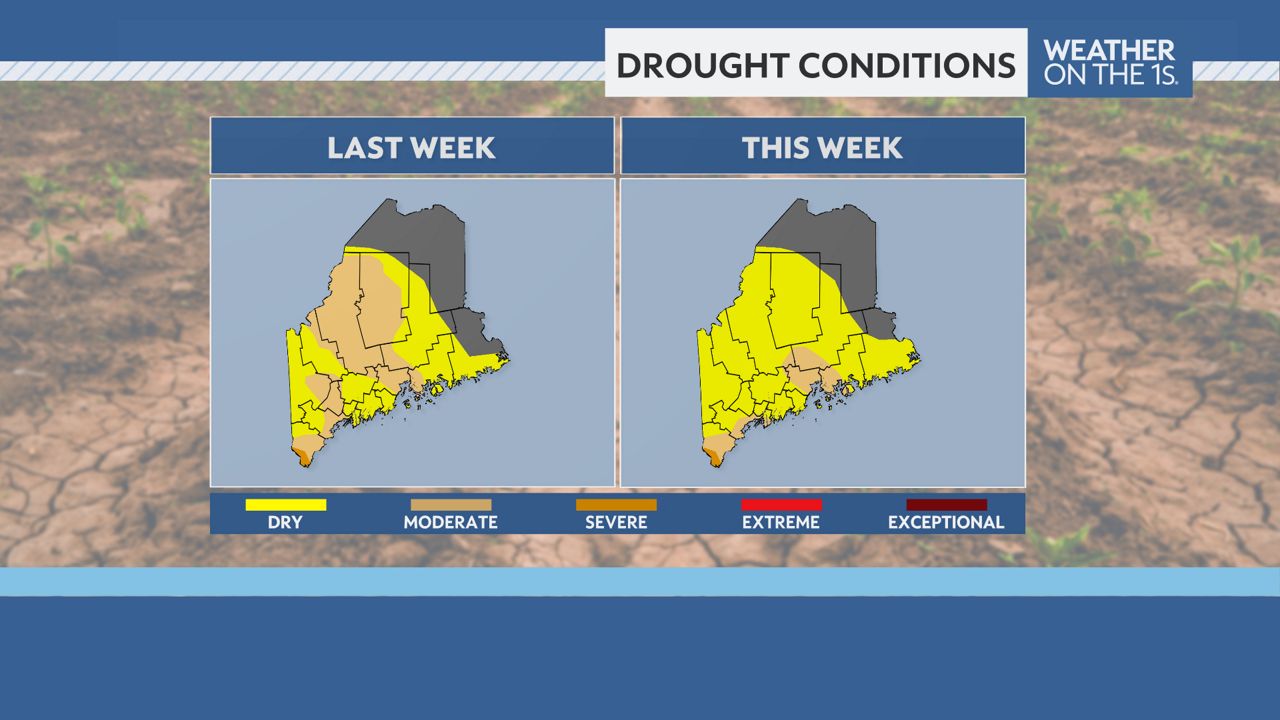
The recent rain in Maine is easing the drought that parts of the state have been experiencing since the fall.
Scott Dean, a Spectrum meteorologist, said much of Maine has been at least “dry” for several months. Parts of the state, including Portland, Bangor and Bar Harbor, are under a “moderate” drought.
Much of the country is also experiencing a drought, Dean added. The Southeast is seeing extreme levels of drought, and the West coast has been under a drought for years. There are many factors that go into this, including climate change, weather patterns like El Niño and La Niña and other factors.
And, when an area does experience drought, it can become a feedback loop. With less moisture in the ground and atmosphere, the drought can “feed upon itself,” Dean said.
Advertisement
“It takes a while to get into a drought and it also takes a while to get out of one,” Dean said.
But, the rainy days in Maine have been alleviating the drought, Dean said. And, the trend is likely to continue — the forecast is predicting above average levels of precipitation for the next three to four weeks.
“Hopefully, we are continuing to head in the right direction as the drought has eased in these areas,” Dean said.
In fact, if these rains do continue, Maine could come out of the drought sometime this summer.
STANDISH – Craig J. Ahlemeyer, 48 of Standish, passed away unexpectedly, Saturday, June 13, 2026.A memorial service will be held at 1 p.m., Saturday, June 27 th at Standish Congregational Church, 25 Oak Hill Road in Standish. A reception will follow.To see Craig’s full obituary, share a memory or leave the family an online condolence, please visit http://www.athutchins.com.