Alaska
Postcards from Alaska: Escape Florida’s sweltering summer for the last frontier


Greetings from Alaska! There’s nothing quite like escaping the sweltering dog days of summer in Florida to experience the land of the midnight sun and temperatures that helped me regain my chill.
It was just by luck that my girlfriend, Karissa, invited me on this epic expedition several months ago, prompting my immediate and enthusiastic “Yes!” Our adventure-filled itinerary included breathtaking views on hikes in Denali National Park, a soothing dip in natural hot springs and an icy trek on the Matanuska Glacier. Two other friends joined for the excursion, which featured a rental camper van for driving and sleeping.
The trip of a lifetime began in Anchorage, where we caught Alaska Railroad’s Coastal Classic Train to Seward on a route ranked among the top 10 train rides in North America by National Geographic. On the way to the quaint waterfront town that’s bordered by Resurrection Bay and Kenai Fjords National Park, we gazed in awe at mountains towering over the train, cascading waterfalls and glaciers off in the distance. During our time in the small town of less than 3,000, we embarked on a sea kayaking trip to see otters and bald eagles in their natural habitat and spent an afternoon hiking the Harding Icefield Trail, which overlooks Exit Glacier.
Flatlanders be warned: Hiking up hundreds or thousands of feet of elevation gain during a hike proves challenging when all you have to train with are flights of stairs in parking garages.
After soaking in the waterfront views from Seward and a picturesque return trip on the train, it was time to pick up a rental 2023 Mercedes-Benz Sprinter van. The van was decked out with a queen bed, a sink (with a hot water heater!) and plenty of storage. The adventure van included an awning, solar power and all-terrain tires for wherever our travels took us.
We dashed off to Denali National Park, which had just reopened after the Riley Fire near the park’s entrance. During our two-night stay there, we were only able to behold a mere fraction of the massive 6.1-million-acre expanse, which serves as home to North America’s highest peak. On several hikes, we stood amazed at sweeping views of mountains and valleys in front of us, also enjoying some lower elevation hikes through scenic forests, along lakeshores and next to rushing creeks. The fresh mountain air proved to be just what the doctor ordered, and it felt like everything was much bigger and open in Alaska.
Our aching legs needed a reprieve after a few hard hikes, so our next stop was Chena Hot Springs, a refreshing oasis an hour outside of Fairbanks. While the property is a destination for seeing the northern lights during the winter months, we enjoyed a “fire and ice” sort of experience with a soak in the more than 100-degree water and a visit to the on-site Aurora Ice Museum, an indoor building filled with ice sculptures where guests can sip appletinis served in carved-ice martini glasses.
Every stop on our journey benefited from long days when the sun didn’t set until almost midnight, allowing us to fit many activities into a single day.
After a unique dining experience at the Alaska Salmon Bake in Fairbanks and a quick stop at North Pole, Alaska — where we snapped photos with a towering Santa statue — it was time to head south on the Richardson Highway. Running for several hundred miles through Alaska’s interior, the scenic drive is where we camped for a night and hiked to the Castner Glacier ice cave. Along the way, we spotted a mama and baby moose in a pond right next to the road, just a few dozen feet away.
The end of our grand Alaskan adventure featured one of the trip’s biggest highlights: a full-day excursion onto the Matanuska Glacier, which is 27 miles long and 4 miles wide. Led by guides Samantha and Julian, our group of four learned how to use crampons for the first time for traction on ice, then used harnesses and ropes to scale ice walls and repel down frozen canyons. The landscape felt surreal and was certainly a welcome way to enjoy some crisp temperatures far away from the heat of Florida.
Determined to squeeze as much as we could into the final portion of our trip, we sprinted in the van down to the Homer Spit, a narrow finger of land that extends for 4.5 miles into Kachemak Bay. There, we watched a full moonrise after the sun finally set around 11 p.m., then woke the next day to find our first hot shower in days at a nearby campground before feasting on fresh salmon and halibut for lunch. Before hitting the road to catch flights home in Anchorage, we visited the famous Salty Dawg Saloon, established in 1957 and housed in a cabin built in 1897. The building formerly served as the town’s post office, a railroad station, a grocery store and a coal mining office for 20 years.
While the trip seemed to end too soon, I know we made many new memories in the 49th state and relished every second of our time there. Whenever Florida’s heat indexes soar into the triple digits, all I have to do is close my eyes and picture myself back on that glacier to find my chill once again.
Find me @PConnPie on Instagram or send me an email: pconnolly@orlandosentinel.com.



No one envies the Alaska Legislature being called back into a second special session on the proposed liquefied natural gas pipeline. One wonders if legislators are being held hostage to the governor’s predetermined decision. While the benefits of an LNG project are easily imagined, the economic risks of the Alaska LNG project must not be ignored.
Alaskans are not assured that Glenfarne, the company that was granted 75% of this project in an undisclosed document, won’t just flip it — sell it — to another entity after it gains billions of dollars in concessions from Alaska. Why the sudden change by Glenfarne and the Alaska Gasline Development Corporation from saying no legislative action was needed to the recent assertion that billions of dollars in property tax reductions are now necessary? It is without question that local municipalities will collectively incur hundreds of millions of dollars in direct impact costs.
Will Alaska give away another resource “farm” again? How would Alaska respond if the LNG project stalls and our resource continues to be a stranded asset? No purchaser has signed on the dotted line to actually buy fixed quantities of our gas. Are prospective purchasers interested? Yes. Have they signed binding contracts? No.
Russia has natural gas pipelines flowing into China. Russia has substantial volume to sell, having lost its natural gas sales to Europe after invading Ukraine. China currently produces 60% of its oil and natural gas needs by fracking its resources in western China. What would keep the Chinese from selling their or Russian natural gas to Alaska’s potential customers in Asia?
Natural gas prices have remained steady, which says there is plenty of it. Can Alaska’s project, including costly export facilities, be built at a cost that allows it to compete?
Legislators, please respond. But don’t sell out the interests of Alaskans. Glenfarne’s and AGDC’s lack of truthful answers raises many red flags. The correct decision is to let Glenfarne pay for its project. If it can’t or won’t, it isn’t economic.
Patrice Lee is a 49 year resident of Alaska, a retired math and science teacher, and a former elected member of the Interior Gas Utility Board of Directors. She lives in Fairbanks.
• • •
The Anchorage Daily News welcomes a broad range of viewpoints. To submit a piece for consideration, email commentary(at)adn.com. Send submissions shorter than 200 words to letters@adn.com or click here to submit via any web browser. Read our full guidelines for letters and commentaries here.

The intense marine heat wave conditions that began roiling the Bering Sea in about 2016 resulted in the lowest winter sea ice extent measured in 150 years, widespread bird and marine mammal die-offs, a drastic shift in fish populations and a crash of snow crab stocks.
Now new research is tying the marine heat wave to the recent collapse of Yukon River chinook salmon.
A study published in April, written by scientists at the National Oceanic and Atmospheric Administration’s Alaska Fisheries Science Center and University of Alaska Fairbanks, showed the correlation between the extreme heat wave conditions and the nosedive in Yukon River chinook stocks. The heat wave was accompanied by a dramatic increase in deaths of older juvenile and adult chinook that, had they survived, would have returned from the ocean to freshwater spawning grounds, the study found.
The study was published in the journal Ecological Applications.
The Yukon River’s runs of chinook, also called king salmon, have been in a long-term decline since their past heyday, when they numbered in the hundreds of thousands and the river was one of the biggest sources of that salmon species.
The sharp downturn in recent years resulted in a 2022 return that was the lowest on record. Widespread fishery closures have been in effect for years along the Yukon River system in both Alaska and Canada.
The study evaluated four general reasons for the sharp decline: poor juvenile “recruitment” into the ocean, which refers to the successful migration of surviving juvenile fish from freshwater; deaths of fish in the marine environment at the start of their migration back to freshwater; harvests that target the salmon; and bycatch, the unintentional harvest of salmon by commercial fishing vessels targeting other species, such as pollock.
Poor juvenile recruitment emerged as an important factor, which was to be expected, the study said.
“Not surprisingly, we found evidence to suggest that impacts operating in the early life stages have likely contributed to declines in run sizes over the past two decades, which is consistent with previous research,” NOAA Fisheries researcher Lukas DeFilippo, the lead author, said in a statement.

But the information about spiking mortality among adults and older juveniles was new, the NOAA scientists said. That new trend represents “an apparent shift in the critical life history stages and processes” for Yukon River chinook, and a potential bottleneck limiting population recovery, the study said.
Exactly how the heat wave conditions caused deaths of salmon at sea is yet to be determined, the study said. It listed several factors that could have worked in combination, including lack of suitable prey, infections by the parasite Ichthyophonus and other diseases, as well as increased energy demands brought on by warmer temperatures.
Harvests, either intentional or as bycatch, did not emerge as important factors in the recent Yukon chinook declines, the study found.
The study contained some warnings.
Even though the marine heat wave conditions have eased, the abundance of prey that salmon need in the ocean has not returned to normal, it noted. And mortality rates in those later life stages continue to be higher than they were prior to the latest heat wave.
And the heat problems for older salmon are likely to become more common in years to come, the study said.
“Given that marine heatwaves are expected to become more frequent and severe with continued warming . . . similar rises in mortality—and concomitant limitation of productivity and recovery potential—as described here could become increasingly common in the future,” the study said.
An earlier study by NOAA Fisheries and the Alaska Department of Fish and Game tied successive heatwaves in both the Bering Sea and Gulf of Alaska to sharp declines in chum salmon stocks. That 2023 study also pointed to higher mortality out in the ocean.
Originally published by the Alaska Beacon, an independent, nonpartisan news organization that covers Alaska state government.

As the fight for control of the U.S. Senate grows increasingly competitive, eyes are turning north to Alaska and a contest pitting, among its contestants, Dan Sullivan vs. Dan Sullivan — and, no, it’s not about a candidate living a double life or wrestling demons within himself.
Confused?
That may be the point.
Daniel S. Sullivan is Alaska’s two-term Republican senator. He’s seeking reelection in November.
Daniel J. Sullivan is a retired school teacher and political novice. He calls himself an independent Republican cut from the same polar-fleece lining as the state’s maverick GOP senator, Lisa Murkowski.
Political handicappers give Daniel J. Sullivan little chance of winning the highly competitive race. So is there some other reason he’s running? Is his presence on the ballot intended to draw enough befuddled voters away from the incumbent to elect his Democratic challenger, former Rep. Mary Peltola?
That’s what Republicans think. And you don’t have to be standing on the banks of the Kenai River to smell something fishy.
When Daniel J. Sullivan launched his campaign in May, he did so as plain old “Dan Sullivan,” with a website closely resembling that of the incumbent. The press release announcing his candidacy was written by one “Amber Lee.” There is an Alaska political strategist named Amber Lee who has supported Peltola in the past.
(For such a sparsely populated state, there sure are a lot of doppelgangers in this political saga.)
Election officials say Daniel J. Sullivan asked to appear on the ballot as a Republican, even though he hadn’t previously been affiliated with the party. In fact, over the years he’d contributed money to Democrats, including Peltola. He also asked to be identified on the ballot as “Dan S. Sullivan” before changing his mind, an attorney for the state told Alaska’s Supreme Court, which took up the matter late last month.
“That’s not an innocent mistake, or random mistake,” Chris Murray told the justices. “There’s a lot of other letters in the alphabet that could have been a typo.”
The political consultant Amber Lee declined to comment when reached by the Anchorage Daily News. She did not respond to an email from your friendly political columnist.
For his part, Daniel J. Sullivan denied any malice or mischievous intent.
“This is my choice,” he told the Associated Press. He said he had no contact with Peltola’s campaign — “zero, none, zilch” — and denied anyone from the state Democratic Party or any national Democratic operatives had contacted him to run.
Peltola’s campaign has adamantly denied any involvement. So, too, have the Alaska Democratic Party and the Democrat’s national Senate campaign committee.
After an investigation, Daniel J. Sullivan was removed from the Aug. 18 primary ballot. Carol Beecher, head of Alaska’s Division of Elections, said his candidacy was intended to “confuse or mislead” voters.
Sen. Dan Sullivan (R-Alaska) attends meetings at the U.S. Capitol in 2025.
(Francis Chung / Politico via Associated Press)
But the state’s high court overturned that decision, instructing elections officials to figure out a way to keep Daniel J. Sullivan’s name on the ballot “within the confines of existing Alaska ballot design law.”
It’s been nearly 20 years since the state sent a Democrat to the U.S. Senate, but this election looks to offer the party its best shot in years, thanks to Peltola.
Jessica Taylor, of the nonpartisan Cook Political Report, called her “the ideal recruit,” given Peltola’s fundraising prowess and her ability to outperform other Democrats by avoiding the toxic taint of the national party. (Peltola’s slogan —”Fish, family and freedom” — is about as far removed from the Whole Foods-shopping, Prius-driving Democratic image as it gets.)
Democrats need to win four seats in November to take control of the Senate, from a menu that includes Alaska, Iowa, Maine, North Carolina, Ohio and Texas while, at the same time, hanging on to contested Senate seats in Georgia, Michigan, Minnesota and New Hampshire. The Cook Political Report rates Alaska as one of the few toss-up races in the bunch.
The state has a ranked-choice election system in which the top four vote-getters advance to November. Ivan Moore, who does nonpartisan polling in Alaska, said that system virtually ensures Sullivan and Sullivan will face off against each other in a runoff that includes Peltola. At that point, Moore suggested, the choice to most voters will be clear.
Under the solution devised by state election officials, the senator will be listed as “Sullivan, Dan S.” and as “(Registered Republican) Incumbent.” His challenger will be identified as “Sullivan, Daniel J. Jr.” with no party affiliation.
“I imagine there’s some people out there who don’t know what the word ‘incumbent’ means,” Moore said. “But I find it pretty hard to believe that people who are dead set on voting for Dan S. Sullivan, the senator, are going to go in the voting booth and vote for the wrong person when Dan S. has the word ‘incumbent’ next to his name and Dan J. doesn’t have any party affiliation.”
Political hijinks are nothing new. But the level of partisan gamesmanship seems to be growing as the old saying about all being far in love and war is increasingly applied to campaigns and elections.
It was something of a novelty in 2002 when Democrats meddled in the California Republican primary to promote their preferred candidate. Now it’s common practice.
Redistricting, or redrawing the nation’s congressional lines to reflect changes in population, used to occur once a decade following the national census. But spurred by President Trump, the last year has seen an arms race among states, including California, which gerrymandered their political maps to boost a preferred party and, essentially, decide House races before a single ballot is cast.
Politics, another old saying goes, ain’t beanbag.
But it doesn’t have to be this slanted and cynical. There’s no need for fishy-smelling candidates like Daniel J. Sullivan.
-

 News29 minutes ago
One person killed in Maine in second fatal ICE-involved shooting in less than a week | CNN
-

 New York2 hours ago
How a Family of 5 Lives on $46,000 a Year in Wakefield
-

 Los Angeles, Ca2 hours ago
Southern California braces for 110-degree heat, thunderstorms this week
-
 Detroit, MI2 hours ago
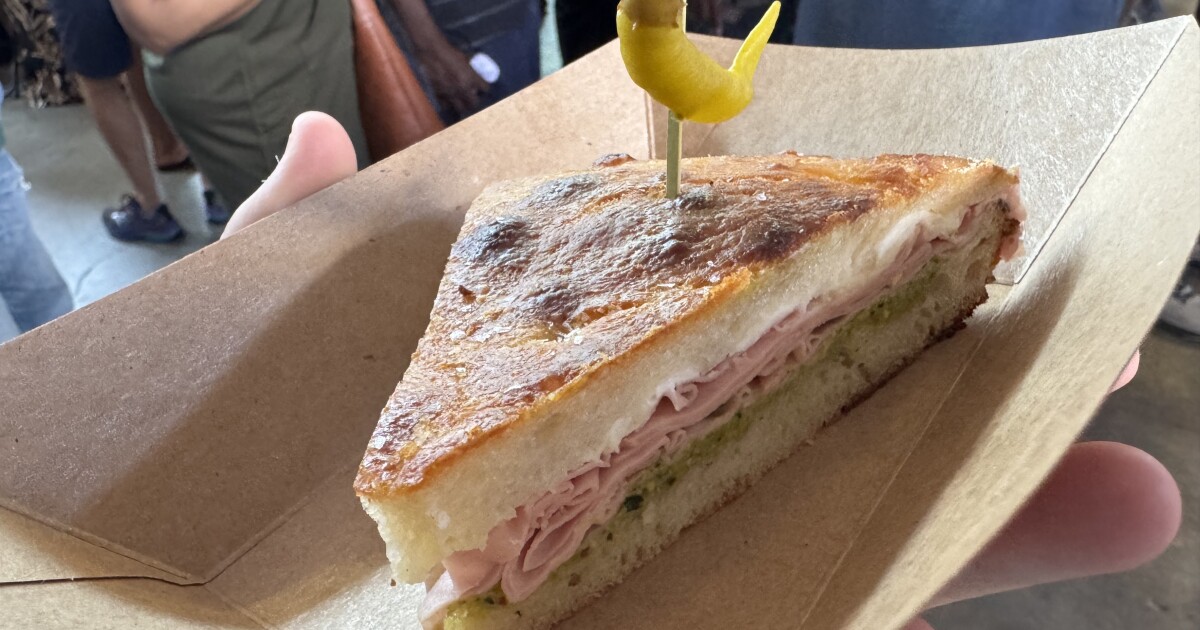
Detroit Sandwich Party returns to Eastern Market on Sept. 6
-

 San Francisco, CA3 hours ago
A Leak of San Francisco Police Drone Footage Exposes the New Reality of Urban Surveillance
-

 Dallas, TX3 hours ago
Viral East Dallas coffee shop fears major sales drop amid six-week road closure
-

 Miami, FL3 hours ago
3 hurt in fire on Lincoln Road that started underground
-

 Boston, MA3 hours ago
Rideshare driver charged in Logan airport passenger assault to appear in court

