Politics
Project 2025 plan calls for demolition of NOAA and National Weather Service

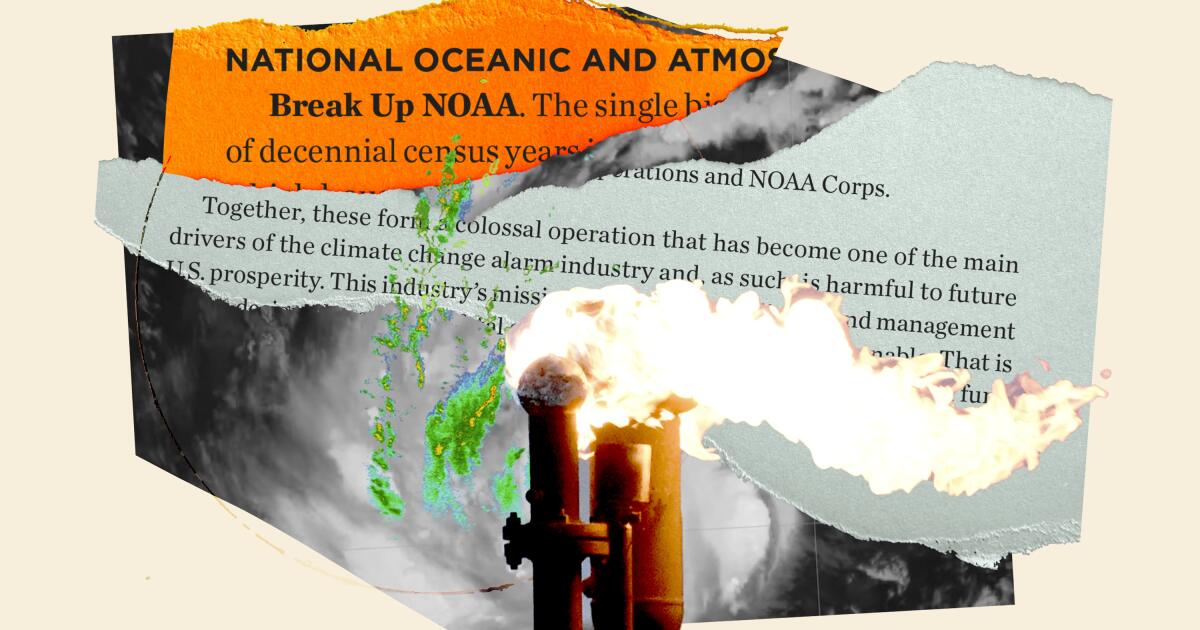
Among its many sweeping calls for change in American government, a conservative platform document known as Project 2025 urges the demolition of some of the nation’s most dependable resources for tracking weather, combating climate change and protecting the public from environmental hazards.
“Break up NOAA,” the document says, referring to the National Oceanic and Atmospheric Administration and its six main offices, including the 154-year-old National Weather Service.
“Together, these form a colossal operation that has become one of the main drivers of the climate change alarm industry and, as such, is harmful to future U.S. prosperity,” the document says.
Aggressive and impactful reporting on climate change, the environment, health and science.
The call to dismantle a vital federal department has raised the hackles of experts who say NOAA provides not only important free data, such as weather forecasts and satellite observations, but also life-saving information about hurricanes, heat waves, atmospheric rivers and other extreme events — many of which have been shown, through myriad studies, to be worsening due to global warming.
“The National Weather Service, and NOAA more generally, is a key agency in tracking what’s happening with our climate — and in particular the ways in which humans are changing the climate,” said Matthew Sanders, a lecturer at Stanford Law School and the acting deputy director of the Environmental Law Clinic.
“To propose undercutting, breaking up and quote-unquote streamlining NOAA is really an effort to block and make less available information about climate change in order to serve an agenda of climate change denial,” he said.
The 922-page document was published by the Heritage Foundation, a conservative think tank based in Washington, D.C.
Among its arguments for dismantling NOAA are concerns about the agency’s mission as well as its size. It notes that NOAA is the largest agency under the U.S. Department of Commerce, uses about half of the department’s $12 billion annual operational budget in a typical year, and contains more than half of its personnel.
“This industry’s mission emphasis on prediction and management seems designed around the fatal conceit of planning for the unplannable,” the document says. “That is not to say NOAA is useless, but its current organization corrupts its useful functions. It should be broken up and downsized.”
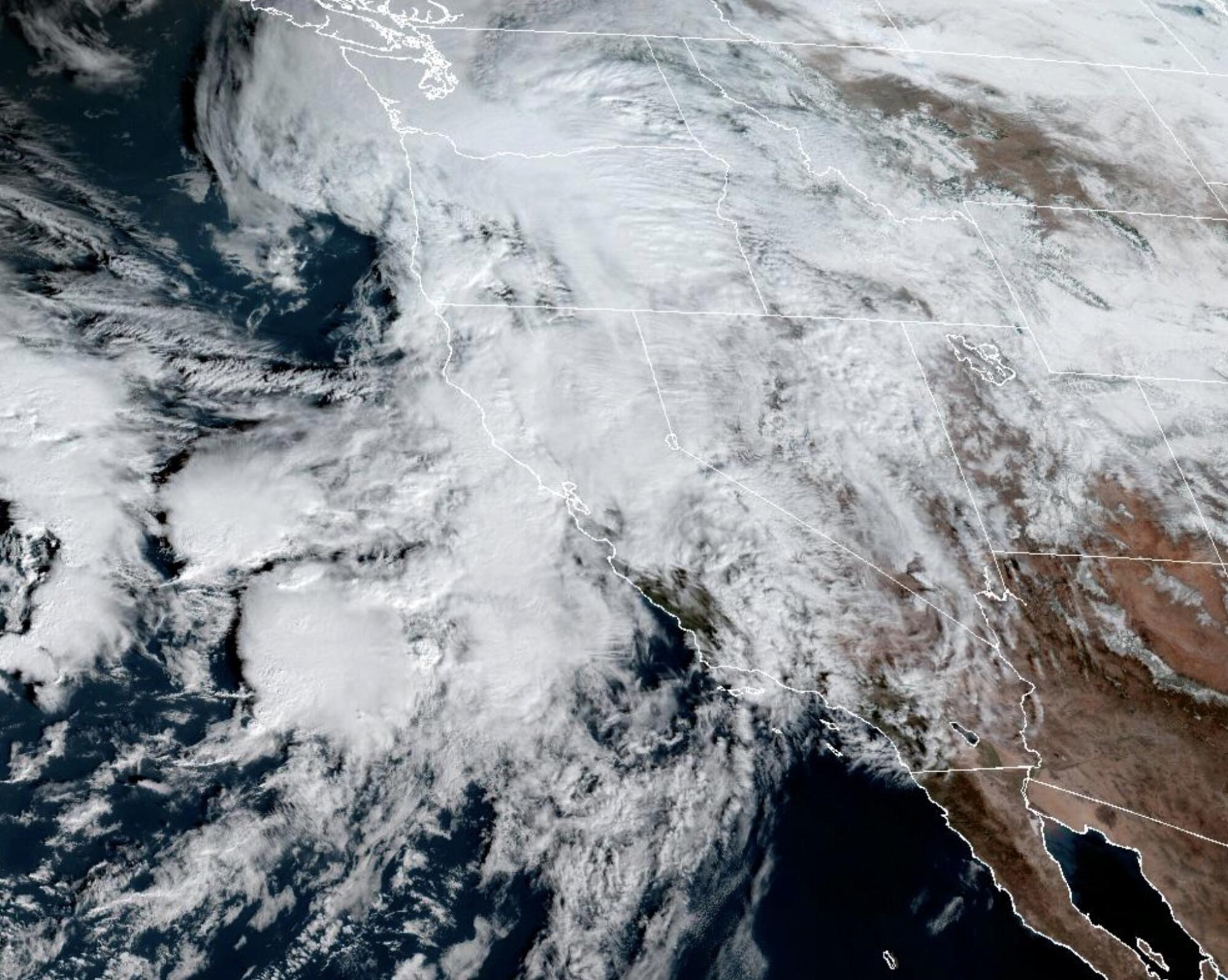
Satellite imagery of a California storm from the National Oceanic and Atmospheric Administration.
(NOAA / National Weather Service)
The plan also states that forecasts provided by private companies such as AccuWeather are more accurate than those provided by the National Weather Service, and so it recommends that the NWS “fully commercialize its forecasting operations,” or enter partnerships to sell its data.
In a statement, AccuWeather’s chief executive Steven R. Smith said the company has not suggested that the NWS commercialize its operations, nor does it agree with the view outlined in the plan. AccuWeather relies on NOAA’s weather data as one of 190 sources in its forecast engine, and also partners with NOAA and dozens of other government agencies to share life-saving weather alerts with the public, Smith said.
“AccuWeather is extremely proud of our track record of superior accuracy, but it has never been our goal to take over the provision of all weather information,” he said.
In fact, AccuWeather is only one of many agencies and research institutions that depend on NOAA’s ground instruments, satellites, balloons, weather models and forecasts to aid in their own outlooks and analyses, according to Robert Rohde, chief scientist at Berkeley Earth, a nonprofit organization focused on environmental data science.
“Lots of people rely on the information that NOAA has collected and provides, and NOAA in turn has provided one of the most comprehensive weather monitoring systems in the world,” Rohde said.
Breaking up the agency would not only be detrimental to the American public, it would also be harmful to the advancement of science, according to Rohde. Blaming NOAA for climate change alarmism is akin to wanting to “shoot the messenger,” he said.
“NOAA has been a key resource in the federal government in providing information about climate change and communicating the risks, and they do so in a very responsible way,” Rohde said. “I don’t think they hype it up — they’re not saying the world is ending. But it is a risk on the horizon that has impacts, and the world is changing, and I think we need to face that with open eyes.”
Scott Smullen, deputy director of communications with NOAA, declined to comment on Project 2025, saying “we don’t speculate on what might or might not happen with the agency.”
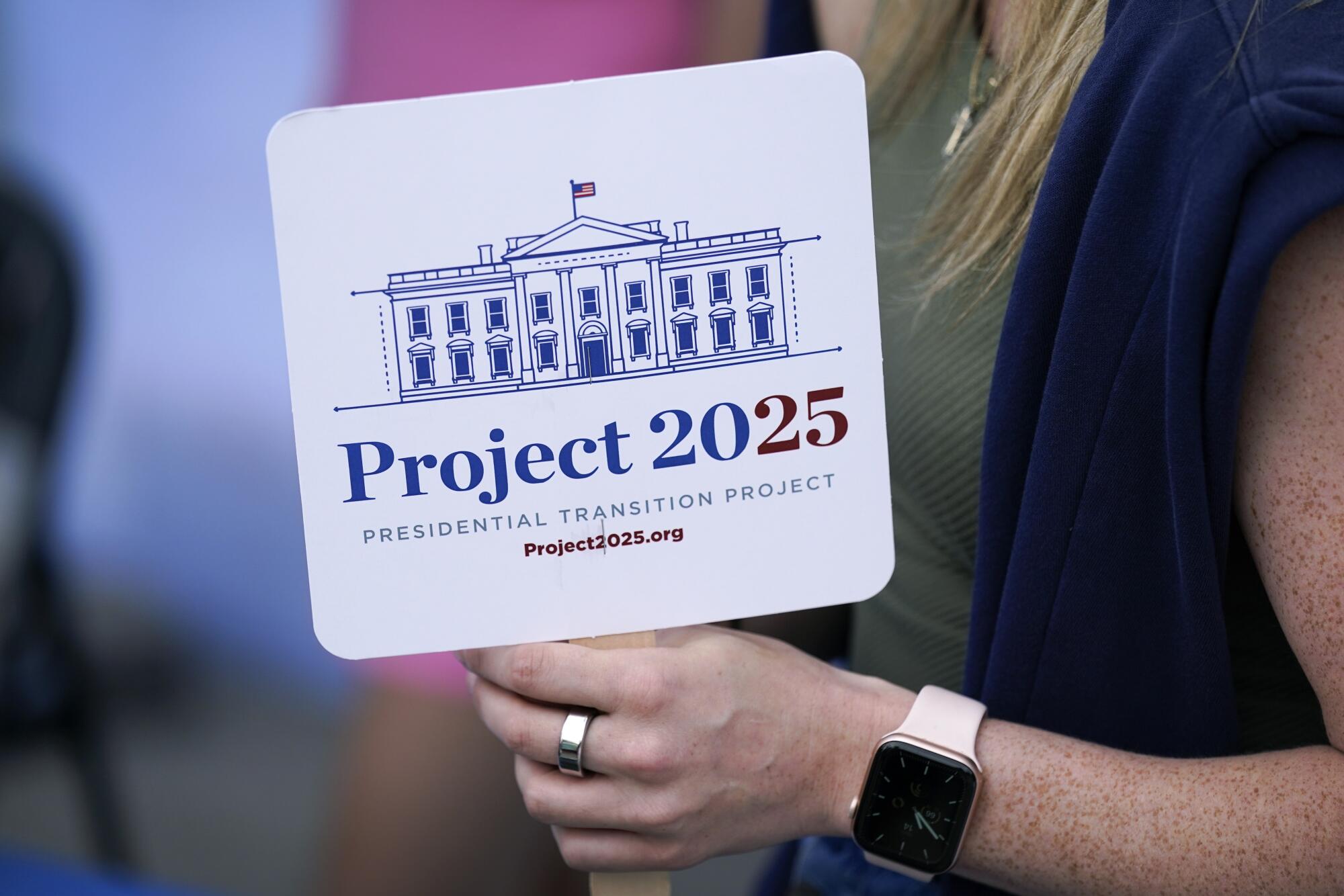
A woman holds a Project 2025 fan at the Iowa State Fair, in Des Moines, recently.
(Charlie Neibergall / Associated Press)
The section of Project 2025 pertaining to NOAA was authored by Thomas Gilman, who served as assistant secretary of commerce and chief financial officer of the U.S. Department of Commerce during Donald Trump’s presidential administration.
Prior to that appointment, Gilman was chief executive of Chrysler Financial and spent more than four decades in the global automotive industry, a sector closely tied to oil and gas interests. Gilman is currently director of ACLJ Action, an advocacy organization “dedicated to liberty, constitutional government and religious freedom,” according to its website. He is also chairman of Torngat Metals, a rare earth development company.
The Heritage Foundation did not respond to a request to speak with Gilman for this article.
In recent weeks, Trump has distanced himself from the plan — stating on social media that he knows nothing about Project 2025 and that he has “no idea who is behind it.”
However, the plan includes contributions from other members of his Republican administration, including former budget director Russell Vought; former deputy chief of staff Rick Dearborn; former Housing and Urban Development Secretary Ben Carson; and former chief of staff of the U.S. Environmental Protection Agency, Mandy Gunasekara. Trump’s name is mentioned in the document more than 300 times.
Project 2025 isn’t solely focused on weather. Its sweeping recommendations include plans to restrict abortion and contraceptives, cut social security, outlaw pornography, end marriage equality, end student loan relief efforts and eliminate other federal agencies such as the Department of Education.
On the environment, it calls for increased Arctic drilling, the deregulation of the oil industry, the repeal of the Inflation Reduction Act — President Biden’s landmark climate legislation — and withdrawal from the Paris climate agreement, among other recommendations.
Rohde, of Berkeley Earth, said moving away from international goals to reduce fossil fuel emissions “will necessarily lead to more carbon dioxide in the atmosphere and higher temperatures in the future.” The planet just recorded its hottest-ever daily global temperature, and has experienced a record 12 consecutive months of warming above 1.5 degrees Celsius, an international limit established under the Paris agreement.
Rohde also cautioned that privatizing or commercializing NOAA would lead to less available data for scientific researchers. Such outcomes have already been seen in other countries that have tried similar models, such as France, which only recently committed to making more of its weather archives public, he said.
“You really talk about throwing away the baby with the bathwater if you cut off the access to those measurement programs and those monitoring programs by making them commercial so that only a few organizations will have them,” he said.

A National Weather Service meteorologist in Oxnard helps to monitor Hurricane Hilary in August 2023.
(Ringo Chiu/For The Los Angeles Times)
Project 2025 also calls for the repeal of the U.S. Department of the Interior’s America the Beautiful Initiative. That plan, sometimes referred to as 30×30, seeks to conserve at least 30% of the U.S.’s land and waters by 2030, and has been hailed by environmental groups as a critical step for reversing habitat and species loss and ensuring access to nature for future generations.
Project 2025 says the initiative is being used to “advance an agenda to close vast areas of the ocean to commercial activities, including fishing, while rapidly advancing offshore wind energy development to the detriment of fisheries and other existing ocean-based industries.”
But the 30×30 initiative builds on existing legal authorities to achieve the benefits of conservation, including prudent efforts to avoid over-extracting land and water resources, according to Sanders, of Stanford, who also served as an attorney in the U.S. Department of Justice’s environment and natural resources division. Withdrawing from such an effort is “not a good idea,” he said.
“I think we find that every time we use one of these authorities to set aside an area for conservation, whether on a short-term or a longer-term basis, we look back at that decision as being enlightened, meaning that it was an exercise in wisdom to promote benefits that benefit humanity long term,” Sanders said.
Those conservation efforts, as well as the services provided by NOAA and the NWS, are deeply familiar to most Californians.
The agency is often the first to foresee potentially dangerous events — such as atmospheric rivers, extreme heat waves, fire weather conditions or even a rare West Coast hurricane — and disseminate information to the public.
And while Trump has publicly shied away from Project 2025, the former president’s first administration included efforts to roll back more than 100 environmental regulations and pare down the functions of some federal agencies. Trump also appointed climate change deniers to senior posts in the Department of the Interior, the EPA and other departments.
Many Californians may recall a tense 2020 exchange between Trump and Wade Crowfoot, the state’s natural resources secretary, over explosive wildfires and record-breaking temperatures that plagued the state that year.
“It’ll start getting cooler — you just watch,” Trump told Crowfoot at the time.
“I wish science agreed with you,” Crowfoot countered.
“I don’t think science knows,” Trump said.
To break up NOAA and dismantle the National Weather Service would be like a return to those years “on steroids,” Sanders said, as such efforts would severely hamper the federal government’s ability to understand or take action on climate change.
It would also shift the onus of gathering and distributing critical climate and weather information onto state and local agencies, who are not singularly equipped to handle the magnitude of the challenge.
“That’s inherently less efficient and that handicaps informed decision-making — particularly when you’re dealing with something like climate change, which is not a local issue,” Sanders said. “It has local impacts, but it’s a national and international issue, so you need agencies that have the resources and the focus of tracking that kind of problem at a more national level.”



new video loaded: Virginia Voters Approve New Map Favoring Democrats

By Shawn Paik
April 22, 2026

NEWYou can now listen to Fox News articles!
Sparks flew on Capitol Hill as Sen. Elizabeth Warren, D-Mass., accused Federal Reserve nominee Kevin Warsh of being a potential “sock puppet” for President Donald Trump.
Warsh, tapped by Trump in January to lead the Federal Reserve, faced a two-and-a-half-hour confirmation hearing before the Senate Banking, Housing, and Urban Affairs Committee.
If confirmed, he would take the helm of the world’s most powerful central bank, shaping interest rates, borrowing costs and the financial outlook for millions of American households for the next four years.
WHO IS KEVIN WARSH, TRUMP’S PICK TO SUCCEED JEROME POWELL AS FED CHAIR?
Kevin Warsh, nominee for chairman of the Federal Reserve, listens to ranking member Sen. Elizabeth Warren, D-Mass., make an opening statement during his Senate Banking, Housing and Urban Affairs Committee confirmation hearing on Tuesday, April 21, 2026. (Tom Williams/CQ-Roll Call, Inc via Getty Images)
In her opening remarks, Warren sharply criticized Warsh’s record and questioned his independence, arguing he is “uniquely ill-suited for the job as Fed chair” and warning he could give Trump influence over the central bank.
She accused Warsh of enabling Wall Street during the 2008 financial crisis, which fell during his tenure as a Federal Reserve governor when he served from 2006 to 2011.
“In our meeting last week, we discussed the 2008 financial crash, where 8 million people lost their jobs, 10 million people lost their homes and millions more lost their life savings,” Warren said. “Giant banks, however, got hundreds of billions of dollars in bailouts… and he said to me that he has no regrets about anything he did.”
She added that Warsh “worked tirelessly to arrange multibillion-dollar bailouts” for Wall Street CEOs, with nothing for American families.
The hearing grew more tense as Warren pivoted to ethics concerns, pressing Warsh over his undisclosed financial holdings and questioning him over links to business dealings connected to the late convicted sex offender Jeffrey Epstein.
The two spoke over each other and raised their voices in a heated exchange on Capitol Hill.
WARSH’S $226 MILLION FORTUNE UNDER SCRUTINY AS FED NOMINEE FACES SENATE CONFIRMATION
Sen. Elizabeth Warren: The Fed has been plagued by deeply disturbing ethics scandals in recent years. It’s critical that the next chair have no financial conflicts — none. You have more than $100 million in investments that you have refused to disclose. So let me ask: do the Juggernaut Fund or THSDFS LLC invest in companies affiliated with President Trump or his family, companies tied to money laundering, Chinese-controlled firms, or financing vehicles linked to Jeffrey Epstein?
Kevin Warsh: Senator, I’ve worked closely with the Office of Government Ethics and agreed to divest all of my financial assets.
Warren: Could you answer my question, please? You have more than $100 million in undisclosed assets. Are any of those investments tied to the entities I just mentioned? It’s a yes-or-no question.
Warsh: I have worked tirelessly with ethics officials and agreed to sell all of my assets before taking the oath of office.
Warren: Are you refusing to tell us if you have investments in vehicles linked to Jeffrey Epstein? You just won’t say?
Warsh: What I’m telling you is those assets will be sold if I’m confirmed.
Warren: Will you disclose how you plan to divest these assets? The public might question your motives if, for example, someone who profits from predicting Fed policy cuts you a $100 million check as you take office.
Sen. Elizabeth Warren questions Kevin Warsh during his Senate Banking, Housing and Urban Affairs Committee confirmation hearing on Tuesday, April 21, 2026. (Tom Williams/CQ-Roll Call, Inc via Getty Images)
Warsh: I’ve reached a full agreement with the Office of Government Ethics and will divest those assets before taking the oath.
Warren: I’m asking a very straightforward question. Will you disclose how you divest those assets?
Warsh: As I’ve said, I’ve worked with ethics officials.
Warren: I’ll take that as a no.
In a separate exchange, Warren invoked Trump’s past statements about the Fed and challenged Warsh to prove his independence in real time.
She insisted that Warsh answer whether he believes Trump won the 2020 presidential election and if he would name policies of the president with which he disagrees. The hopeful future Fed chair dodged the question and said he would remain apolitical, if confirmed.
THE ONE LINE IN WARSH’S TESTIMONY SIGNALING A BREAK FROM THE FED’S STATUS QUO
Warren: Donald Trump has made clear he does not want an independent Fed. He has said, “Anybody that disagrees with me will never be Fed chairman.” He’s also said interest rates will drop “when Kevin gets in.” Let’s check out your independence and your courage. We’ll start easy. Mr. Warsh, did Donald Trump lose the 2020 election?
Warsh: Senator, we should keep politics out of the Federal Reserve.
Warren: I’m asking a factual question.
Warsh: This body certified the election.
Warren: That’s not what I asked. Did Donald Trump lose in 2020?
Warsh: The Fed should stay out of politics.
Warren: In our meeting, you said you’re a “tough guy” who can stand up to President Trump. So name one aspect of his economic agenda you disagree with.
CLICK HERE TO DOWNLOAD THE FOX NEWS APP
Kevin Warsh listens to a question during a Senate Banking, Housing, and Urban Affairs Committee confirmation hearing on Tuesday, April 21, 2026. (Graeme Sloan/Bloomberg via Getty Images)
Warsh: That’s not something I’m prepared to do. The Fed should stay in its lane.
Warren: Just one place where you disagree.
Warsh: I do have one disagreement — he said I looked like I was out of central casting. I think I’d look older and grayer.
Warren: That’s adorable. But we need a Fed chair who is independent. If you can’t answer these questions, you don’t have the courage or the independence.

On March 28, a sunny Saturday in southwestern Utah, Jack Hoopes and his wife, Lorna, brought their homemade signs to the local “No Kings” rally.
The couple joined a crowd of 1,500 or so marching through the main picnic area of a park in downtown St. George. Their signs — cut-out words on a black background — chided lawmakers for failing to stand up to President Trump and urged America to “make lying wrong again.”
After about an hour, the two were ready to go home. They got in their silver Volvo SUV, but before pulling away, Jack Hoopes decided to swing past the demonstration, which was still going strong. He tooted his horn, twice, in a show of solidarity.
That’s when things took a curious turn.
A police officer parked in the middle of the street warned Hoopes not to honk; at least that’s what he thinks the officer said as Hoopes drove past the chanting crowd. When he spotted two familiar faces, Hoopes hit the horn a third time — a friendly, howdy sort of honk. “It wasn’t like I was being obnoxious,” he said, “or laying on the horn.”
Hoopes turned a corner and the cop, lights flashing, pulled him over. He asked Hoopes for his license and registration. He returned a few moments later. A passing car sounded its horn. “Are you going to stop him, too?” Hoopes asked.
That did not sit well. The officer said he’d planned to let Hoopes off with a warning. Instead, he charged the 71-year-old retired potato farmer with violating Utah’s law on horns and warning devices. He issued a citation, with a fine punishable up to $50.
Hoopes — a law school graduate and prosecutor in the days before he took up potato farming — is fighting back, even though he estimates the legal skirmishing could cost him considerably more than the maximum fine. The ticket might have resulted from pique on the officer’s part. But Hoopes doesn’t think so. He sees politics at play.
“I’ve beeped my horn for [the pro-law enforcement] Back the Blue. I’ve beeped my horn for Black Lives Matter,” Hoopes said. “I’ve seen a lot of people honk for Trump and for MAGA.”
He’s also seen plenty of times when people honked their horns to celebrate high school championships and the like.
But Hoopes has never heard of anyone being pulled over, much less ticketed, for excessive or unlawful honking. “I think it’s freedom of expression,” he said.
Or should be.
Jack and Lorna Hoopes made their own protest signs to bring to the “No Kings” rally in St. George, Utah.
(Mikayla Whitmore / For The Times)
St. George is a fast-growing community of about 100,000 residents set amid the jagged red-rock peaks of the Mojave Desert. It’s a jumping-off point for Zion National Park, about 40 miles east, and a mecca for golf, hiking and mountain-bike riding.
It’s also Trump Country.
Washington County, where St. George is located, gave Trump 75% of its vote in 2024, with Kamala Harris winning a scant 23%. That emphatic showing compares with Trump’s 59% performance statewide.
St. George is where Hoopes and his wife live most of the time. When summer and its 100-degree temperatures hit, they retreat to southeast Idaho. The couple get along well with their neighbors in both places, Hoopes said, even though they’re Democrats living in ruby-red country. It’s not as though they just tolerate folks, or hold their noses to get by.
“Most of my friends are conservative,” Hoopes said. “Some of the Trump people are very good people. We just have a difference of opinion where our country is going.”
He was speaking from a hotel parking lot in Arizona near Lake Havasu while embarked on an annual motorcycle ride through the Southwest: four days, a dozen riders, 1,200 miles. Most of his companions are Trump supporters, Hoopes said, and, just like back home, everyone gets on fine.
“Right?” he called out.
“No!” a voice hollered back.
Actually, Hoopes joked, his charitable road mates let him ride along because they consider him handicapped — his disability being his political ideology.
Hoopes is not exactly a hellion. In 2014, he and his wife traveled to Africa to participate in humanitarian work and promote sustainable agriculture in Kenya and Uganda. In 2020, they worked as Red Cross volunteers helping wildfire victims in Northern California.
Virtually his entire life has been spent on the right side of the law, though Hoopes allowed as how he has racked up a few speeding tickets over the years. (His career as a prosecutor lasted four years and involved three murder cases in the first 12 months before he left the legal profession behind and took up farming.)
He’s never had any problems with the police in St. George. “They seem to be decent,” Hoopes said.
A department spokesperson, Tiffany Mitchell, said illicit honking is not a widespread problem in the placid, retiree-heavy community, but there are some who have been cited for violations. She denied any political motivation in Hoopes’ case.
“He must’ve felt justified,” Mitchell said of the officer who issued the citation. “I can’t imagine that politics had anything to do with it.”
And yes, she said, honking a horn can be a political statement protected by the 1st Amendment. “But, just like anything else, it can turn criminal,” Mitchell said, and apparently that’s how the officer felt on March 28 “and that’s the direction he took it.”
The matter now rests before a judge, residing in a legal system that has lately been tested and twisted in remarkable ways.

Jack Hoopes’ case is now before a judge in St. George, Utah.
(Mikayla Whitmore / For The Times)
As he left an initial hearing earlier this month, Hoopes said his phone pinged with a fresh headline out of Washington. Trump’s Justice Department, it was reported, was asking a federal appeals court to throw out the convictions of 12 people found guilty of seditious conspiracy for their roles in the Jan. 6, 2021, insurrection.
“We have a president that pardons people that broke into the Capitol and defecated” in the hallways and congressional offices, Hoopes said. “Police officers died because of it, and yet I get picked up for honking my horn?”
Hoopes’ next court appearance, a pretrial conference, is set for July 15.
-

 New Hampshire2 minutes ago
Hiker who set out in warm spring weather found dead after snowstorm in New Hampshire mountains
-

 New Jersey8 minutes ago
2028 New Jersey ATH has ‘great experience’ on visit to Syracuse
-

 New Mexico14 minutes ago
Governor establishes Energy Affordability and Grid Reliability Council – 13-member council designed to protect ratepayers, modernize the grid – Office of the Governor – Michelle Lujan Grisham
-
North Carolina20 minutes ago
NC State’s 2026 Atlantic hurricane forecast calls for an average season with 12 to 15 named storms
-

 North Dakota26 minutes ago
Value of North Dakota oil rises as Iran war upends markets – KVRR Local News
-

 Ohio32 minutes ago
NWSL announces expansion to Columbus, Ohio
-
Oklahoma38 minutes ago
Woman rescued from Oklahoma City house fire; no injuries reported
-

 Oregon44 minutes ago
Wine Enthusiast names 2 Oregon sparkling wines among best

