Lifestyle
These dictators are different. 'Autocracy, Inc.' explains how


Naval vessels participate in a Taiwanese military drill near the naval port in Kaohsiung in southern Taiwan on Jan. 27, 2016.
Sam Yeh/AFP via Getty Images
hide caption
toggle caption
Sam Yeh/AFP via Getty Images
The United States and other major democracies face the most challenging geopolitical landscape in decades. The crises include a bloody battle for land in Eastern Europe that challenges the principle of territorial sovereignty, the risk of a Chinese invasion of Taiwan in the coming years and a brutal war in Gaza that could still spread.
We are in a new era, but how do we define it, and what is the fundamental threat?
Several recent books tackle this crucial question. New York Times White House and National Security correspondent David Sanger calls this historical moment “New Cold Wars.” He sees the U.S. defending the West against a rising China and resurgent Russia. CNN anchor and Chief National Security analyst Jim Sciutto calls it “The Return of Great Powers.”
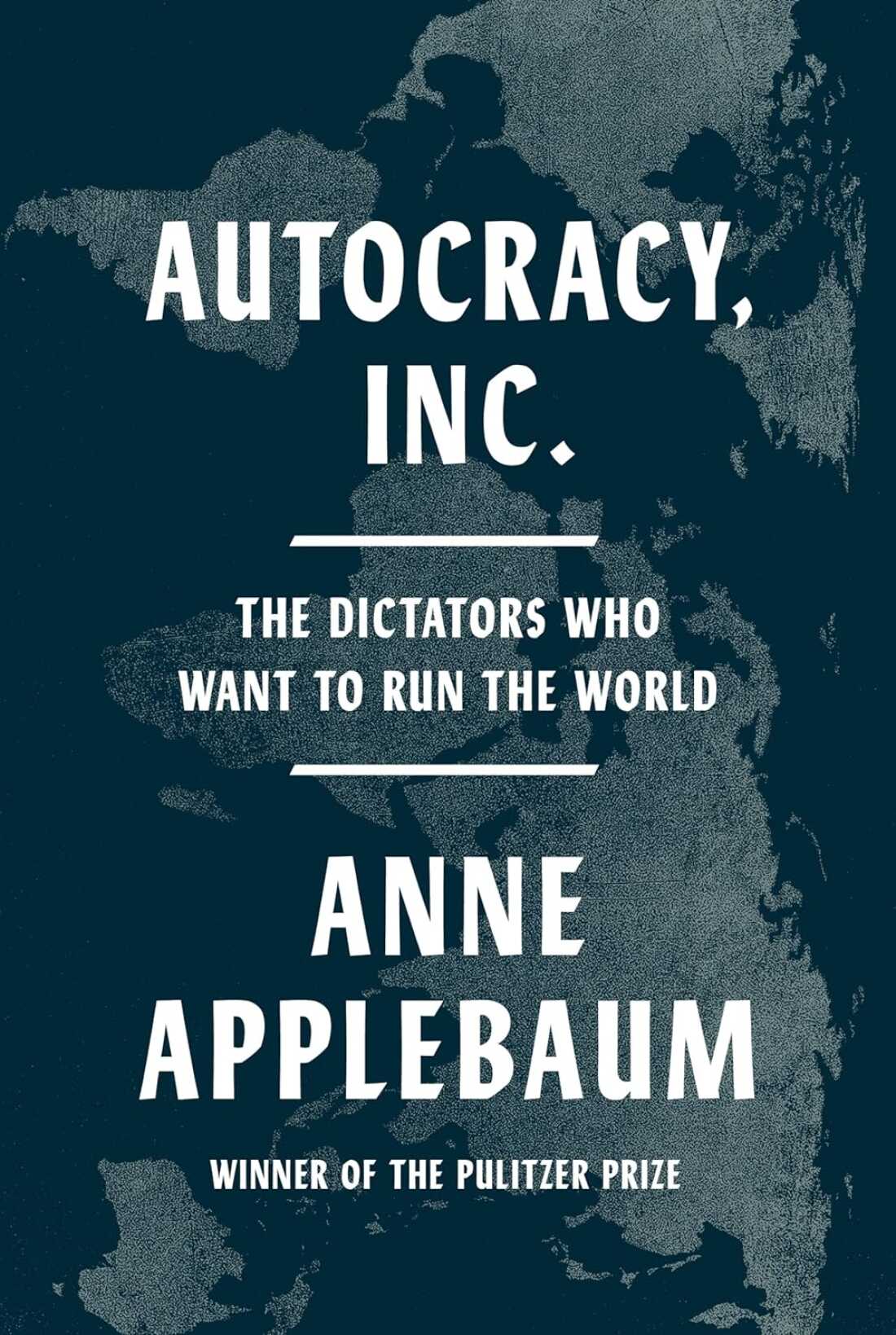
In her new book, the Atlantic’s Anne Applebaum takes a different, more sweeping view. We are not in Cold War 2.0, she argues, but a battle for the future world order against what she calls “Autocracy, Inc., The Dictators Who Want to Rule the World.”

Autocracy, Inc., is not a club. There are no meetings like SPECTRE in a James Bond movie, where villains give progress reports on their kleptocratic gains and attacks on democracy. Instead, Applebaum writes, it is a very loosely knit mix of regimes, ranging from theocracies to monarchies, that operate more like companies. What unites these dictators isn’t an ideology, but something simpler and more prosaic: a laser-focus on preserving their wealth, repressing their people and maintaining power at all costs.
These regimes can help each other in ways large and small, Applebaum writes.
Countries such as Zimbabwe, Belarus and Cuba voted in favor of Russia’s annexation of Crimea at the United Nations in 2014. Russia gave loans to Venezuela’s authoritarian President Nicolas Maduro, while Venezuelan police use Chinese-made water cannons, tear gas and surveillance equipment to attack and track street protesters.
Of course, U.S. companies have also supplied authoritarian regimes. When covering the crushing of the democracy movement in Bahrain during the Arab Spring, I rummaged through bins of empty rubber bullet canisters made by a company in Pennsylvania.
More recently and more alarming, though, have been China’s tacit support for Russia’s invasion of Ukraine and President Vladimir Putin’s June visit to North Korea, which the U.S. accuses of supplying weapons to Russia.
But Autocracy Inc., uses more than conventional arms to attack democracies. In order to retain power and build more wealth, autocrats also undermine the idea of democracy as a viable choice for their own people. Fearful of its former Soviet republics drifting further West – see Ukraine – Russia and its three main TV channels broadcast negative news about Europe an average of 18 times a day during one three-year stretch.
China extends its message through local media and helps other dictatorships. After satellite networks dropped Russia Today – RT – following the invasion of Ukraine, China’s StarTimes satellite picked up RT and put it back into African households, where it could spread Moscow’s anti-Western, anti-LGBTQ message, which resonates in many African nations.
The goal is not to persuade people that autocracy is the answer, but to encourage cynicism about the alternative. Applebaum says the message is this: You may not like our society, but at least we are strong and the democratic world is weak, degenerate, divided and dying.
How did the world end up here?
Applebaum is strong on how Western misjudgment and greed enabled and empowered autocrats over the decades. A working theory in Washington and Berlin was that greater economic integration and dependency between the West and China and Russia would serve as a glue and deterrent, making conflict too costly. But Europe’s dependence on Russian gas predictably backfired. Moscow used it as a source of blackmail following the invasion of Ukraine.
Meanwhile, corporate America’s heavy investment in China helped fuel the country’s extraordinary economic rise, but didn’t lead to the desired political results. Instead of becoming a more liberal, Western-friendly regime, the Communist Party became a more powerful rival. Among other things, Beijing used its new wealth to build islands in the South China Sea and a blue-water navy to challenge America’s.
At just over two hundred pages, Applebaum’s book is slender. She might have done more to detail the boomerang effect of globalization. When American companies exported jobs to China, they cut labor costs, boosted profits and lowered prices for consumers. Those business decisions devastated communities built on everything from auto plants to furniture factories.

That sowed the seeds for the populist backlash in 2016 that continues to roil the country to the benefit of America’s authoritarian opponents.
What is to be done? First, make life harder for dictators.
Applebaum says democratic nations have to make it more difficult for kleptocrats to stash their money overseas. She suggests an international coalition of treasury and finance ministry officials across Europe, Asia and North America work to strengthen transparency and tighten laws together.

This will be tough. Kleptocrats make lucrative clients for lawyers, financiers and real estate agents. One of London’s unofficial industries is money-laundering. And, in a complex political landscape, it can be useful for democracies to work with corrupt regimes to achieve bigger goals.
Another way to combat dictatorship is for democracies to deliver at home, as Charles Dunst argues in Defeating the Dictators: How Democracy Can Prevail in the Age of the Strongman. Political grid-lock, income inequality, stagnant wages and rising crime can provide fertile ground for populists.
Anti-incumbency and accountability have stood out as themes during this epic year of elections as voters punished long-serving parties, such as the Conservatives in the UK and the African National Congress in South Africa.
More broadly, Applebaum says, democratic countries need to reduce their economic dependence on authoritarian rivals. Europe’s reliance on Russian gas was an embarrassing and costly lesson. Minerals could prove another one for the United States.
Today, the U.S. only produces 4% of the world’s lithium and 13% of its cobalt, while China processes more than 80% of all critical minerals.
With the world’s next geopolitical fault-line perhaps lying in the waters around the Taiwan Strait or the South China Sea, this kind of math just doesn’t figure.
Frank Langfitt is NPR’s Global Democracy correspondent. Previously, he spent nearly two decades reporting overseas, based in Beijing, Nairobi, Shanghai and London. In February 2022, he covered Russia’s invasion of Ukraine.


Since leaving office, former Vice President Mike Pence founded the policy and advocacy organization Advancing American Freedom.
Drew Angerer/Getty Images
hide caption
toggle caption
Drew Angerer/Getty Images

Since leaving office, former Vice President Mike Pence founded the policy and advocacy organization Advancing American Freedom.
Drew Angerer/Getty Images
Former Vice President Mike Pence played a key role in bringing President Trump to power in 2016. By putting his name on the Republican ticket, he helped reassure the Republican establishment and evangelical voters who were wary of Trump’s brash brand of populism.
Pence’s departure from Trump’s leadership of the Republican party began when Trump called on Pence to refuse to certify the results of the 2020 election — pressure Pence rejected.
“For four years, we had a close working relationship. It did not end well,” Pence wrote in his memoir So Help Me God, which was released in 2022.
In the years since leaving office, Pence has been advocating for an ideological restructure of the Republican party, and founded the policy and advocacy organization Advancing American Freedom. Pence builds on the theme of reimagining the Republican party in his new book What Conservatives Want, which provides a critique of the second Trump administration and what he terms the “populist right.”
In an interview with Morning Edition, Pence detailed to NPR’s Steve Inskeep his critique of the second Trump administration, shared his perspective on civil rights legislation and challenged Trump’s tariffs and other interventions in the economy.
Listen to the full interview by clicking on the blue play button above; and read highlights from the conversation below.
‘The populist right’ does not represent conservative beliefs
Pence believes that Trump has embraced “the populist right” over traditional conservatives in the Republican party.
The sale of economic American company U.S. Steel to Nippon Steel in Japan exemplifies this shift, Pence said.
In his first term, President Trump opposed the sale. But in his second term, he approved the sale and took a golden share — a class of shares in which a government can own a very small percentage of the company but has outsized voting rights.
Pence said that he was taken aback by Trump’s decision to take a golden share.
Free trade is essential to American conservatism
Pence takes umbrage with his former boss’ tariff-laden economic policy.
Pence said it violates conservatism’s bedrock belief in the power of free trade, and Trump has gone about granting exceptions to tariffs in an unfair way.
Granting waivers to large corporations from certain tariffs is “one of the lesser reported aspects of the tariff regime that’s been imposed by the administration,” Pence added.
Trump and Pence ran in 2020 on a mission to “drain the swamp,” rooting out government corruption and wasteful spending. However, Pence said Trump appears to have shifted from those goals.
“There’s maybe nothing more swampy than the battle over getting tariff waivers for big business,” Pence said.
Women’s rights on the right
There is a debate among the ultraconservative right about the role of women in civic life.
The concept of “household voting,” has become a familiar talking point for ultra-right-wing communities online. Supporters of “household voting” advocate that every American household should get one vote, the vote being that of the husband’s. This concept has been promoted by figures such as Abby Johnson, a prominent anti-abortion activist who spoke at the 2020 Republican National Convention. When asked about whether he supported household voting, Pence said he is not aligned
“It’s one person, one vote in this country. And people have bled and died for that principle throughout the years of our history,” Pence said.
He added that American families don’t need to be propped up by government programs to boost childbirth. “What American families need is an application of the kind of principles that will create higher wages, more opportunities, more jobs,” Pence said.
Should conservatives stand for civil rights?
Pence said he was an admirer of senator and one-time presidential candidate Barry Goldwater.
Notably, Goldwater voted against the Civil Rights Act of 1964.
“Should conservatives stand for civil rights?” asked Inskeep.
Pence responded that civil rights are important to conservatives, but that equality of opportunity is what legislation ought to enshrine, not equality of outcome.
Pence added that he stood by the Supreme Court’s decision to ban partisan gerrymandering on the basis of race, rendering ineffective a key provision of the Voting Rights Act of 1965.


Milly Alcock in Supergirl.
Warner Bros. Pictures
hide caption
toggle caption
Warner Bros. Pictures
Hollywood’s newest Supergirl is kind of a dirtbag — in the good way. Fearless and grumpy, Supergirl (Milly Alcock) sets out on a quest to support a new pal’s revenge journey and to make a point that should be clear by now: Never mess with a lady’s dog. Also featuring David Corenswet and Jason Momoa, is Supergirl a worthy follow up to Superman?
If you want more DC superhero action, check out these episodes:
‘Superman’ takes off and nails the landing
‘The Batman’ puts the emo in emote
Connect with Pop Culture Happy Hour:
Letterboxd / Facebook
Our weekly newsletter
Support Pop Culture Happy Hour+
-

 Lifestyle8 minutes ago
Former Vice President Mike Pence believes Washington is more ‘swampy’ under Trump
-

 Technology23 minutes ago
Prime Day’s final hours bring rare discounts on Philips Hue smart lights
-

 World26 minutes ago
Video shows gaping hole after small plane crashes into towering skyscraper
-

 Politics31 minutes ago
Warren tells Trump to ‘sign the damn bill’ as bipartisan housing package remains stalled in Washington
-

 Health38 minutes ago
Common food preservatives may raise blood pressure and heart risks, study suggests
-

 Sports40 minutes ago
Who is Alyssa Thomas? WNBA star suspended for punching Caitlin Clark in the throat
-

 Technology46 minutes ago
Fox News AI Newsletter: Waymo’s robotaxi recall
-
Business53 minutes ago
Cisco to lay off more than 400 workers in California


