Politics
Kamala Harris: Everything you need to know

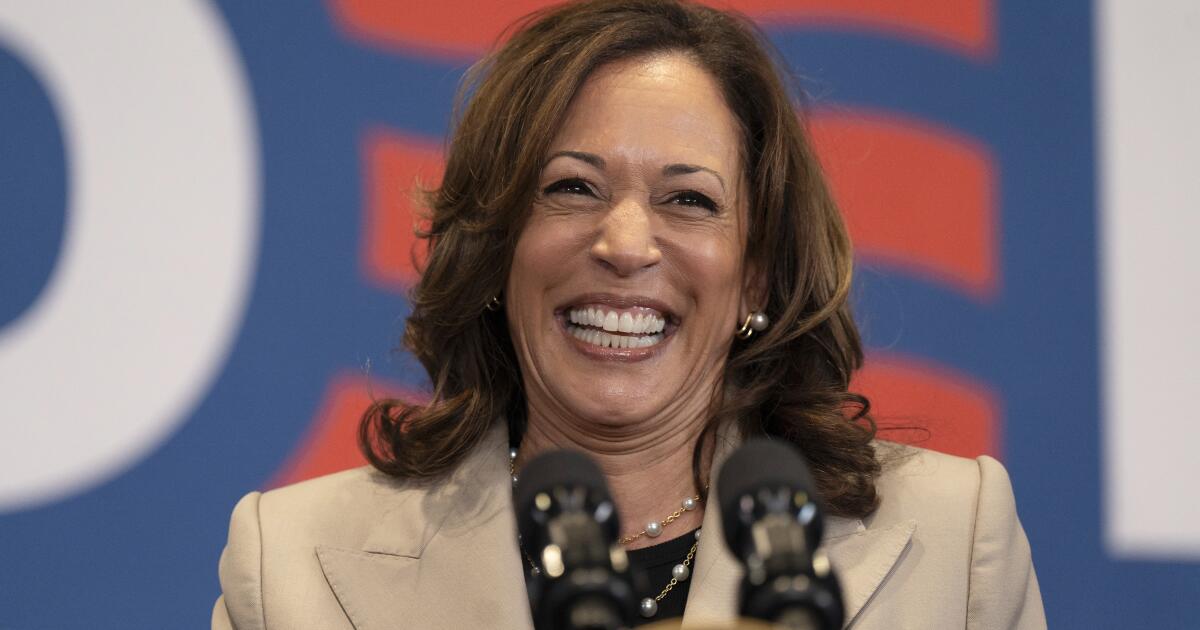
Kamala Harris’ life has been filled with milestones.
Her elementary school class in the 1970s was the second one to integrate Berkeley schools.
Harris was the first woman elected as San Francisco’s district attorney.
She was the first woman to be elected as California’s attorney general.
She was the first person of color to be elected to the U.S. Senate from California.
She was first woman elected vice president of the United States.
Now, with President Biden announcing Sunday that he will step aside as the Democratic presidential nominee and endorsing Harris, she is close to becoming the party’s Democratic nominee for president.
The Times has been covering Harris extensively for two decades. Here is an overview of her story from our pages.
President Biden listens as Vice President Kamala Harris speaks.
(Susan Walsh / Associated Press)
California roots
From Oakland to Canada and back, with inspiration from India
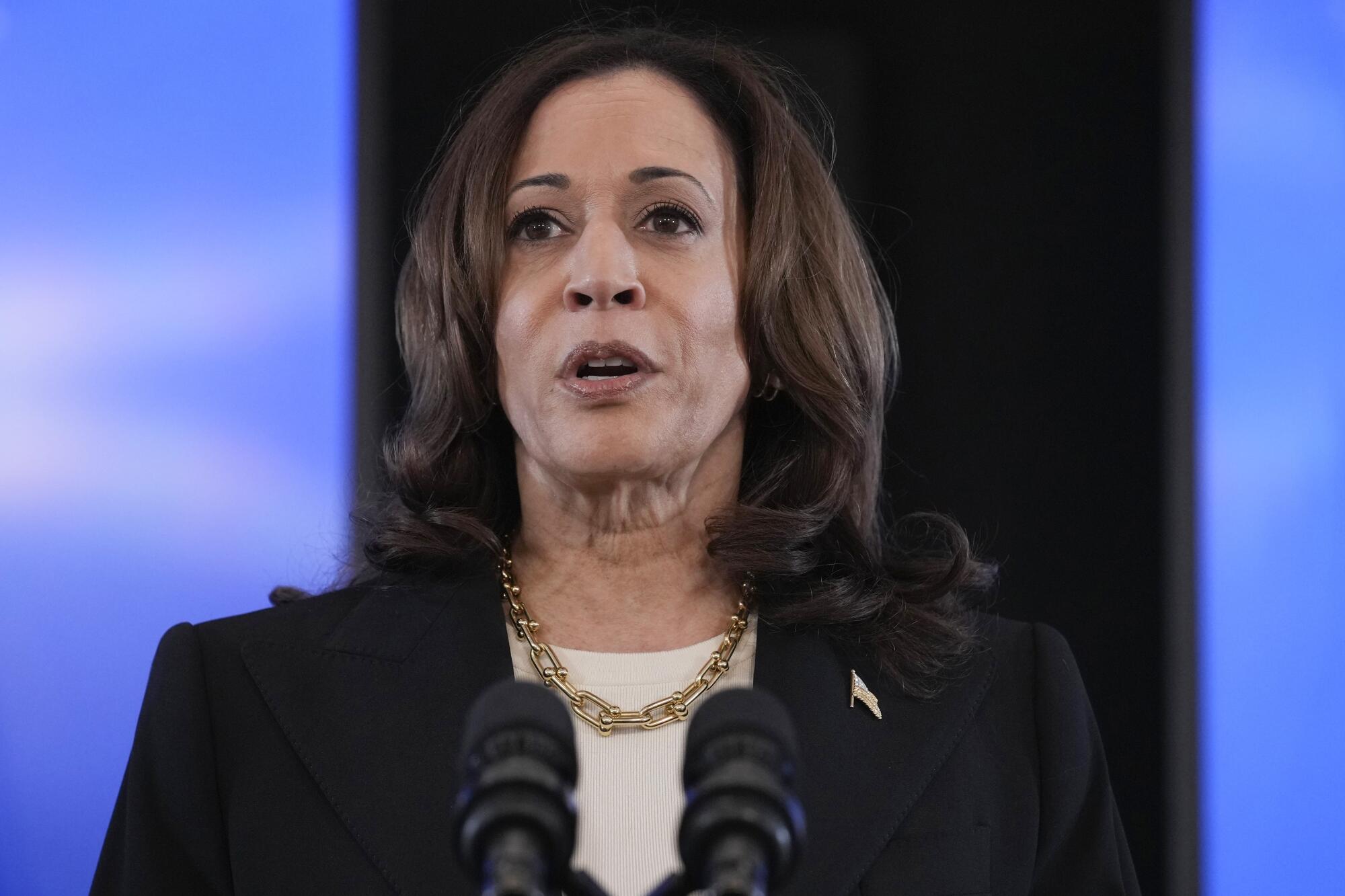
Vice President Kamala Harris speaks about sexual violence.
(Susan Walsh / Associated Press)
Political beginnings
A prosecutor with an ambition for Bay Area politics
- Harris got her start in Bay Area politics and law enforcement. She prosecuted murder, rape, assault and drug cases at the Alameda County district attorney’s office in Oakland from 1990-98.
- San Francisco Dist. Atty. Terence Hallinan had hired Harris in 1998 to lead his career-criminal unit. She ended up running against him and winning in 2003. The campaign was bruising, with critics citing her relationship with San Francisco’s colorful and controversial Mayor Willie Brown. Her record as a prosecutor included some progressive policies but other ones that critics would later say were too “tough on crime.”
-
In 2010, Harris moved to statewide politics, defeating Republican Steve Cooley for attorney general.
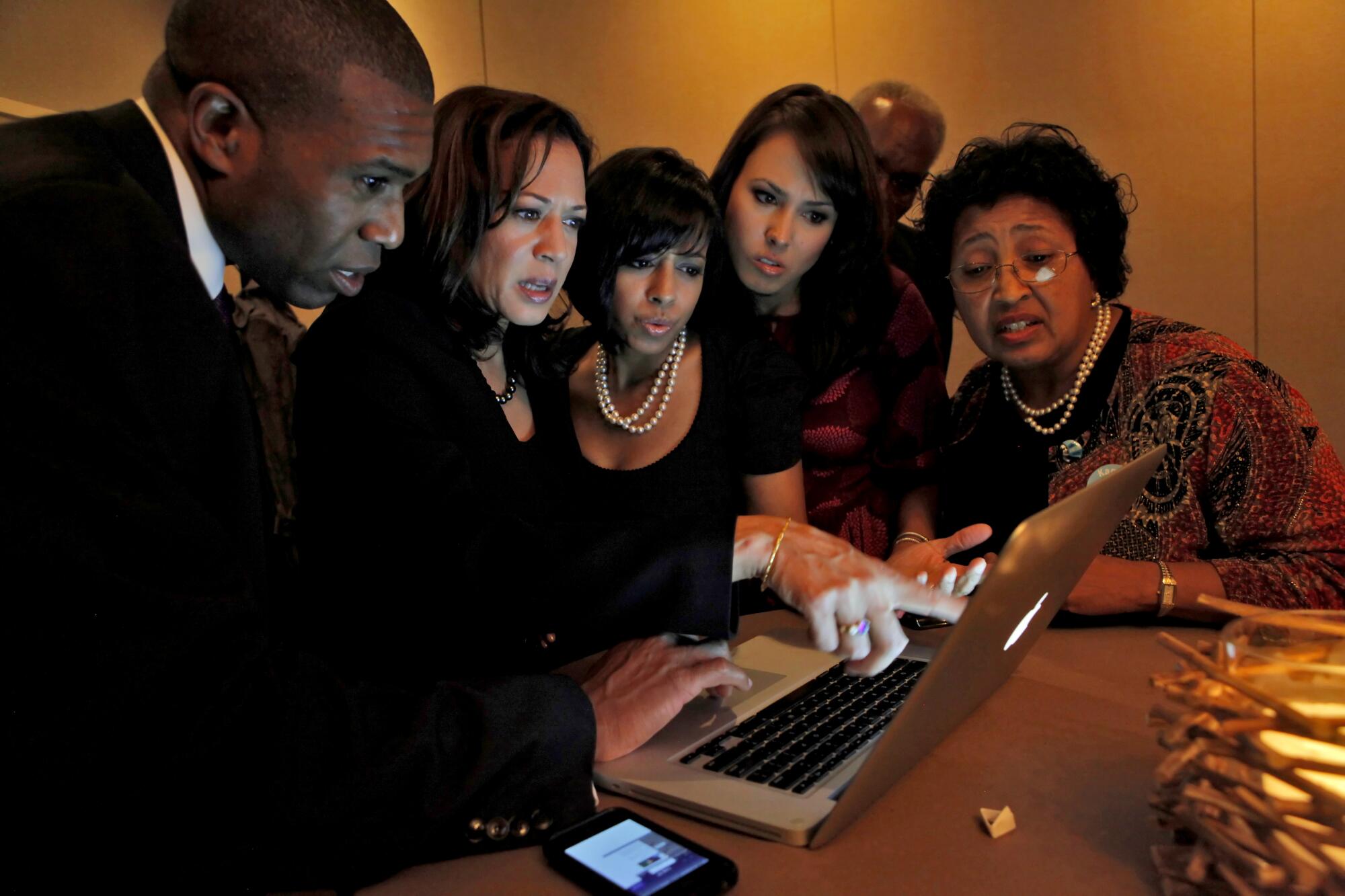
Tony West, left, and Kamala Harris look up the poll results with family Maya Harris, Meena Harris and parents Frank and Peggy Harris on Nov. 2, 2010, in San Francisco.
(San Francisco Chronicle/Hearst N/Hearst Newspapers via Getty Imag)
- As attorney general, she started implicit-bias training for law enforcement, and as district attorney she launched a program that enabled first-time nonviolent offenders to get their charges dismissed if they finished job training. Critics have faulted her, though, for working in court to uphold California’s death penalty, despite her personal opposition, and for her threats to jail parents of chronically truant schoolchildren.
In 2016 The Times editorial board praised Harris for being willing to stand up to the little guy as attorney general. AG. But it issued this warning: “Harris has at times seemed more focused on her political career than on the job she was elected to do. She has been too cautious and unwilling to stake out a position on controversial issues, even when her voice would have been valuable to the debate.” - Harris got national attention for her efforts to have courts overturn California’s ban on gay marriage and allow same-sex couples to legally marry.
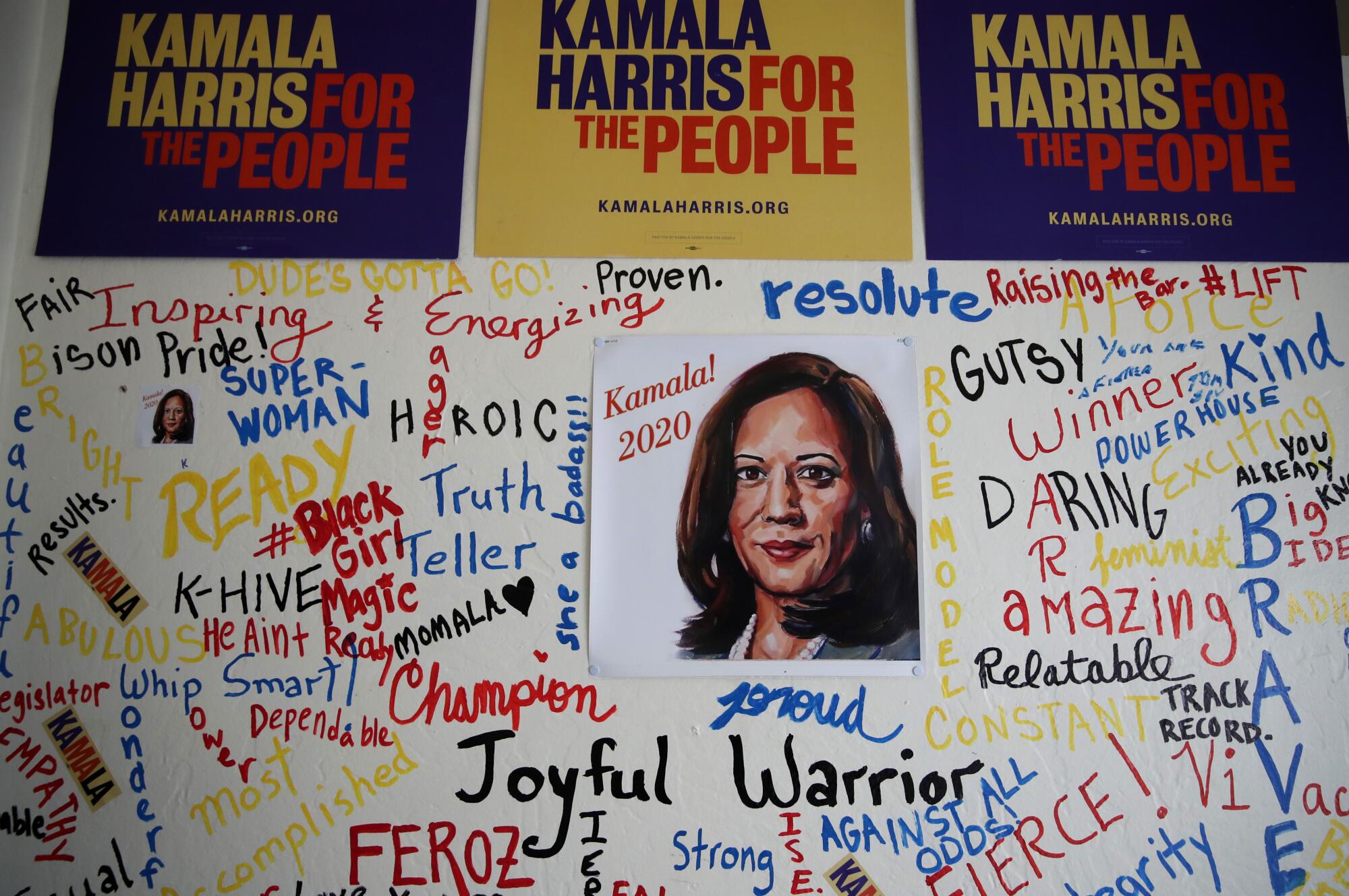
A picture of Kamala Harris at an Oakland campaign office in 2019.
(Justin Sullivan/Getty Images)
National stage
Breaking barriers with a rise to Washington
- Her next move was the 2016 race to replace the retiring Barbara Boxer as U.S. senator. With Democrats dominant in California, it came down to a history-making battle between her and Southern California’s Loretta Sanchez. When Harris won, The Times declared that she tore “down a color barrier that has stood for as long as California statehood.”
- In 2019, she began her campaign for U.S. president. Early on she built strong momentum, drawing a crowd of roughly 20,000 to a lavish Oakland rally. She raised $1.5 million in just 24 hours. She boasted a string of endorsements from California politicians.
- But her campaign slowly sputtered. As The Times reported in March 2019, the fall “stems in part from Harris’ failure to present a compelling case for her candidacy beyond her background as a prosecutor, her buoyant personality and a deep contempt — shared by others in the contest — for President Trump.”
- In December, she suspended her campaign. The Times called it a “lackluster end to an initially soaring presidential bid premised on the California senator’s personal biography and prosecutorial acumen. Ultimately, her run foundered with a muddled purpose, campaign infighting and an inability to sustain support from vital Democratic voting blocs, particularly African Americans.”

Sen. Kamala Harris kick-starts her presidential campaign at a rally in her hometown of Oakland on Jan. 27, 2019.
(Marcus Yam/Los Angeles Times)
- Biden locked in the nomination, but there was no guarantee he would pick her as his running mate. Some felt the Biden team was angry at her treatment of him during the campaign. But Biden ended up selecting Harris. The Times said at the time: “In many ways, Harris is a safe pick — broadly popular in the Democratic Party and well acquainted with the rigors of a national campaign. But her selection also carries symbolic heft in this moment when race relations are at top of mind for voters.”
- Harris held her own during her debate with Vice President Mike Pence and serving as an effective surrogate. The Times reported “Those who have spoken with Harris say she sees the changes — in style, in her approach to campaigning, in the faces surrounding her — worth the goals she now pursues: replacing Trump with Biden and becoming the first female vice president in history.”
- Harris was elected as the nation’s first female vice president (and first person of color to be vice president) in November 2020.
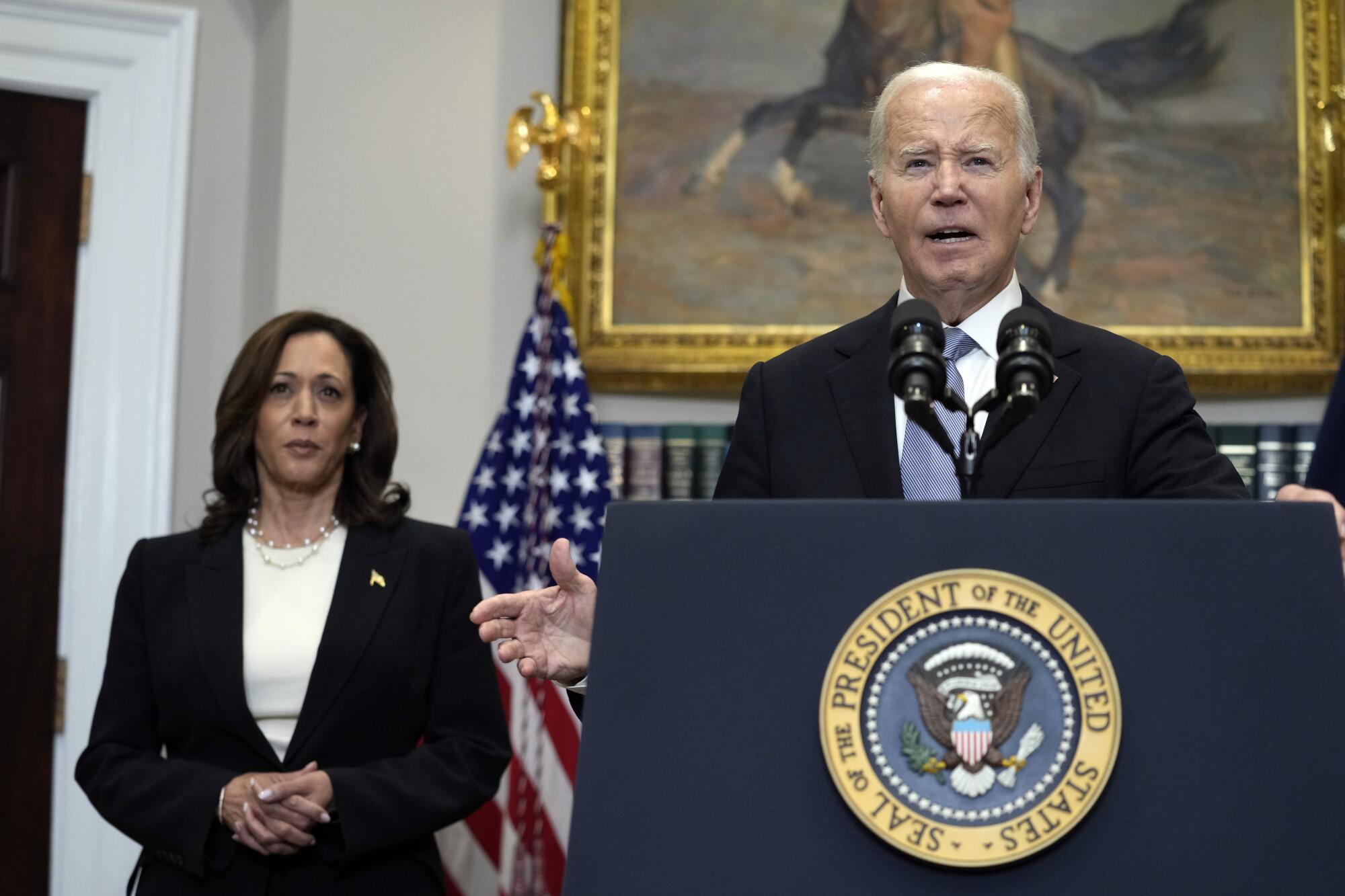
President Biden speaks from the Roosevelt Room earlier this month with Kamala Harris beside him.
(Susan Walsh / Associated Press)
Vice president
Struggling to find her footing in a big job
- Harris made history when she took office, but her term has been marked by successes and struggles.
- After her first year in office, The Times offered this assessment: “Harris has struggled to tell her own story, leaving others to fill the void. Conservative media have attacked her while mainstream outlets have published a string of stories about low morale and high staff turnover in her office. Like many vice presidents, Harris is learning how hard it is to define herself as a No. 2.
- She was handed a difficult assignment in those early months: Leading diplomatic efforts to curb migration from Central America. There were early controversies, such as when she told would-be immigrants not to come to the United States. As the immigration issue has become hot in the 2024 race, Harris faces tough questions about her role in Biden policies.
- Democrats worried about Harris’ lackluster poll numbers as they considered a leader of the party after Biden. “Harris has become a source of tension among Democrats, as growing worries over Harris’ political stature collide with concerns that any move to sideline her would alienate the voters needed to win elections and undercut the party’s promise of equity,” The Times wrote in 2021.
Some fear Harris was shrinking in the job. “Caution has long been a hallmark of Harris’ political career, and the subservient nature of the vice presidency, as well as the scrutiny of Biden loyalists sensitive to the merest hint of personal ambition, reinforce that inclination,” Times columnist Mark Z. Barabak wrote in 2021. - After the Supreme Court struck down Roe vs. Wade, Harris emerged as a leading voice in protecting reproductive rights.
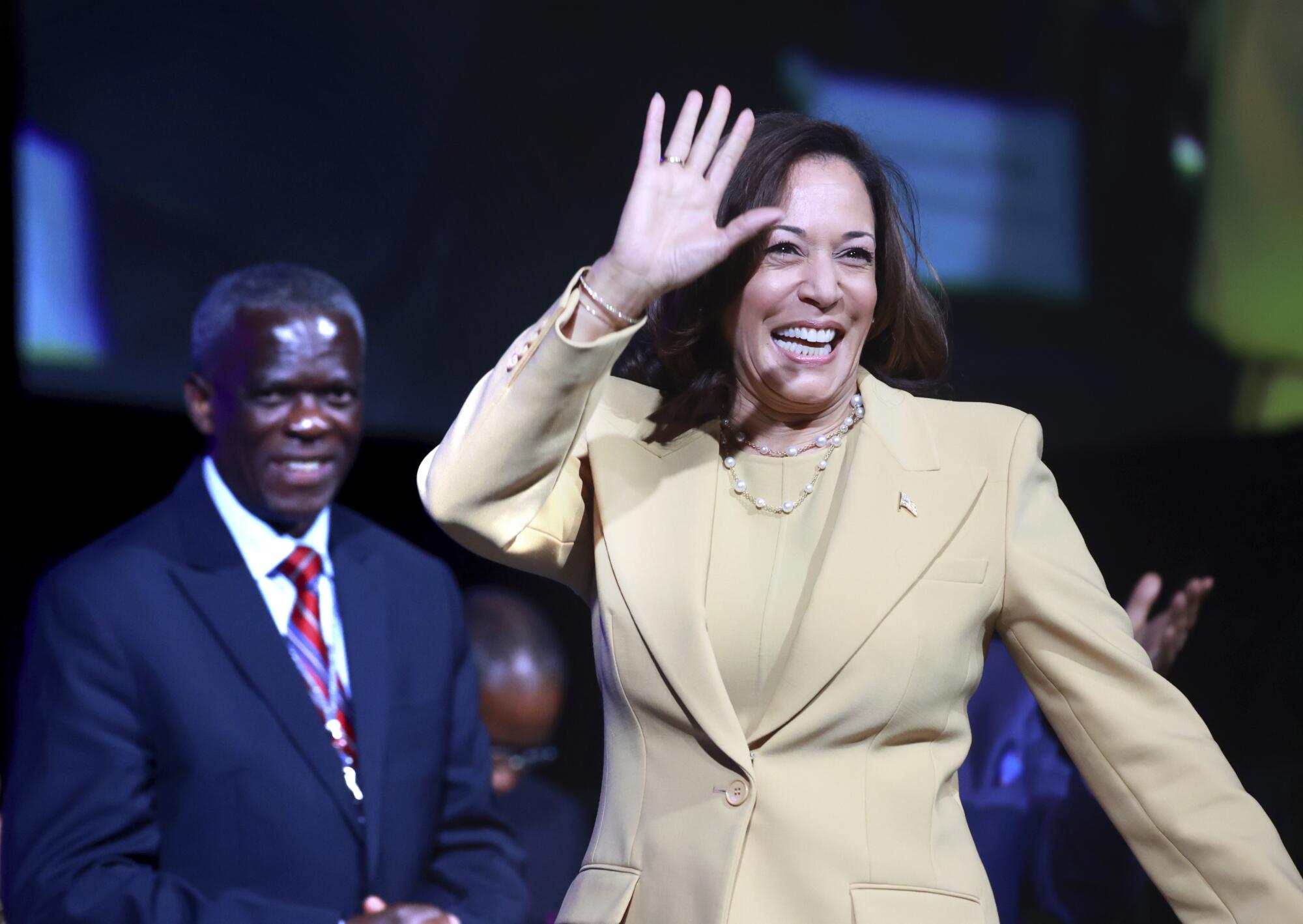
Vice President Kamala Harris takes the stage in Orlando, Fla., at the 20th Quadrennial Convention of the Women’s Missionary Society of the African Methodist Episcopal (AME) Church on Aug. 1, 2023.
(Joe Burbank / Associated Press)
- Barabak in early 2024 rated her this way: “Harris finally seems to have found her footing in a role to which she is accustomed and adept: prosecuting attorney.”
- Harris has endured unprecedented levels of hate on social media. “Research shows that Harris may be the most targeted American politician on the internet, one who checks every box for the haters of the fever swamps: She’s a woman, she’s a person of color and she holds power,” The Times found.
- Before Biden’s disastrous debate performance, Harris was still struggling to present herself as a successor. “More than three years into the oldest president in history’s first term, his understudy has failed to win over a majority of voters or convince them that she is ready to step in if Biden falters, according to polls,” The Times reported in April.
- Harris’ star rose as Democrats began to call on Biden to step aside and end his reelection campaign. She had remained publicly supportive of Biden, even as calls for her to replace him at the head of the ticket grew louder.

Politics
Biden judge rejects Trump’s sanctuary cities lawsuit, says even a win wouldn’t solve DOJ’s problem

Authorities investigate ICE ramming incident in New Jersey
Criminal defense attorney Josh Ritter and former NYPD Lt. Darrin Porcher react to the New Jersey incident where an illegal alien allegedly rammed an ICE agent. They emphasize the staggering 3300% increase in vehicle attacks against law enforcement officers.
NEWYou can now listen to Fox News articles!
A federal judge has tossed the Trump administration’s lawsuit against four New Jersey sanctuary cities, ruling the Justice Department targeted local policies that largely mirror a statewide immigration directive — meaning a court victory wouldn’t eliminate restrictions on ICE cooperation.
U.S. District Judge Evelyn Padin of the District of New Jersey, who was appointed by President Joe Biden, on Wednesday dismissed the Department of Justice’s lawsuit against Newark, Hoboken, Jersey City and Paterson, ruling the federal government lacked standing because striking down the cities’ policies would not remedy its alleged injuries.
“The Federal Government’s case has a fundamental flaw — it treats the Challenged Policies as though they operate in isolation. They do not,” Padin wrote. “New Jersey’s Immigrant Trust Directive is a statewide directive that, like the Challenged Policies, limits voluntary cooperation with federal civil immigration enforcement beyond what the law requires.”
The lawsuit was part of President Donald Trump’s renewed immigration crackdown following his return to office. Since declaring a national emergency at the southern border on Jan. 20, 2025, the administration has aggressively targeted so-called sanctuary jurisdictions, arguing that local policies limiting cooperation with ICE obstruct federal immigration enforcement and violate the Constitution.
DHS TORCHES NEW JERSEY’S PROFANE ‘F—ICE ACT’ AS ASSAULTS ON AGENTS SKYROCKET 1,300%
Immigration and Customs Enforcement (ICE) agents stand outside Delaney Hall detention center in Newark, New Jersey. 5/28/26. (Rashid Umar Abbasi for Fox News Digital.)
The Justice Department filed the lawsuit in May 2025, arguing the four cities’ sanctuary policies violate the Constitution’s Supremacy Clause by interfering with federal immigration enforcement, including limiting voluntary cooperation with ICE, restricting information sharing, declining to honor certain immigration detainers and barring participation in civil immigration enforcement beyond what federal law requires.
Newark, Hoboken and Jersey City each adopted executive orders declaring themselves “fair and welcoming” or “sanctuary” cities, while Paterson implemented police procedures designed to comply with New Jersey’s immigrant protections. The cities have argued the policies preserve community trust and allow local police to focus on state and local crime rather than federal civil immigration enforcement.
But Padin did not address the question of whether the sanctuary policies are constitutional. Instead, she ruled the federal government lacked standing because New Jersey’s Immigrant Trust Directive independently imposes many of the same restrictions on law enforcement agencies across the state.
GOP CANDIDATE RIPS BLUE STATE DIRECTIVE MEDDLING IN POLICE FORCE’S COOPERATION WITH ICE: ‘HANDCUFFED’
New Jersey Gov. Mikie Sherrill said ICE is denying her access to Newark’s Delaney Hall detention center. (Rashid Umar Abbasi for Fox News Digital; Daniel Heuer/Bloomberg via Getty Images)
The directive, first issued under former Gov. Phil Murphy in 2018 and codified into state law by Gov. Mikie Sherrill earlier this year, limits when state and local police can cooperate with federal immigration authorities on civil immigration enforcement.
Because the statewide directive wasn’t challenged in this case, Padin concluded that even if she struck down the cities’ policies, many of the same restrictions would remain in place.
“Even if the Court enjoined the Challenged Policies,” she wrote, “its injuries would persist.”
NEW JERSEY’S BAN ON PRIVATELY OPERATED ICE DETENTION CENTERS STRUCK DOWN BY COURT
That directive has already survived multiple legal challenges. The Third Circuit upheld it after New Jersey counties argued it conflicted with federal immigration law, and the Justice Department later sued New Jersey directly over the policy, lost and did not appeal.
“No judgment here could invalidate the ITD or relieve municipal law enforcement officers of their independent obligation to follow it,” Padin wrote.
U.S. Immigration and Customs Enforcement agents are seen at Terminal 1 of JFK Airport in New York City. An ICE agent saved the life of a 1-year-old boy at JFK after performing the Heimlich maneuver, the Department of Homeland Security said. (Getty Images)
The opinion also faulted the government for failing to identify concrete injuries caused solely by the cities’ policies. While the Justice Department cited several instances in which ICE detainers allegedly were ignored, every example involved the Essex County Correctional Facility, a county-operated jail that is not a defendant in the lawsuit and is governed by the statewide directive.
“The Federal Government must plead facts that substantiate its feared harm,” Padin wrote.
CLICK HERE TO DOWNLOAD THE FOX NEWS APP
Padin dismissed the lawsuit without prejudice, meaning the administration isn’t barred from bringing the case again if it can overcome the standing issue.
The Justice Department declined to comment.

WASHINGTON — The Supreme Court ruled Thursday that the Trump administration may end the Temporary Protected Status granted to more than 350,000 Haitians and Syrians whose home countries remain unsafe.
In a 6-3 decision, the court’s conservative majority said Congress gave the administration, not judges, the power to cancel or renew this temporary protection for non-citizens who are living and working here.
In a second win Thursday for the Trump administration, the court also upheld the administration’s policy of blocking asylum seekers at the southern border.
By the same 6-3 vote, the court said migrants do not have a right to apply for asylum if they are not already in the United States.
The decision on Temporary Protected Status could affect up to 1.3 million non-citizens who are in the country.
In 1990, Congress authorized this emergency humanitarian relief for non-citizens whose home countries were wracked by armed conflict, natural disasters or other extraordinary disruptions.
Under the law, the Department of Homeland Security may grant this protection for 6, 12 or 18 months and either renew or extend it for a similar period.
But this legal authority has been under dispute since Trump returned to the White House last year and targeted the 1.3 million people with TPS from 17 countries who were living in the United States.
Trump’s lawyers said the law made clear there was “no judicial review” of the government’s decision to cancel the grant of temporary protection.
However, immigrant rights lawyers argued the government failed in its duty to consult the State Department and assess whether it was safe for migrants to return home.
Repeatedly, U.S. district judges agreed with the challengers and ruled the administration’s decisions were “arbitrary” and unreasonable. But in nearly every case, the Supreme Court granted emergency appeals from the administration and set aside those orders.
Since TPS was created, the government has ended the protected designation for citizens of 18 countries.
DHS under then-Secretary Kristi Noem ended TPS for Honduras, Nicaragua, Afghanistan and Venezuela. A spokesperson for the agency previously said the Haiti designation became “a de facto amnesty program” and that allowing Syrians to remain is contrary to national interest.
Advocates for the immigrants argue that the administration failed to conduct the required process to properly evaluate each country’s conditions and instead acted on political grounds driven by racial animus.
State Department travel advisories for both countries warn people against traveling to either because of the risk of terrorism, kidnapping and widespread violence. But Federal Register notices announcing the terminations said country conditions had improved enough.
Recently released internal documents show that DHS decided to terminate protections for Haitians without any input from the State Department.
Citing the documents, which were obtained by the National TPS Alliance in a separate lawsuit, lawyers for the Haitians asked the Supreme Court to dismiss the case and send it back to lower courts. They argued that the justices should first consider the communications before issuing a decision.
Internal emails show that homeland security officials sought a recommendation from the State Department in May 2025, ahead of Noem’s early June deadline on whether to extend protections for Haiti. But by the time Noem signed what appears to be a final decision memo, U.S. Citizenship and Immigration Services had not received input from the State Department, the emails show.
“State recommendation for Haiti TPS has not come in despite of many outreach,” a homeland security deputy assistant secretary wrote in a June 2, 2025, email. A recommendation “would be helpful to have,” the person added.
Eleven days later, a USCIS project manager wrote in an email that Noem “recently elected to terminate Haiti without country conditions from DOS.”
USCIS initially recommended automatically extending protections before Homeland Security decided to terminate them, earlier versions of the memo indicate.
The June decision was blocked by a federal judge. In November, DHS issued another notice terminating TPS protections for Haitians.
That time, according a previously publicized email, a homeland security senior counselor asked a State Department official for the agency’s views on the country conditions in Haiti. The official, Spencer Chretien, didn’t address the country conditions but responded that “there would be no foreign policy concerns.”
Lawyers for the Haitians argued that response didn’t meet the legal standard for a sufficient consultation, though the Trump administration disagreed.

NEWYou can now listen to Fox News articles!
An explosive meeting in the Senate turned into a win for President Donald Trump and his administration as key Republicans flipped on another bid to handcuff the administration’s authorities in Iran.
In its final act before leaving Washington, D.C., for an over two-week break, the Senate rejected Democrats’ attempt to rein in Trump’s war powers in Iran as talks continue between Iran and the U.S. to hammer out a long-term peace deal.
It was the same war powers resolution from Sen. Tim Kaine, D-Va., that passed over a month ago and stunned Republicans in the upper chamber.
‘HE NAMED NAMES’: TRUMP’S SENATE MEETING EXPLODES INTO SHOUTING MATCH OVER IRAN
Majority Leader John Thune, R-S.D., and Senate GOP leaders are pushing forward with budget reconciliation to fund the final piece of government that had been shut down by Senate Democrats’ opposition to President Donald Trump’s Immigration and Customs Enforcement actions. (Nathan Posner/Anadolu)
What seemed like a predetermined outcome just hours after Trump and Sen. Bill Cassidy, R-La., sparred over the Iran war, and the administration’s lack of forthcomingness with lawmakers, during a closed-door meeting to discuss the president’s marquee voter ID and citizenship verification legislation turned into a surprise late night win.
Trump argued to the GOP that the previous war powers resolution, which passed on Tuesday thanks in part to a pair of Republicans being absent, hurt the administration’s negotiating position with the Iranians.
Meetings with key holdouts at the White House helped change the minds of Cassidy and Sen. Rand Paul, R-Ky., who has routinely voted with Democrats on every war powers resolution brought forward, and provided the administration with a win as they work toward a deal beyond the 60-day memorandum of understanding with Iran.
IRATE REPUBLICANS ACCUSE TRUMP OF HANDING DEMOCRATS A WIN AFTER BLOWING UP HOUSING PACKAGE
“I want to thank Vice President [JD] Vance and Special Envoy [Steve] Witkoff for the thorough briefing this afternoon on Iran,” Cassidy said on X. “I appreciate the quick invitation to the White House to address many of my concerns.”
And Paul, who voted present, noted that his “opinion on the debate over war and executive power has not changed and I have voted that way several times.”
“But since hostilities seem to be over and the President asked me to give consideration to his negotiating position, I will do so,” Paul said on X. “My vote of present is a way to give the President more space and leverage to negotiate a lasting peace.”
Sen. Chris Murphy, D-Conn., who has been at the forefront among Democrats in pushing war powers resolutions in the upper chamber, acknowledged that “this is a different moment,” but cautioned that the ceasefire appeared to be “precarious right now.”
When asked if he believed Trump’s case to Republicans that the successful war powers vote just a day before was hurting the administration’s leverage, Murphy said, “The Iranians don’t — you know, all they have to do is read a poll and find out that people in this country don’t support the war. They didn’t support the war.”
TRUMP HEADS TO CAPITOL HILL FOR PIVOTAL MEETING AS SENATE GOP DIVISIONS DEEPEN
President Donald Trump boards Air Force One as he departs Reading Regional Airport in Reading, Pa., on Tuesday, June 23, 2026. (Evelyn Hockstein/Reuters)
Still, it marked a key win for Senate Majority Leader John Thune, R-S.D., and the Senate GOP’s whip operation, led by Senate Majority Whip John Barrasso, R-Wyo., to flip the skeptics into backers of the administration’s long game in Iran after several contentious weeks in the Senate spurred by Trump’s last-minute decisions that either derailed or torpedoed several of his key agenda items.
Thune and Barrasso, accompanied by Sens. Lindsey Graham, R-S.C., and Bernie Moreno, R-Ohio, huddled in the GOP leader’s office as the vote wound down late Wednesday to call Trump, and share the news of the vote.
“Wow! The Senate just changed its vote on Iran from 50-48 against, to 50-47 for,” Trump said on Truth Social. “Rand Paul and Bill Cassidy changed. Thank you to Leader John Thune, Lindsey Graham, Bernie Moreno, and all. This vote puts Iran on notice!”
It also comes at a time when speculation has swirled over the nature of Thune and Trump’s relationship as the president, accompanied by chatter online, have ramped up the pressure to pass the Safeguarding American Voter Eligibility (SAVE) America Act.
CLICK HERE TO DOWNLOAD THE FOX NEWS APP
Moreno made the case that the questions over their relationship, and Thune’s position as leader, was just noise, and that “there’s not a single solitary Senator running for office that says leader Thune should be replaced, not one, even non-incumbents.”
“What today showed is that President Trump has a kind of relationship with John Thune where he says, ‘Hey, let me talk to the guys,’ understand the situation,” Moreno said. “As much as Cassidy and Trump got into it, it was because they’re both passionate, they’re both smart people.”
“And now, we’ve most importantly sent the Iranians a message that President Trump has the full backing of the Congress, and that was an incredibly important day,” he continued. “That’s a huge victory for us.”
-

 Detroit, MI12 minutes ago
Scene active as police shoot, kill man on Detroit’s west side
-

 San Francisco, CA22 minutes ago
Civil grand jury report warns of wildfire risk at SF’s Glen Canyon Park
-

 Dallas, TX27 minutes ago
Ivory Coast advances at World Cup, how to buy Ivory Coast tickets
-

 Miami, FL34 minutes ago
Men used fake credentials to enter Brazil vs. Scotland match at Miami Stadium, deputies say
-

 Boston, MA37 minutes ago
3 arrested after trying to break into downtown building, Boston police say – The Boston Globe
-

 Denver, CO49 minutes ago
RTD to bring back BroncosRide bus service after 5-year suspension
-

 Seattle, WA52 minutes ago
FOLLOWUP: Sound Transit Board finalizes $400+ million spending installment for West Seattle light rail
-

 San Diego, CA57 minutes ago
Streetsblog San Diego Launches July 27 — Help Us Build the Future of Transportation Journalism – Streetsblog California

