Politics
Column: We were promised a 'softer' Donald Trump. What we got was a fully Trumpified Republican Party

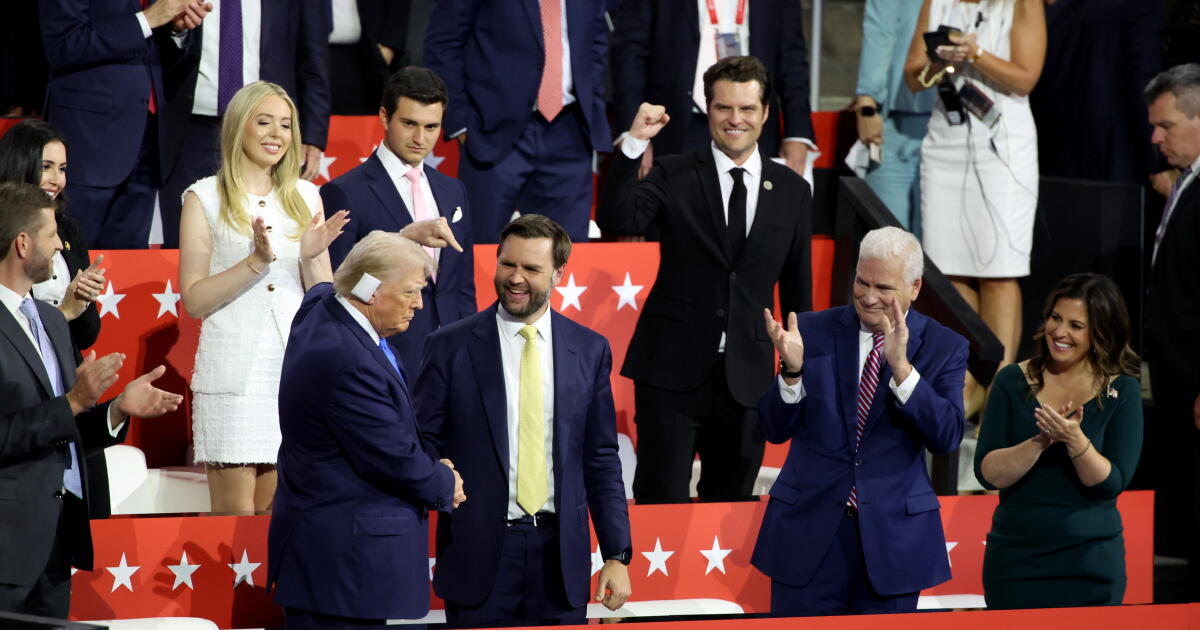
Donald Trump couldn’t restrain himself.
The former president’s aides had promised that his acceptance speech at the Republican National Convention would showcase a “softer,” more conciliatory Trump — and, for perhaps 20 minutes, it did.
But for viewers who watched the whole 92-minute stem-winder, which devolved into a meandering list of bogus claims and well-worn grievances, the lesson was that there is no New Trump. If anything, this year’s version of Trump is even Trumpier than before — one committed to cementing the populist transformation of the GOP for at least another generation.
So the convention in Milwaukee ended with its mission only half accomplished.
Political conventions are lumbering anachronisms, but they survive because they serve two purposes. First, they ratify a choice of nominee and unify and inspire party activists. Then they take advantage of free television time to present their message to the uncommitted but persuadable voters they need to win.
This week’s convention ratified not only Trump’s third nomination, but also the lasting triumph of his grievance-based MAGA ideology over the rest of the GOP. It brought skeptical holdouts like former South Carolina Gov. Nikki Haley back into the Trumpist fold (even though she drew boos) and produced a show of party unity.
Former U.N. Ambassador Nikki Haley, who was Trump’s chief primary rival, was one of the former foes who fell in line behind the ex-president during the Republican National Convention this week.
(Robert Gauthier / Los Angeles Times)
But when it came to a message that might persuade suburban voters, women and others in the center of the electorate that this year’s Trump is an improvement over previous models, the convention fell short — a missed opportunity for a candidate who has never won more than 47% of the popular vote.
The first time Trump won the GOP nomination, in 2016, it was a hostile takeover by an insurgent with weak Republican credentials. Dissidents like Texas Sen. Ted Cruz and Ohio’s then-Gov. John Kasich warned that the New York real estate mogul was taking the party down a path to destruction.
The second time, in 2020, Trump’s nomination was automatic, the traditional act of a party denominating an incumbent president.
This time, the convention made it clear that the old business-dominated, “country club” Republican Party of Richard M. Nixon, Ronald Reagan and the two George Bushes is long gone.
“Trump has realigned the parties in a way that wasn’t there before,” said Geoffrey Kabaservice, author of “Rule and Ruin,” a history of modern Republicanism. “Almost every white working-class voter is going to be a Republican. Almost every college-educated voter is going to be a Democrat” — a reversal of the norm for more than half a century. “That realignment appears likely to last several decades at least.”
The most striking evidence is the nominee’s choice of Ohio Sen. J.D. Vance for vice president.
The 39-year-old populist was the Trumpiest of the three finalists; North Dakota Gov. Doug Burgum and Florida Sen. Marco Rubio had roots in the party’s pre-Trump establishment.
In his convention speech, Vance made it clear that, like Trump, he blames old-style Republicans like the Bushes for the nation’s ills as much as he blames Democrats.
“From Iraq to Afghanistan, from the financial crisis to the Great Recession, from open borders to stagnating wages, the people who govern this country have failed and failed again,” he said.
Vance’s selection may have partly reflected electoral strategy: He could help the ticket win white working-class voters in the industrial swing states of Wisconsin, Michigan and Pennsylvania. But it was also a signal of the direction Trump wants the party to take in 2028.
“Vance is a generational play, not an electoral play,” Democratic strategist David Axelrod said.
In a second Trump administration, Vance would not act as a restraining influence, as Burgum or Rubio might have, but as an intensifier of Trump’s populist instincts.
Vance has been more explicit than Trump on his desire to end U.S. aid to Ukraine immediately. “I don’t really care what happens to Ukraine, one way or the other,” he said in 2022.
Intriguingly, Vance has broken from GOP orthodoxy — and from Trump’s positions — on several economic issues. He has said he does not think cuts in corporate taxes, a key part of Trump’s agenda, are necessary. He has suggested he could support a $20 minimum wage, anathema to most business leaders.
Some of the most interesting battles of a second Trump administration could center on those issues.
“What you have in this ticket is a weird amalgam of plutocratic populism,” Kabaservice said. “It’s incoherent and inconsistent. It’s not clear which parts Trump has signed onto. After all, which part of his agenda is most likely to pass? I think the answer is big corporate tax cuts.”
Trump’s acceptance speech was also a weird amalgam — between the kinder, gentler nominee his aides had hoped to showcase and the angry, resentful candidate he has been for most of the last decade.
On Thursday morning, daughter-in-law Lara Trump, vice chair of the GOP, promised that the acceptance speech would reveal “a bit softer version” of the nominee, who she said had been deeply affected by his brush with death after being wounded in a gunman’s assassination attempt.
But after a long description of the assassination attempt and a brief appeal to national unity — “We must not criminalize dissent or demonize political disagreement,” Trump said — he resumed demonizing President Biden and other Democrats, including “crazy Nancy Pelosi,” accusing them of “destroying our country.”
Trump’s definition of “unity,” it turned out, did not include mutual respect or bipartisan cooperation. It boiled down to accepting his policies and dropping every federal prosecution he faces.
“If Democrats want to unify our country, they should drop these partisan witch hunts,” he said.
Most of the address — much of which departed from his written text, as Trump usually does — was a loop of greatest hits from Trump’s stump speeches. It included a torrent of bogus claims, accusations and yet another admiring mention of the “late, great” fictional cannibal, Hannibal Lecter. The only sign of restraint was that this time, he did not use the word “vermin” to describe his political opponents or promise to prosecute them if he reaches the White House.
If he had accomplished the change in tone that his aides sought to broaden his appeal, he might have paved a path for his party to a popular-vote majority and control of the House of Representatives and Senate. But the speech he gave probably kept alive the doubts many voters have about his fitness for office.
And he gave Democrats an opening they can exploit — but only if they can settle on a nominee of their own.



WASHINGTON — The Supreme Court ruled Thursday that the Trump administration may end the Temporary Protected Status granted to more than 350,000 Haitians and Syrians whose home countries remain unsafe.
In a 6-3 decision, the court’s conservative majority said Congress gave the administration, not judges, the power to cancel or renew this temporary protection for non-citizens who are living and working here.
In a second win Thursday for the Trump administration, the court also upheld the administration’s policy of blocking asylum seekers at the southern border.
By the same 6-3 vote, the court said migrants do not have a right to apply for asylum if they are not already in the United States.
The decision on Temporary Protected Status could affect up to 1.3 million non-citizens who are in the country.
In 1990, Congress authorized this emergency humanitarian relief for non-citizens whose home countries were wracked by armed conflict, natural disasters or other extraordinary disruptions.
Under the law, the Department of Homeland Security may grant this protection for 6, 12 or 18 months and either renew or extend it for a similar period.
But this legal authority has been under dispute since Trump returned to the White House last year and targeted the 1.3 million people with TPS from 17 countries who were living in the United States.
Trump’s lawyers said the law made clear there was “no judicial review” of the government’s decision to cancel the grant of temporary protection.
However, immigrant rights lawyers argued the government failed in its duty to consult the State Department and assess whether it was safe for migrants to return home.
Repeatedly, U.S. district judges agreed with the challengers and ruled the administration’s decisions were “arbitrary” and unreasonable. But in nearly every case, the Supreme Court granted emergency appeals from the administration and set aside those orders.
Since TPS was created, the government has ended the protected designation for citizens of 18 countries.
DHS under then-Secretary Kristi Noem ended TPS for Honduras, Nicaragua, Afghanistan and Venezuela. A spokesperson for the agency previously said the Haiti designation became “a de facto amnesty program” and that allowing Syrians to remain is contrary to national interest.
Advocates for the immigrants argue that the administration failed to conduct the required process to properly evaluate each country’s conditions and instead acted on political grounds driven by racial animus.
State Department travel advisories for both countries warn people against traveling to either because of the risk of terrorism, kidnapping and widespread violence. But Federal Register notices announcing the terminations said country conditions had improved enough.
Recently released internal documents show that DHS decided to terminate protections for Haitians without any input from the State Department.
Citing the documents, which were obtained by the National TPS Alliance in a separate lawsuit, lawyers for the Haitians asked the Supreme Court to dismiss the case and send it back to lower courts. They argued that the justices should first consider the communications before issuing a decision.
Internal emails show that homeland security officials sought a recommendation from the State Department in May 2025, ahead of Noem’s early June deadline on whether to extend protections for Haiti. But by the time Noem signed what appears to be a final decision memo, U.S. Citizenship and Immigration Services had not received input from the State Department, the emails show.
“State recommendation for Haiti TPS has not come in despite of many outreach,” a homeland security deputy assistant secretary wrote in a June 2, 2025, email. A recommendation “would be helpful to have,” the person added.
Eleven days later, a USCIS project manager wrote in an email that Noem “recently elected to terminate Haiti without country conditions from DOS.”
USCIS initially recommended automatically extending protections before Homeland Security decided to terminate them, earlier versions of the memo indicate.
The June decision was blocked by a federal judge. In November, DHS issued another notice terminating TPS protections for Haitians.
That time, according a previously publicized email, a homeland security senior counselor asked a State Department official for the agency’s views on the country conditions in Haiti. The official, Spencer Chretien, didn’t address the country conditions but responded that “there would be no foreign policy concerns.”
Lawyers for the Haitians argued that response didn’t meet the legal standard for a sufficient consultation, though the Trump administration disagreed.

NEWYou can now listen to Fox News articles!
An explosive meeting in the Senate turned into a win for President Donald Trump and his administration as key Republicans flipped on another bid to handcuff the administration’s authorities in Iran.
In its final act before leaving Washington, D.C., for an over two-week break, the Senate rejected Democrats’ attempt to rein in Trump’s war powers in Iran as talks continue between Iran and the U.S. to hammer out a long-term peace deal.
It was the same war powers resolution from Sen. Tim Kaine, D-Va., that passed over a month ago and stunned Republicans in the upper chamber.
‘HE NAMED NAMES’: TRUMP’S SENATE MEETING EXPLODES INTO SHOUTING MATCH OVER IRAN
Majority Leader John Thune, R-S.D., and Senate GOP leaders are pushing forward with budget reconciliation to fund the final piece of government that had been shut down by Senate Democrats’ opposition to President Donald Trump’s Immigration and Customs Enforcement actions. (Nathan Posner/Anadolu)
What seemed like a predetermined outcome just hours after Trump and Sen. Bill Cassidy, R-La., sparred over the Iran war, and the administration’s lack of forthcomingness with lawmakers, during a closed-door meeting to discuss the president’s marquee voter ID and citizenship verification legislation turned into a surprise late night win.
Trump argued to the GOP that the previous war powers resolution, which passed on Tuesday thanks in part to a pair of Republicans being absent, hurt the administration’s negotiating position with the Iranians.
Meetings with key holdouts at the White House helped change the minds of Cassidy and Sen. Rand Paul, R-Ky., who has routinely voted with Democrats on every war powers resolution brought forward, and provided the administration with a win as they work toward a deal beyond the 60-day memorandum of understanding with Iran.
IRATE REPUBLICANS ACCUSE TRUMP OF HANDING DEMOCRATS A WIN AFTER BLOWING UP HOUSING PACKAGE
“I want to thank Vice President [JD] Vance and Special Envoy [Steve] Witkoff for the thorough briefing this afternoon on Iran,” Cassidy said on X. “I appreciate the quick invitation to the White House to address many of my concerns.”
And Paul, who voted present, noted that his “opinion on the debate over war and executive power has not changed and I have voted that way several times.”
“But since hostilities seem to be over and the President asked me to give consideration to his negotiating position, I will do so,” Paul said on X. “My vote of present is a way to give the President more space and leverage to negotiate a lasting peace.”
Sen. Chris Murphy, D-Conn., who has been at the forefront among Democrats in pushing war powers resolutions in the upper chamber, acknowledged that “this is a different moment,” but cautioned that the ceasefire appeared to be “precarious right now.”
When asked if he believed Trump’s case to Republicans that the successful war powers vote just a day before was hurting the administration’s leverage, Murphy said, “The Iranians don’t — you know, all they have to do is read a poll and find out that people in this country don’t support the war. They didn’t support the war.”
TRUMP HEADS TO CAPITOL HILL FOR PIVOTAL MEETING AS SENATE GOP DIVISIONS DEEPEN
President Donald Trump boards Air Force One as he departs Reading Regional Airport in Reading, Pa., on Tuesday, June 23, 2026. (Evelyn Hockstein/Reuters)
Still, it marked a key win for Senate Majority Leader John Thune, R-S.D., and the Senate GOP’s whip operation, led by Senate Majority Whip John Barrasso, R-Wyo., to flip the skeptics into backers of the administration’s long game in Iran after several contentious weeks in the Senate spurred by Trump’s last-minute decisions that either derailed or torpedoed several of his key agenda items.
Thune and Barrasso, accompanied by Sens. Lindsey Graham, R-S.C., and Bernie Moreno, R-Ohio, huddled in the GOP leader’s office as the vote wound down late Wednesday to call Trump, and share the news of the vote.
“Wow! The Senate just changed its vote on Iran from 50-48 against, to 50-47 for,” Trump said on Truth Social. “Rand Paul and Bill Cassidy changed. Thank you to Leader John Thune, Lindsey Graham, Bernie Moreno, and all. This vote puts Iran on notice!”
It also comes at a time when speculation has swirled over the nature of Thune and Trump’s relationship as the president, accompanied by chatter online, have ramped up the pressure to pass the Safeguarding American Voter Eligibility (SAVE) America Act.
CLICK HERE TO DOWNLOAD THE FOX NEWS APP
Moreno made the case that the questions over their relationship, and Thune’s position as leader, was just noise, and that “there’s not a single solitary Senator running for office that says leader Thune should be replaced, not one, even non-incumbents.”
“What today showed is that President Trump has a kind of relationship with John Thune where he says, ‘Hey, let me talk to the guys,’ understand the situation,” Moreno said. “As much as Cassidy and Trump got into it, it was because they’re both passionate, they’re both smart people.”
“And now, we’ve most importantly sent the Iranians a message that President Trump has the full backing of the Congress, and that was an incredibly important day,” he continued. “That’s a huge victory for us.”

WASHINGTON — President Trump canceled his planned signing Wednesday of the landmark housing bill Congress passed this week, in a striking decision to jeopardize a rare bipartisan success in order to demand that lawmakers pass voter ID legislation.
The president’s reversal, as a stage and chairs for the signing ceremony were set up in the Capitol and stakeholders were arriving on the Hill, underscored his fixation on asserting some federal control over election processes.
And it displayed a remarkable willingness to threaten a bill that he and his party could have framed as a win on affordability ahead of the midterm elections, as Republicans fight to keep U.S. House control amid economic dissatisfaction among Americans.
Hours before the president torpedoed the bill signing, the White House had said the measure was an example of a “promise kept.”
“Today’s Housing News Conference and Signing is hereby cancelled until such time as we pass the desperately needed SAVE AMERICA ACT, which I consider to be a National Emergency,” Trump wrote Wednesday morning on his social media website.
It opened a new front in ongoing tension between Trump and Senate Republicans, which already had neared a breaking point this week over the proof-of-citizenship bill. Senate leaders have told the president that the bill, dubbed the SAVE America Act, does not have the votes to pass.
And it shocked lawmakers who had been celebrating the bipartisan accomplishment. Rep. Maxine Waters (D-Los Angeles), who had helped lead negotiations, said Trump was “slapping millions of families in the face” after having supported the bill.
“Trump is making his promise crystal clear: If you’re dealing with high housing costs, you’re on your own,” Waters told reporters at a Democratic news conference Wednesday afternoon.
The housing bill, which passed with overwhelming support in the House on Tuesday evening and the Senate on Monday, aims to boost housing supply. It is the most significant legislation Congress has passed on housing in more than 30 years, and it contains a host of provisions aimed at removing regulatory barriers, improving federal programs and incentivizing new home building.
As president, Trump has 10 days to sign or veto bills after they are presented. If he takes no action and Congress remains in session, a bill becomes law. Rep. Katherine Clark (D-Mass.), the House minority whip, said Republican leadership had not yet presented the bill to Trump.
House Speaker Mike Johnson (R-La.) indicated to reporters Wednesday that a signing could still be on the table, saying he had spoken to Trump about “delaying” the housing bill before the president announced the cancellation.
“He decided — I didn’t announce it, I wanted him to announce it — but we’re delaying this,” Johnson said. “He has a window of time before he has to sign a bill and he’s going to use a little bit more of that window of time and we’re gonna go through this together.”
Johnson said he had promised an effort to advance the SAVE America Act, saying election integrity “is the top priority.” The speaker accused Democrats of wanting “to allow for cheating and fraud in the elections because it is the only way Marxists can win.”
The White House did not respond when asked whether the president planned to veto the bill or sign it later.
Jim Tobin, president of the National Assn. of Home Builders, which advocated for the bill, said he was on his way to the ceremony, getting ready to walk through Capitol security, when Trump posted.
It was “very disappointing,” Tobin said, citing two years of bipartisan work among industry leaders, lawmakers and the White House, but he said he believed the bill may still ultimately become law.
“People, I believe, want to run — back home — on the affordability issue,” Tobin said. “This would be a great feather in a lot of Congress members’ hats, as well as the president’s, so I’m confident that we’ll get there.”
Last week, the NPR/PBS News/Marist Poll and Fox News poll found record dissatisfaction with the economy among Americans and Trump’s support slipping among key demographics. The president also lashed out about that on his social media website earlier Wednesday, writing without evidence: “MY REAL POLL NUMBERS ARE THE HIGHEST THEY HAVE EVER BEEN. THANK YOU!!!”
Before Trump announced the cancellation, he posted about the legislation, labeling it “the Elizabeth ‘Pocahontas’ Warren centric housing bill,” and railed about the SAVE America Act.
His push for the election overhaul bill could be a test of Senate Republicans’ willingness to counter him.
In recent months, they have revolted against several of his priorities, including security funding for a White House ballroom and a $1.8-billion fund to pay people who claim to have been politically persecuted by the federal government. On Tuesday, four Republican senators joined with Democrats to approve a war powers resolution seeking to block U.S. military action in Iran.
Trump, who for years has tried to sow doubt in American elections, has pressed Republicans to pass the SAVE America Act ahead of the midterm elections. He has said the bill would “guarantee” the midterms for Republicans.
Frustrated that the bill has fallen short of the 60-vote threshold needed to pass the Senate, Trump has repeatedly pressured Senate Majority Leader John Thune (R-S.D.) to eliminate the filibuster rule. Thune has refused.
“He is trying to put pressure on the Senate and on his own caucus to pass an unpopular bill as part of his effort to interfere in the elections,” said Wendy Weiser, democracy program director at the Brennan Center for Justice at New York University. “We need to take seriously the possibility that he’s really trying to blow up the Senate over this.”
Earlier this year, Trump said he would not sign any other legislation before the election overhaul measure was passed, arguing that it “supersedes everything else.” He has threatened to not renew a key U.S. surveillance law if it does not include the voting law. And at a rally in Pennsylvania on Tuesday, the president said the election bill was needed because states such as California were trying to rig the election.
“California is totally rigged. All mail-in ballots, it’s a disgrace,” the president told the crowd.
In Washington, the voting law has already passed the House three times. But it has stalled in the Senate. Sen. Thom Tillis (R-N.C.) told reporters Wednesday that it was an “unachievable goal” to try to get the bill passed.
The legislation would require voters to provide proof of citizenship when they register, require Americans show identification when casting a ballot and require states to send voter data to the Department of Homeland Security.
Voting rights advocates say it would create unnecessary barriers to voting for citizens. There are less disruptive ways to verify a voter’s citizenship status, and the bill would also create administrative challenges for election officials, said Wren Orey, elections project director at the Bipartisan Policy Center.
It serves Trump to continue pushing the bill even without support to pass it, said Eric Kashdan, director of federal advocacy at the Campaign Legal Center; if Republicans suffer losses in the midterms, Trump may use the narrative that elections are vulnerable to fraud.
“If they can say that without the SAVE Act these elections are not secure, that lays the groundwork for the administration to possibly interfere in the elections or just sow doubt,” Kashdan said.
Rep. Brad Sherman (D-Sherman Oaks) said Trump was holding the bill hostage in a bid “to control California’s elections.”
“The stage was set both physically and metaphorically for the president to sign a historic housing bill for the American people,” said Sherman, who contributed a provision to the housing bill that would help disabled veterans get rental assistance. “Trump must put his ego aside and put the American people first and sign this bill into law.”
-
Politics10 minutes ago
Supreme Court rules Trump may end legal protection for Haitians and Syrians
-
 Science13 minutes ago
Drug overdoses in L.A County drop for third straight year. Here’s why
-
 Sports18 minutes ago
Drug charges against U.S. skiing great Bode Miller to be dropped, his attorney says
-

 World28 minutes ago
Prioritise workers’ health during heatwaves, says ETUI
-
News55 minutes ago
Federal judge halts Trump’s election executive order seeking to create a federal voter list
-

 Los Angeles, Ca2 hours ago
Boyle Heights warehouse cleanup begins as crews face 85 million pounds of spoiled food
-

 Detroit, MI3 hours ago
Would Detroit Lions Salary Cap Be Wrecked If Terrion Arnold Gets Cut?
-

 San Francisco, CA3 hours ago
Two more Presidio Heights homes reach $10M range as luxury supply dwindles

