News
Indicted election deniers from several states are Republican Convention delegates


Republican vice presidential candidate Sen. JD Vance, R-Ohio, speaks at the 2024 Republican National Convention on Wednesday in Milwaukee as Republican presidential candidate former President Donald Trump watches. There are more than a dozen so-called “fake electors” from several states serving as delegates at this year’s convention.
Carolyn Kaster/AP
hide caption
toggle caption
Carolyn Kaster/AP
In order to travel to the Republican National Convention in Milwaukee this week, three Arizona delegates needed permission from a judge.
That’s because GOP Arizona state Sens. Jake Hoffman and Anthony Kern, as well as Nancy Cottle, are among the 18 people indicted by an Arizona grand jury for their roles in an alleged scheme to upend the 2020 presidential election by throwing their state’s 11 Electoral College votes to former President Trump.
Hoffman, Kern and Cottle aren’t the only people in this situation who are at the convention in Milwaukee. Three delegates from Georgia, five from Nevada and two from Michigan also face charges for similar “fake elector” schemes in their respective states, according to an NPR review of delegate rosters and news reports.
Election deniers from Pennsylvania, New Mexico and Wisconsin are also present as delegates at the RNC.
A lawsuit was also filed in Wisconsin against those who cast fraudulent electoral college votes for Trump. But the case was partly settled after those fake electors agreed to formally state their actions were “part of an attempt to improperly overturn the 2020 presidential election results.”
The delegates’ roles in Milwaukee are largely ceremonial — on Monday, delegates from each state pledged their support for Trump as the Republican Party’s standard bearer in 2024.
But some former GOP officials say their presence is a stain on the party.
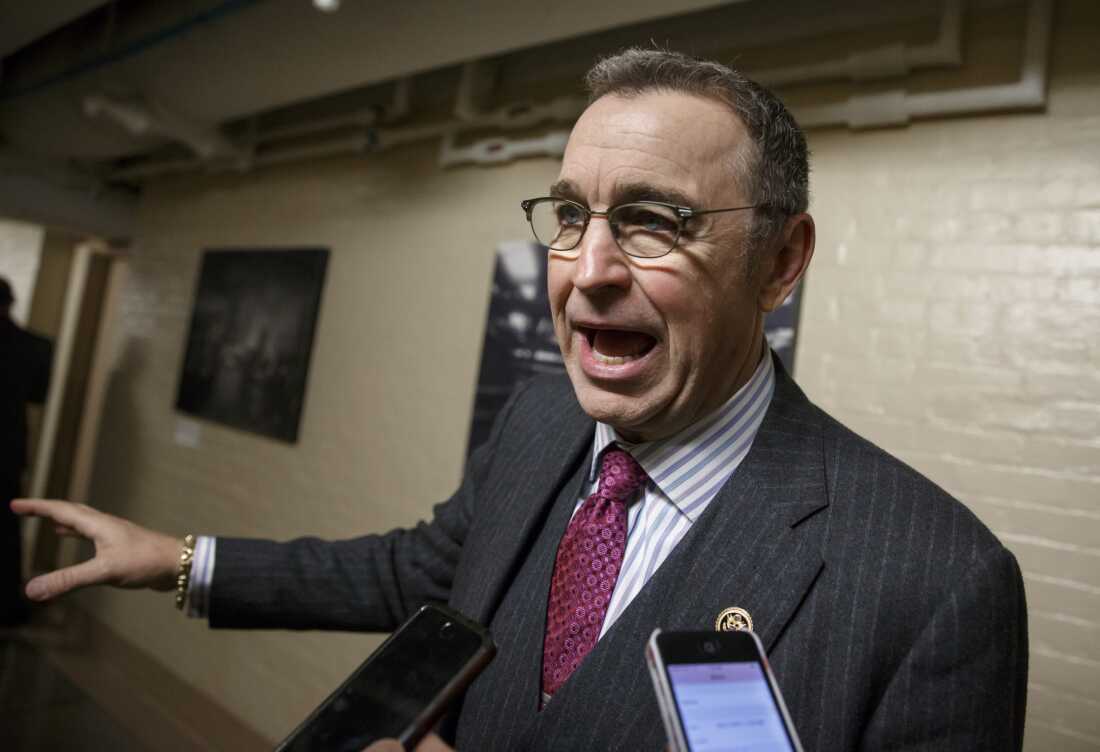
Then-Rep. Matt Salmon, R-Ariz. talks to reporters on Capitol Hill in Washington in this January 2015 file photo.
J. Scott Applewhite/AP
hide caption
toggle caption
J. Scott Applewhite/AP
“When those kinds of people are the ones that we’re sending from our state, here in Arizona, back to… the top brass of the Republican Party nationally? It reflects badly on us as a state, I believe,” said former congressman Matt Salmon.
In Arizona, it’s not just Hoffman, Kern and Cottle that worries Salmon.

There’s also Shelby Busch, the chair of Arizona’s RNC delegation, who earlier this year threatened to lynch a Republican elected official who’s defended the integrity of elections in Maricopa County.
And Liz Harris, the state’s elected Republican National Committeewoman, was expelled from the Arizona Legislature in 2023 for inviting a witness to present false charges about lawmakers and other state officials — including allegations of an election-related bribery scheme involving the Sinaloa drug cartel.
Sending Harris, Busch and others to the RNC is not what Salmon, who once served as chair of the Arizona GOP, would call putting the state’s “best foot forward.”
“It ebbs our credibility, and our integrity,” he said.
Gina Swoboda, the current chair of the Arizona Republican Party, doesn’t share those concerns. As for the three “fake electors,” Swoboda says such a thing “doesn’t exist.”
“That’s a made up leftist frame,” she said Monday from the convention floor. “We’ve always had alternate electors.”
What Hoffman, Kern and Cottle — the three indicted delegates — did was “in keeping with what we have done historically,” Swoboda added.
“They were proud to represent President Trump in 2020. Arizona stands by everyone who stood by President Trump. We would never do anything less,” she said.
Hoffman, an alternate delegate whose fellow Arizona Republicans elected him the state’s national committeeman, chalks up his indictment as a product of “the Democrats’ weaponization of our justice system” and vows he’ll be vindicated from “this naked political persecution.”
When asked if his presence at the convention was, as Salmon argued, a poor reflection of the Republican brand, Hoffman claimed the charges were part of a plot to divide the country.
“They are doing such a good job at it that an assassin attempted to assassinate President Trump just a few days ago. That is not something that we take lightly,” Hoffman said, adding that he has received death threats that he blamed on “the likes of Rachel Maddow and other insane leftists in the media.”
In Milwaukee, party officials have largely shied away from rehashing a four-year-old election loss. But Trump, too, has historically stood by those who attempted to upend his 2020 loss.
Kern, for instance, boasts of Trump’s 2022 endorsement for Arizona Senate in a recent ad for his 2024 congressional campaign. In it, Kern describes himself as a “hometown hero who actually did stand up for President Trump.”
And the former president has surrounded himself with election deniers, from his choice of vice presidential running mate — Ohio Sen. J.D. Vance has said he thought the 2020 election was “stolen from Trump” — to those seeking employment at the RNC.
Salmon worries that kind of continued acceptance of persistent election denialism will drive essential voters away from the conservative cause.
“I’m talking about the right-of-center voters who are independents, Democrats, and Republicans,” Salmon said “They want us to talk about real problems and making their future better. They don’t want to keep talking about, you know, what happened in the last election.”



A federal judge on Wednesday permanently barred President Donald Trump’s administration from implementing most of his first executive order on elections, part of which sought to require people to show documentary proof of citizenship when they register to vote.
The ruling by U.S. District Court Judge Denise Casper in Boston effectively converts a preliminary injunction she issued a year ago, in which she temporarily blocked many of Trump’s efforts to overhaul elections, into a permanent ban.
Casper rejected the Republican administration’s argument that the lawsuit to block the changes brought by Democratic state attorneys general was premature because the rules had yet to be put in place. Instead, she agreed that the Constitution gives states and Congress the authority to regulate elections, and that Trump’s requirements violated the separation of powers.
The Constitution “does not grant the President any specific powers over elections,” wrote Casper.
Among other proposed changes, Trump’s order would have required people to provide documentary proof of citizenship when registering to vote, prevented mail ballots from being counted if they arrive after Election Day, even if they were postmarked by then, and punished states that failed to comply by withholding certain federal money.
In a statement, New York Attorney General Letitia James said she was grateful the court had blocked Trump’s “unconstitutional attempt to seize control of our elections” and would continue to defend voting rights in this year’s midterm elections.
“Generations of Americans fought tirelessly for the right to vote, and we honor their legacy by protecting that right against anyone who tries to undermine it,” said James, a Democrat.
A voter casts a ballot during New York’s primary election on Tuesday, June 23, 2026, in New York. (AP Photo/Ryan Murphy)
California Attorney General Rob Bonta, whose state was the lead plaintiff in the case, said the ruling reaffirmed the constitutional principle that it s up to the states and Congress to set election rules.
“While we are proud of this result, we are clear-eyed that President Trump’s attacks on voting rights and our elections show no signs of slowing down,” Bonta, a Democrat, said in a statement. “So let me be clear: we will keep fighting back every step of the way.”
Requests for comment sent to the White House and he U.S. Department of Justice were not immediately returned.
The ruling was the latest in a series against the elections executive order Trump signed just months after taking office for his second term. The Republican president has since signed another executive order on elections that seeks to create a national voter list and limit mail balloting. That directive also faces multiple legal challenges.
Last fall, a federal judge in Washington, D.C., overseeing a separate challenge to the first election executive order by civil rights and Democratic Party-aligned groups blocked the government from taking steps to include the proof-of-citizenship requirement on the federal voter registration form. That judge later barred Trump’s defense secretary from requiring documentary proof of citizenship when military personnel register to vote or request ballots.
In an apparent nod to the difficulty of implementing a proof-of-citizen requirement by executive order, Trump is pushing legislation in the Republican-controlled Congress to create such a mandate. The SAVE America Act has passed the House but has stalled in the Senate, leading Trump to advocate for eliminating the filibuster that is blocking the legislation.
On Wednesday, he abruptly canceled the expected signing of a bipartisan housing bill, saying he would not sign legislation until Congress passes his proof of citizenship requirement for voting.
The president and many of his Republican allies have been promoting the narrative that voting by noncitizens is a major problem, when in fact it’s quite rare. The federal voter registration form already requires people to attest that they are U.S. citizens. Violating that is punishable as a felony that can lead to prison or deportation.
In another major voting case, the U.S. Supreme Court is due to issue an opinion soon on whether mail ballots must arrive by Election Day. That could immediately change the rules in 14 states that allow grace periods ranging from days to weeks if the ballots are postmarked by Election Day.
Casper, who was nominated by Democratic President Barack Obama, is the chief judge for the U.S. District Court for the District of Massachusetts.

new video loaded: Mamdani Allies Sweep New York Primaries
transcript
transcript
Mamdani Allies Sweep New York Primaries
Mayor Zohran Mamdani’s progressive coalition had a big night on Tuesday. Brad Lander, Darializa Avila Chevalier and Claire Valdez won their Democratic House primaries.
-
“I see a New York that we can all afford. I see a New York that truly invests in its babies, not bombs.” Reporter: “What’s the first thing you’re looking forward to doing in Congress?” “Well, tomorrow — thank you — I mean, tomorrow morning, you know, I’m going to be back at 26 Federal Plaza doing court watching, and we want to carry that into Congress as well.”
By Julie Yoon
June 24, 2026

A massive 826,780-square-foot warehouse sits illuminated Feb. 12, 2026, in the El Paso suburb of Socorro, Texas, that was recently purchased by the U.S. Department of Homeland Security for $122.8 million.
Morgan Lee/AP
hide caption
toggle caption
Morgan Lee/AP
A federal appeals court on Tuesday allowed the Trump administration to resume carrying out speedy deportations of undocumented migrants throughout the United States, not just near the border.

A divided three-judge panel of the U.S. Court of Appeals for the District of Columbia Circuit threw out a lower court decision that temporarily blocked President Donald Trump’s expanded use of expedited removal. The ruling was a big victory for the Republican administration, which views the expansion of so-called expedited removal as a key tool for carrying out its mass deportation policy.
Expedited removal — quick deportation without a chance to appear before a judge — has previously been applied to migrants arriving by sea or caught at or near the border shortly after crossing.
In January, Trump expanded its use to undocumented migrants all over the United States. Immigration agents began whisking migrants away from courthouses where they had gone for immigration proceedings and then removing them from the country within days.
“The Trump administration’s push for fast-track deportations will subject people to an unfair and error-prone system,” Anand Balakrishnan, senior staff attorney with the ACLU’s Immigrants’ Rights Project, said in a statement.
Balakrishnan represented plaintiffs in arguments before the appellate panel and said its ruling “undermines the fundamental principle that people receive due process when the government seeks to deport them.”

DC Circuit Judge Justin R. Walker, one of the judges on the panel, said the plaintiffs had not shown the expanded use of expedited removal violated due process rights. Immigrants received notice of removal proceedings and were given a chance to respond, he wrote in his opinion.
Walker and the second judge in the majority, Neomi Rao, were appointed by Trump. The third judge on the panel was appointed by President Barack Obama, a Democrat.
Walker said there was no requirement that the administration inform immigrants that they can avoid expedited removal if they can show they have been in the United States for more than two years.
“The constitutional requirement is notice of the action the government is taking and the grounds for it, plus an opportunity to respond,” he wrote, adding that the plaintiffs’ “contrary reasoning would require immigration officers to provide what amounts to legal advice.”
Walker and Rao vacated an order by U.S. District Judge Jia Cobb that put the expanded use of expedited removal on hold. Cobb, who was appointed by President Joe Biden, a Democrat, ruled in August that the administration had not developed procedures to ensure migrants were not wrongly deported under the expedited process.

The plaintiffs had put forward “substantial evidence” that the expedited removal process, on the contrary, carried a high risk of error when applied more broadly, Cobb said. The ruling cited examples of people who had lived in the U.S. for far longer than two years but were still ordered to be removed in expedited proceedings.
In his opinion, Walker acknowledged evidence of such errors, but said they resulted from “individual officers’ failure to follow the law — not defects in the written directives under review or the procedures they incorporate.”
The Trump administration has argued that its expansion of expedited removal includes protections to prevent arbitrary removal. In a court filing in October, Justice Department attorneys said Cobb’s ruling was an “egregious error” that was depriving the administration of an “essential tool to combat the unprecedented surge of illegal immigration over the past few years” and efficiently deport potentially millions of people.
-

 Wyoming19 seconds ago
Speedy Cow community-owned internet service goes live in Wyoming County
-

 Crypto7 minutes ago
14 AI Models Including Claude, ChatGPT and Grok Predict Bitcoin’s Price Outlook
-

 Finance10 minutes ago
G7 Recommits to Development, Investment Finance to Drive Shared Prosperity
-

 Fitness10 minutes ago
Social Fitness: Why Independent Living Communities Are Vital for Healthy Aging
-

 Movie Reviews25 minutes ago
‘Supergirl’ review: DC Studios serves up a second less-than-super movie
-
World37 minutes ago
FACT FOCUS: Norway brought its own food to the World Cup. But not because it distrusts US products
-

 Health1 hour ago
Does Metformin Help With Weight Loss? How To Maximize Your Results
-
 Lifestyle1 hour ago
A judge says the Kennedy Center must update him on its plans — and address that tarp

