Connect with us

News

Hunt for the nation's oldest monuments, and prepare to get muddy

Published

on

Hunt for the nation's oldest monuments, and prepare to get muddy

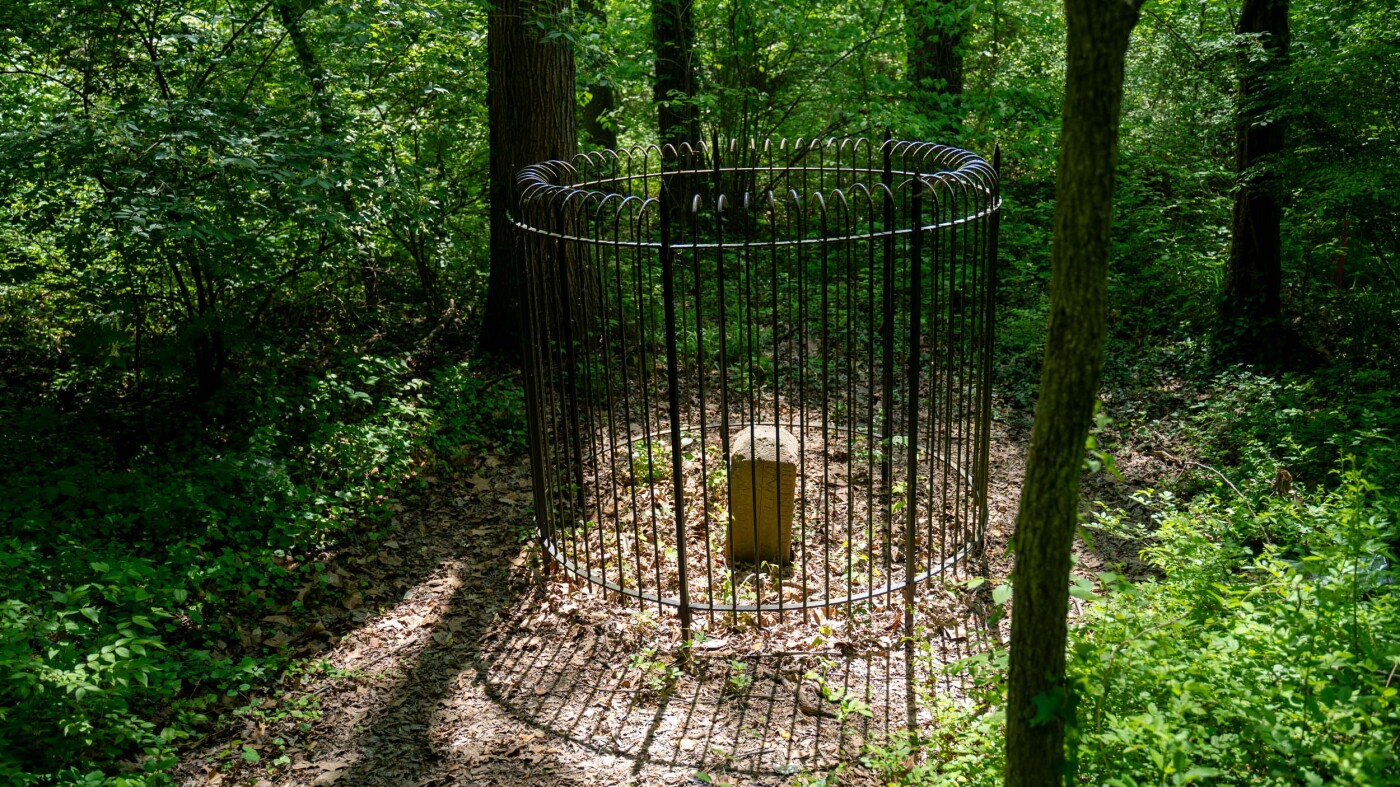
D.C.’s east cornerstone, located at the city’s easternmost point, is hidden in a small patch of woods in a residential neighborhood.

Jacob Fenston/For NPR


hide caption

toggle caption

Advertisement

Jacob Fenston/For NPR

If you’ve been to Washington, D.C., chances are you paid a visit to some of the city’s many monuments.

You probably didn’t see D.C.’s oldest monuments — even though they are thought to be the first federal monuments anywhere in the country, dating back to the 1790s. But they aren’t on any tourist map, and many are at risk of being destroyed.

The monuments in question are D.C.’s boundary stones. Placed by surveyors more than 200 years ago, they delineated the borders of what would become the young nation’s new capital city. Today, 36 of the original 40 sandstone markers remain, but they’re far outside the downtown areas most visitors see.

Advertisement
One face of each stone is carved with the year it was set in the ground, either 1791 or 1792.

One face of each stone is carved with the year it was set in the ground, either 1791 or 1792.

Jacob Fenston for NPR


hide caption

toggle caption

Jacob Fenston for NPR

Advertisement

I recently toured all of D.C.’s boundary stones in one day. It took more than 9 hours, crammed in the back of a minivan traversing the wilds of Washington, from the tony mansions along the Potomac River, to a mucky swamp behind the city’s car impound lot.

“It is a long day, and you’ve really got to be into it,” says Stephen Powers, who leads the small tour.

Powers may be the foremost expert on D.C.’s boundary stones and he’s largely responsible for a resurgence of interest in them in recent years. He’s been making these treks each year since 2005. He checks on each stone, and he brings along as many people as he can fit in his vehicle.

A capitol carved out of field and forest

The U.S. Constitution itself authorized the creation of the new nation’s capital — a 10-mile by 10-mile square — and President George Washington selected the exact location. Before any construction could start, surveyors set out through old-growth forests and farmland, manually measuring and marking the official borders. Every mile along the way, they set a boundary stone.

Advertisement

Now, more than 200 years later, many are unmarked and tough to get to. For example, one is hidden in a bit of overgrown woods wedged between the eight-lane I-295 freeway and the Potomac River.

I’m riding next to Sharon Pitts, a local who lives nearby in Alexandria, Va. She’s having fun on this unusual tour, but it’s a little outside her comfort zone. She says she doesn’t usually spend her Sundays wearing khaki cargo pants and muddy boots.

“Oh, no, no! Church,” she says, laughing. “I’m all dressed up and all that.”

Sharon Pitts on the hunt for the southeast #9 boundary stone, located in a small forest between the Potomac River and I-295.

Sharon Pitts on the hunt for the southeast #9 boundary stone, located in a small forest between the Potomac River and I-295.

Jacob Fenston for NPR


hide caption

Advertisement

toggle caption

Jacob Fenston for NPR

Powers pulls his minivan over on the shoulder of I-295 , then guides the group over the guardrail as cars whiz by.

Advertisement

A short way into the vine-draped trees, we clamber over a broken section of chain-link fence, and then bushwhack through brambles.

Then, we find it: a little, pyramid-shaped stone, about 2 feet tall. It’s pitted, and dotted with lichen, but you can clearly make out the carved numbers: 1792.

The stone is engraved with the word “Maryland” on one side, and “Jurisdiction of the United States” on the other.

“This is one of the earliest representations of the words ‘United States’ carved into stone,” Powers says.

He waves his arms to show where the border runs, dividing Maryland and the District of Columbia.

Advertisement

For Powers, the boundary stones are a hobby. By day he’s a civil engineer at Metro, D.C.’s public transit agency. In 2005, he got interested in the stones when his second-grade daughter did a school project on them. At the time, before ubiquitous smartphones and GPS-powered maps, he had to spend countless hours tracking down the people who knew how to find each stone. Now, he runs a website with an interactive map and directions to each stone.

Over the centuries, Washington’s boundary stones have been threatened by the elements, in particular water, erosion, and falling trees. A few may have been damaged or gone missing during the Civil War. But in more recent years, there’s been an even bigger threat: the automobile.

On the tour, we pull into a gas station parking lot, and dash across a major intersection. At the spot where a boundary stone should be, there is instead wreckage from a car crash — twisted pieces of metal and yellow caution tape fluttering in the breeze.

Powers was one of the first people on the scene after the crash happened a few days earlier. He found the boundary stone intact, but covered with smashed car parts, including the Maryland license plate from the vehicle involved — a detail that may help police track down the culprit.

District officials later retrieved the stone. They’re still figuring out how to reinstall it to prevent further damage.

Advertisement

Powers heard about the crash from Janet McFarland with the D.C. chapter of the Daughters of the American Revolution. The group has been helping look after the boundary stones for more than a century, and McFarland was on her way to a cleanup of one of the boundary stones when she spotted the one that had been hit and alerted Powers.

“Cars right now are our biggest enemy,” says McFarland.

The boundary stones used to be in the middle of nowhere. In the 1700s, Washington, D.C. was just an idea — an imagined street grid of grand avenues and squares to be built over what was then a rural landscape at the confluence of two rivers.

As Washington’s population grew, the stones were swallowed up by the city. Now, one is on the unnaturally verdant lawn of a self-storage business, one is next to a strip mall parking lot, one is in a cemetery. Many are along busy roads.

On the tour, we see at least three that have been hit by cars over the years.

Advertisement

A bit of history in a suburban yard

Many boundary stones are in people’s yards. Rosa García has one in front of her bungalow. Her house is in Mt. Rainier, Md., but the sidewalk and street are in D.C.

When I call out to her, she’s not surprised to have a stranger at her front gate.

“Plenty of people come by,” she tells me in Spanish. They stop, takes pictures.

She doesn’t mind all the attention to the unusual lawn ornament. “Pues, es historia,” she says. It’s history.

Over the years there have been surges of interest in the boundary stones. They were almost completely forgotten for the first century of their existence, before being surveyed again in 1894.

Advertisement

Powers says there have been many people before him who’ve been fascinated by, even obsessed with, the boundary stones.

“I like to call them stoners,” Powers says. “I walk in their footprints.”

There have been efforts to elevate the status of the stones, and better preserve them. In the 1980s there was an unsuccessful push to turn all of them into National Historic Landmarks, a move that would open the door to federal funding.

There has been some government investment: in 2015, D.C. led a project to restore the stones, digging up, repairing, and resetting them. For the four stones that were missing, concrete replicas were made.

A few of the stones have informational signs, but most don’t. Powers says that’s not necessarily a bad thing.

Advertisement

“I have mixed emotions about that. There are some that I really feel should be more accessible,” he says.

Others, he says, are probably better off hidden — protected by their obscurity, and more fun to visit.

We finally come to the end of the tour, at the western corner stone. We’ve gone 57.8 miles, circumnavigating the city and getting a 360-degree view of life in modern-day Washington. We drove through neighborhoods that are home to Supreme Court justices and cabinet secretaries; we stopped for coffee in a vibrant community of Ethiopian immigrants; we wolfed down a packed lunch behind a dusty concrete plant.

“You get the diversity of it all,” Powers says.

As the minivan pulls to a stop, Sharon Pitts records the time — it’s 9 hours, 33 minutes after we started.

Advertisement

“This has been such a wonderful day,” Pitts says.

News

Three more people charged with damaging Reflecting Pool after Trump’s multimillion-dollar restoration | CNN Politics

Published

on

Three more people charged with damaging Reflecting Pool after Trump’s multimillion-dollar restoration | CNN Politics

Three more people have been criminally charged with destruction of property at the Lincoln Memorial Reflecting Pool.

Officers say they detained Cameron Thiers, Sophie Dennison-Gibby and Justin Carreno one Saturday afternoon in June and described in court documents witnessing them peeling and removing pieces of blue paint from the Reflecting Pool.

One officer “witnessed Carreno reach down into the reflecting pool and pull up a piece of the blue paint,” according to the court documents.

The officer who detained Dennison-Gibby “found 1 additional piece of the reflecting pool liner” in her purse, the documents said.

All three incidents were recorded on the officers’ body worn cameras, they said in the court documents.

Advertisement

Several “partnering law enforcement agencies assigned to the Reflecting Pool” working with US Park Police were involved in detaining the two men and one woman — including officers from Texas, Oklahoma, Montana and California.

One of the officers said in court documents that Thiers “admitted to removing a piece of blue sealant from the Reflecting Pool and still had it in his hand when I made contact with him.”

The three defendants were arraigned in court Wednesday and pleaded not guilty to the misdemeanor charges of destruction of property with a value less than $1,000. The judge ordered them to stay away from the Reflecting Pool.

Lawyers for Thiers and Dennison-Gibby declined to comment. CNN has reached out to Carreno’s attorney.

If found guilty of destruction of property, the defendants could be fined up to $1,000 and face a maximum of 180 days behind bars.

Advertisement

The New York Times first reported that three additional people had been charged with damaging the Reflecting Pool.

President Donald Trump has repeatedly claimed that vandals caused major damage to the pool by gashing the lining after his administration spent more than $14 million on renovations, though he has not provided evidence to support that claim. The officers who charged Carreno, Thiers and Dennison-Gibby did not accuse them of gashing the lining.

Former Olympic canoeist David Hearn was indicted by a grand jury in Washington, DC, last week for allegedly damaging the Reflecting Pool. Hearn — unlike Carreno, Thiers and Dennison-Gibby – was charged with destruction of property with a value of more than $1,000 which carries a maximum penalty of 10 years in prison, if convicted. He is set to be arraigned in court Thursday.

Crews began draining the Reflecting Pool over the weekend to make repairs, according to Interior Secretary Doug Burgum, for the second time in three months.

The move comes after weeks of problems – algae blooms, green-hued water, a chipping bottom and the administration’s allegations of vandalism – that have plagued the iconic landmark, making its woes the subject of national interest.

Advertisement
Continue Reading

News

Supreme Court financial disclosures reveal how their books add to their income

Published

on

Supreme Court financial disclosures reveal how their books add to their income

Supreme Court Justice Amy Coney Barrett speaks at the Reagan Library on Sept. 9, 2025, in Simi Valley, Calif. Barrett discussed and signed copies of her new book, Listening to the Law: Reflections on the Court and Constitution.

Mario Tama/Getty Images


hide caption


toggle caption

Advertisement

Mario Tama/Getty Images

Even as the Supreme Court was handing down one legal thunderbolt after another last week, the justices were quietly releasing their annual financial reports. Justice Samuel Alito was the only sitting justice to request an extension, which he has done for 15 years. The disclosures do not give a complete account of the justices’ total income and wealth, but they give insights into their concertgoing, guest professorships and even their involvement in youth sports.

In addition to their salaries, much of the justices’ reported income came from their book deals. Justice Ketanji Brown Jackson led the pack earning more than $1.1 million last year for a total of roughly $4 million since her memoir, Lovely One, was published in 2024.

Justices Sonia Sotomayor, Neil Gorsuch, Amy Coney Barrett and retired Justice Anthony Kennedy also reported income from published books. Earnings from their books ranged from $849,000 for Barrett, to $300,000 for Gorsuch and $88,000 for Sotomayor, whose books include her 2013 autobiography and five children’s books. Justice Clarence Thomas, who previously earned $1.5 million for his 2007 memoir, listed no publisher payments last year, and Justice Brett Kavanaugh, one of 13 co-authors of a 2016 legal treatise, also received no payments last year. Kavanaugh is said to be working on a memoir but he listed no payments for the anticipated book. Alito does have a book coming out in the fall, but with his financial report still outstanding, there is no data on how much he was paid for the work in 2025.

Advertisement

The only two sitting justices who have not written books are Chief Justice John Roberts and Justice Elena Kagan.

Many justices also earned income from teaching at law schools. Roberts reported income from New England Law, located in Boston, and Gorsuch reported teaching income from George Mason University in Virginia. Thomas taught classes at Catholic University in Washington, D.C., and Barrett and Kavanaugh taught at Notre Dame Law School. Barrett graduated from the school and began teaching there 23 years ago; Kavanaugh has family connections to Notre Dame.

Continue Reading

News

Manhattan Building’s Columns Buckled Beneath New Addition, Images Show

Published

on

Manhattan Building’s Columns Buckled Beneath New Addition, Images Show

At least two structural columns buckled and failed in a 37-story office tower in Midtown Manhattan on Tuesday, prompting evacuations of nearby streets and buildings. While city officials asserted that the tower was in no danger of collapsing completely, outside engineers said further failures in the structure could not be ruled out.

A pair of columns that failed completely were part of the tower’s existing structure. A New York Times review of images and videos from inside the building has found that several floors were added atop these columns.

Advertisement

City officials said in a news conference on Tuesday that the building was continuing to move, while they simultaneously assured the city that the building would not suffer “total collapse.” “The way this building is constructed, it’s a steel-frame building,” John Esposito, a chief in the Fire Department in New York, said at the afternoon news conference. “So, it would not be a total collapse. It would be more of a localized collapse.” Still, he said, “that remains our concern, that it’s moved.”

Advertisement

Engineers said that the movement itself was cause for concern. In a properly designed steel building, they said, loads should redistribute quickly to surviving structural supports if columns failed.

Joe DiPompeo, a former president of the Structural Engineering Institute at the American Society of Civil Engineers, said that if the structure had been overloaded, he would expect any movement “to happen very quickly,” rather than gradually.

“Generally when a column buckles, it’s a sudden failure,” Mr. DiPompeo said. He said that a full collapse remained unlikely given the redundancies built into the building codes.

Advertisement

Engineers often refer to the most dangerous possibility as a progressive collapse, a process in which structures near the initial failure become overstressed and also fail, potentially bringing down the building if the sequence continues. While unlikely, it cannot be ruled out, Mr. DiPompeo said.

Footage recorded from inside the building shows at least two structural columns appear to have failed completely, Mr. DiPompeo said. Other nonstructural, interior walls — or at least the metal “studs” that were in place to hold them up — also appear to have deformed.

Advertisement

“The only way that really happens is if the floor above them dropped. It looks like the floor above could have dropped a foot or two, which is obviously not a good situation,” Mr. DiPompeo said.

@fernando40tiktok.commarc via Storyful

Advertisement

Advertisement

Image from @fernando40tiktok.commarc via Storyful

Advertisement

Image from @Bogs4NY via X

Advertisement

The 37-story building is in the process of being converted from office space into residential units. Four new floors and a large vertical portion were added onto the existing building in recent months. The vertical portion consists of a stack of over a dozen new floors cantilevered out over the existing building below.

Engineers said that there was nothing inherently wrong with adding residential floors or the cantilevered section above the columns that failed, as long as the original structure and the modifications had properly accounted for the added weight and wind loads.

“The cantilever alone doesn’t change anything,” Mr. DiPompeo said, but it does put additional load on the columns underneath — a factor that should have been reflected in the design.

Advertisement

Nathan Berman, managing principal and founder of MetroLoft, the developer overseeing the conversion, said on Tuesday that “this incident is nothing more than a typical construction mishap.”

He said two columns near the northwest corner of the tower had bent under the weight of additions to the building above, most likely because those columns had not been properly reinforced, though he said an investigation would determine the cause. The rest of the columns, he said, “picked up the weight.” He estimated the affected floors above the failed columns had sagged by a maximum of four inches.

Advertisement

Mr. Berman said that he expected the problems to be fixed and the project to be completed with, at most, a slight delay.

On Tuesday evening, installation of temporary shoring was set to begin shortly, in order to help stabilize the 20th and 21st floors of the building.

Advertisement
Continue Reading
Advertisement

Trending