West
California couple’s bodies recovered from waterfall near Yosemite: 'They were important'

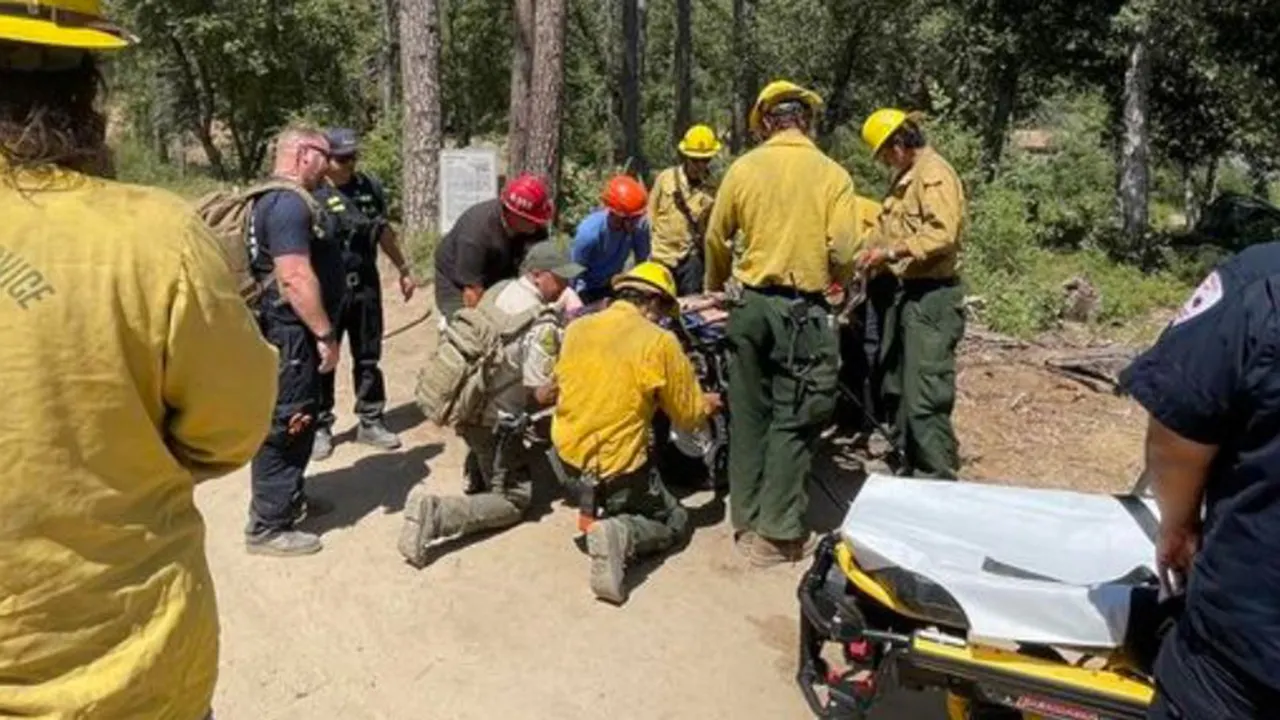
Search and rescue teams recovered the bodies of a man and a woman who were found near Angel Falls, not far from Yosemite National Park in central California, this week, the Madera County Sheriff’s Department confirmed to Fox News Digital.
They were identified as Monica Ledesma, 34, and James Hall, 35, who were in a relationship, the sheriff’s department said.
Rescuers first located Ledesma’s body Wednesday, after being notified about an unresponsive woman in the water not far from Bass Lake. Some of Hall’s belongings were found near Ledesma and his body was soon recovered.
“James died a hero trying to save his girlfriend Monica,” a fundraising page set up for Hall’s family said. “Unfortunately, they both were taken from us.”
CALIFORNIA HIKERS RESCUED AFTER RUNNING OUT OF WATER DURING BLISTERING HEAT WAVE
Search and rescue teams recovered two bodies near Angel Falls, not far from Yosemite National Park in central California, the Madera County Sheriff’s Department revealed to Fox News Digital. (Madera County Sheriff’s Office)
At a vigil for the couple, Hall’s mother said it was “maybe the hardest day of our lives,” according to KFSN-TV. “But it’s here for a reason and I think it’s in the name of love.”
MYSTERY AS HUGE GROUP OF PEOPLE FALLS VIOLENTLY ILL WHILE HIKING THROUGH REMOTE PART OF GRAND CANYON
Nancy O’Hara, who was friends with the couple, told the station: “Not only were they kind and considerate, and took care of us old folks, took care of the young folks.”
Angel Falls is not far from Yosemite National Park. (Mark Hume/Chicago Tribune/Tribune News Service via Getty Images)
Ledesma was the mother of an 8-year-old son and 14-year-old daughter, her mom told the station.
“Our hearts go out to the families of those who were lost at Angel Falls today,” Madera County Sheriff Tyson Pogue said in a statement. “We would like to thank our allied partners for their outstanding support and response to today’s events, whose simultaneous occurrence stretched resources. I applaud the efforts of the rescue and recovery teams, who performed their duties diligently and respectfully.”
The bodies were recovered at Angel Falls. (John Walker/Fresno Bee/Tribune News Service via Getty Images)
O’Hara added, “Monica and James were important here. They were important because they were family. Not related except by heart. Kindness is something that run through all of them and they were examples.”
The sheriff’s department said places like Angel Falls that are close to parking lots and trails often give hikers a “false sense of security about the level of danger that exists. When hiking around the water, extra caution needs to be taken. Rocks can be extremely slippery even when they aren’t wet. One missed step can result in a serious injury or fatality.”
The department added: “The water is extremely swift, and deadly cold. Warm air temperatures do not mean warm water temperatures. Cold water can very quickly remove heat from the body and lead to a loss of movement in the limbs. When heading into rivers and streams, always take precautions, such as wearing a life vest, bringing a life preserver with you, and following all river/stream closures.”
The department didn’t explain Ledesma and Hall’s causes of death.
Read the full article from Here


The intense marine heat wave conditions that began roiling the Bering Sea in about 2016 resulted in the lowest winter sea ice extent measured in 150 years, widespread bird and marine mammal die-offs, a drastic shift in fish populations and a crash of snow crab stocks.
Now new research is tying the marine heat wave to the recent collapse of Yukon River chinook salmon.
A study published in April, written by scientists at the National Oceanic and Atmospheric Administration’s Alaska Fisheries Science Center and University of Alaska Fairbanks, showed the correlation between the extreme heat wave conditions and the nosedive in Yukon River chinook stocks. The heat wave was accompanied by a dramatic increase in deaths of older juvenile and adult chinook that, had they survived, would have returned from the ocean to freshwater spawning grounds, the study found.
The study was published in the journal Ecological Applications.
The Yukon River’s runs of chinook, also called king salmon, have been in a long-term decline since their past heyday, when they numbered in the hundreds of thousands and the river was one of the biggest sources of that salmon species.
The sharp downturn in recent years resulted in a 2022 return that was the lowest on record. Widespread fishery closures have been in effect for years along the Yukon River system in both Alaska and Canada.
The study evaluated four general reasons for the sharp decline: poor juvenile “recruitment” into the ocean, which refers to the successful migration of surviving juvenile fish from freshwater; deaths of fish in the marine environment at the start of their migration back to freshwater; harvests that target the salmon; and bycatch, the unintentional harvest of salmon by commercial fishing vessels targeting other species, such as pollock.
Poor juvenile recruitment emerged as an important factor, which was to be expected, the study said.
“Not surprisingly, we found evidence to suggest that impacts operating in the early life stages have likely contributed to declines in run sizes over the past two decades, which is consistent with previous research,” NOAA Fisheries researcher Lukas DeFilippo, the lead author, said in a statement.

But the information about spiking mortality among adults and older juveniles was new, the NOAA scientists said. That new trend represents “an apparent shift in the critical life history stages and processes” for Yukon River chinook, and a potential bottleneck limiting population recovery, the study said.
Exactly how the heat wave conditions caused deaths of salmon at sea is yet to be determined, the study said. It listed several factors that could have worked in combination, including lack of suitable prey, infections by the parasite Ichthyophonus and other diseases, as well as increased energy demands brought on by warmer temperatures.
Harvests, either intentional or as bycatch, did not emerge as important factors in the recent Yukon chinook declines, the study found.
The study contained some warnings.
Even though the marine heat wave conditions have eased, the abundance of prey that salmon need in the ocean has not returned to normal, it noted. And mortality rates in those later life stages continue to be higher than they were prior to the latest heat wave.
And the heat problems for older salmon are likely to become more common in years to come, the study said.
“Given that marine heatwaves are expected to become more frequent and severe with continued warming . . . similar rises in mortality—and concomitant limitation of productivity and recovery potential—as described here could become increasingly common in the future,” the study said.
An earlier study by NOAA Fisheries and the Alaska Department of Fish and Game tied successive heatwaves in both the Bering Sea and Gulf of Alaska to sharp declines in chum salmon stocks. That 2023 study also pointed to higher mortality out in the ocean.
Originally published by the Alaska Beacon, an independent, nonpartisan news organization that covers Alaska state government.

In most cases, the number of players drafted is a strong indication of how good a college baseball team was the previous season. Arizona had nine draftees last year after reaching the College World Series, but following a disastrous 2026 campaign only two Wildcats heard their names called in the 2026 MLB Draft.
Right-handed pitcher Owen Kramkowski was selected by the Tampa Bay Rays in the 5th round, while fellow righty Collin McKinney went in the 9th round to the Baltimore Orioles.
Kramkowski was taken with the No. 145 picks, which has a bonus slot value of $506,100. McKinney’s bonus slot at No. 260 is $213,300. Players chosen in the 11th round or later can sign for up to $150,000 without it impacting a team’s bonus pool.
The two draft picks for Arizona is its fewest since 2022, when catcher Daniel Susac went in the 1st round and outfielder Tanner O’Tremba went in the 15th round. It was also the first time since 2014 the UA did not have a player taken in the first four rounds.
While the loss of existing UA players to the MLB Draft was minimal, the same can’t be said for future Wildcats. Two members of Arizona’s 2026 recruiting class as well as three transfers signed this summer were drafted Sunday.
Incoming freshman catcher Francisco Rivero, from Canyon del Oro High School in Oro Valley, went in the 15th round to the Washington Nationals while righty Garrett Ahern—a transfer from GCU—went in the 16th round to the New York Yankees. The 17th round then saw righties McCarty English (Southern Miss) and Collin Cobb (Williston State JC) and New Mexico prep righty Jack Byers all get picked.
Each has until July 27 to sign a pro contract or they’ll join the Wildcats this fall for the 2027 season.
The 6-foot-3 Kramkowski, who grew up in Sahuarita, is the fifth player recruited to the UA out of high school by Chip Hale and his staff to get drafted. He spent three seasons with the Wildcats and was part of the weekend rotation the last two years, starting the opening game of the College World Series. In 2025 he wen 9-6 with a 5.48 ERA, striking out 90 batters in 92 innings, but struggled as a junior with a 1-8 record and 6.13 ERA.
In 35 career appearances, Kramkowski walked only 38 batters in 165.1 innings against 165 strikeouts.
The 6-foot-5 McKinney spent the last two seasons at the UA after beginning his career at Baylor. He was the Wildcats’ Friday night starter for most of 2025 before getting moved to the bullpen, and this past spring spent time in the rotation and as a reliever. He struck out 109 in 91.2 innings with Arizona.
McKinney had entered the NCAA transfer portal last month and committed to Houston but is expected to sign.
Arizona’s lack of draft picks from its roster was indicative of a team that went 19-34, its worst record since 1994, and finished 9-21 in the Big 12 after winning the conference tournament title the previous year. The same can’t be said for ASU, which failed to advance beyond the NCAA regionals despite having 10 draft picks on the roster.

Paramount has made repeated entreaties to Bonta to strike a deal that would allow its merger with Warner Bros. to close.
The studio proposed a firm commitment, via a consent decree, to produce 30 films annually, with a 45-day theatrical release window and a 90-day streaming window, alongside promises to keep both Paramount and Warner Bros. lots open in California, the people said.
Privately, Ellison and other Paramount executives have expressed frustration at Bonta’s refusal to engage, and have pointed to the commitments around content spending — some $30 billion annually — and employment that would flow into California. Already, the region has faced a production exodus to other states — even to Canada — with thousands of entertainment jobs lost in recent years. Ellison and his executives have said that the combined Warner Bros.-Paramount would create jobs in California, helping to stymie that outflow.
But Paramount believes Bonta’s office has rebuffed its overtures, creating what one Ellison adviser said is an “inhospitable” environment for Paramount to operate in. If Bonta sues, the adviser said, the state’s hostility would push the company over the edge.
Bonta’s office did not respond to a request for comment. Last month, he told MSNOW that there were “red flags in the air everywhere,” and that he was “concerned about job loss and prices being increased.”
In a statement, Paramount said, “We continue to engage constructively with the remaining few regulators around the world still considering the merger, including State Attorneys General, and are prepared to address any legitimate antitrust issues.” It added: “We are confident this transaction raises no such concerns, as demonstrated by the dozens of antitrust authorities around the world that have carefully reviewed the transaction.”
-
 Alabama5 minutes ago
The positions Alabama football will continue to recruit in the 2027 recruiting class
-

 Alaska12 minutes ago
Bering Sea heat wave cited as trigger for nosedive in Yukon River chinook salmon
-

 Arizona18 minutes ago
Arizona pitchers Owen Kramkowski, Collin McKinney taken in 2026 MLB Draft
-

 Arkansas23 minutes ago
Arkansas officials react to death of Sen. Lindsey Graham
-

 California30 minutes ago
Exclusive: Paramount weighs leaving California over Warner Bros. rift
-

 Colorado36 minutes ago
New Colorado wildfire sparks evacuations south of Steamboat Springs
-

 Connecticut42 minutes ago
Cyclosporiasis outbreak prompts food safety concerns in Connecticut
-

 Delaware48 minutes ago
Delaware still in drought despite heavy rainfall

