Oregon
FDA Issues Warning on Potentially Contaminated Shellfish from Oregon and Washington – WestsideToday


Shellfish From These Areas Carries Risk of Paralytic Shellfish Poisoning
The FDA has issued an alert advising consumers, restaurants, and food retailers in multiple states to avoid shellfish from specific harvesting areas in Oregon and Washington due to potential contamination with paralytic shellfish toxins (PSTs).
The affected shellfish include oysters and bay clams harvested from Netarts Bay and Tillamook Bay in Oregon on or after May 28, 2024, and all shellfish species from specific growing areas in Willapa Bay, Washington, harvested between May 26 and May 30, 2024. These products were distributed in California and other states.
- Oregon: Netarts Bay and Tillamook Bay, harvested on or after May 28, 2024.
- Washington:
- Stony Point, harvested between May 26 and May 30, 2024.
- Bay Center, harvested between May 29 and May 30, 2024.
- Bruceport, harvested between May 29 and May 30, 2024.
Health Risks of Paralytic Shellfish Poisoning (PSP): PSP is caused by neurotoxins known as saxitoxins. Symptoms can begin within 30 minutes of consumption and range from tingling and numbness to respiratory paralysis. Severe cases can be fatal due to asphyxiation. The FDA advises that PSP toxins cannot be removed by cooking or freezing.
- Consumers: Avoid eating the specified shellfish and seek medical attention if symptoms of PSP occur.
- Restaurants and Retailers: Dispose of the specified shellfish and prevent cross-contamination by following strict sanitation protocols.
Background: The Oregon Department of Agriculture and Washington State Department of Health initiated recalls due to elevated PST levels in the specified shellfish. The FDA is monitoring the situation and will provide updates as necessary.
For more information, visit the FDA website.


In the early months of the COVID-19 pandemic, a group of prison inmates sued the state of Oregon, arguing it was failing to protect them from the surging public health threat.
On Wednesday, more than six years later, representatives of those inmates—and the estates of inmates who died of the disease—announced they have settled with the state for a massive $49 million.
In a separate news release, Gov. Tina Kotek’s office framed the deal as a way to efficiently resolve a complex and weighty legal dispute: State officials, her office said, determined that the settlement “was in the best financial interest of the state and would minimize the continued distress of those impacted to settle rather than continue with the litigation.”
The case, Maney v. Oregon, includes two class action suits filed during the pandemic. According to the Oregon Justice Resource Center, which represented plaintiffs in the case, the suit covers about 5,000 people who were in Oregon Department of Corrections custody between Feb. 1, 2020, and May 31, 2022.
One class, which includes those who tested positive for or were diagnosed with COVID-19, would get $15.9 million under the deal. The other, the estates of 38 incarcerated people who died from COVID-19, would receive $33 million.
The settlement awaits approval by a magistrate judge, and most of the payout requires an appropriation by the Oregon Legislature during the coming 2027 session.
The suit emerged out of the dark early days of a still-mysterious pandemic—which posed clear risks in closed spaces like prisons. The OJRC says inmates in Oregon endured prolonged lockdowns, disruptions to prison operations, and suspension of visitation and programming.
They also died of COVID at far greater rates than Oregonians in general. The UCLA Law COVID Behind Bars Data Project tallied 52 deaths in Oregon prisons tied to COVID. By June 2021, according to the Marshall Project, the state’s prisons had one of the highest rates of COVID-related deaths in the country.
“We initiated this suit to protect the lives of some of our society’s most vulnerable people, packed into aging facilities with no ability to social distance from each other or [prison] officers,” said Juan Chavez, director of the OJRC’s Civil Rights Project, in a written statement. “The horrors that then came to pass during the pandemic shocked and saddened us. But we also saw, and were inspired by, the resilience and solidarity held amongst incarcerated people.”
Kotek’s office noted the mitigation measures the Department of Corrections implemented amid the pandemic, and said the agency incorporated lessons from the era into its operations.
“This historical event placed significant demands on our corrections workforce, and I appreciate the dedication DOC employees demonstrated throughout the COVID-19 pandemic,” Kotek said in her statement, adding that it was important to remember the impact on incarcerated people and their families too, especially those who lost loved ones. This settlement, she said, “is an opportunity for people to heal and find closure after such a challenging chapter in Oregon’s history.”
Willamette Week’s reporting has real-life impact that changes laws, forces action by civic leaders, and drives compromised politicians from public office.
Support WW.

PORTLAND, Ore. (KATU) — The Oregon Zoo has welcomed a second red panda to their ranks this month, as 6-year-old Liu gets settled in to the habitat.
Liu comes to Portland from the Toledo Zoo as part of the Association of Zoos and Aquariums’ Species Survival Plan for red pandas.
He arrived just weeks after Enoki, a female red panda, and caregivers will soon introduce the duo in the hopes that they may eventually help add to the population of the endangered species.
PAST COVERAGE | Enoki the red panda joins Oregon Zoo, ‘exploring, snacking & napping’ in new habitat
For those coming to see the pandas, they should be easy to tell apart. Liu has a blonde tail, and Enoki is much smaller with a darker coat.
“He’s very handsome,” said Dr. Carlos Sanchez, the zoo’s director of animal health, who stopped by Liu’s habitat to observe, a red panda plushy tucked under one arm. “His tail is so blond — surfer blond.”
Liu was born on June 28, 2019 at Prospect Park Zoo in Brooklyn. His name means “willow” in Mandarin Chinese, a nod to his mother, whose name is also Willow.
Enoki is nearly three years old, and is of the refulgens subspecies of red panda, known for having darker faces and more prominent tail rings.
“These two represent a species in trouble,” said Kelly Gomez, who oversees the zoo’s red panda area. “In the past 25 years, habitat loss, poaching and the illegal wildlife trade have wiped out nearly half the world’s red panda population. Hopefully, we can help inspire a new chapter in the conservation of this incredible species.”
The duo joins the Oregon Zoo family more than a year after the death of Moshu, the zoo’s previous resident red panda who was dubbed “Sir Snacks-a-Lot.” Moshu was 14 years old.
More info from the Oregon Zoo.

Summer is in full swing, and across the country, the songs of birds and the cheeps of baby chicks are filling the air. While birdwatching season is happening just about everywhere right now, the Pacific Northwest offers something truly special: the chance to see puffins along the Oregon Coast. If you’re wondering when, where and how to see puffins in Oregon, you’re in the right place.
Few wildlife sightings feel as magical as spotting a Tufted Puffin (Fratercula cirrhata) in the wild. These beloved seabirds return to the Oregon Coast each year during their breeding season, drawing birdwatchers, photographers and nature lovers hoping for a glimpse of their bright orange beaks, expressive faces and unmistakable charm. For many visitors, seeing puffins in their natural habitat is a heartwarming coastal experience that captures the spirit of the Pacific Northwest.
Because puffins are seasonal migratory birds that nest in specific coastal areas, timing and location are key. With a bit of planning—and a little luck—you can witness one of Oregon’s most iconic wildlife moments along its rugged coastline. Here are the best places to see puffins on the Oregon Coast.
What Are the Best Places to See Puffins in Oregon?
If you’re wondering where you can you see these cute creatures, there are three spots that are worth going to and are hailed as the best places to see puffins in Oregon.
Haystack Rock, Cannon Beach
Haystack Rock is a popular place where puffins nest in Oregon.Getty Images Big5 Studio
Few wildlife encounters feel as effortless as spotting puffins right from shore, and Haystack Rock at Cannon Beach is one of the rare places where that’s possible.
This towering sea stack isn’t just an Oregon landmark, it’s also a seasonal nesting site for Tufted Puffins, who return here each year to raise their young on the rocky ledges. From the beach, visitors can often catch glimpses of puffins flying to and from the rock or resting along its cliffs, especially during the warmer months when activity peaks.
Because it requires no boat or hike to access, Cannon Beach remains one of the most rewarding and beginner-friendly places to experience puffins in the wild.
Face Rock State Scenic Viewpoint (Bandon)

Image via Getty Images/Moelyn Photos
For a quieter, more immersive coastal experience, Face Rock in Bandon offers a different kind of puffin viewing.
Here, the focus shifts from crowds to coastline where Tufted Puffins and other seabirds nest along offshore rocks just beyond the shoreline. The setting is calmer than Cannon Beach, making it ideal for visitors who want to slow down and scan the horizon for wildlife activity.
Every Saturday and Sunday from now until July 26, Face Rock Wildlife Interpreters will host on-site sessions at Face Rock Wayside from 9 am to 11 am, where guests will get to look out for puffins nesting on Face Rock with the wildlife interpreters’ help. Whether you go puffin-peeping on your own or with a group, be sure to bring binoculars!
Three Arch Rocks National Wildlife Refuge
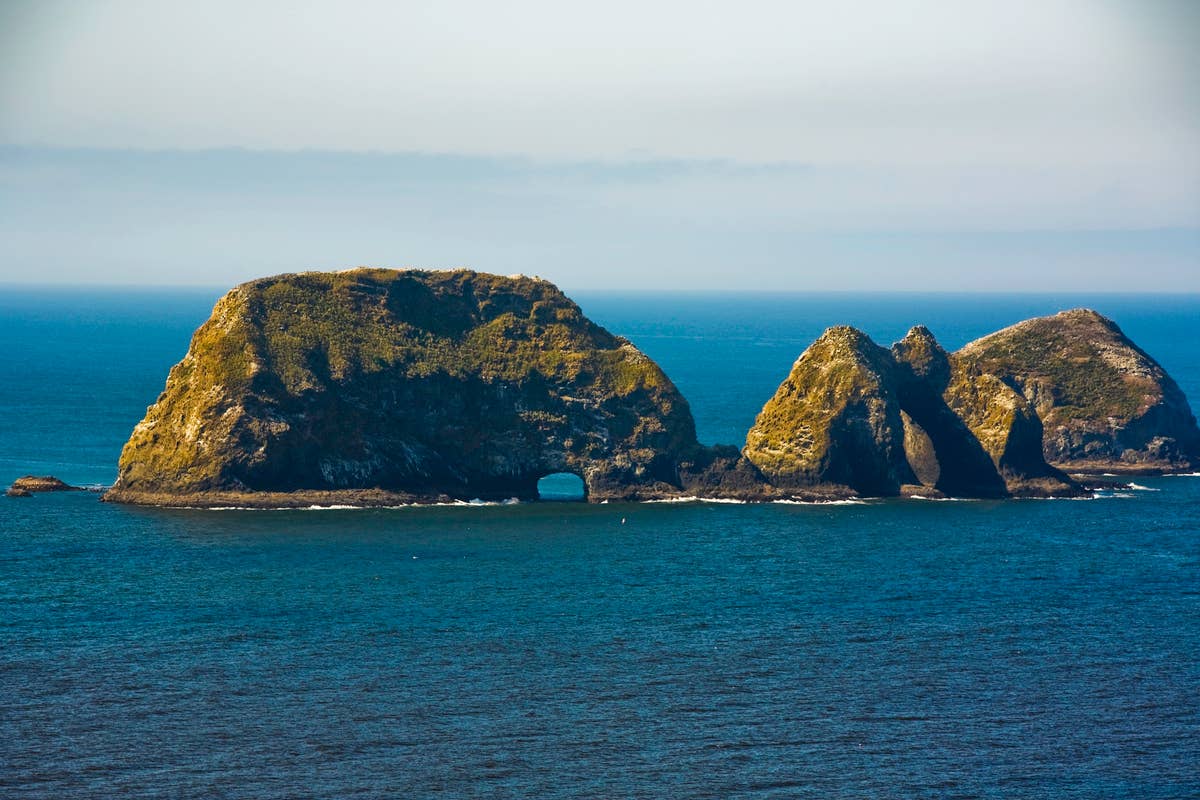
Image via Getty Images/Bob Stefko
If looking for something a little closer to Portland, Three Arch Rocks is home to the largest breeding colony of Tufted Puffins in Oregon. A trip to Three Arch Rocks National Wildlife Refuge is sure to be a treat for any lovers of the Pacific Northwest’s coastal wildlife.
Not only is it one of the top places in Oregon to spot nesting puffins over the summer, but it is also the only pupping site on the North Oregon coast for the federally-threatened Steller sea lion, one of two sea lion species native to Oregon. Incidentally, the Steller sea lion’s pupping season, which runs from mid-May to mid-July, coincides with the first half of the Tufted Puffin’s nesting season, so right now is the perfect time of year for a visit!
When Do Puffins Arrive on the Oregon Coast?
For a large part of the year, Tufted Puffins live far out at sea across the North Pacific Ocean (in fact, they can be found as far eastward as Japan). However, from right now through August, Tufted Puffins are making their way back to coastal islands along the Oregon coastline to create their nests and raise their young until they are strong enough to join them out at sea. Therefore, if you want to catch a glimpse of them, now’s the perfect time.
What’s the Best Time of Day to See Puffins in Oregon?
These birds don’t follow a predictable shoreline schedule, which is part of what makes spotting them such a rewarding experience. So when’s the best time to see puffins in Oregon? Throughout the day during the breeding season, they move between offshore feeding areas and nesting sites on rocky cliffs and sea stacks. However, early morning and late afternoon often offer the most consistent viewing opportunities, when bird activity around colonies tends to increase and lighting conditions make movement easier to spot from shore.
For visitors hoping to increase their chances, choosing calm, clear days can make distant movement easier to detect against the waves.
What Do Puffins Eat and Why Do They Come to Oregon?
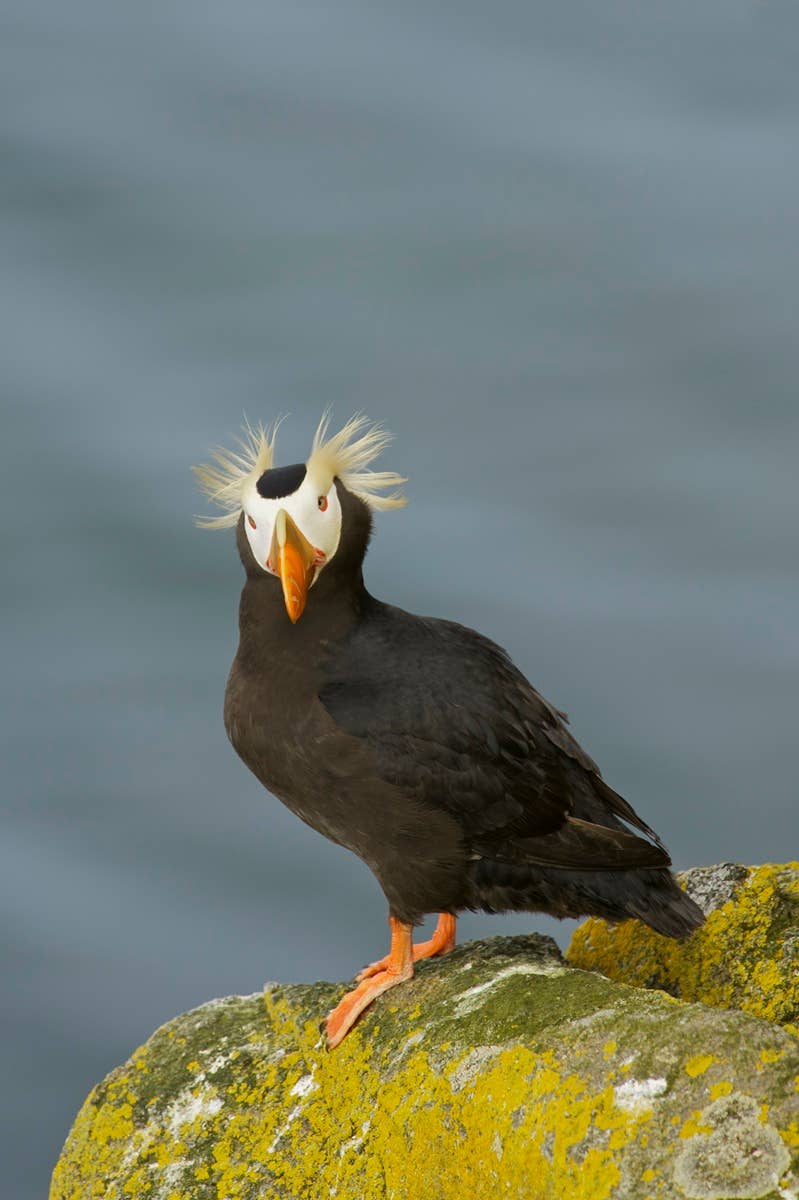
Tufted Puffins return to the Oregon Coast each summer.Getty Images Enrique Aguirre Aves
The presence of puffins along the Oregon Coast is closely tied to the health of the surrounding ocean ecosystem.
Oregon’s offshore waters provide an especially productive feeding environment thanks to cold currents that bring nutrients to the surface, supporting large fish populations. After all, Tufted Puffins rely on small schooling fish such as sand lance, anchovies and herring, which they catch by diving underwater and carry multiple fish back to feed both themselves and their chicks during the nesting season.
Combined with nearby rocky islands that offer protected nesting sites, the region creates an ideal seasonal habitat for breeding puffins and is what brings them back each year. It’s also why Oregon remains one of the most important puffin-viewing regions on the West Coast.
Tips for Spotting Puffins in Oregon
At one point, the Tufted Puffin’s distribution in North America stretched from northern California to British Columbia and the Aleutian Islands of Alaska. However, starting in the 1990s, the North American Tufted Puffin population plummeted in numbers, and now only a few thousand visit the Pacific Northwest every summer, including only a little over 500 puffins in Oregon. If you want the best odds at spotting these rare birds in Oregon, there are a few things you should keep in mind.
Puffins are easiest to spot when you know what to look for—and where to focus your attention. Bring binoculars and scan rocky cliffs and offshore waters, especially during calm mornings or late evenings when the sea is quieter. Watch for quick, low flights over the water or brief pops of movement near the surface as they dive for fish. Patience pays off, since puffins often appear suddenly and disappear just as quickly.
Why Puffin Sightings in Oregon is Special
Puffin sightings along the Oregon Coast are special because they’re both seasonal and fleeting. These seabirds spend most of their lives far offshore, only returning briefly to coastal nesting areas. That short window makes each sighting feel rare, especially when you catch them diving, flying, or gathering near rocky shorelines. Their bright beaks and energetic behavior make even a quick glimpse feel memorable.
Sources:
-

 Rhode Island38 seconds ago
RI becomes first state to establish grocery self-checkout limits
-

 South-Carolina6 minutes ago
Spartanburg’s Riley Vaughn named Gatorade Girls Track and Field Player of Year in SC
-

 South Dakota13 minutes ago
South Dakota Supreme Court upholds Box Elder burglary, assault convictions
-

 Tennessee16 minutes ago
Middle Tennessee man facing 64-count indictment involving child sex crimes, police say
-

 Texas21 minutes ago
A Judge Issued a Rebuke to the Texas GOP’s Claims About the East Plano Islamic Center
-

 Utah28 minutes ago
Utah Royals FC Announce the Addition of Assistant Coach Jessie van den Broek to 2026 Coaching Staff | Utah Royals
-

 Vermont31 minutes ago
Record-setting CVU runner named Vermont’s top girls track and field athlete by Gatorade
-

 Virginia36 minutes ago
VA Spirits Board & VA Distillery Co. Commemorate America’s 250th with Exclusive Trio Pack

