News
In attempting to curtail immigration, the U.S. looks for allies in Latin America


U.S. President Joe Biden greets President of Mexico Andres Manuel Lopez Obrador during a welcome ceremony as part of the ‘2023 North American Leaders’ Summit at Palacio Nacional on January 09, 2023 in Mexico City, Mexico.
Hector Vivas/Getty Images/Getty Images South America
hide caption
toggle caption
Hector Vivas/Getty Images/Getty Images South America
Earlier this week President Joe Biden announced Executive Actions which, with some exceptions, effectively closes the border to most undocumented asylum seekers.
This is the latest of a series of measures the administration has enacted in recent weeks with the goal of curtailing illegal immigration into the country.
In pursuing that objective, the administration has also been leaning on governments of Mexico and Central America, where the outcome of recent presidential elections could impact the flow of migrants to the US.
US immigration policy is toothless without Mexican cooperation, which has been in effect for decades.
Current President Andres Manuel Lopez Obrador has been accepting deportees, and last year deployed the Mexican national guard to police migration, leading to serious accusations of human rights abuses.
The recent election of President Claudia Scheinbaum is unlikely to change much, migration has become a major issue in Mexico.
“It now is a priority for Mexico”, says Lila Abad, of the Wilson Center. “And that’s because Mexico is no longer just a transit country. It is now a destination country.”
Like her predecessor, Scheinbaum has said that in order to stop immigration, root causes like poverty must be addressed.
While the recent Mexican elections don’t change much, there have been several significant shifts in Central America. Panama recently electedPresident Jose Raul Mulino, who has vowed to close the Darien Gap, the dangerous jungle region that hundreds of thousands of migrants trek through to get to the U.S. every year. It’s not clear how Mulino would do that.
Then in El Salvador Nayib Bukele started on June 1 a second term as president. The US has had an uneasy relationship with the self-described“worlds coolest dictator”. But last week Secretary of Homeland Security Alejandro Mayorkas attended his presidential inauguration ceremony.
Roman Gressier from the newspaper El Faro In English says, it’s clear that the Biden Administration has shifted its stance to “we’re not getting in the mud on the issue of unconstitutional re-election, and we are stressing migration cooperation, and economic.”
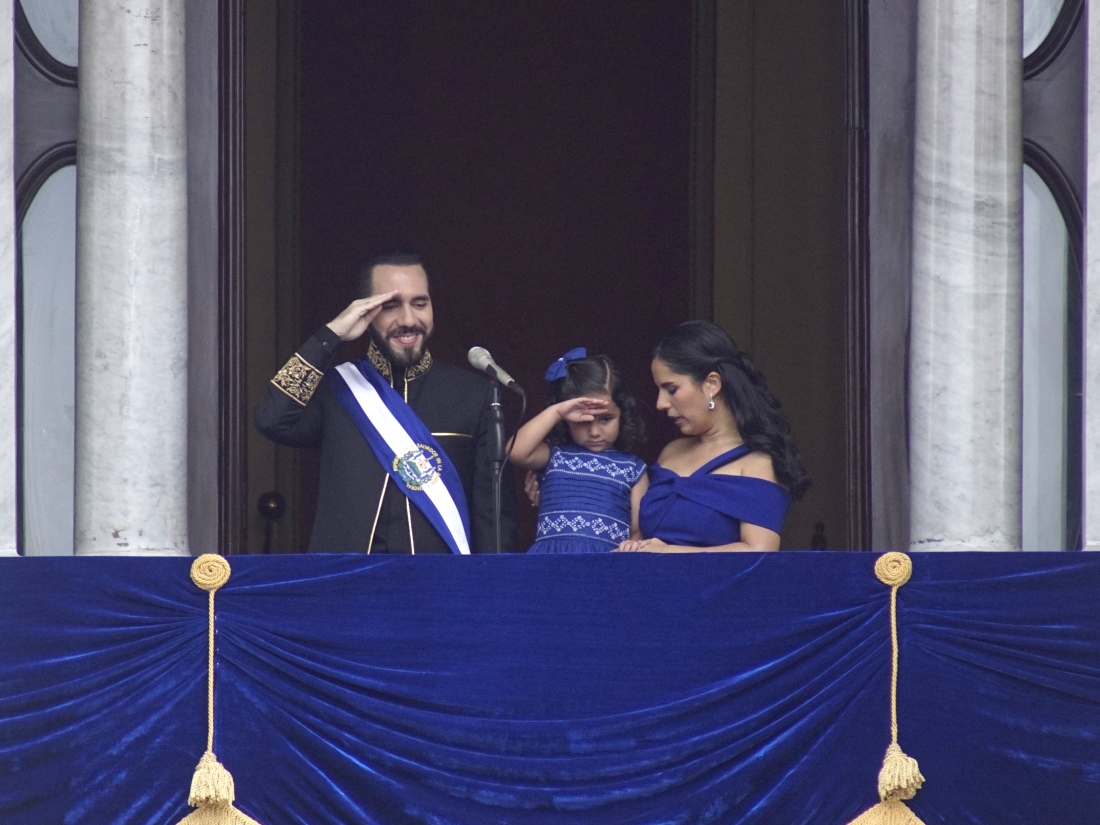
El Salvador’s President Nayib Bukele and his daughter Layla salute while standing on a balcony with first lady Gabriela Roberta Rodríguez, after he was sworn in for a second term, in San Salvador, El Salvador, Saturday, June 1, 2024.
Salvador Melendez/AP/AP
hide caption
toggle caption
Salvador Melendez/AP/AP
At the end of the day, immigration analysts say deterrence alone doesn’t work long term to curb irregular migration, certainly not when people are fleeing for their lives.
To that point, perhaps one of the most impacting of migration is happening in Venezuela, a country going through a severe humanitarian crisis. Around 7.7 million Venezuelan migrants and refugees have been displaced as of last year. The exodus shows no signs of slowing down.
Estefani, a Venezuelan mom living in a New York City shelter, recently told NPR she knew the route to the U.S. could be dangerous, even deadly, but she didn’t feel she had a choice. She asked for her name to be withheld because she was sexually assaulted on her journey.
“Raising a child in Venezuela is very difficult. You can feed them lunch, but then there’s no dinner,” she said.
Estefani tried to live in Colombia and Ecuador, and eventually got desperate enough that she ventured to the U.S.
As presidential campaigns intensify in the United States, there is a growing pressure for Latin American countries to help enforce immigration. But analysts say that as long as people like Estefani see no other choice but to pick up and leave their country, any deterrence policies in the U.S.-Mexico border is no more than a short-lived fix.

News
“It’s blood money”: Family of exonerated man in Texas yogurt shop murders speaks out after settlement

The widow and the daughter of Maurice Pierce, one of the four men wrongfully accused in the 1991 Texas yogurt shop murders, have confirmed they signed a multimillion-dollar settlement with the city of Austin.
Kimberli and Marisa Pierce spoke with correspondent Erin Moriarty in a new episode of the podcast “48 Hours: Case by Case.” Moriarty has reported on the yogurt shop murders for over 30 years.
Maurice Pierce’s widow Kimberli made clear that their priority has never been financial compensation. “It’s blood money for us. He died for this money,” Kimberli Pierce said. “It’s about the reform and the changes that need to happen, not only in Austin, but apparently across the country.”
They also went into great detail about what they believe happened when Maurice Pierce was shot and killed by police in 2010.
Maurice Pierce was one of four men, along with Michael Scott, Robert Springsteen and Forrest Welborn, who were wrongfully accused in the murders of four teenage girls in Austin on Dec. 6, 1991. Eliza Thomas, Amy Ayers, and sisters Jennifer and Sarah Harbison were tied up, shot and left inside the yogurt shop as it was set ablaze.
The four men were exonerated in February after investigators linked another man, Robert Eugene Brashers, to the killings. The city of Austin subsequently offered a $35 million settlement. Because Maurice Pierce died in 2010, his share of $10 million will go to Kimberli and Marisa Pierce.
Eight days after the killings, 16-year-old Maurice Pierce was arrested at a mall, carrying a .22, the same caliber handgun connected to the crime. Kimberli Pierce said police told Maurice Pierce that his gun was the murder weapon. He responded by mentioning his friend Forrest Welborn. Maurice Pierce was then wired up and sent to speak with Welborn, but investigators ultimately determined that Welborn and the others knew nothing about the murders, and no charges were filed at that time.
Marisa Pierce has said there was no evidence when her father was questioned, “only a detective and a narrative, a narrative so completely false. It feels evil.”
Nearly eight years later, in 1999, all four men were arrested after Scott and Springsteen confessed to the murders. They later recanted, saying they had been coerced. Springsteen and Scott were tried and convicted, but later those convictions were overturned on constitutional grounds. A subsequent DNA test excluded all four men. Maurice Pierce was never convicted but spent three years in jail before his release in 2003.
Kimberli Pierce said her husband came home a hardened man. She believes police continued to harass Maurice and their family after his release. In 2010, Maurice Pierce was stopped for a routine traffic stop, fled on foot, and was shot and killed by an Austin police officer who said Pierce had stabbed him with a knife.
Marisa and Kimberli Pierce told “48 Hours” that they intend to review the circumstances surrounding the night of Maurice Pierce’s death. Marisa Pierce revealed in new, emotional detail that she was on the phone with her father at the time. She believes he panicked and was only trying to get away, not to hurt anyone. She described her father’s last breaths: “And in those last moments, he had just said I’m sorry, I don’t think you’re gonna see me again, and I love you.”
“48 Hours” reached out to the Austin Police Department about the Pierces’ allegations of harassment and their questions about Maurice Pierce’s death in 2010. The police department said they had no additional comment.
For the Pierce family, the settlement is a starting point, not an end point. They have put forward seven proposed reforms they hope the city of Austin will approve, including appointing a child advocate whenever a minor is questioned, prohibiting deceptive interrogation tactics, educating juveniles about their rights and establishing accountability measures to address tunnel vision in police investigations.
In a statement shared with “48 Hours,” the Pierces wrote: “Real justice is not only about acknowledging harm after the fact but about creating safeguards that prevent future families from enduring the same pain.”
This year, Maine nearly became the first state to pass a statewide moratorium on new data centers. But before the law could take effect, supporters of an A.I. data center project in the small town of Jay rallied to fight the ban — and won. So why do residents there want one? We traveled to Jay to find out.

The U.S. Supreme Court
Drew Angerer/AFP via Getty Images
hide caption
toggle caption
Drew Angerer/AFP via Getty Images
The U.S. Supreme Court on Thursday handed the Trump administration a tool that could make it far more difficult for asylum seekers to enter the United States.
Asylum is a form of legal protection available to people fleeing persecution in their home countries if they meet certain criteria. Under U.S. law, an asylum seeker who “arrives in” the U.S. is entitled to apply for asylum and generally cannot be removed from the country until their asylum application is processed.
By a 6-3 vote, the high court ruled that federal law allows the government to stop asylum seekers from physically setting foot in the country, effectively keeping them from applying for asylum.
The Obama administration was the first to try stemming the flow of asylum seekers that way. But the lower courts blocked the policy on grounds that it violated federal law by denying asylum to people who otherwise would have qualified for it, had they been permitted to literally put one foot over the border.
The Trump administration, however, sought to revive the policy, contending that the lower court’s ruling “deprives the Executive Branch of a critical tool for addressing border surges and preventing overcrowding at ports of entry.” And on Thursday, the Supreme Court agreed.
Writing for the majority, Justice Samuel Alito ruled that because asylum seekers are not in the U.S. when they are turned away at the border, they did not “arrive in” the country. Therefore, he continued, the legal protections for asylum seekers have not kicked in.
Writing for the liberal dissenters, Justice Sonia Sotomayor noted that Border Patrol agents speak with all immigrants at legal entry points and speaking with an agent is effectively the first step in “arriving in” the U.S.
-

 South-Carolina54 seconds ago
South Carolina adds to America250 time capsule set to be buried July 4
-

 South Dakota6 minutes ago
17 Republican attorneys general, including South Dakota’s, sue California over plastics law
-

 Tennessee13 minutes ago
‘Oppressive’ heat is on the way. How long will heat dome last in Tennessee
-

 Texas16 minutes ago
Giraffe that escaped Texas ranch spotted by helicopter, manager says
-

 Utah21 minutes ago
Utah weather conditions trigger historic red flag warning as wildfires rage in state
-

 Vermont28 minutes ago
Arlington Common, Albert Construction recognized by Preservation Trust of Vermont
-

 Virginia30 minutes ago
Virginia Cannabis: Will Retail Finally Start In 2027?
-

 Washington36 minutes ago
Touring Trump’s Washington: How the president is putting his imprint on the nation’s capital

