News
New Jersey Sen. Bob Menendez to seek independent reelection bid amid corruption trial

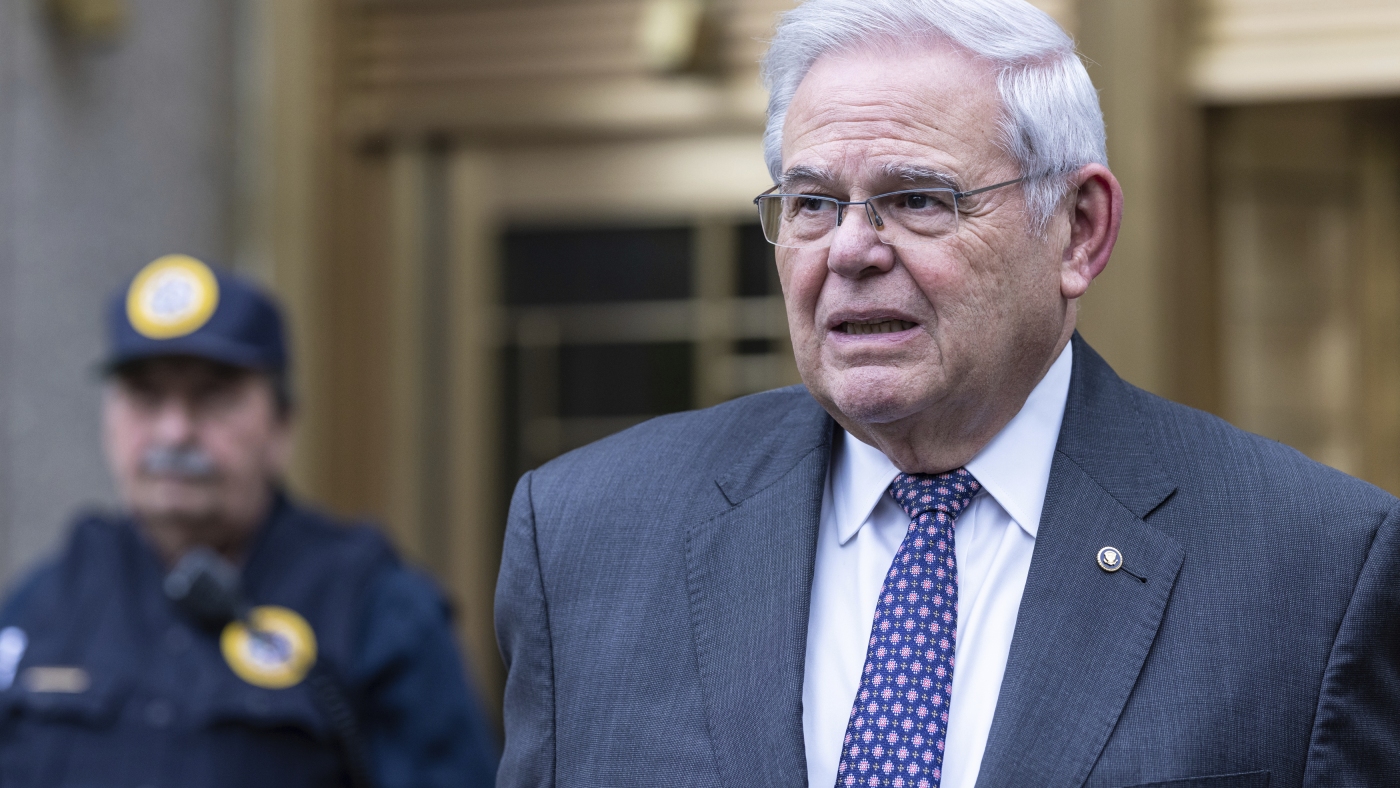
New Jersey Sen. Bob Menendez leaves the Manhattan federal court after the second day of jury selection in his trial on May, 14, 2024, in New York.
Stefan Jeremiah/AP
hide caption
toggle caption
Stefan Jeremiah/AP
TRENTON, N.J. — U.S. Sen. Bob Menendez, a New Jersey Democrat who is on trial on federal bribery charges in New York, has filed to run as an independent candidate for reelection.
Menendez, 70, had said this year that he would not seek the Democratic nomination to pursue a fourth term, and on Monday he filed paperwork with the state to launch an independent bid on the ballot. He had previously said an independent run for office was possible.
Asked on his way into court Monday if he’s changing political parties, Menendez said in Spanish, “no, independent doesn’t mean I’m changing.”
Later Monday, Menendez told reporters who asked him about his run that he’d done a lot for the state of New Jersey, particularly during the pandemic and after Superstorm Sandy.
Menendez listed his party in documents filed with the state as “Menendez for Senate.”
The political stakes are high, given the Democrats’ narrow control in the Senate, where New Jersey is normally safely in Democratic hands. It’s unclear how much support Menendez could siphon from U.S. Rep. Andy Kim, who is in a favorable position to win the Democratic primary, which ends Tuesday. The GOP hasn’t won a U.S. Senate election in the state since 1972.
Kim, a three-term congressman from the 3rd District, said Menendez was running for himself, not the public.
“Americans are fed up with politicians putting their own personal benefit ahead of what’s right for the country,” Kim said.
Menendez, his wife, Nadine, and three business associates were charged last year by federal prosecutors in New York with running a scheme in which Menendez promised to use his office to help the businessmen in return for gold bars, cash, a mortgage payment on his wife’s house and a luxury car. The Menedezes and two of the business associates have pleaded not guilty. A third pleaded guilty and agreed to testify.

In court, prosecutors have argued that Menendez sought to sell his office to enrich himself, helping business associate Wael Hana get a lucrative monopoly on certifying meat exports to Egypt as meeting Islamic guidelines, and assisting Fred Daibes with investments linked to a member of the Qatari royal family.
Menendez has denied there was any corrupt scheme. His attorneys said his conduct constituted carrying out diplomacy and working on behalf of constituents. The gold bars belonged to his wife, and the cash laying around his house was a longtime habit stemming from his parents’ escape from Communist Cuba, according to his attorney.
Daibes and Hana are on trial alongside Menendez. Nadine Menendez is undergoing treatment for breast cancer, the senator has said, and is expected to go on trial later this summer.
Menendez has held elected office for most of his life, getting on the Union City, New Jersey, school board just two years out of high school. Since then, he has been elected to office in the Legislature, as a U.S. representative and in 2006 as a U.S. senator.
He survived politically after another federal trial — that time in New Jersey on charges that he used his office to help a friend defraud Medicare — in 2017. It ended in a deadlocked jury, and prosecutors declined to hold another trial. In 2018, with the backing of the state’s Democratic establishment, Menendez won reelection.
But his political fortunes turned after the September 2023 indictment when allies across the state, including Gov. Phil Murphy, and in the Senate called for his resignation.
Menendez vowed to beat the charges against him, and like last time, promised to stick around. But Menendez didn’t appear on ballots for Tuesday’s primary. By filing as an independent, he’s aiming for November instead.
Two Republican candidates, Curtis Bashaw and Christine Serrano Glassner, have garnered the most attention. Bashaw, a southern New Jersey hotel developer, has won significant county party support, while Serrano Glassner has former President Donald Trump’s endorsement.
Sen. Steve Daines, chair of the National Republican Senatorial Committee, said Menendez’s decision “makes that race a little more interesting.”
Democrats said they’re confident their party will keep control of the seat.
Sen. Gary Peters, chair of the Democratic Senatorial Campaign Committee, had not heard of Menendez’s decision when a reporter asked him about the impact it would have on the race: “We’re going to win. A Democrat will win.”


Members of the National Guard stand in front of a large image of U.S. President Donald Trump that hangs from the the Robert F. Kennedy Department of Justice Building on May 18, 2026 in Washington, D.C.
Andrew Harnik/Getty Images North America
hide caption
toggle caption
Andrew Harnik/Getty Images North America
WASHINGTON, D.C. — In a strongly worded letter to the head of Michigan’s National Guard, Gov. Gretchen Whitmer reiterated troops from her state are only to be used for operations surrounding America 250 celebrations in Washington, D.C., and not for President Trump’s long-running — and controversial — joint task force to fight crime. She said that she would pull her troops from the city if that is not the case, in the letter obtained by NPR.
“Please take all necessary measures to ensure the Michigan National Guard is only supporting the narrow and limited America 250 Mission and is in no way supporting the D.C. Safe and Beautiful Mission,” wrote Gov. Whitmer, referencing the official name for the federal task force.
Trump deployed hundreds of troops to Washington, D.C., in August of 2025, in what experts said was a stunning departure from governing norms. He said he did so to address rampant crime, despite declining crime rates at the time. The number of troops in the city has increased over time to more than 4,800 from Washington, D.C. and almost two dozen states, which until recently were exclusively Republican-led.
Michigan — which has 161 guard members currently in the city — is one of four Democratic-led states that sent members of their National Guard to D.C. in recent weeks, ahead of an influx of tourists for America 250 celebrations. North Carolina and Kentucky each sent one member of their guard, while Minnesota sent more than a hundred last week.
Kentucky confirmed to NPR Monday that it had recalled its one guard member over the weekend, after that member was “diverted to the task force by the federal government without the knowledge or consent of Gov. Beshear of the Kentucky Guard,” Scottie Ellis, a spokesperson for Gov. Beshear, wrote to NPR in an email.
When contacted by NPR, spokespeople for each respective Democratic governor’s office made it clear that their guard members were sent to help specifically with America 250, not for law enforcement purposes as part of the larger ongoing federal joint task force operation. All four states have been clear about their opposition to the Trump administration’s ongoing deployment of National Guard troops to D.C., filing an amicus brief in support of litigation challenging it as recently as May.
But in recent days, a video of troops identifying themselves as Michigan National Guard members patrolling the Georgetown waterfront — an upscale neighborhood more than a mile away from any official America 250 celebrations — began circulating on social media. NPR has authenticated the video. Whitmer’s office did not immediately respond to NPR’s request to verify that the troops were Michigan members.
All state guard members are currently in D.C. under Title 32 status, which essentially means that the federal government pays for the deployment, but the state governors maintain control and command of their troops. But former National Guard officials say it’s impractical for states to play a role in day-to-day activities in a complex national mission like what’s happening in D.C.
“If the National Guard has defined the America 250 Mission to extend beyond direct support for events celebrating the nation’s 250th anniversary, please let me know so we can ensure the Michigan National Guard’s efforts are carefully limited,” Gov. Whitmer’s letter reads.
It goes on to say that if that can’t be ensured, then Gov. Whitmer will “end Michigan’s support for the America 250 mission.”
Legal experts, like those at the Brennan Center for Justice who have closely been watching Trump’s ongoing deployment to D.C., worry that drawing a distinction between the America 250 celebration and the general mission of the joint task force in the city will prove difficult. The joint task force is largely carrying out high visibility presence patrols in residential neighborhoods, public parks and metro stations.
Troops from all four Democratic-led states are listed as part of the official federal joint task force numbers released to the public. Gov. Whitmer said the Michigan troops should not be included in that count.
The offices for other Democratic governors NPR reached out to about that list also said their guard members shouldn’t be included.
When asked about the confusion, a spokesperson for the joint task force told NPR that it is overseeing all guard members in D.C. for organizational purposes, but being on the list “does not change their specific mission.” The joint task force did not immediately respond to NPR’s request for comment as to why Michigan guard members were apparently in Georgetown, and if that was part of the America 250 operations.

Sen. Ruben Gallego, D-Ariz., walks out of the Senate chamber on Oct. 1, 2025.
Andrew Harnik/Getty Images
hide caption
toggle caption
Andrew Harnik/Getty Images
The Senate Ethics Committee has dismissed a complaint brought against Sen. Ruben Gallego involving allegations of campaign finance violations and potential sexual misconduct.
The allegations against the Arizona Democrat were brought to the committee in April by a fellow member of Congress, Rep. Anna Paulina Luna, R-Fla. But in a letter to Gallego dated June 26, the committee said it had uncovered no wrongdoing.
“Based on the investigation of the Committee, the Committee did not find evidence that your actions violated Federal law, Senate rules, or related standards of conduct,” the panel wrote.
The panel also said it appreciated Gallego’s “full cooperation” throughout the investigation.
Gallego welcomed the findings, saying in a statement that the dismissal “reaffirms what I have said about these accusations from the beginning: they were right-wing conspiracies peddled by far-right activists like Anna Paulina Luna, the White House, and their allies.”

“I look forward to an apology from Rep. Luna for weaponizing the ethics process while refusing to investigate historic corruption that’s making life harder for families,” he continued.
Whispers about potential misconduct by Gallego began to circulate in April following the resignation of Rep. Eric Swalwell, D-Calif. Swalwell stepped down in response to a swell of sexual assault and misconduct allegations. NPR has not independently verified the allegations against Swalwell, but he has adamantly denied them.
Swalwell and Gallego were close friends, and during Swalwell’s short-lived 2020 presidential campaign, it was Gallego who served as campaign chair.
In the immediate aftermath of Swalwell’s resignation, Gallego denied knowledge of any alleged history of sexual misconduct, though he acknowledged to reporters that their close friendship may have made it difficult for him to accept rumors about Swalwell and his behavior toward women.
“My friendship with him, our family’s friendship together with him, clouded my judgment, and I was wrong — I deeply, deeply regret that,” Gallego said.
Within days of the resignation, a cryptic post on social media by Luna sparked speculation about Gallego.
“It’s seems like the Senate has its own trash to take out. @LeaderJohnThune You need to look into the allegations against one of your Senators, it’s very disturbing. My chief will be contacting your chief,” she wrote.
The following day, Luna confirmed to CBS News she was referring specifically to Gallego.
Despite the dismissal by the ethics panel, Luna shot back at Gallego on Monday, writing on social media, “These are not conspiracy theories.”
“The good news about DC is everyone talks, and eventually the reporters come forward with your texts,” she said.
The allegations against Swalwell earlier this year brought on a fresh reckoning in Congress over the behavior of some of its male members — some 10 years after the #MeToo movement reshaped the conversation around sexual assault. Shortly after Swalwell resigned, so too did Rep. Tony Gonzales, R-Texas, who had previously admitted to an affair with a former staffer who later died by suicide.

Horse mounted riders circle atop a hill at the Battle of Little Bighorn National Monument, near Last Stand Hill, on June 25.
Kadin Mills/NPR
hide caption
toggle caption
Kadin Mills/NPR
CROW AGENCY, Mont. — Under the expansive Montana sky, hundreds of members and descendants of 19 tribal nations gather at one of America’s most famous battlefields. They’re here to watch as Native American riders on horseback charge onto the same land their ancestors did 150 years ago when they defeated the U.S. Army’s 7th Cavalry under the command of Lt. Col. George Armstrong Custer.
The riders race across the dry landscape — kicking up clouds of dust before circling at the top of a hill at Little Bighorn Battlefield National Monument. Some of them are wearing headdresses and regalia, others are wearing tank tops and T-shirts. Many of them are carrying their tribal flags in a show of unity — the same unity that made possible their swift victory on June 25, 1876.
“It was so important then, 150 years ago. … It’s important today still,” said Gaby Strong, who is Sisseton-Wahpeton and Mdewakanton. “Our victories are still possible.”

Custer’s goal was to force Native Americans onto reservations. After the 1874 discovery of gold in the Black Hills, Indigenous peoples living off reservations were directed to report to their U.S. field offices, called Indian Agencies, or be deemed hostile.
Native American leaders, including Crazy Horse and Sitting Bull, organized villages and tribes together in a resistance effort.
Several battles broke out in what is now Montana and South Dakota as military forces attempted to push remaining groups onto reservations.
“Crazy Horse, he went from band to band, leader to leader, to tell them about this idea of our relatives coming together for a much greater cause than themselves,” said Christopher Eagle Bear. He is Sicunga Lakota from the Rosebud Sioux Tribe.
In 1876, Custer was tracking a nomadic village of various peoples, including the Oceti Sakowin (Sioux), Cheyenne and Arapaho. Custer was tracking that camp with the help of about three dozen Arikara and Crow scouts. Scouting for the U.S. government was a common practice among many tribes.
Custer divided his forces of around 700 men into three columns, hoping to surround the village.
By June 25, the village had swelled to an estimated 8,000 people. Custer decided to attack early out of fear the allied tribes would disband and escape — a decision which proved to be a fatal mistake.
“It was early morning, they were camped. Then all of a sudden they’d seen Custer’s platoon coming over the ridge,” Eagle Bear said, recounting the battle known to the Lakota as the Battle of Greasy Grass.

Christopher Eagle Bear, 27, is the youngest tribal council member for the Rosebud Sioux Tribe. He said the commemoration was about reclaiming and celebrating their identity.
Jessica Plance for NPR
hide caption
toggle caption
Jessica Plance for NPR
“They say the battle lasted as long as it took you to make a cup of coffee and drink it,” he said.
Custer was outnumbered. By the battle’s end, 268 of Custer’s forces were killed, mostly U.S. soldiers. Custer was among those killed. On the other side, fewer than 100 Native Americans were killed, including women and children.
Custer’s crushing defeat sparked fear and outrage nationwide. The U.S. government responded by changing its approach to Indian policy, shifting to forced assimilation. Just three years after the battle, the first off-reservation federal Indian Boarding School opened in Carlisle, Pa. Hundreds more followed, beginning a century of abuse that attempted to erase Native ways of life.
“They realized that they couldn’t destroy us head on. … So after that, they did the next best thing that you could do to tear apart a nation, and that was take away the children,” said Eagle Bear.
Youth leaders hope to inspire the next generation

People are taking down tipis at an encampment along the Little Bighorn River during the 150th anniversary commemoration of the Battle of the Little Bighorn near Little Bighorn Battlefield National Monument. The encampment brought together tribal members from across the Plains for ceremonies, storytelling and remembrance.
Jessica Plance for NPR
hide caption
toggle caption
Jessica Plance for NPR
Eagle Bear is camping at the site of that historic village. To commemorate their victory, people from various tribal nations have set up their tipis here, and there is a council lodge in the middle of the camp.
Eagle Bear is here as one of the coordinators for the Rosebud Sioux Tribe’s camp, and he said he wants to set an example for the next generation.
“Someday from now, you know, the kids that are here today, they’re going to come together during the 200th anniversary and they’re going to talk about what they witnessed as kids,” he said. “My prayers are being answered every single day with the fact that these kids are here.”
Just feet away, a group of children are playing lacrosse with traditional sticks to the sound of drumming. And cooking for the camp are members of the Sicunga Youth Council.
“We’ve been planning this for roughly eight months now. So it’s very heartwarming to see everyone that actually showed up and that’s here,” said Ashlen Bonshirt, a member of the youth council.
“We did plan the lacrosse, and there’s yoga, and there are all these different amazing things for our youth,” she said. “But on the other side of it is the garbage, the showers — everything that is here, we had to plan for it.”
The camp is full of young people. School groups, youth councils and kids with their families are staying in tipis all around. Many of them are learning things about the battle that weren’t covered in school.
“I feel like a lot of it is whitewashed,” said 13-year-old Gianna Larocque-Mahto. She’s Dakota, of the Sisseton-Wahpeton Oyate, and she’s here with her grandmother.
“We didn’t get to learn about the Native people’s side, like the Dakota people’s side. We only got to learn from one perspective,” she said. “And I feel like that’s not fair. … I think it’s important that we learn from all different people’s perspectives and not just one person.”

Champion Marquez and his friend Elijah Wallowing pose in front of a tipi in the encampment.
Jessica Plance for NPR
hide caption
toggle caption
Jessica Plance for NPR

Gianna Larocque-Mahto rode her horse to the camp from nearby Busby, Mont., joining a group of other riders. They started their “Victory Ride” in Ashland, Mont., roughly 60 miles away.
Kadin Mills/NPR
hide caption
toggle caption
Kadin Mills/NPR
Eighteen-year-old Champion Marquez is Cheyenne. He’s also staying at the camp, and he’s been volunteering here this week — working security, helping elders and setting up tipis.
Marquez said the commemoration gives him hope for the future. “Hope that a bunch of new generations are going to learn about what happened at the Battle of Little Bighorn. Seeing all these kids having fun, playing with each other, all these events for them happening.”
“Seeing all this here just [reassures] that … we’re still here.”

A group of children from different tribal nations play lacrosse together using traditional equipment.
Kadin Mills/NPR
hide caption
toggle caption
Kadin Mills/NPR
-

 Oregon2 minutes ago
Baker County was 1st official jurisdiction in Eastern Oregon – La Grande Observer
-

 Pennsylvania7 minutes ago
Editorial: Classrooms reflect Pennsylvania’s demographic reality
-

 Rhode Island14 minutes ago
Rhode Island wins 5 gold medals at 2026 Special Olympics
-

 South-Carolina17 minutes ago
Hricik launches no-money pledge campaign for SC attorney general
-
South Dakota22 minutes ago
SD Lottery Powerball, Lotto America winning numbers for June 29, 2026
-

 Tennessee29 minutes ago
PHOTOS: The Strawberry Moon lights up Middle Tennessee Monday night
-

 Texas32 minutes ago
Hot, muggy and breezy conditions continue for North Texas ahead of Fourth of July
-
 Utah37 minutes ago
‘She gave of herself constantly’: Loved ones remember woman killed in Utah-Colorado wildfire

