Montana
Montana presidential primary gives option for “no preference” votes

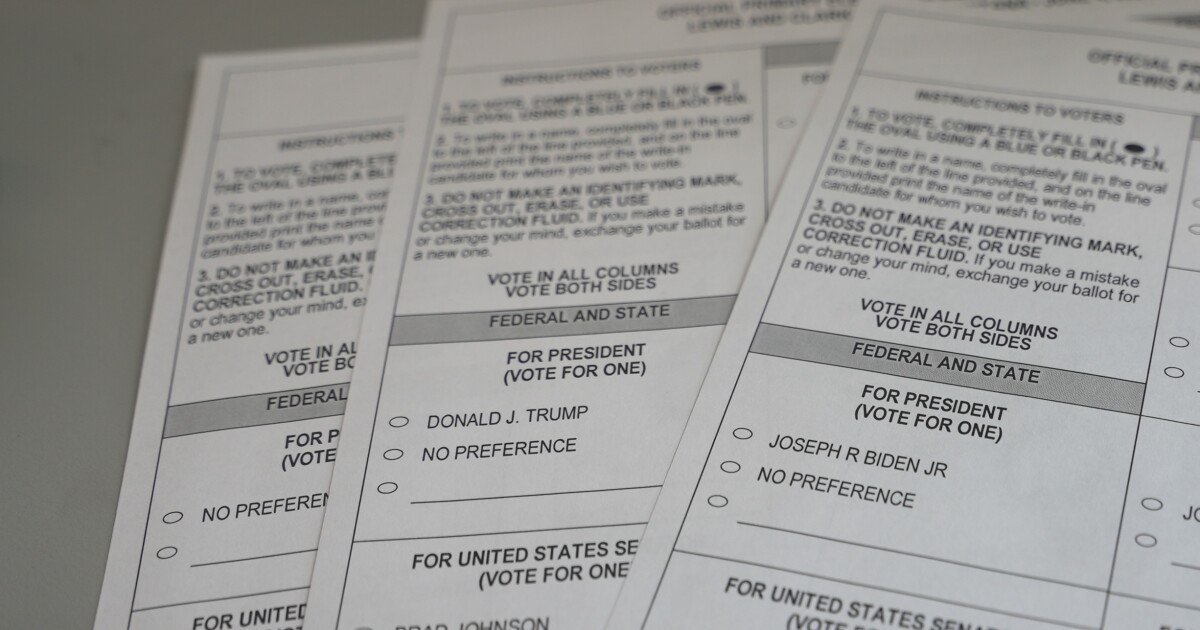
HELENA — Only two names are appearing on Montana’s presidential primary ballots this year: Joe Biden and Donald Trump. However, voters do have another option.
For 50 years, Montana law has required that voters in the state’s presidential primaries have a choice to vote “no preference” instead of for a candidate.
One group actively encouraging voters to support “no preference” is Montanans 4 Palestine, which has organized protests against Democratic and Republican politicians because of their stances on Israel’s war in Gaza. Several weeks ago, they announced they would campaign for a “no preference” vote in the Democratic primary as a way to protest the Biden administration, saying it hasn’t done enough to stand up against what they describe as a genocide.
“Ultimately, this is an expression of disgust with the president’s policies,” said co-founder Brendan Work.
Last weekend, Montanans 4 Palestine members were knocking on doors in Bozeman and Missoula to get out their message, and Work said they’ll be canvassing again this weekend. They’ve also distributed yard signs in several cities across the state.
Work said they’re making the case voting “no preference” is a low-risk way for people to show they’re unhappy with the administration.
“Biden has already won the nomination pretty much, and this vote is not like a vote for Trump,” he said. “So it’s a good way for people to express their feelings – and it’s easy to do: It’s right on the ballot; it says ‘Joe Biden,’ and ‘no preference.’ And that’s an easy choice for a lot of us.”
Jonathon Ambarian
Work estimates his group has around 300 members, and he says it’s grown significantly since the start of the war in Gaza. He said their initial goal is to get 5,000 “no preference” votes, which he said would demonstrate there’s a “pro-peace constituency” that leaders need to listen to, especially in the closely watched race for Montana’s U.S. Senate seat. Their higher target is to crack 15% of the Democratic primary vote, which would allow for the selection of “no-preference” delegates for the Democratic National Convention. Work said that would likely take 20,000 votes.
This campaign follows visible efforts to encourage “uncommitted” votes in Democratic primaries in a number of other states, including Michigan, Washington and Wisconsin. That vote has often ended up between about 8% and 15%, reaching as high as nearly 19% in Minnesota’s primary and 29% in Hawaii’s caucus. However, Biden has won the overwhelming majority of delegates – projected by national analysts to be more than 3,600, compared with just over 30 uncommitted delegates.
A spokesperson for Biden’s campaign released a statement to MTN Thursday.
“The President believes making your voice heard and participating in our democracy is fundamental to who we are as Americans,” they said. “He shares the goal for an end to the violence and a just, lasting peace in the Middle East. He’s working tirelessly to that end.”
2024 will be the first time in 40 years that neither the Republicans nor the Democrats have multiple candidates listed on their Montana primary ballot. In recent election cycles, the highest “no preference” vote totals have generally come when there’s only one candidate on the ballot – like in 2012, when “no preference” got 9.4% of the Democratic primary vote in Barack Obama’s reelection year, and in 2020, when Trump was the only Republican candidate and 6.2% of the vote was for “no preference.”
The largest share of “no preference” votes for both Republicans and Democrats in Montana came in 1992: 16.6% and 24%, respectively.
Montana “No Preference” Vote History:
1976:
Republicans: 2.2%, 1,996 votes
Democrats: 3.6%, 3,820 votes
1980:
Republicans: 3.8%, 3,014 votes
Democrats: 11.9%, 15,466 votes
1984:
Republicans: 7.5%, 5,378 votes
Democrats: 28,385 votes (Montana Democrats held a caucus and no candidates appeared on the primary ballot)
1988:
Republicans: 7.5%, 6,520 votes
Democrats: 3.6%, 4,083 votes
1992:
Republicans: 16.6%, 15,098 votes
Democrats: 24.0%, 28,164 votes
1996:
Republicans: 7.2%, 8,533 votes
Democrats: 10.0%, 9,176 votes
2000:
Republicans: 4.1%, 4,655 votes
Democrats: 22.1%, 19,447 votes
2004:
Republicans: 5.6%, 6,340 votes
Democrats: 7.4%, 6,899 votes
2008:
Republicans: 2.4%, 2,333 votes
Democrats: 2.4%, 4,358 votes
2012:
Republicans: 3.8%, 5,456 votes
Democrats: 9.4%, 8,270 votes
2016:
Republicans: 4.7%, 7,369 votes
Democrats: 4.2%, 5,415 votes
2020:
Republicans: 6.2%, 13,184 votes
Democrats: 2.8%, 4,250 votes



The Montana Lottery offers multiple draw games for those aiming to win big.
Here’s a look at June 23, 2026, results for each game:
Winning Mega Millions numbers from June 23 drawing
48-51-60-63-66, Mega Ball: 20
Check Mega Millions payouts and previous drawings here.
Winning Big Sky Bonus numbers from June 23 drawing
06-21-22-31, Bonus: 13
Check Big Sky Bonus payouts and previous drawings here.
Feeling lucky? Explore the latest lottery news & results
When are the Montana Lottery drawings held?
- Powerball: 8:59 p.m. MT on Monday, Wednesday, and Saturday.
- Mega Millions: 9 p.m. MT on Tuesday and Friday.
- Lucky For Life: 8:38 p.m. MT daily.
- Lotto America: 9 p.m. MT on Monday, Wednesday and Saturday.
- Big Sky Bonus: 7:30 p.m. MT daily.
- Powerball Double Play: 8:59 p.m. MT on Monday, Wednesday, and Saturday.
- Montana Cash: 8 p.m. MT on Wednesday and Saturday.
- Millionaire for Life: 9:15 p.m. MT daily.
Missed a draw? Peek at the past week’s winning numbers.
This results page was generated automatically using information from TinBu and a template written and reviewed by a Great Falls Tribune editor. You can send feedback using this form.

We cover lots of hard news here at The Drive. Y’know, the stuff that keeps you updated on the automotive industry and enthusiast scene. Other times, we don’t. Other times, we write silly car-related stuff because it’s fun. This is one of those times. A giant banana recently got pulled over in Montana, and as the Cowboy State Daily put it, it wasn’t its first time.
According to the Montana State Police, the giant banana car and its driver, Steve Braithwaite, were pulled over near Billings because part of the license plate was blocked. He did not receive a ticket. Also, the plate reads “SPLIT.”
“We’ve stopped speeders, distracted drivers, and even a few unusual vehicles… but this one definitely stands out.
The Big Banana Car was stopped cruising near Billings today. While it may be apPEALing, traffic laws still apply to fruit. 😎 🍌
Safe travels, Montana,” said the Montana State Police’s Facebook page.
According to the report, Braithwaite has been pulled over hundreds of times over the decade he’s been driving his banana car across the country. In fact, he believes that during the first few years he had the thing, he was one of the most frequently pulled-over men in America.
“Driving around in a banana and having all these people, all these smiles and waves, affects me. It actually does something fantastic,” he told the outlet.
He even claims to have been pulled over once for “peeling out,” which was, of course, a joke.
Another report claims that Braithwaite began working on the fiberglass banana in 2008 and finished it in 2011. It’s based on a 1993 Ford F-150 and is a bout 23 feet from tip to tip.
Keep on keepin’ on, Steve.
Got a tip? Email us at tips@thedrive.com

Log landing, western Montana. Photo: Jeffrey St. Clair.
Way back in 1995 Bob Brown, the Republican president of the Montana Senate, called me into his office.
He had co-sponsored a bill with a pro-logging Missoula Democrat to establish a “sustained yield” level of logging on Montana’s state trust lands – and he was worried it wasn’t working out the way he hoped.
Bob was right to be worried then and Montanans are right to be worried now because Trump’s Forest Service Chief and former timber industry lobbyist Tom Schultz, has just unleashed the “sustained yield” scam on Montana’s National Forests.
To appreciate Brown’s concerns, it’s important to understand that the 1995 Montana legislature had two-thirds Republican majorities in the House and Senate and Republican Marc Racicot in the Governor’s Office.
Those majorities put Montana’s environment in the cross-hairs with a raft of industry-friendly deregulatory bills. That included the timber industry, which was losing the “timber wars” in large part because Plum Creek Timber, one of the largest private forest landowners in the West, had decided to “liquidate” its “timber assets” – also known as “forests.”
That decision resulted in massive clearcuts since there were virtually no regulations on logging private land. Plum Creek scalped the forests of northwest Montana, including the lands around Bob’s home in Whitefish, leaving barren, knapweed infested stumpfields that remain to this day. His goal was to protect the lands around the trout streams he’d fished growing up and hoped the bill would do that.
It was the closing weeks of the session and Bob wanted to know if it was possible to reduce the environmental impacts of his bill since it had been heavily amended to favor extraction, not “sustained yield.” My advice was to let the bill die because he didn’t have the votes to remove the amendments the timber industry lobbyists stuck on the bill. But he didn’t take that advice, the bill passed, and the logging level for Montana’s state forests was set at 52 to 55 million board feet per year.
Two years later, Tom Schultz went to work for Montana’s Department of Natural Resources and Conservation, heading the trust lands timber division and earning the sobriquet “Chainsaw Tom” for his pro-logging zeal. Like the stumpfields, his dedication to the timber industry remains to this day – only now he’s in charge of the United States Forest Service and bringing chainsaws to millions of acres of our remaining intact forests.
If you believe that “sustained yield” is supposed to be a carefully calculated determination of how many millions of board feet of timber can be logged every year on a sustainable basis that means limiting logging to the pace at which the forests can regrow – regardless of the demands of the rapacious timber industry.
In the “old days” loggers liked to refer to forests as “100 year gardens.” But of course forests aren’t gardens, they’re complex ecosystems – and the timber industry doesn’t wait a century for forests to regrow.
It’s unlikely that quaint misnomer is even applicable in today’s climate with hotter, longer summers, minimal snowpack, and extreme drought. Yet, Montana’s “sustained yield” is now nearly 10 million board feet a year higher than when Brown’s bill passed, defying logic and science and justifying his concerns from 30 years ago.
“Chainsaw Tom” Schultz has now reappeared and demands that 350-500 million board feet of Montana’s national forests be logged over 10 years. Schultz’s timber industry lobbyist background offers a clue as to where that “sustainable yield” number came from — and the reason we will likely be left with nothing but stumpfields and knapweed from his “landscape scale” logging of our remaining intact forests.
-

 Kansas7 minutes ago
Jac Caglianone make puny ball go very far in Royals win
-

 Kentucky10 minutes ago
Top knee doctor confident Jayden Quaintance’s injury not a long-term concern, but clean-up procedure possible
-

 Louisiana15 minutes ago
Congress authorizes more than $16M for 11 projects in Louisiana, New Mexico and Texas
-
 Maine22 minutes ago
Saco | Ice Cream Social with Girl Scouts of Maine
-

 Maryland25 minutes ago
Maryland congressional incumbents cruise to primary wins
-

 Michigan30 minutes ago
Michigan basketball champ Yaxel Lendeborg joins Warriors, gets chance to learn from Curry, Draymond Green
-

 Massachusetts37 minutes ago
Massachusetts man indicted on murder charge in child’s 2017 death
-

 Minnesota40 minutes ago
Justin Liles: North-central Minnesota faces hail, gusty winds in Tuesday night storms

