Simply sign up to the Chinese economy myFT Digest — delivered directly to your inbox.
China’s consumer inflation edged higher in April while factory prices continued to slide, pointing to a continued rocky recovery in the world’s second-largest economy as Beijing battles lagging consumer demand and global trade tensions.
The national consumer price index rose 0.3 per cent year on year in April, official statistics showed on Saturday, ticking up from an 0.1 per cent rise in March, with price increases in areas including energy, education and tourism offsetting falling food costs.
China’s economy had been beset by flat or falling consumer prices for almost a year, with the country’s 1.4bn consumers widely opting to save instead of spend in the wake of the Covid-19 pandemic.
Advertisement
But a third straight month of consumer inflation in April suggested some stabilisation of domestic demand despite a years long crisis in the important real estate market.
The inflation reading — better than the 0.2 per cent predicted by economists surveyed by Bloomberg — came as President Xi Jinping leans on a manufacturing revival, particularly in high-tech industries, to boost economic growth and offset the property sector slowdown.
The strategy has stoked growing fears among western leaders of cheap Chinese imports flooding their markets, especially as declining prices in the country’s manufacturing sector make Chinese goods cheaper.
The data from the National Bureau of Statistics on Saturday showed prices in China’s industrial sector in April remained mired in negative territory. The producer price index declined by 2.5 per cent on a year earlier last month, after declining 2.8 per cent in March and 2.7 per cent in February.
Analysts said prices in the all-important manufacturing sector may be a better barometer of the true health of the economy.
Advertisement
“Chinese manufacturers have volume but they don’t have prices,” said Chen Long of Plenum, a Beijing-based research firm.
“GDP growth in real terms looks pretty decent, but then if you look at nominal GDP growth and corporate profits — they produce a lot, but they don’t make a lot of money because prices are falling,” he added.
Profits at Chinese companies listed on domestic exchanges were down 5 per cent year on year in the first quarter, excluding the financial industry, he noted.
Data released on Thursday showed the value of China’s exports in dollar terms rose 1.5 per cent year on year in April, but analysts said export growth in volume terms has been closer to 10 per cent or higher in recent months. The trend is driving renewed tensions with China’s most important trading partners, including the EU and the US.
French leader Emmanuel Macron and European Commission president Ursula von der Leyen earlier this week warned Xi on a visit to the continent that the EU needed to protect itself from cheap Chinese imports. In the US, the Biden administration is planning to raise tariffs on Chinese electric vehicles and other green energy imports next week.
Advertisement
In response, Xi has brushed off western leaders’ concerns. He told German Chancellor Olaf Scholz last month that China’s exports were helping to ease global inflation, and this week told European leaders that China did not have an overcapacity problem.
This undated photo released by the U.S. Department of Justice shows Jeffrey Epstein and Ghislaine Maxwell.
AP/U.S. Department of Justice
hide caption
toggle caption
Advertisement
AP/U.S. Department of Justice
WASHINGTON — The Justice Department said Wednesday that it may need a “few more weeks” to release all of its records on the late sex offender Jeffrey Epstein after suddenly discovering more than a million potentially relevant documents, further delaying compliance with last Friday’s congressionally mandated deadline.
The Christmas Eve announcement came hours after a dozen U.S. senators called on the Justice Department’s watchdog to examine its failure to meet the deadline. The group, 11 Democrats and a Republican, told Acting Inspector General Don Berthiaume in a letter that victims “deserve full disclosure” and the “peace of mind” of an independent audit.
The Justice Department said in a social media post that federal prosecutors in Manhattan and the FBI “have uncovered over a million more documents” that could be related to the Epstein case — a stunning 11th hour development after department officials suggested months ago that they had undertaken a comprehensive review that accounted for the vast universe of Epstein-related materials.
Advertisement
In March, Attorney General Pam Bondi told Fox News that a “truckload of evidence” had been produced after she ordered the FBI to “deliver the full and complete Epstein files to my office.” She issued the directive after saying she learned from an unidentified source that the FBI in New York was “in possession of thousands of pages of documents.”
In July, the FBI and Justice Department indicated in an unsigned memo that they had undertaken an “exhaustive review” and had determined that no additional evidence should be released — an extraordinary about face from the Trump administration, which for months had pledged maximum transparency. The memo did not raise the possibility that additional evidence existed that officials were unaware of or had not reviewed.
Wednesday’s post did not say when the Justice Department was informed of the newly uncovered files.
In a letter last week, Deputy Attorney General Todd Blanche said Manhattan federal prosecutors already had more than 3.6 million records from sex trafficking investigations into Epstein and his longtime confidant Ghislaine Maxwell, though many were copies of material already turned over by the FBI.
The Justice Department said its lawyers are “working around the clock” to review the documents and remove victims names and other identifying information as required by the Epstein Files Transparency Act, the law enacted last month that requires the government to open its files on Epstein and Maxwell.
Advertisement
“We will release the documents as soon as possible,” the department said. “Due to the mass volume of material, this process may take a few more weeks.”
The announcement came amid increasing scrutiny on the Justice Department’s staggered release of Epstein-related records, including from Epstein victims and members of Congress.
Republican Rep. Thomas Massie, of Kentucky, one of the chief authors of the law mandating the document release, posted Wednesday on X: “DOJ did break the law by making illegal redactions and by missing the deadline.” Another architect of the law, Rep. Ro Khanna, D-Calif., said he and Massie will “continue to keep the pressure on” and noted that the Justice Department was releasing more documents after lawmakers threatened contempt.
“A Christmas Eve news dump of ‘a million more files’ only proves what we already know: Trump is engaged in a massive coverup,” Senate Minority Leader Chuck Schumer, D-N.Y., said after the DOJ’s announcement. “The question Americans deserve answered is simple: WHAT are they hiding — and WHY?”
The White House on Wednesday defended the Justice Department’s handling of the Epstein records.
Advertisement
“President Trump has assembled the greatest cabinet in American history, which includes Attorney General Bondi and her team — like Deputy Attorney General Blanche — who are doing a great job implementing the President’s agenda,” spokeswoman Abigail Jackson said in a statement.
After releasing an initial wave of records on Friday, the Justice Department posted more batches to its website over the weekend and on Tuesday. The Justice Department has not given any notice when more records might arrive.
Records that have been released, including photographs, interview transcripts, call logs, court records and other documents, were either already public or heavily blacked out, and many lacked necessary context. Records that hadn’t been seen before include transcripts of grand jury testimony from FBI agents who described interviews they had with several girls and young women who described being paid to perform sex acts for Epstein.
Other records made public in recent days include a note from a federal prosecutor from January 2020 that said Trump had flown on the financier’s private plane more often than had been previously known and emails between Maxwell and someone who signs off with the initial “A.” They contain other references that suggest the writer was Britain’s former Prince Andrew. In one, “A” writes: “How’s LA? Have you found me some new inappropriate friends?”
The senators’ call Wednesday for an inspector general audit comes days after Schumer introduced a resolution that, if passed, would direct the Senate to file or join lawsuits aimed at forcing the Justice Department to comply with the disclosure and deadline requirements. In a statement, he called the staggered, heavily redacted release “a blatant cover-up.”
Advertisement
Republican Sen. Lisa Murkowski of Alaska joined Sens. Richard Blumenthal, D-Conn. and Jeff Merkley, D-Ore., in leading the call for an inspector general audit. Others signing the letter were Democratic Sens. Amy Klobuchar of Minnesota., Adam Schiff of California, Dick Durbin of Illinois, Cory Booker and Andy Kim, both of New Jersey, Gary Peters of Michigan, Chris Van Hollen, of Maryland, Mazie Hirono, of Hawaii, and Sheldon Whitehouse of Rhode Island.
“Given the (Trump) Administration’s historic hostility to releasing the files, politicization of the Epstein case more broadly, and failure to comply with the Epstein Files Transparency Act, a neutral assessment of its compliance with the statutory disclosure requirements is essential,” the senators wrote. Full transparency, they said, “is essential in identifying members of our society who enabled and participated in Epstein’s crimes.”
‘The old world is dying,” Antonio Gramsci once wrote. “And the new world struggles to be born.” In such interregnums, the Italian Marxist philosopher suggested, “every act, even the smallest, may acquire decisive weight”.
In 2025, western leaders appeared convinced they – and we – were living through one such transitional period, as the world of international relations established after the second world war crashed to a halt.
During such eras, Gramsci more famously wrote, “morbid phenomena of the most varied kind come to pass”. And at present there is no more morbid phenomenon than the crisis of legitimacy for the networks of rules and laws on which the international order was based – the world that the US was central in creating in 1945.
No one can say they were not warned about the wrecking ball that was about to be inflicted on the global order by Donald Trump.
The US secretary of state, Marco Rubio, spelled out with admirable clarity in his Senate confirmation hearing in February how Trump disowned the world his predecessors had made. “The postwar global order is not just obsolete, it is now a weapon being used against us,” he said. “And all this has led us to a moment in which we must now confront the single greatest risk of geopolitical instability and generational global crisis in the lifetime of anyone alive here today.”
Advertisement
The rules-based international order had to be jettisoned, Rubio said, because it had been built on a false assumption that a foreign policy serving core national interests could be replaced by one that served the “liberal world order, that all the nations of earth would become members of the democratic western-led community”, with humankind now destined to abandon national identity and become “one human family and citizens of the world. This was not just a fantasy. We now know it was a dangerous delusion”.
Marco Rubio at his Senate confirmation hearing. Photograph: Graeme Sloan/EPA
Rubio’s assessment was echoed in the recent US national security strategy, with its warnings of European cultural erasure and determination to back nationalist parties that believe in “strategic stability with Russia”. The US would no longer seek to “prop up the entire world order like Atlas”, the document said.
On paper these sound like relatively coherent statements of “America first”, but in practice Trump’s foreign policy is a mass of confusion in which this formal non-interventionist ideology has clashed with sporadic interventions that uneasily blend notions of global order with the US national interest. There is no linear Trump foreign policy, just a catherine wheel of disconnected explosions thrown out across the night sky. As Donald Trump Jr asserts, as if it were a virtue, his father is the most unpredictable man in politics. The hugely personal nature of US foreign policy gives Washington’s erstwhile allies just enough false hope that the break with America is not real.
Amid this chaos there has been one consistent target for Trump’s contempt: the constraints imposed by international law, and its value system built around national sovereignty, including the prohibition of the use of force to change external borders. In its place Trump pursues “sheer coercive power” – or what has been described as mobster diplomacy, in which shakedowns, blackmail and deal-making are the agents of change.
Faced with the choice, for example, between expelling Russia from Ukraine – something the US undoubtedly has the military means to do by arming Kyiv sufficiently – or forging a profitable relationship with Vladimir Putin in which both sides plunder Ukraine’s considerable material resources, Trump unmistakably wants to choose the latter. Ukraine, it emerges, shall pay any price, bear any burden, meet any hardship, in order to assure the survival and the success of the Trumpian economy. For the EU and Nato this is indeed the moment when every act has the potential to be decisive for the future sovereignty of Europe and the UN charter.
Advertisement
Similarly the sovereignty of Venezuela, sitting on 303bn barrels of crude oil – about a fifth of the world’s reserves – becomes, like that of Greenland, Canada and Mexico, the subject of Trump’s marauding eye. Warned on social media that killing Venezuelan civilians without any due process – as the US has done by bombing numerous boats in the Caribbean and Pacific – would be described a war crime, the US vice-president, JD Vance, was brazen enough to reply “I don’t give a shit what you call it”. The Pentagon has subsequently claimed implausibly that it was permissible in US law to blow up shipwrecked sailors stranded in the water because they were combatants representing a threat to US security.
Meanwhile, the rules of free trade are shredded as Trump deploys the sheer size of the US market to extort not just money from allies, but changes in their domestic policy. A country’s standing in the White House is not judged by any rational criteria, let alone its democratic status, but on a leader’s personal relationship to Trump and his ruling clique – a blatantly monarchical order.
Qatar’s foreign policy adviser, Majed al-Ansari (left). Photograph: Noushad Thekkayil/EPA
Finally, Israel’s occupation and bombardment of Gaza, with European powers often complicit bystanders, is brutal in itself but also strips bare the supposed universality of international norms. In the words of Majed al-Ansari, the foreign policy adviser to Qatar’s prime minister and a man who has had more dealings with Israel than most in 2025: “We are living in an age of disgusting impunity that is taking us back hundreds of years. We are reduced to giving concession after concession not to stop acts of aggression, but to ask those responsible to kill fewer people, destroy fewer neighbourhoods. We do not even ask them to have respect for international law, but ask to take a step back from going 100 miles away from international law.”
All this has been accompanied by an open assault on the institutions of international law that stand in the way of coercive power. Nicolas Guillou, a French judge at the international criminal court, recently gave an interview to Le Monde in which he spelled out the impact of US sanctions imposed on him in August as a result of the ICC’s issuing an arrest warrant against Benjamin Netanyahu for crimes against humanity.
The sanctions have changed every aspect of his daily life. Guillou explained: “All my accounts with American companies, such as Amazon, Airbnb, PayPal and others, have been closed. For example, I booked a hotel in France through Expedia, and a few hours later, the company sent me an email cancelling the reservation, citing the sanctions.”
Advertisement
For having the temerity to uphold the basics of international humanitarian law and the value of the lives of Palestinian civilians at the international court, which deals with issues such as war crimes and genocide, Guillou said he had in effect been sent back to live in the 1990s. European banks, cowed by the threats of US Treasury officials in Washington, rushed to close his accounts. The compliance departments of European companies, acting as the valets of the US authorities, refused to provide him services.
Meanwhile, European institutions – even signatories to the Rome statute that established the international court in 2002 – look the other way. Major Palestinian human rights groups such as Al-Haq also find their bank accounts closed as they face sanctions for cooperating with the ICC. The judges at the international court of justice, the UN body that deals with intergovernmental disputes, have had to take evasive action to prevent their assets being seized.
The US has left or sought to undermine several other UN bodies, such as the Human Rights Council and Unesco. In total it is estimated to have cut $1bn (£750m) in funding for organisations linked to the UN and fired 1,000 US government staff whose portfolios reinforced major UN functions.
At the UN general assembly, the key site of this year’s disputes between the US and the rest of the world, the US almost relishes its isolation. Other multilateral institutions – the World Trade Organization, the Paris climate agreement structure, the G20 – have become zones of conflict, places where the US can assert its dominance or indifference, either by absenting itself or demanding humiliating fealty from its one-time allies. John Kerry, a former US vice-president, said that under Trump the US was turning “from leader to denier, delayer and divider”.
“When the United States walks away, old excuses find new life. China not only enjoys newfound freedom from scrutiny,” Kerry said: it slowly fills the gap left by the US departure.
Advertisement
Washington’s turning away from international law and its institutions is especially sad because, as Dr Tor Krever, an assistant professor of international law at the University of Cambridge, points out, with Gaza “the language of legality has become the dominant frame of popular and political discourse”.
In a special edition of the London Review of International Law, more than 40 academics have written essays discussing whether this sudden public faith in international law as a harbinger of justice is a load that the law has the capacity to bear. Law cannot be a substitute for politics or settle ideological conflicts in a polarised world. Prof Gerry Simpson, the chair of public international law at the LSE, said he needed to swallow his longstanding doubts about international law’s efficacy “in the face of the enormous faith that had been placed on it, especially by the young”.
Illustration: Brian Stauffer
The inability to meet new public expectations has led to what Prof Thomas Skouteris, the dean of the law college at the University of Khorfakkan, UAE, describes as “a fin de siècle mood” about international law. Writing in the Leiden Journal of International Law, he argues: “International law’s lexicon – sovereignty, genocide, aggression – has become almost ambient, saturating the political atmosphere with juridical resonance. But ubiquity brings a strange paradox. The more present international law appears, the less decisive it feels. Norms are invoked with greater frequency and intensity even as their capacity to settle disputes or forestall violence seems to weaken. What once promised order increasingly reads as performance.”
The paradox is revealed in its starkest form when rulings of the UN security council or the international courts are invoked by western leaders who, in the next breath, prostrate themselves in front of Trump, caving in to his demands, calling him “daddy”, as Nato’s Mark Rutte did, and sending more lavish gifts to the Sun King and his family.
Very few in 2025 stood up against what the Dutch historian Rutger Bregman called “immorality and unseriousness … the two defining traits of our leaders today”.
Advertisement
Tom Fletcher, the head of the UN humanitarian agency Ocha, was arguably an exception. In May he asked UN diplomats “to reflect – for a moment – on what action we will tell future generations we each took to stop the 21st-century atrocity to which we bear daily witness in Gaza. It is a question we will hear, sometimes incredulous, sometimes furious – but always there – for the rest of our lives … Maybe some will recall that in a transactional world, we had other priorities. Or maybe we will use those empty words: We did all we could.”
Oman’s foreign minister, Badr bin Hamad Al Busaidi. Photograph: Stefan Rousseau/PA
His was a genuine howl of despair. Another cry of pain came from Oman’s foreign minister, Badr bin Hamad Al Busaidi. Speaking to the Muscat retreat of the Oslo Forum, an international mediators’ discussion group, he explained: “We are worryingly close to a world in which certain kinds of foreign intervention – if not outright invasion and annexation of territory – are accepted as a normal part of international relations, rather than as illegal violations of our shared international order. How did this happen?”
Al Busaidi claims the problem predated Trump. “Restraint and respect for international law was abandoned in the aftermath of 9/11, with the launch of not one but two foreign interventions, in Iraq and Afghanistan, ostensibly aimed at the elimination of a terrorist threat, but in reality, functioning as explicit projects of regime change.”
Now some on the left welcome the idea that international law’s entry into the limelight has coincided with its loss of credibility. The critics would share the view of the Marxist Perry Anderson, writing in New Left Review, that “on any realistic assessment, international law is neither truthfully international nor genuinely law”.
They argue that US presidents – Democrat and Republican alike – have always in reality exempted themselves from the law’s constraints. The US has never been a signatory to the Rome statute or the UN convention on the law of the sea. Roosevelt was not that interested in forging a club of democracies, but wanted as much to create a law-based stability pact with Russia. Indeed, Prof John Dugard, a member of the South African legal team at the international court of justice, has argued that the Biden team’s choice of the phrase “rules-based order” was a revealing code because it showed the US ambiguity towards international law.
Advertisement
The Russian foreign minister, Sergei Lavrov, has long declared that the US is promoting “a west-centric rules-based order as an alternative to international law”. China’s foreign minister, Wang Yi, made the same criticism in May 2021 during a UN security council debate on multilateralism. “International rules must be based on international law and must be written by all,” he said. “They are not a patent or privilege of a few. They must be applicable to all countries and there should be no room for exceptionalism or double standards.”
For much of the global south too, the rules conceal histories of violence and racial hierarchy. Others see international law with its references to proportionality, distinction and necessity as a futile attempt to soften the essential brutality of war.
It has been left to an older generation to insist there is something precious worth preserving. Take the response of Christoph Heusgen, the outgoing chair of the Munich Security Conference, in the wake of Vance’s speech attacking European values made in February 2025.
Heusgen, who served for 12 years as Angela Merkel’s adviser on security and foreign policy affairs, told the conference: “We have to fear that our common value base is not that common any more … It is clear that our rules-based international order is under pressure. It is my strong belief that this more multipolar world needs to be based on a single set of norms and principles, on the UN charter and the universal declaration of human rights.
“This order is easy to disrupt. It’s easy to destroy, but it’s much harder to rebuild. So let us stick to these values.”
Advertisement
But Ansari, despondent after a year of often fruitless Middle East diplomacy, predicts we are “moving from a world order to disorder”.
“I don’t think we are moving towards a multipolar system. I don’t think we are even moving to a power-based international order. I don’t think we are moving towards any kind of system.
“We are moving into a system where anybody can do whatever they like, regardless if they are big or small. As long as you have the ability to wreak havoc, you can do it because no one will hold you accountable.”
Good morning. You’re reading the Up First newsletter. Subscribe here to get it delivered to your inbox, and listen to the Up First podcast for all the news you need to start your day.
Today’s top stories
The Justice Department yesterday released about 30,000 pages of new documents, including flight logs, memos and letters, related to disgraced financier and convicted sex offender Jeffrey Epstein. The files contain hundreds of references to President Trump.
President Donald Trump in the Oval Office of the White House in Washington, Dec. 15.
Anna Moneymaker/Getty Images
hide caption
Advertisement
toggle caption
Anna Moneymaker/Getty Images
🎧 It’s well established that Epstein was well-connected and knew many influential figures, including Trump and former president Bill Clinton, NPR’s Sarah McCammon tells Up First. She emphasizes that Trump has not been accused of any wrongdoing, but notes that the documents continue to highlight the relationship between Trump and Epstein, raising questions about how much Trump knew about Epstein’s activities. She adds that it’s unclear which documents are credible and which aren’t. On social media, the DOJ has claimed that one of the files — a letter from Epstein to convicted sex offender Larry Nassar — is fake.
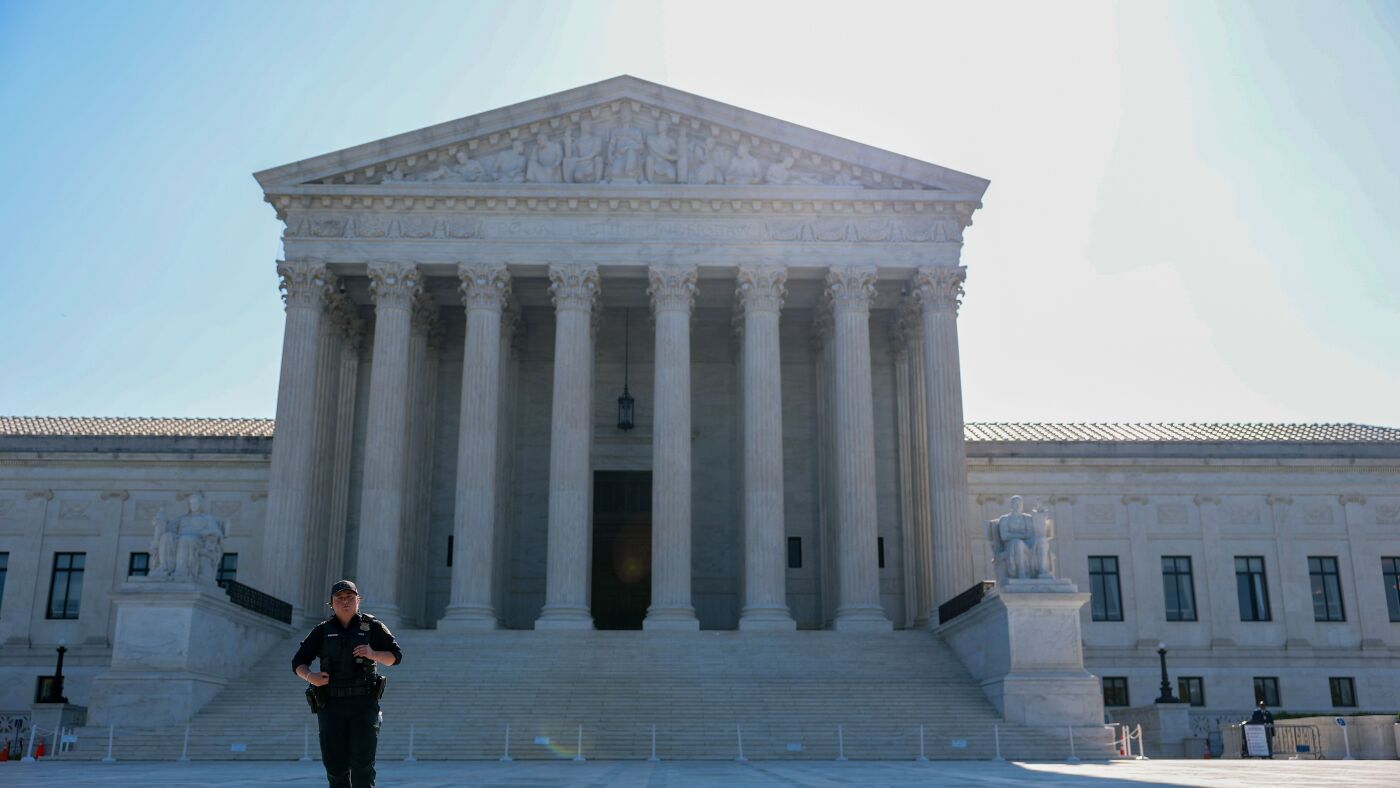
The Supreme Court has ruled that National Guard troops must stay out of Chicago — for now. The decision is one of several “emergency docket” cases in which the conservative majority court has ruled against Trump since he began his second term as president. The justices ruled 6-3, stating that the president failed to explain why the situation in Chicago warranted an exception to a law called the Posse Comitatus Act, which limits the military’s ability to execute laws on U.S. soil.
🎧 Because the ruling came through an emergency decision, it does not set precedent, NPR’s Kat Lonsdorf explains. The decision applies only to this specific case in Illinois, not to troop deployments elsewhere. But deployments in other cities are currently tied up in litigation in lower courts, and Lonsdorf says lower court judges tend to look to these emergency decisions for guidance.
The U.S. economy grew faster than economists expected from July through September, according to a delayed report from the Commerce Department on the nation’s gross domestic product (GDP). The agency usually releases this report in October, but it pushed it to this month due to the government shutdown.
🎧 Two factors helped drive the growth, NPR’s Alina Selyukh reports. The first was people and companies spending money on artificial intelligence and other technologies. The other is what Selyukh called the “perpetual motion machine” that is the American consumer. Americans are continuing to spend, despite recent polling showing growing uncertainty about their financial prospects. A new Conference Board report on consumer confidence found that sentiment declined for the fifth consecutive month, as Americans worry about inflation, the political landscape, and the labor market.
Today’s listen
Mariah Carey’s “All I Want for Christmas Is You” first hit No. 1 in 2019 and has topped the chart every holiday season since.
Denise Truscello/Getty Images for Live Nation Las/Getty Images North America
Advertisement
hide caption
toggle caption
Denise Truscello/Getty Images for Live Nation Las/Getty Images North America
Advertisement
Christmas stirs a mix of joy, anticipation and … yearning. That tender longing runs through holiday classics like Mariah Carey’s “All I Want For Christmas Is You” and Judy Garland’s version of “Have Yourself A Merry Little Christmas.” Slate music critic Carl Wilson speaks with Morning Edition about why the holiday evokes this sense of yearning, and why these songs still resonate. Listen and grab some inspiration for your Christmas playlist.
Picture show
Mason “Bric” LaDue, a hip-hop music industry professional turned cattle rancher, takes the reins off of his horse, Valero, on Feb. 5, 2025, at his family’s ranch in Marquez, Texas.
Michael Minasi/KUT News
hide caption
toggle caption
Advertisement
Michael Minasi/KUT News
As the year comes to a close, NPR photojournalists are sharing a collection of images that defined 2025. The photographs capture the biggest headlines and quiet, powerful human scenes across the U.S. They’re representative of the fact that journalism not only documents factual events but also conveys the experiences and emotions felt in the many places we call home. Here’s a look at some of the images that resonated with the photographers this year.
3 things to know before you go
A family at their Victorian-era Christmas dinner, circa 1840.
Hulton Archive/Hulton Archive
hide caption
Advertisement
toggle caption
Hulton Archive/Hulton Archive
Today, the word “yule” conjures up images of cozy Christmas cheer. But Yuletide traditions got their start in wild parties and animal sacrifice. On this week’s Word of the Week, dive into the pagan origins of Yule festivals.
The Middle Collegiate Church, a centuries-old space in New York City, will hold its first Christmas Eve service tonight after a six-alarm fire destroyed the building in 2020. The church officially reopened on Easter this year.
At the Ground Zero Hurricane Katrina museum in Waveland, Miss., an exhibit showcasing letters written to Santa in the wake of the storm tells stories of resilience and recovery. (via New Orleans Public Radio)
This newsletter was edited by Majd Al-Waheidi. Brittney Melton contributed.