News
Students and civil rights groups blast police response to campus protests


Police face off with pro-Palestinian students after dismantling part of the encampment barricade on the campus of the University of California, Los Angeles, early on May 2.
Etienne Laurent/AFP via Getty Images
hide caption
toggle caption
Etienne Laurent/AFP via Getty Images

Police face off with pro-Palestinian students after dismantling part of the encampment barricade on the campus of the University of California, Los Angeles, early on May 2.
Etienne Laurent/AFP via Getty Images
A broken ankle.
Concussions.
Tasered.
Pepper sprayed.
These are some of the claims of injuries stemming from police conduct — and inaction — from students and university faculty involved in pro-Palestinian demonstrations on university campuses in New York and Los Angeles.
Aidan Doyle, a 21-year-old junior at the University of California, Los Angeles, told NPR that the slow response from police, decisions made by university officials and the violence from counterprotesters would be things he’s unlikely to ever forget.
“The treatment of the protesters by the cops was horrible and unforgivable. But it was nothing compared to what the counterprotesters did assaulting 80, 90, 100 of us,” said Doyle, a member of the school’s pro-Palestinian encampment.
The students, like Doyle, and some faculty at universities across the country have spent the past few months protesting for Palestinian freedom. They’ve called on their universities to divest from companies that have businesses or investments in Israel because of the country’s military operation in Gaza.
These demonstrations have ramped up in recent weeks as students began erecting encampments on their school campuses, even taking over a school building to bring awareness to their cause.
University and police officials repeatedly demanded students disperse and take down their encampments, but protesters refused, arguing a right to free speech, and maintained that their demonstrations were peaceful. Some protesters at demonstrations, including at the University of California, Los Angeles, fought with counterprotesters.
Students and faculty, alumni, civil rights groups and some politicians allege that universities endangered public safety by calling in police in response to the protesters’ refusal to disperse. Some have said law enforcement used excessive, military-like force in their effort to clear some of the biggest student-run pro-Palestinian demonstrations and encampments in New York City and Los Angeles.
Days after police broke up the encampment and takeover of Columbia University’s Hamilton Hall, the New York City Police Department admitted that an officer accidentally fired his gun while inside the building. No one was hit by the bullet in that incident.
Isabelle Leyva, a senior organizer with the New York Civil Liberties Union, described “a consistent pattern of NYPD escalation at pro-Palestine protests” over the past few months. The organization is an affiliate of the American Civil Liberties Union.
The NYPD has responded to more than 2,400 protests and demonstrations since Oct. 7, and nearly half of them were related to the conflict between Israel and the Palestinians, Police Commissioner Edward Caban said during a press conference last week.
“And every one, we’ve worked to keep protesters safe and protect their First Amendment rights,” he said.
But Leyva said that last week’s protests in New York City were unlike anything she’s seen before. She worked with several monitors, including students, that observed the demonstrations at Columbia University and The City College of the City University of New York where police were called in to disperse student encampments on April 30.
“We saw, in my personal experience, the largest deployment of the NYPD that I’ve ever seen at a protest,” Leyva said. She saw violence during the arrests of people outside of campus that were protesting during the NYPD’s raid on Columbia’s Hamilton Hall.
In Los Angeles, students at UCLA reported being struck by rubber bullets fired by a massive police response to the demonstration at the school while also witnessing officers reportedly delaying their response as counterprotesters rained sticks, fists and rocks onto their encampment.
More than 2,100 people have been arrested on college campuses across the country over the previous two weeks on universities across the U.S, according to a tally from the Associated Press.
On Monday, tense interactions between protesters and police were still being reported. Columbia leadership requested a police presence through May 17, until commencement activities for the school were over.
UCLA’s chapter of the Students for Justice in Palestine reported more than 45 students, other members of the university, members of the press and lawyers were arrested at 6 a.m. Monday by the members of the Los Angeles Sheriff’s Department and the Los Angeles Police Department. At the time, UCLA SJP said, no students were protesting. The group also alleges that police kept these students on the ground in handcuffs for hours.
In New York protests, police used a controversial specialty unit
Russ Hicks, a longtime police academy trainer in Washington state, told NPR’s Martin Kaste that to have a larger response from law enforcement is safer, both for officers and for the protesters.
“What you don’t want is a handful of five officers managing a large crowd because that’s when things get out of control,” Hicks said. Officers may end up “using too much force because they don’t have enough people,” he said.
But Molly Biklen, the NYCLU’s associate legal director, argues that police arriving in such large numbers, as was the case at Columbia and City College, “often leads to escalation rather than de-escalation.”
The NYPD’s controversial Strategic Response Group (SRG) was brought in to break up the student encampments on the night of April 30. The SRG “responds to citywide mobilizations, civil disorders, and major events with highly trained personnel and specialized equipment,” according to the NYPD’s website.
The NYCLU has long called for the dissolution of the SRG, saying it is “a violent, overfunded, and unaccountable unit of the NYPD notorious for its abuse of protesters, particularly those standing up for racial justice.” The SRG has also drawn condemnation from Human Rights Watch.
The NYCLU filed a lawsuit over alleged aggressive over-policing from the NYPD during Black Lives Matter protests in 2020. Last September, a settlement was reached that mandates the NYPD will only be allowed to deploy the SRG under certain conditions. Not all provisions have been fully implemented, Biklen said.
The New York Police Benevolent Association, the police union, said it intends to appeal the settlement, calling it “misguided” and dangerous to the lives of frontline officers.
Biklen said other universities have responded “with dialogue” and in other ways.
“There’s a number of ways to respond,” Biklen said, “that just don’t involve throwing hundreds of cops at problems. That has been a way in which society has tried to respond to every single problem that we have in a city. And, I think we’ve seen that that is not the answer.”
Officials claim some protesters weren’t students and that they threatened safety
Pro-Palestinian supporters confront police during demonstrations at The City College of New York as the NYPD cracks down on protest camps at both Columbia University and CCNY on April 30, in New York City.
Spencer Platt/Getty Images
hide caption
toggle caption
Spencer Platt/Getty Images
Pro-Palestinian supporters confront police during demonstrations at The City College of New York as the NYPD cracks down on protest camps at both Columbia University and CCNY on April 30, in New York City.
Spencer Platt/Getty Images
Police in New York City and the Mayor Eric Adams have repeatedly said that about half of the people arrested at Columbia and City College are not currently affiliated with either school — allegations the schools are repeating.
City officials said 29% of the 112 people arrested at a protest at Columbia last week were not affiliated with the school. At the City College protest, 60% of the 170 arrested were not affiliated with the school, according to the city’s press release.
The NYPD has not directly responded to NPR’s repeated requests to get clarification on how the department and Adams have made that determination.
Police said school officials have said they made the decision to call in extra security measures in response to “violence and vandalism” — not because the students were holding peaceful protests.
Since October, “there has been a pattern of demonizing protesters specifically that are protesting in support of Palestinian Liberation,” said the NYCLU’s Leyva. “When we start to paint protesters as outside agitators, as terrorists, as people who want to harm the city, etc. in the public’s mind, that allows people to justify mass police presence, including police violence and mass arrests.”
NPR has submitted a Freedom of Information Act request for police body camera footage from law enforcement agencies in New York and Los Angeles.
In response to the encampment at UCLA, officers from multiple units arrived including the Los Angeles County Sheriff’s Department, the California Highway Patrol, the Los Angeles Police Department, and the UCLA Police Department.
“The Sheriff’s Department is committed to protecting people’s constitutional rights and their right to exercise free speech,” the agency said in a statement to NPR on Monday. “However, when actions turn violent and cross the line into criminal misconduct the Department will intervene and enforce the laws appropriately. We encourage the public to protest peacefully and listen to law enforcement instructions.”
The California Highway Patrol confirmed to NPR that officers responding to the demonstrations “utilized aerial distraction devices” that didn’t come into physical contact with anyone. When certain demonstrators threatened officers by throwing objects and weapons, the CHP said “sponge rounds and bean bag rounds were used on a limited basis in response. The CHP did not deploy any chemical agents during this incident.”
The LAPD referred NPR to UCLA police, which didn’t respond to a request for comment.
A student says he will never forget what happened at UCLA
Police face off with pro-Palestinian students after dismantling part of the encampment barricade on the UCLA campus in Los Angeles early on May 2.
Etienne Laurent/AFP via Getty Images
hide caption
toggle caption
Etienne Laurent/AFP via Getty Images
Police face off with pro-Palestinian students after dismantling part of the encampment barricade on the UCLA campus in Los Angeles early on May 2.
Etienne Laurent/AFP via Getty Images
A large number of police arrived at schools in New York City and Los Angeles, dressed in riot gear, some holding shields and batons.
Graphic videos and images have emerged of violent clashes on the night of April 30 and May 1 between pro-Palestinian student demonstrators and counterprotesters on the UCLA campus. Videos on social media showed law enforcement standing off to the side during the fighting and shooting rubber bullets into the melee.
Doyle, the UCLA junior, said he joined the encampment on the school’s Royce Quad the week before arrests were made calling it peaceful.
He allowed NPR to use videos he shared of his experience at the encampment on Instagram.
On Sunday, April 28, a pro-Israeli rally started near the encampment. Nothing violent happened, but tension was brewing, Doyle said. Pressure continued to mount when on Tuesday, April 30, things erupted. That’s when a large group of counterprotesters surrounded the encampment, hurling fireworks, sticks and other items.
Doyle said he was hit in the face with a rock and a plastic traffic cone.
A student at UCLA shares how he was attacked at the Palestine Solidarity Encampment.
He received 12 staples to the back of his head. pic.twitter.com/DJfZclZ7zc
— Sulaiman Ahmed (@ShaykhSulaiman) May 4, 2024
Counterprotesters continued to attack the encampment throughout the night, including hitting students with pepper spray and other chemicals, he said.
“I saw a girl probably 20 years old, being struck in the face by men who are counterprotesting. It was one of the most disturbing things I’ve ever seen,” Doyle said.
At around 2 a.m., Los Angeles Mayor Karen Bass tweeted that LAPD officers were responding to the violence and said that the “violence unfolding this evening at UCLA is absolutely abhorrent and inexcusable.”
Police arrived at around midnight or 1 a.m., from Doyle’s recollection.
“We watched as they lined up on the hill alongside the counterprotesters, and they stood there and did nothing,” he said.
The LAPD confirmed that its officers, along with other state and local law enforcement agencies responded.
“Once mutual aid resources were formed and coordinated, they separated the two groups. No arrest were made, no force was used, and no officers were injured,” the LAPD wrote on X.
A California Highway Patrol (CHP) officer fires a flash-bang while clearing a pro-Palestinian encampment after dispersal orders were given at the University of California, Los Angeles (UCLA) campus, on May 2, 2024 in Los Angeles, California.
Mario Tama/Getty Images
hide caption
toggle caption
Mario Tama/Getty Images
A California Highway Patrol (CHP) officer fires a flash-bang while clearing a pro-Palestinian encampment after dispersal orders were given at the University of California, Los Angeles (UCLA) campus, on May 2, 2024 in Los Angeles, California.
Mario Tama/Getty Images
Students, including Doyle, returned to the encampment the next night, on May 1, despite the attacks from the night before.
That’s when more than 200 pro-Palestinian protesters were surrounded by Los Angeles police and were arrested. LAPD Chief Dominic Choi said 210 arrests were made by the UCLA Police Department for failure to disperse and that he was “thankful there were no serious injuries to officers or protestors.”
But the UCLA Palestine Solidarity Encampment said police “tore students from our human chain and shot rubber bullets at close range. Many were rushed to the ER after the bullets connected with heads and hands.”
Doyle said he and hundreds of other protesters were handcuffed and bundled into buses where they stayed for hours before getting to the police station.
“We were in the bus for something like 4 1/2 hours,” he said. One of his fellow demonstrators requested a trip to the bathroom, which was ignored, Doyle said. Eventually, Doyle said, that person defecated on himself.
UCLA Chancellor Gene Block issued a statement defending the decision to call in law enforcement.
“Several days of violent clashes between demonstrators and counter-demonstrators put too many Bruins in harm’s way and created an environment that was completely unsafe for learning,” Block wrote. “In the end, the encampment on Royce Quad was both unlawful and a breach of policy. It led to unsafe conditions on our campus and it damaged our ability to carry out our mission.”
Block has said the attack on the encampment from counterprotesters will be investigated and “may lead to arrests, expulsions and dismissals.”
City College violence was “more aggressive” than Columbia’s, civil rights group says
Police arrest protesters during pro-Palestinian demonstrations at The City College Of New York as the NYPD cracks down on protest camps at both Columbia University and CCNY on April 30, in New York City.
Spencer Platt/Getty Images
hide caption
toggle caption
Spencer Platt/Getty Images
Police arrest protesters during pro-Palestinian demonstrations at The City College Of New York as the NYPD cracks down on protest camps at both Columbia University and CCNY on April 30, in New York City.
Spencer Platt/Getty Images
The images that emerged from the NYPD’s response at Ivy League Columbia University were striking.
As media attention was trained on Columbia, students at City College faced violence “even more aggressive than what we saw outside of Columbia,” Leyva said.
This kind of response is even more striking and layered because City College has more students of color “who are already impacted disproportionately by policing and police violence,” Leyva said.
NYCLU’s protest monitors saw pepper spray and tasers being deployed, students being beaten and sustaining injuries, she said. Arrests continued well into the early hours at City College.
“Around campus is where we documented the bulk of the violence. So that was six or seven police on top of one person for arrest, pushing people onto the sidewalk, using barricades that were lifted and then arresting those people on the sidewalk, despite the fact that the orders to avoid arrest was to go onto the sidewalk,” Leyva said. “This was all in an effort to keep people as far away from campus and being able to see what was going on.”
In a recent statement, the CUNY Gaza Solidarity Encampment said, “We reject the claim that there was violence against any officer from a member of the encampment or a supporter since their injuries were a consequence of their own pepper spray,”
Corinna Mullin, an adjunct assistant professor in the Department of Political Science at John Jay College, said the police raid on the City College encampment “was a horrifying experience.” Mullin supported the students’ cause and stood alongside other faculty members. She spoke last week at a press conference organized by student protesters.
“We were surrounded on all sides by hundreds of police officers. It felt like a military invasion. It was terrifying — terrifying. I’ve never experienced anything like it before. There was an unnecessary and excessive use of force,” Mullin said.
She detailed witnessing police batons pressed against protesters’ necks and chests. Once in jail, people were left standing, denied water and access to a bathroom for hours, she said. She also witnessed a Muslim woman’s hijab being removed from her head.

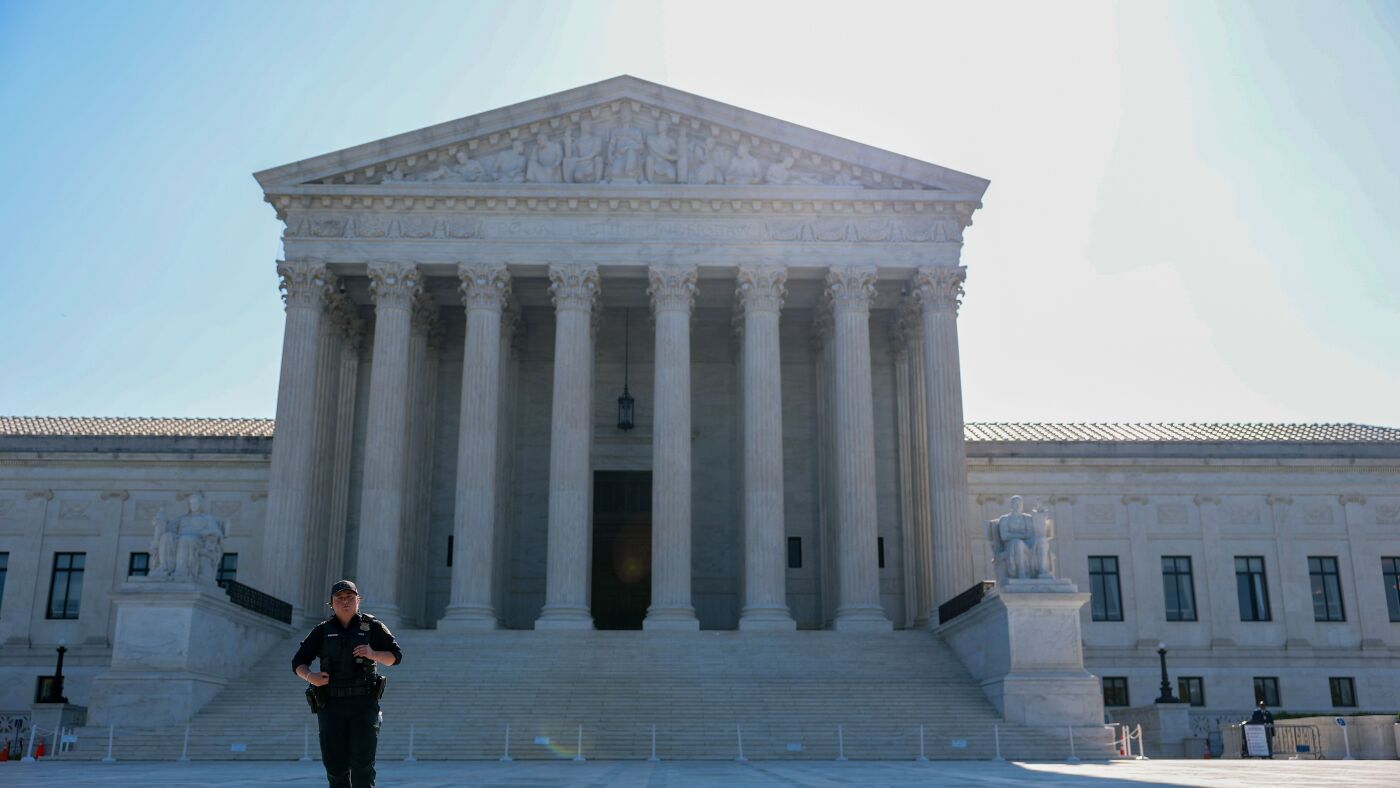
The U.S. Supreme Court
Tasos Katopodis/Getty Images
hide caption
toggle caption
Tasos Katopodis/Getty Images
The Supreme Court Tuesday upheld the long-established right of children born on U.S. soil to automatic American citizenship, regardless of their parents’ immigration status. In so doing, the court rejected President Trump’s most aggressive attempt to limit immigration in the United States.
Writing for the court majority, Chief Justice John Roberts traced birthright citizenship back to the founding of the nation. Just as the colonists demanded “the rights of Englishmen” more than 250 years ago, he said, Congress, after the Civil War, amended the Constitution to specify automatic citizenship for any child born on U.S. soil.
“Citizenship then and now was the right to have rights”—and the framers of the 14th amendment extended that promise to every free born person in this land. He concluded: “We keep that promise today.”
The vote was 6-to-3, depending on how you count it. Altogether, five justices signed on to the Roberts’ majority opinion. A sixth, Justice Brett Kavanaugh, agreed only that federal legislation enacted in the 1950s grants automatic citizenship for children born in the U.S.
Justice Clarence Thomas wrote the lead dissent, a 91-page opus that agreed with Trump’s assertion that the 14th amendment only applied to former slaves and their descendants. The Thomas dissent added ominously that he “was not sure that “today’s opinion will stand the test of time.” The dissent was joined by Justice Neil Gorsuch, with Justice Samuel Alito writing a separate dissent.
Justice Ketanji Brown Jackson, who, like Thomas is African American, responded to some of the themes in the Thomas dissent.
“Despite his longstanding endorsement of a colorblind society,” she wrote, “Justice Thomas now surprisingly suggests that the citizenship clause was a race-conscious remedial measure relating only to freed slaves.”
Cecillia Wang, legal director of the ACLU, who successfully argued the case at the Supreme Court, said President’s Trump failed attempt to limit birthright citizenship was transparent.
“A majority of the court saw through what the president was trying to do in spinning birthright citizenship as something that can flex and retract and expand depending on what the administration in power thinks about immigration policy,” she said.
Wang sees birthright citizenship as “much more fundamental than that.”
“It is part of how our country rejected caste distinctions and championed freedom and equality,” she said.
Yale law professor Akhil Amar called the court’s opinion a classic example of the court sticking to the original meaning of the Constitution. The text of the 14th Amendment, he said, “is about the child. It doesn’t say anything about parents.”
University of Virginia law professor Amanda Frost, however, was surprised and saddened that the court was so closely divided.
“The very length of the opinion,” she told NPR, plus “the fact that you had four justices say the Constitution does not require near universal birthright citizenship, which had been the understanding, that suggests that this is a fringe argument that the Trump administration has succeeded in moving into the mainstream, even though it has not succeeded in the end of the result.”
The issues in the birthright case focused in large part on the longstanding, and as of Tuesday, still standing, meaning of the 14th Amendment, which was enacted after the Civil War. It guarantees birthright citizenship to almost all persons born or naturalized in the United States. Chief Justice Roberts pointedly said the only exceptions written into the amendment were for certain Indian tribes, which were not subject to the laws of the United States at the time, and the children of foreign diplomats. That understanding was so well accepted that even in World War II, when Japanese citizens were confined to internment camps, their children, born in those camps, were automatically deemed to be American Citizens.
The Supreme Court’s decision Tuesday was the second time the justices have upheld birthright citizenship. The court’s previous decision came in 1898 in the case of Wong Kim Ark, born in the U.S. to Chinese parents. His great grandson, Norman Wong, issued a statement today saying, “My great grandfather, Wong Kim Ark, never set out to become a symbol. He was one man, only a cook, and yet he stood up for what was right, and I believe that it has made a difference. As a result, he stood up for the rights of all of us Americans – it just so happens that I am related to him. Today’s ruling shows that his victory remains as important now as it was in 1898.”
The high court also issued opinions in two other cases on Tuesday. In a 6-to-3, ideologically divided vote, the court upheld state laws that prevent transgender athletes from playing on women’s sports teams. Writing for the conservative majority, Justice Brett Kavanaugh said that the laws violate neither federal statutes nor the 14th Amendment. States, he said, have a legitimate interest in protecting the safety of sports, which he suggested could be compromised if transgender girls or women are allowed to play on female teams. Similarly, he said transgender athletes could also compromise fairness in athletic competition.
Sitting in the court chambers Tuesday when Kavanaugh summarized his opinion were not only his wife and mother, but his two daughters, whose athletic teams their father has long coached.
Justice Sonia Sotomayor, joined by her liberal colleagues, issued a partial dissent. She agreed with the majority that the benefits of sports are “immense,” but she wrote that these laws unconstitutionally deny transgender athletes the opportunity to play with their peers.
In a third ideologically divided case Tuesday, the Court struck down decades-long limits on the amount of money political parties can spend on candidates. The limits were challenged by the Republican National Committee. The decision may well increase by millions of dollars the amount of money that will pour into campaigns.

Rep. Thomas Kean Jr., R-N.J., arrives at the U.S. Capitol with his wife Rhonda Kean on June 30.
Anna Moneymaker/Getty Images
hide caption
toggle caption
Anna Moneymaker/Getty Images
New Jersey Republican Thomas Kean Jr. said it was struggles with depression that kept him away from Congress for nearly four months with no explanation to his constituents.
Kean last voted on March 5th, missing numerous votes and other appearances on Capitol Hill since. In April, House Speaker Mike Johnson told reporters he had spoken to Kean and that he was dealing with an undisclosed medical issue. Kean was not spotted until recently at his New Jersey home.
Speaking from the House floor on Tuesday, the second term lawmaker said he had checked into a hospital for testing several months ago after health concerns, and was subsequently diagnosed with depression.
“Talking about myself has never come naturally,” Kean said. “But I believe that I owe an explanation to the people of New Jersey’s seventh district, to my colleagues in this chamber and to the American people for my absence.”
Kean said he originally did not think his diagnosis would result in a long-term absence. Doctors recommended he remain in the hospital to address the illness, and it was his fastest route to recovery, he said.
“It is physical. It is emotional,” he said. “And until you experience it yourself, it is difficult to fully understand how powerful this illness could be.”
Kean said he miscalculated how long he would be away, estimating it would be a matter of weeks. However, he said like the roughly 48 million Americans who have battled the illness, he learned there is no timeline for recovery.
“I am grateful that I accepted help,” Kean said. “Today I stand before you healthier, stronger and excited to return to the work that I love.”
Kean’s absence proved a struggle for House Republicans, who contend with a razor thin majority to pass party priorities. For weeks, Kean and his office declined to share additional details on why he was away, feeding rumors and speculation and raising interest in a member known for his privacy.
Despite his absence, Kean won the GOP primary earlier this month to defend his seat in Congress in this fall’s midterm elections. He will face Democrat Rebecca Bennett, a former U.S. Navy helicopter pilot and healthcare executive.
Bennett has targeted Kean’s absence in her campaign. Democrats have said Kean’s 7th congressional district is a top target to flip in their pursuit of taking back the majority.
“Tom Kean Junior, wherever you are, you have failed this district,” Bennett told supporters at an event last week.
In a statement after Kean’s remarks on Tuesday, Bennett said she was relieved he was well and wished him good health.
“But let’s be clear: I got into this race because Tom Kean Jr. was failing our community long before this absence,” she said.
Kean is not the first member of Congress in recent years to speak publicly about their struggles with depression. Sen. John Fetterman, D-Pa., took leave from the Capitol in 2023 after he was diagnosed with the illness. In Fetterman’s case, his office announced the news within days of his starting treatment.
Kean was elected to Congress for his first term beginning in 2023, flipping a district that was represented by former Democratic Congressman Tom Malinowski.
He comes from a long line of politicians: His father, former New Jersey Gov. Thomas Kean Sr., was appointed by former President George W. Bush as a chair of the 9/11 Commission. Kean’s grandfather and great grandfather also served in Congress.

Members of the National Guard stand in front of a large image of U.S. President Donald Trump that hangs from the the Robert F. Kennedy Department of Justice Building on May 18, 2026 in Washington, D.C.
Andrew Harnik/Getty Images North America
hide caption
toggle caption
Andrew Harnik/Getty Images North America
WASHINGTON, D.C. — In a strongly worded letter to the head of Michigan’s National Guard, Gov. Gretchen Whitmer reiterated troops from her state are only to be used for operations surrounding America 250 celebrations in Washington, D.C., and not for President Trump’s long-running — and controversial — joint task force to fight crime. She said that she would pull her troops from the city if that is not the case, in the letter obtained by NPR.
“Please take all necessary measures to ensure the Michigan National Guard is only supporting the narrow and limited America 250 Mission and is in no way supporting the D.C. Safe and Beautiful Mission,” wrote Gov. Whitmer, referencing the official name for the federal task force.
Trump deployed hundreds of troops to Washington, D.C., in August of 2025, in what experts said was a stunning departure from governing norms. He said he did so to address rampant crime, despite declining crime rates at the time. The number of troops in the city has increased over time to more than 4,800 from Washington, D.C. and almost two dozen states, which until recently were exclusively Republican-led.
Michigan — which has 161 guard members currently in the city — is one of four Democratic-led states that sent members of their National Guard to D.C. in recent weeks, ahead of an influx of tourists for America 250 celebrations. North Carolina and Kentucky each sent one member of their guard, while Minnesota sent more than a hundred last week.
Kentucky confirmed to NPR Monday that it had recalled its one guard member over the weekend, after that member was “diverted to the task force by the federal government without the knowledge or consent of Gov. Beshear of the Kentucky Guard,” Scottie Ellis, a spokesperson for Gov. Beshear, wrote to NPR in an email.
When contacted by NPR, spokespeople for each respective Democratic governor’s office made it clear that their guard members were sent to help specifically with America 250, not for law enforcement purposes as part of the larger ongoing federal joint task force operation. All four states have been clear about their opposition to the Trump administration’s ongoing deployment of National Guard troops to D.C., filing an amicus brief in support of litigation challenging it as recently as May.
But in recent days, a video of troops identifying themselves as Michigan National Guard members patrolling the Georgetown waterfront — an upscale neighborhood more than a mile away from any official America 250 celebrations — began circulating on social media. NPR has authenticated the video. Whitmer’s office did not immediately respond to NPR’s request to verify that the troops were Michigan members.
All state guard members are currently in D.C. under Title 32 status, which essentially means that the federal government pays for the deployment, but the state governors maintain control and command of their troops. But former National Guard officials say it’s impractical for states to play a role in day-to-day activities in a complex national mission like what’s happening in D.C.
“If the National Guard has defined the America 250 Mission to extend beyond direct support for events celebrating the nation’s 250th anniversary, please let me know so we can ensure the Michigan National Guard’s efforts are carefully limited,” Gov. Whitmer’s letter reads.
It goes on to say that if that can’t be ensured, then Gov. Whitmer will “end Michigan’s support for the America 250 mission.”
Legal experts, like those at the Brennan Center for Justice who have closely been watching Trump’s ongoing deployment to D.C., worry that drawing a distinction between the America 250 celebration and the general mission of the joint task force in the city will prove difficult. The joint task force is largely carrying out high visibility presence patrols in residential neighborhoods, public parks and metro stations.
Troops from all four Democratic-led states are listed as part of the official federal joint task force numbers released to the public. Gov. Whitmer said the Michigan troops should not be included in that count.
The offices for other Democratic governors NPR reached out to about that list also said their guard members shouldn’t be included.
When asked about the confusion, a spokesperson for the joint task force told NPR that it is overseeing all guard members in D.C. for organizational purposes, but being on the list “does not change their specific mission.” The joint task force did not immediately respond to NPR’s request for comment as to why Michigan guard members were apparently in Georgetown, and if that was part of the America 250 operations.
-

 Lifestyle3 minutes ago
ICICLE: Capturing Interest in Chinese Brands
-
 Politics10 minutes ago
Newsom signs off on 100% California tax for money from Trump’s $1.8-billion ‘slush fund’
-
 Science13 minutes ago
After bold pledge, EPA shelves microplastics testing in U.S. drinking water
-
 Sports18 minutes ago
Walter Alston, Dave Roberts and everyone in between: The 10 managers in L.A. Dodgers history
-

 World28 minutes ago
World’s oceans experience hottest June ever, scientists say more heat ahead
-
News55 minutes ago
What the Supreme Court did on the final day of its term
-

 Los Angeles, Ca2 hours ago
Los Angeles County man convicted of sex trafficking, abusing woman he was dating
-

 Detroit, MI3 hours ago
Detroit Tigers tee off on New York Yankees with 5 homers in win

