Entertainment
After Blackpink, a new crop of Korean artists take on Coachella


This time last year, the five members of the K-pop group Le Sserafim were glued to the Coachella Valley Music and Arts Festival livestream on YouTube, watching Blackpink make history as the first Korean headliner. On Saturday afternoon, they were getting glammed up in an artist trailer all their own, hours out from making their own Coachella debut.
“Coachella was something I could hardly dream of coming to, even as a spectator,” said Huh Yunjin, of the groundbreaking HYBE girl group. “We’ve watched performances like Blackpink and Billie Eilish online and were like, ‘It’d be so amazing to stand on a stage like this one day.’ ”
“It’s a very famous festival in Korea as well,” added Kim Chaewon, through a translator. “For a lot of artists there, it’s a dream opportunity.”
This year, that opportunity arrived for a whole new generation of Korean acts. After Blackpink’s fast ascent from newcomer to top-billed act, Coachella is already cultivating its next generation of K-pop and South Korean music more broadly. Genres always wax and wane at the fest, with classic rock and EDM giving way to rap and pop. But it looks like South Korean music is a new core element for the fest.
On Friday night the K-pop group Ateez — already an arena act in the U.S. — put on an explosive set to an audience where many were likely seeing them live for the first time. The eight-piece group’s core fandom could barely believe their luck to be able to see them so close.
“When I was training, I really looked forward to this kind of big festival,” said Ateez’s captain Kim Hongjoong, in full goth-glam regalia backstage just a couple hours before his band’s Sahara Tent set. “Coachella has a lot of iconic stages, and Korean fans really love to see Beyoncé, the Weeknd, and Blackpink perform here. I think our performance style really fits at this huge festival. I’ve waited a long time for this.”
The group left it all on the stage on Friday — singing, rapping and dancing with a ferocity and skill that showed the work they put in to get here. Who knows if they’ll get to headline one day, but now there’s proof it’s possible, and Ateez is leading a new class of Korean acts working toward it.
“We really love to perform for our fans, of course, but we’re also curious about how other audiences hear our music,” Hongjoong said. “Today’s a new experience that’s so important to us.”
For Kim Woosung, the singer of the Korean rock band the Rose, Coachella is close enough to a hometown show — he spent much of his childhood in the Valley here.
“I personally always loved Coachella,” Woosung said. “Performing here was always a goal for us, after our first international festival run we left so inspired by the vibe. It’s a dream to be here on stage just one year later.”
The Rose’s sound leans more toward the richly detailed, expansive rock of groups like U2 and the 1975 — singles like “Back to Me” and “You’re Beautiful” howl and soar on their own terms, and brought the group to the Forum in Inglewood last year. Woosung recently teamed up with BTS’ Suga and the late Ryuichi Sakamoto on the song “Snooze.” A magic-hour Sunday set on the Outdoor stage will be a showpiece for non-K-pop Korean music to resonate with new rocker crowds from Woosung’s old hometown.
“We are proud to represent Korea in listeners’ personal journeys in music,” said the band’s bassist Lee Jaehyeong. “We have so many artists from different lands and styles that we want to watch this year as fans again.”
The range of Korean music at Coachella spans even wider — the longtime Goldenvoice affiliates in 88 Rising have a Mojave Tent set, “Futures,” devoted to emerging pan-Asian talent that has often included Korean acts. South Korean DJ and producer Peggy Gou found her own success in underground club music, fully outside any Korean pop apparatus (she’s more of a late-night Berlin type). Her own set Friday in the Sahara was packed out after her single “(It Goes Like) Nanana” became a smash on TikTok. Gou’s become an in-demand fashion model, and with her debut LP, “I Hear You,” is en route to becoming one of house music’s big crossover success stories.
On Saturday night, Le Sserafim made a strong claim to its own long future at Coachella. Dressed in custom Nicolas Ghesquière leather, the group played heated Afro-Latin tracks like “Antifragile” and brought out Chic legend Nile Rodgers for their collaboration “Unforgiven” — a strong endorsement from a guy that previous Sahara Tent legends Daft Punk and Avicii have looked up to.
“We only met him in person for the first time yesterday,” Yunjin said (she grew up partly in New York and long admired his productions). “It was absolutely crazy to work with him. He taught us that when you collaborate, you never want to take away from that person. You always want to add. There are so many acts that came before us that we have so much gratitude for.”
The group’s music is unusually candid and bristling about the pressures for perfection young women face in K-pop — a sentiment many young fans relate to. The group formed in 2022, but to judge by the slammed Sahara Tent for the set, SoCal will be seeing much more of Le Sserafim soon.
“After this, we really want to go the beach in Santa Monica,” Yunjin said. “And we hear L.A. has a pretty great K-town.”


Arts
Mother Mary
Director: David Lowery
A24, Topic Studios, Access Entertainment
In Theaters: 04.24.2026
“Hail Mary, full of grace, the Lord is with thee,” or whatever the fuck those silly little Catholics say. With David Lowery’s ninth feature, our dear Mother Mary is anything but full of grace. Though she is full of something … g-g-g-GHOSTS!
Mother Mary follows a distraught pop star (take a wild guess at her name), played by the always lovely Anne Hathaway (The Princess Diaries, The Devil Wears Prada), who dramatically ends up on the doorstep of her ex-best friend and costume designer, Sam Anselm (Michaela Coel, Chewing Gum, Black Mirror). She confesses to Sam, after barging her way into her secluded design studio, that she needs a dress that feels like “her.” This is something she feels her current team of designers can’t do and is very important, as she’s performing a new unreleased song to celebrate her comeback. During the creation of the gown, the two women reminisce and catch up, all in the same haunted breath. During their heart-to-heart (pun intended), they both realize that at some point since their separation, they each have been taking turns experiencing a haunting by the red, shapeless form of a (what they both determine is at least female) “ghost.”
Now, not to sound like a broken record, kids, but what is my favorite saying? That’s right, “there are no perfect movies,” and Mother Mary is an example of a very complicated and imperfectly okay movie. Lowery’s writing is, at times, far too abstract or obtuse, which can lead to quite a bit of confusion for about 100 of the film’s 112-minute runtime. Before it’s clarified, the relationship between the two female leads is hard to decipher. Are they best friends, former lesbian lovers or a secret, worse, third option? Does this red ghost actually have anything to do with unresolved feelings these women still have for each other, or is it just aesthetic?
There are also interesting “visions” Sam gets when talking things through with Mother Mary that feel somewhat like they tangle the film’s overall seam. It also lacks a lot of raw edges you would normally see when two women discuss a “friendship break-up.” Mary Mother also has yet to break the curse of the inaccurate on-screen popstar portrayal. I’m not sure why, but for some reason, Hollywood cannot get the feel of a popstar just quite right on screen. Mother Mary is supposed to be Lady Gaga, yet it feels like her on-stage scenes are what dads imagined watching Hannah Montana must’ve looked and felt like to their daughters. This is something that seems unfathomable when you have Jack Antonoff and Charli XCX to help write the soundtrack.
That being said, once the ending hits you in the face and you finally get the full picture that Lowery is painting, the film saves itself. Lowery does something interesting and unique when it comes to the haunting genre of horror, as his characters are not haunted by ghouls and goblins but by emotional moments or memories in time. This is something that, when done right, is the epitome of beauty and is frankly more terrifying than any jumpscare by a James Wan demon. What’s more haunting than the what-ifs and what-could-have-beens of an intense connection with another human being, romantic or platonic? What’s more punishing than being the one who committed the sin that severed your red thread connection? Lowery also puts the infamous Bechdel Test to shame, as there is not a single male character with dialogue for the entirety of the film.
Do I love what Lowery is trying to do here? Yes. Does he stumble and fumble along the way? Absolutely. I’m not saying that you shouldn’t see Mother Mary, but also if you miss it … you’re not missing much. —Yonni Uribe
Read more film reviews by Yonni Uribe:
Wasatch Mountain Film Festival Review: Protecting Our Playground
Film Review: The Drama
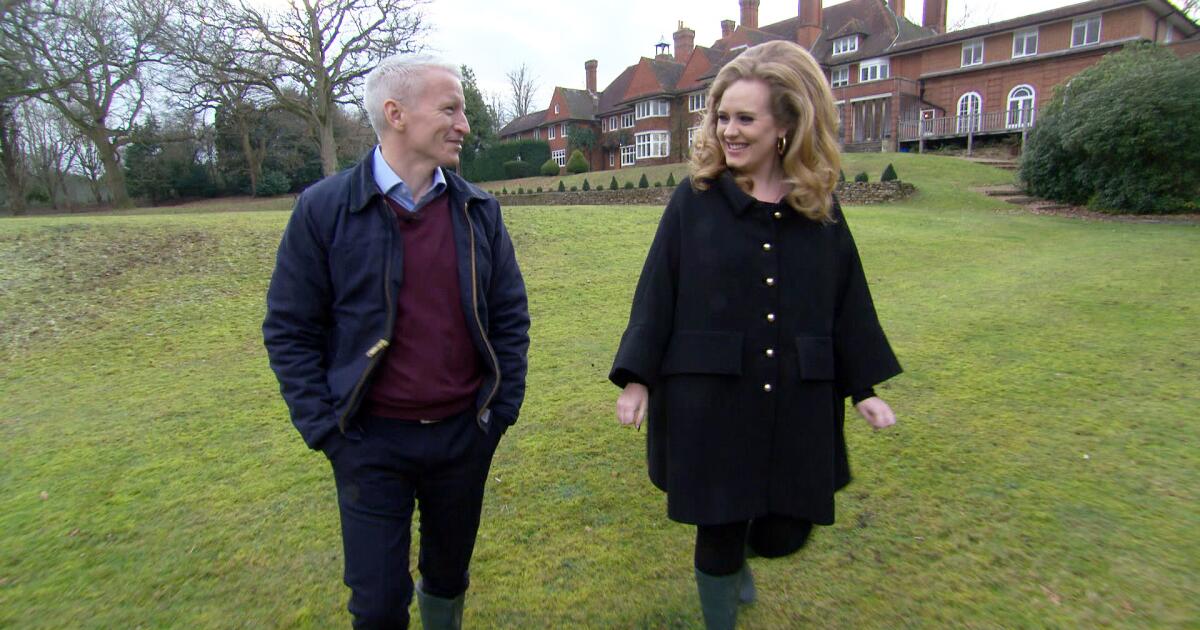
Anderson Cooper has signed off from “60 Minutes” for the last time.
After two decades as a correspondent on the CBS’ news magazine, he officially ended his run Sunday night.
Cooper, who also hosts a news program on CNN, announced in February his plans to leave CBS, months after an internal shake-up that followed the arrival of editor-in-chief, Bari Weiss.
“Things can always evolve and change, and I think that’s awesome, and things should evolve and change, but I hope the core of what ’60 Minutes’ is always remains,” Anderson said on-air. “I think the independence of ’60 Minutes’ has been critical.”
Throughout the farewell segment, the 58-year-old journalist, who was hired in 2007, reminisced about some career highlights, like speaking with Holocaust survivors and people battling malnutrition in Niger, as well as interviewing A-listers like Lady Gaga and Prince Harry. He also said he hopes the show continues to be a reliable source of investigative journalism.
“I think the trust it has with viewers is critical to the success of ’60 Minutes.’ When you see a ’60 Minutes’ story, and you’re like, ‘That was a really good story.’ It was a good story because it requires time, it requires patience, it requires money,” he said. “I hope that’s known and honored and valued and continues.”
His departure comes at an uncharted time for CBS, as the company undergoes several leadership changes. Last year, billionaire David Ellison successfully merged his company, Skydance Media, with Paramount, CBS’s parent company. Soon after, Ellison hired Bari Weiss as CBS News editor-in-chief.
Two months after taking on the new role, Weiss made the widely panned decision to pull a “60 Minutes” episode that examined the alleged abuse of deportees sent from the U.S. to an El Salvador prison. The decision earned Weiss heavy criticism and accusations that the move was politically motivated, which CBS has denied.
Cooper said that he’s leaving the program to spend more time with his young children. He will remain as an anchor for CNN.
He added, “I hope ’60 Minutes’ is around for when my kids grow up and have kids of their own, and they can watch it with their kids.”

3.5/5 stars
The American filmmaker started his career with 1994’s Little Odessa, starring Tim Roth as a Russian-Jewish hitman operating in the Brighton Beach area of New York. His next two films, The Yards (2000) and We Own the Night (2007), kept him ensconced in the world of low-life criminals.
Paper Tiger also casts the Russian mob as the antagonists. Set in 1986 in Queens, New York, it stars Miles Teller and Adam Driver as the Pearl brothers, Irwin and Gary.
Irwin (Teller), an engineer, is married to Hester (Scarlett Johansson) and has two teenage sons: Scott (Gavin Goudey), who is about to turn 18, and the younger Ben (Roman Engel), who is diligently studying for his exams.
Gary (Driver), a former policeman who still has connections on the force, encourages Irwin to team up and create an environmental clean-up business involving the filthy Gowanus Canal.
-

 Ohio4 minutes ago
Woman dies after Monday morning crash in Columbiana County
-
 Oklahoma10 minutes ago
Scotfest Oklahoma returns in 2026, will be final event for historic festival
-

 Oregon16 minutes ago
Marion County sheriff releases sex offender information under Oregon public safety law
-

 Rhode Island28 minutes ago
Rhode Island Philharmonic Orchestra announces 2026 Summer Pops schedule
-

 South-Carolina34 minutes ago
Commentary: Echoes of yesterday in today’s SC redistricting debate
-

 South Dakota40 minutes ago
Eastern South Dakota farmer finishes planting ahead of schedule – Brownfield Ag News
-

 Tennessee46 minutes ago
18 officer-involved shooting cases statewide so far in 2026, per TBI
-

 Texas52 minutes ago
Target is remodeling stores in Texas. See which ones

