South
Alaskan community rebuilds while grappling with fatal landslide's impact

- A landslide struck Wrangell Island last November in southeast Alaska, killing six people, including a family of five.
- Wrangell’s community is slowly returning to normalcy with the upcoming tourism and seafood processing seasons.
- Alaska faces the threat of additional landslides due to an increase in intense rain.
Jamie Roberts and her husband felt lucky when they found an A-frame cabin on forest-draped Wrangell Island in southeast Alaska, where they could settle on a few acres and have some chickens.
A stretch of highway a few miles north, the only road into town, did make her nervous; there, waterfalls cascaded and rocks tumbled from towering bluffs on stormy days. But she always felt safe at her home of more than 20 years.
That all changed the night of Nov. 20 after heavy rains, when a torrent of earth and trees rushed down a mountainside next to their home, cutting a swath to the sea. It killed six people, including a family of five; demolished two houses; and buried the highway.
DEATH TOLL IN ALASKA LANDSLIDE CLIMBS TO 3; 3 OTHERS STILL MISSING
The landslide lacked the scale of one that erased a neighborhood in Oso, Washington, 10 years ago this Friday. But it, too, left a community unmoored, wondering whether the dramatic landscape above was as permanent as it once seemed.
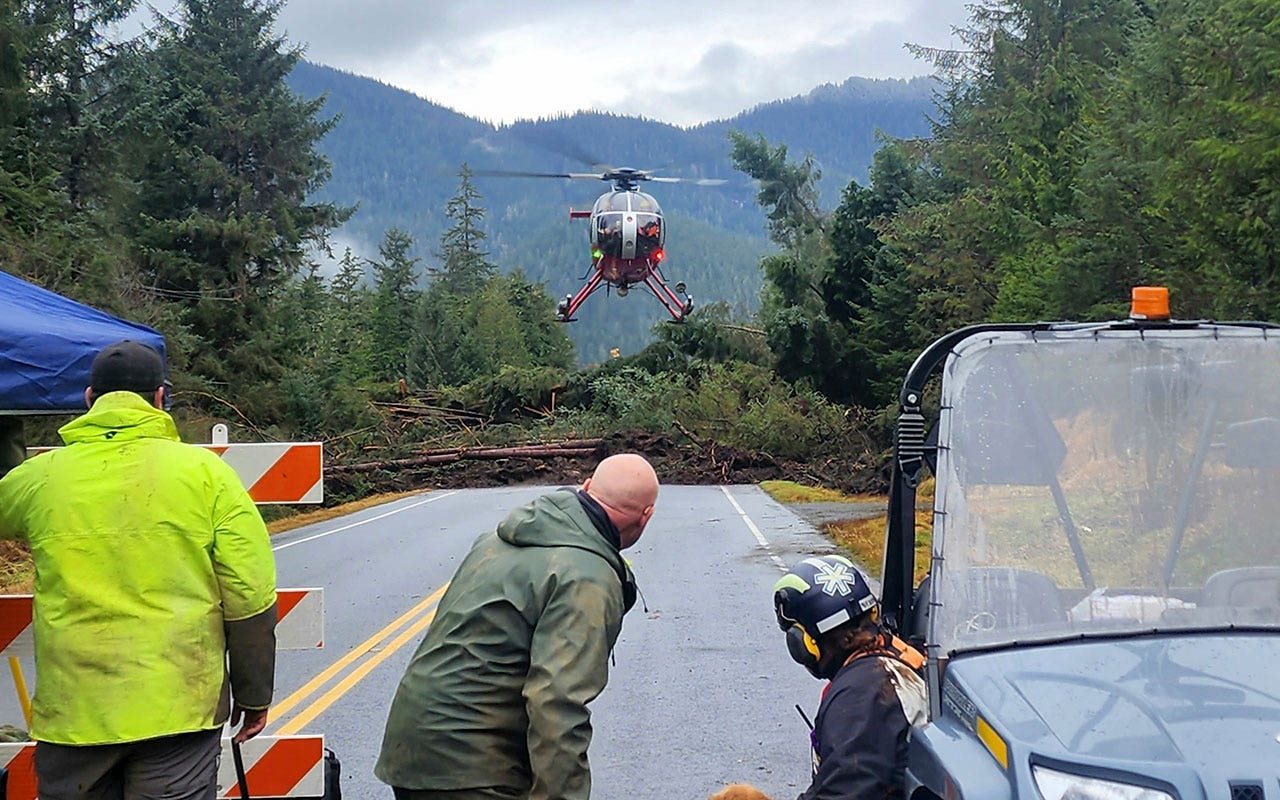
This photo shows a helicopter arriving near the Zimovia Highway where ground teams, including search and rescue dogs, actively searched following a fatal landslide on Nov. 22, 2023. Last November, a landslide struck Wrangell Island in southeast Alaska, killing six people, including a family of five. (Willis Walunga/Division of Homeland Security and Emergency Management via AP, File)
Roberts and her family have moved from their home and only returned for brief visits.
“I don’t know that we’d ever sleep very well going back there,” she said.
In some ways, life in Wrangell, a former logging town, is returning to normal. The summer tourism and seafood processing seasons are approaching, and the boys’ varsity basketball team this month competed at state. The highway has been rebuilt.
But trees and other debris still dotted the tidelands and lower portions of the snow-covered scar on a recent day.
That scar is visible from the driveway of Stephen Todd’s waterfront home. Todd, his wife and their dog, Festus, moved back last month after staying closer to town after the slide.
“There were no signs of instability” on that slope before, said Todd, a biologist. “I mean, it’s steep country, but every place is steep country in southeast Alaska.” He and his wife won’t stay in their home when the forecast calls for intense rain.
Rain is a part of life in the region, most of which is nestled in the Tongass National Forest, a temperate rainforest. Communities have long co-existed with landslide risks: In Alaska’s capital, Juneau, the downtown core and tourist district are built into or are at the base of mountains. Thousands of landslides have been documented in the Tongass, though relatively few have been fatal.
But as the climate continues to warm, intense rains are expected to become more frequent in the region and other parts of the West Coast, heightening landslide risk. Researchers have blamed atmospheric rivers for landslides in southeast Alaska that killed three people in Sitka in 2015 and two in Haines in 2020.
After the Wrangell landslide, the state set up a drone operation and weather instruments on Roberts’ property to help officials identify warning signs. A second weather station is planned for the ridgeline above.
State and federal agencies hope to see more high-elevation weather stations installed in the region. The National Weather Service would like to use soil analyses from geologists to better understand how much rain it takes to increase a community’s landslide risk and incorporate that into weather alerts, said senior hydrologist Aaron Jacobs. But the work is intensive, and pulling it together will likely take years.
Wrangell is considering an online dashboard for residents that would use weather data to broadly assess landslide risk, similar to one developed after the Sitka slide, said Mason Villarma, Wrangell’s interim borough manager. Most of Wrangell’s roughly 2,040 people live on the north end of the island. But many homes farther out, along the highway, are built on slopes.
“We can’t tell people whether their property is safe or not. We want to definitely provide them the tools to make good decisions,” Villarma said.
Killed in November were Timothy and Beth Heller, along with their daughters Mara, 16, and Kara, 11. Their son Derek, 12, has not been found. Otto Florschutz, a neighbor, also died. His wife, Christina, survived.
Roberts, who coached Kara and Derek’s swim club, plans to participate in a race Kara wanted to do, in her honor. The club celebrated what would have been Derek’s 13th birthday recently with 13 laps, cupcakes and belly flops — things he would have loved, she said.
FIFTH PERSON CONFIRMED DEAD IN ALASKA LANDSLIDE; 1 STILL MISSING
For a long time, the sound of planes overhead upset Roberts: She thought the noise of the landslide was a jet that was about to crash. Until recently, she would close her eyes or bow her head to avoid seeing the scar on brief visits home to gather personal items.
The family moved four times in the days after the landslide. They need to be out of their current rental by April 1 but haven’t been able to find another house on the island they can afford. They anticipate having to sell their home and move out of state later this year.
Roberts has mixed feelings about selling. She’d be devastated if another family bought the home, only to suffer tragedy.
“Now I’m at the phase where I’m like, ‘It’s not fair,’” she said. “But we get to make the choice of what comes next. And other people didn’t.”

The Georgia Lottery offers multiple draw games for those aiming to win big.
Here’s a look at June 26, 2026, results for each game:
Winning Mega Millions numbers from June 26 drawing
05-13-30-33-52, Mega Ball: 06
Check Mega Millions payouts and previous drawings here.
Winning Cash 3 numbers from June 26 drawing
Midday: 7-6-1
Evening: 1-7-2
Night: 9-5-1
Check Cash 3 payouts and previous drawings here.
Winning Cash 4 numbers from June 26 drawing
Midday: 7-6-2-5
Evening: 4-9-1-9
Night: 4-9-1-1
Check Cash 4 payouts and previous drawings here.
Winning Cash Pop numbers from June 26 drawing
Early Bird: 08
Matinee: 03
Drive Time: 02
Primetime: 13
Night Owl: 14
Check Cash Pop payouts and previous drawings here.
Winning Georgia FIVE numbers from June 26 drawing
Midday: 1-5-9-6-1
Evening: 5-7-0-9-0
Check Georgia FIVE payouts and previous drawings here.
Winning Fantasy 5 numbers from June 26 drawing
03-13-14-16-41
Check Fantasy 5 payouts and previous drawings here.
Winning Millionaire for Life numbers from June 26 drawing
07-15-33-37-51, Bonus: 02
Check Millionaire for Life payouts and previous drawings here.
Feeling lucky? Explore the latest lottery news & results
Are you a winner? Here’s how to claim your prize
- Prizes under $601: Can be claimed at any Georgia Lottery retail location. ALL PRIZES can be claimed by mail to: Georgia Lottery Corporation, P.O. Box 56966, Atlanta, GA 30343.
- Prizes over $600: Must be claimed at Georgia Lottery Headquarters or any Georgia Lottery district office or mailed to the Georgia Lottery for payment.
When are the Georgia Lottery drawings held?
- Powerball: 10:59 p.m. ET on Monday, Wednesday, and Saturday.
- Mega Millions: 11 p.m. ET on Tuesday and Friday.
- Cash 3 (Midday): 12:29 p.m. ET daily.
- Cash 3 (Evening): 6:59 p.m. ET daily.
- Cash 3 (Night): 11:34 p.m. ET daily.
- Cash 4 (Midday): 12:29 p.m. ET daily.
- Cash 4 (Evening): 6:59 p.m. ET daily.
- Cash 4 (Night): 11:34 p.m. ET daily.
- Cash Pop (Early Bird): 8 a.m. ET daily.
- Cash Pop (Matinee): 1 p.m. ET daily.
- Cash Pop (Drive Time): 5 p.m. ET daily.
- Cash Pop (Primetime): 8 p.m. ET daily.
- Cash Pop (Night Owl): 11:59 p.m. ET daily.
- Georgia FIVE (Midday): 12:29 p.m. ET daily.
- Georgia FIVE (Evening): 6:59 p.m. ET daily.
- Fantasy 5: 11:34 p.m. ET daily.
- Jumbo Bucks Lotto: 11 p.m. ET on Monday and Thursday.
- Millionaire for Life: 11:15 p.m. ET daily.
This results page was generated automatically using information from TinBu and a template written and reviewed by a Georgia editor. You can send feedback using this form.

Beechwood senior wide receiver Tyler Fryman has committed to University of Kentucky football and baseball according to Hayes Fawcett of Rivals.
Fryman made the change to the Wildcats on June 26, just three days after announcing he was decommitting from Louisville Cardinals baseball. Fryman had been committed to Louisville since 2023.
The four-star recruit took an official visit to Kentucky on June 19. A week later, he’s flipped his school and added a new sport.
For Beechwood last season, Fryman caught 62 passes for 1,320 yards and 23 touchdowns. He was also the 9th Region Player of the Year in baseball and an indoor track state champion.
Fryman also had football offers from Cincinnati, Notre Dame and Ole Miss among others.

ALEXANDRIA, La. (KALB) – After being hired as the new head coach of the Southern Jaguars, Marshall Faulk made the trip to Central Louisiana to help promote his program.
“These are my eyes for the talent in this area,” Faulk told KALB. “We’re aggressive about recruiting the State of Louisiana, and so when there’s good talent and players coming up here, hanging out with some of the people that I know.”
Southern is Faulk’s first head coaching job after spending last season as an assistant at Colorado.
“I’ve done a lot of stuff in the states that I’ve lived,” Faulk said. “Being born here, I hadn’t done a lot around helping youth sports and helping kids in this environment. I’ve got a lot of information and education around football and things that I can give, and this is a great opportunity to give back.”
The Jaguars only won two games in 2025, but are just two years removed from a SWAC Championship Game appearance.

“Just the guys learning how to practice their willingness to learn,” Faulk said on the traits he’s seen thus far from his team. “They’re wanting their desire to get better, and that’s all you want.”
Southern opens up their season on August 29 against Alabama State at the Birmingham Football Classic.
Click here to report a typo. Please provide the title of the article in your email.
Copyright 2026 KALB. All rights reserved.
-
Georgia6 minutes ago
Georgia Lottery Mega Millions, Cash 3 results for June 26, 2026
-

 Hawaii9 minutes ago
Police recover 19 gaming machines, $7K in Kakaako gambling bust
-

 Idaho14 minutes ago
The reactor race has begun
-

 Illinois21 minutes ago
New Illinois bill aims to overhaul public defense system | The Chicago Report
-

 Indiana24 minutes ago
Driver airlifted after NW Indiana police chase ends with crash into tree
-

 Iowa29 minutes ago
Vote: Class 1A Iowa High School Softball Midseason Player Of The Year
-

 Kansas36 minutes ago
Salina Stars Unite for Final High School Stage at Kansas Shrine Bowl
-

 Kentucky39 minutes ago
Beechwood’s Tyler Fryman commits to the Kentucky Wildcats

