Sports
Prominent MLB team physician sounds alarm on pitching injuries


One of the game’s leading orthopedic surgeons is sounding an alarm on pitching injuries — and citing the advent of the sweeper and power changeup as significant reasons for the spike.
Dr. Keith Meister, the Texas Rangers’ head team physician, said teams are exacerbating the problem by emphasizing pitchers’ performance over their availability.
“These front offices, unfortunately, are living more in the moment than taking a longer, broader-term view,” Meister said. “There is a way to manage this. What if a guy doesn’t have a WHIP (walks and hits per inning pitched) of 0.8. What if he has a WHIP of 1.1 but he’s able to play 162?”
Meister, who pioneered the hybrid elbow procedure that combines a traditional ligament reconstruction with the addition of an internal brace, said surgical techniques changed markedly over the past decade in response to how pitching evolved.
As teams increased their emphasis on velocity and stuff, injury-list placements for pitchers rose from 241 in 2010 to 552 in 2021 before decreasing slightly each of the past two seasons, according to a Major League Baseball spokesperson. The days pitchers spent on the IL more than doubled over a slightly longer span.
A hyperfocus on performance often begins at the youth level. Many pitchers experience problems before ever reaching the majors. The number of pitchers drafted in the top 10 rounds with a history of elbow reconstruction rose from six between 2011 and 2013 to 24 between 2021 and 2023, the league spokesperson said.
Meister, 62, said he repaired approximately 230 elbow ligaments last year and is “way ahead of that pace” this year. Shohei Ohtani threw more sweepers than anyone in baseball from 2021 to 2023 before undergoing his second major elbow procedure. Of course, pitchers who do not throw sweepers or power changeups also are getting hurt, as evidenced by the mounting injuries this spring.
The Boston Red Sox’s Lucas Giolito might require a second elbow reconstruction. The Houston Astros’ Justin Verlander, New York Mets’ Kodai Senga and Toronto Blue Jays’ Kevin Gausman and Alek Manoah are among those dealing with shoulder issues. The San Francisco Giants’ Sean Hjelle is out with an elbow problem, and Tristan Beck had surgery to remove an aneurysm in his arm.
And that is only a partial list.
“We used to say, you get your one TJ, you’re good. Then it was, you get 10 years out of one. Then it was seven to eight,” Meister said. “Now guys break down in three to five, depending upon who they are, the stuff they have, what they throw.”
The game, then, appears to be teetering on a perilous edge. Pitchers are throwing more breaking balls than ever before. They also are throwing harder than at any point in the sport’s history. Velocity commonly is cited as one of the biggest drivers of pitching injuries. And the sport rewards those who chase it.
“Analytics says velo is super important,” said one pitching coach who was granted anonymity for his candor. “Pitchers and analysts pursue velo. The pitchers that don’t do this retire. The ones that stay take on some injury risk to avoid working at Costco.”
Meister, director of the Texas Metroplex Institute for Sports Medicine, acknowledges the dangers velocity poses. But, he said, “spin is worse.”
The sweeper puts tremendous stress on the inner elbow, Meister said. The power “movement” changeup, as Meister calls it, also puts inordinate strain on the arm. “And to throw these pitches,” he said, “you have to squeeze the crap out of the baseball.”
Years ago, Meister recalls hearing the late Johnny Sain, a former major-league pitcher and independent-minded pitching coach, say when a pitcher is holding a ball correctly, he should grip it in a way that he could throw a raw egg without breaking it.
Today it’s the opposite, Meister said. Pitchers apply a “death grip” to the ball, essentially pre-loading every muscle in their arms. At release, those muscles acutely lengthen in what is known as an “eccentric contraction.” The result can be almost like a hamstring tearing, affecting different pitchers in different parts of the arm.
“We’re seeing all these tears in the lat and teres, all these tears of the previously reconstructed ligament, a lot more flexor-tendon tears,” Meister said. “I can tell you it is a consequence of predominantly those two pitches — the sweeping slider and these hard movement changeups.”
Over the past three seasons, the percentage of sweepers thrown has increased from 1.3 to 3 to 4.3 percent league-wide, according to Statcast. The Rangers, the team that employs Meister, barely throw the pitch, as reported by the Dallas Morning News. Meister said the current nomenclature to classify pitches actually is insufficient. He photographs his patients’ grips and has seen four or five different grips for both sweepers and changeups.
Shortly before spring training, Meister shared his concerns on a Zoom call with two Major League Baseball executives involved in injury prevention, Kevin Ma and John D’Angelo. The session was part of a study the league is conducting on pitching injuries. The league has conducted approximately 100 interviews, its spokesperson said, from doctors and athletic trainers to independent researchers and college coaches to club executives and former pitchers. Once the study is complete, the league expects to form a task force.
Not everyone in pitching research and coaching agrees with Meister’s belief that spin is more problematic than velocity.
“A sweeper is just a curveball with a different grip,” one pitching coach pointed out, adding that research is divided on the link between grip strength and spin rates. “And guys aren’t screwballing their changeups to get this movement. For both pitches, they are leveraging the seams to get it to move differently.”
Glenn Fleisig, Biomechanics Research Director for the American Sports Medicine Institute, also expressed doubt sweepers are cause for greater concern.
“We have not studied sweepers, per se, in the biomechanics lab, but we have shown in a number of studies that curveballs and sliders are no more stressful than fastballs,” Fleisig said in an email.
“Therefore, I have no reason to believe sweepers are more of an injury risk factor than other breaking pitches or fastballs. The science points to three main injury risk factors — effort (velocity is an indication of this within pitchers), amount of pitching and mechanics.”
The caveat to research from Fleisig and others focusing on the risks of velocity is that at least one study from Driveline Baseball showed that stress on the elbow per mile per hour on the pitch is higher for secondary pitches like changeups and sliders. Thus, a pitcher who throws his slider as hard as his fastball actually will put more stress on his elbow.
It’s perhaps no accident that Jacob deGrom, who throws his slider as hard as some pitchers throw their fastballs, has struggled to stay healthy. The higher the velocity, the greater the risk, no matter which pitch is thrown — and slider velocity around the league has gone up almost two miles per hour since baseball started publicly tracking it in 2007.
Many pitchers, viewing injuries as almost an occupational hazard, barely seem to care. Advances in “stuff” research, which attempts to value movement and velocity separate from results, show that harder breaking balls are better breaking balls, almost across the board. In addition, oft-injured pitchers often sign big contracts based on the quality of the stuff, not their durability. So, who is going to tell a pitcher not to be like deGrom? Who is going to advise one to avoid throwing a slider like Justin Verlander’s low-90s breaking ball?
Tampa Bay Rays president of baseball operations Erik Neander, whose team lost three starting pitchers to season-elbow injuries in 2023, said finding the optimal intersection between performance and availability is a challenge that extends all the way down to youth baseball.
“For the investment in the player and person and the care you pour in, it’s really difficult to see anyone get hurt and lose their opportunity to play,” Neander said. “How to balance that with giving them the best opportunity to compete and succeed at the major-league level, it’s a very difficult balancing act, one we obsess over. We’d love nothing more than to find a better way to do it that also allows them to have success.”
Right now, it isn’t happening.
Meister said an analyst with one club told him the average major-league career is now under three years for all players and just under 2.7 for pitchers.
“It’s like NFL running-back numbers,” Meister said. “Cynically from the ownership side of things, they’re never going to have to pay big bucks to any of these players. Forget about them becoming free agents. They’re never even going to become arb-eligible.”
Meister said for a time, he believed the league was comfortable with a “next man up” mentality. That disturbed him; only so many arms, he said, are capable of throwing at the major-league level. But lately, he is encouraged by the league’s effort to find solutions.
“What I’ve talked to MLB about is, look, we have all this data on performance. We also have all this data on health. We have to marry these two metrics,” Meister said. “I’m not going to sit here and tell you to never throw a sweeper or never throw a hard changeup. But at some point, you have to say, ‘OK, when we see a pitcher throwing that pitch more than 15 percent of the time, the likelihood of him having an injury to his shoulder or elbow goes (up), whatever, tenfold.”
A return to the art of pitching might be one way to attack the problem. Neander said while teams know stuff is critical to getting major-league hitters out, “the ability to locate can make up an awful lot of ground for any deficiencies in stuff.” But for now, pitchers generally rely upon throwing every pitch as hard as possible, knowing it will produce the greatest benefits.
When talking last year about the effect of children throwing curveballs hard before a certain age, the San Francisco Giants’ Alex Cobb was succinct.
“I used to rip tons of curveballs in my little league game, then I went home and threw the football after the game because I was the quarterback too,” he said last year. “I threw as hard as I could all the time. Maybe you shouldn’t listen to me because I’ve had every surgery known to man … but I also made the big leagues.”
(Top photo of Shohei Ohtani in August 2023: Brian Rothmuller/Icon Sportswire via Getty Images)



NEWYou can now listen to Fox News articles!
All eyes were on Caitlin Clark on Wednesday night as she made her anticipated return from injury in a road matchup in Los Angeles.
But instead of a triumphant comeback, the Fever spent the entire night chasing the Sparks as Clark’s rough return fueled a 106-92 rout.
The superstar never found a groove, looking completely out of sync in her return from a back injury.
STEPHANIE WHITE GIVES CAITLIN CLARK STATUS UPDATE AHEAD OF FEVER-SPARKS, BUT HER NEXT MOVE RAISES QUESTIONS
Caitlin Clark huddles with teammates as the Indiana Fever battle the Sparks. (Photo by Katelyn Mulcahy/Getty Images) ((Photo by Katelyn Mulcahy/Getty Images))
Much of that disjointed performance falls squarely on head coach Stephanie White, who kept Clark on a ridiculously tight leash by limiting her to just 16 minutes. The stop-and-go approach could have sabotaged any chance for the phenom to establish a rhythm.
Clark finished with just 9 points, 4 rebounds and 3 assists. Her minus-16 plus-minus told the story.
The Los Angeles Sparks were severely shorthanded, taking the floor without stars Kelsey Plum and Cameron Brink.
MERCURY’S NOW-DELETED SOCIAL MEDIA POST MOCKING CAITLIN CLARK DRAWS SCRUTINY AFTER STAR’S INJURY
Yet while a depleted Sparks roster played to win, Indiana spent the night over-managing its biggest asset.
With Clark on a minutes restriction and Aliyah Boston out of the lineup, Kelsey Mitchell was forced to shoulder the entire offensive burden.
Mitchell did her part, pouring in 29 points while shooting 5-of-9 from beyond the arc.
Caitlin Clark orchestrates the Fever offense as Indiana battles the Los Angeles Sparks in primetime action. (Photo by Katelyn Mulcahy/Getty Images) ((Photo by Katelyn Mulcahy/Getty Images))
But one hot hand couldn’t stop an efficient LA squad.
The Sparks shot 45% from three-point range, going 9-of-20 from deep to cruise to the 106-92 victory.
White’s next move is to sit Clark against the Mercury on Thursday while Boston returns.
CLICK HERE TO DOWNLOAD THE FOX NEWS APP
After Wednesday’s loss to a shorthanded Sparks team, it’s fair to question whether Indiana’s cautious approach is working. The Fever dropped to 12-9.
Caitlin Clark and Dearica Hamby face off as Fever and Sparks battle at Crypto.com Arena in Los Angeles. (Photo by Tyler Ross/NBAE via Getty Images) ((Photo by Tyler Ross/NBAE via Getty Images))
Send us your thoughts: alejandro.avila@outkick.com / Follow along on X: @alejandroaveela
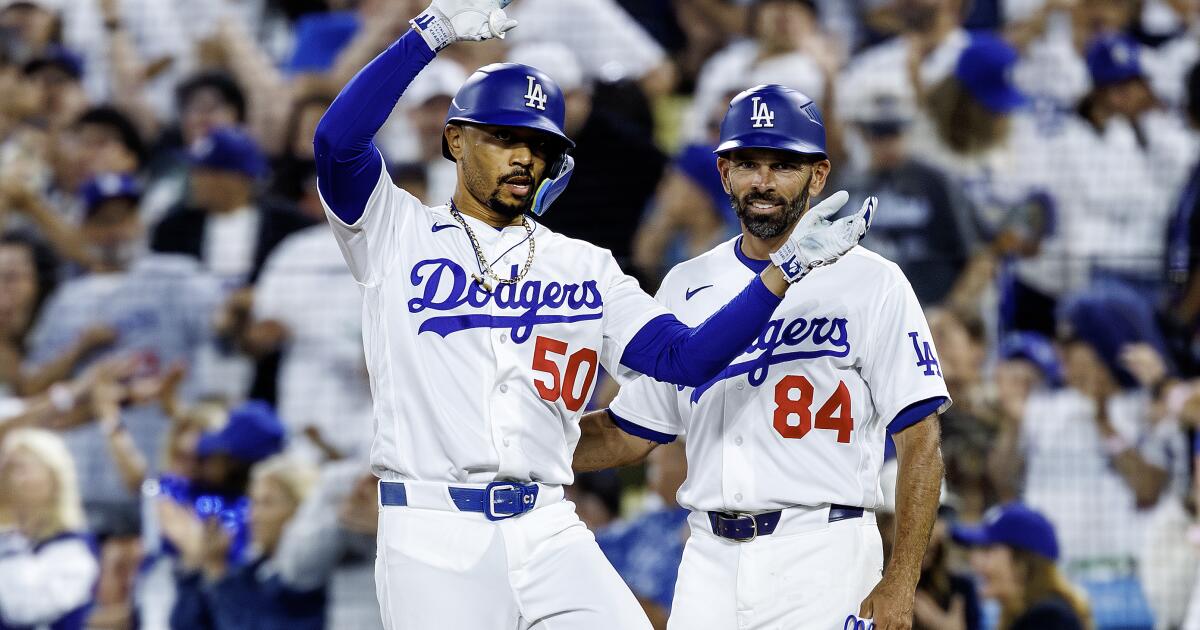
Mookie Betts’ first hit this series against the Rockies couldn’t have come at a more opportune time. With the crack of the ball against his bat, Tommy Edman scored from third, giving the Dodgers the lead.
And as Betts reached first, he pointed to Freddie Freeman, whose single put Edman in scoring position. It had taken a team effort to overcome another middling start from Roki Sasaki, and Betts, who had little to show before his game-winning hit, took the chance to highlight the joint contribution in the Dodgers’ 4-3 rubber-match win over Colorado (38-56).
“It feels great,” Betts said of his nine-pitch battle. “Helping the boys win, that’s really all it is. We play the game to win, and coming through in a big moment is kind of what, when you’re a kid, playing in the backyard, getting that hit is what you always strive to do, and fortunately, I was able to do it.”
Given a three-run lead in the first inning, brought to the Dodgers by a wild pitch and Kyle Tucker’s two-run, line-drive single to left field, Sasaki seemed set up for success.
Still, he gave away the lead as quickly as it came. In the second inning, he left a fastball too far over the plate, and third baseman Kyle Karros drove the ball over the left-center wall. The slider he dealt two batters later to second baseman Edouard Julien also crossed the zone too far over the plate, and Julien rounded the bases with another homer. In the third, a sacrifice fly by Mickey Moniak evened the scored, 3-3.
Sasaki’s troubles this season have been hard to pin down since his last win on May 23, as Sasaki tries to claw back the triple-digit velocity that’s escaped him as of late.
Against the Rockies, his fastball topped out at 99.1 miles per hour before steadily dropping to 98. He had managed five strikeouts in his six innings when manager Dave Roberts replaced him with Jack Dreyer, though the three earned runs couldn’t be ignored.
But Roberts also acknowledged the possibility that the pitcher had been tipping his pitches, possibly since he was playing in Japan, and Sasaki has tried to address it after a three-inning, six-run start last week. Even if he had fully self-corrected, his control issues remain. In the third inning, he walked the tying runner, Brett Sullivan.
“I’ve been working on a lot of things like the tipping stuff,” Sasaki said through interpreter Kensuke Okubo. “Also, I need to make quality pitches.”
Sasaki regained some of his confidence in the fourth when he worked out of a two-base jam with two strikeouts and a flyball to right, something that didn’t go unnoticed by Roberts.
“You can see the demeanor walking off the mound, the confidence,” Roberts said. “For me, it was more of let him end on a high note, feeling good about his outing, and then go from there.”
The Dodgers’ problems were compounded by Alex Call wasting the team’s two challenges in his at-bat in the first inning when the team had already taken the lead. And maybe it would’ve been excusable if Call had driven in the runners on first and second, but instead he ended the inning on a strikeout, stranding both. Roberts called the situation an “outlier” and didn’t feel as though he needed to have a conversation with Call regarding the situation.
After the three-run first, the Dodgers (61-33) remained hitless until Max Muncy laced a double down the right-field line in the sixth, though to little avail. As the innings ticked forward, Colorado’s chances seemed to increase. The Rockies hold the best league batting average (.297) in the eighth and ninth innings (the Dodgers are fourth with .268). And the Dodgers relievers, within the same constraints, have a 3.83 ERA — not bad, but not in the top 10 either.
Third baseman Max Muncy can’t get his glove on a line-drive double by Kyle Karros in the fourth inning.
(Gina Ferazzi/Los Angeles Times)
So when Alex Vesia struggled against the Rockies in the eighth inning and Muncy suffered a throwing error, Colorado seemed in position to score with the bases loaded and one out. Vesia struck out TJ Rumfield and Edgardo Henriquez (4-0), his replacement, retired Karros on a fly ball to right.
After Betts’ single allowed the Dodgers to take the lead, Tanner Scott (13) shut down the Rockies with back-to-back strikeouts, avoiding the team’s eighth series loss of the season.
“Didn’t feel great,” Roberts said. “Fortunately, we won a series, but that’s not the kind of way you want to do it.”
Sports
Justin Verlander announces he will retire after this season: ‘I’ve realized that time has come’

NEWYou can now listen to Fox News articles!
One of the greatest pitchers in the history of baseball will be hanging up his cleats after this season.
Three-time Cy Young Award winner Justin Verlander announced on Wednesday that the 2026 season will be his last.
Amid an injury-riddled season with the Detroit Tigers, Verlander decided it’s time to go.
Detroit Tigers pitcher Justin Verlander watches from the dugout during a game against the Chicago White Sox at Comerica Park in Detroit June 21, 2026. (David Rodriguez-Munoz/USA Today Network via Imagn Images)
“This season has challenged me in ways I haven’t experienced before, both physically and mentally. I’ve always believed that as long as I could compete at the level I expect of myself, I’d keep playing. I never wanted to retire because of a milestone, a number, or a date on the calendar. I wanted the game to tell me when it was time. Over the last several months, I’ve realized that time has come,” Verlander said in a social media post.
“While I’m fully committed to giving my team everything I have for the rest of this season, I’ve decided this will be my last. It’s fitting that I get to finish where it all started – with the Detroit Tigers, the organization that drafted me and gave me my first opportunity.”
Verlander inked a one-year deal with the Tigers, with whom he spent his first 12½ seasons before being traded to the Houston Astros, in the offseason. In Houston, he returned to dominance, winning both of his World Series titles and two of his Cy Young Awards.
“Baseball has given me more than I could have imagined. It taught me discipline, resilience, and the value of continuing to adapt and evolve. I’ve been fortunate to play with and against incredible players, for outstanding organizations, and compete in-front of fans who deeply appreciate the game,” Verlander added in his announcement.
Justin Verlander of the Houston Astros celebrates after the Astros defeated the Philadelphia Phillies in Game 6 of the 2022 World Series at Minute Maid Park Nov. 5, 2022, in Houston, Texas. (Mary DeCicco/MLB Photos via Getty Images)
PHILLIES STAR SAYS ‘BS RULE’ IS KEEPING HIM FROM BEING NAMED ALL-STAR IN FRONT OF HOME CROWD
“To every teammate, coach, player, clubhouse attendant, and fan who has been part of this journey – thank you. It’s been a privilege to share the field with you. To my family, especially my wife Kate, thank you for standing beside me through every season, every rehab, and every high and low. I couldn’t have done this without you. It’s time for the next chapter. But first, I’m excited to finish this season the only way I know how – with everything I’ve got.”
Verlander is the active leader with 3,554 strikeouts, which is good for eighth all-time. He needs 21 to surpass Don Sutton and 87 to pass Tom Seaver.
The 43-year-old made his MLB debut in 2005 and won the American League Rookie of the Year Award the following season in what was just a small glimpse of what was to come.
Verlander was a Cy Young Award finalist on four other occasions, consistently near the top of the leaderboard in just about every pitching stat. MLB Commissioner Rob Manfred gave Verlander a legend’s exemption to this year’s Midsummer Classic, making him a 10-time All-Star.
One could argue that Verlander should have at least one more Cy Young Award on his mantle, but he is on the fast track to Cooperstown and very much in the conversation to join Mariano Rivera as the only player unanimously elected to the Hall of Fame.
Verlander’s best season came in 2022, when he pitched to a career-best 1.75 ERA along with a 0.829 WHIP. However, that came after he missed the entire 2021 season due to Tommy John surgery for an injury he suffered after pitching just one inning in the abbreviated 2020 season.
Houston Astros starting pitcher Justin Verlander throws against the Boston Red Sox during the first inning Aug. 22, 2023, in Houston. (AP Photo/Michael Wyke)
CLICK HERE TO DOWNLOAD THE FOX NEWS APP
He won his first Cy Young Award in 2011, when he was also awarded the MVP Award, and his second in 2019. Verlander’s 11 seasons between his first and final Cy Young Awards are the second-most behind Roger Clemens, who had 18 seasons between his first and seventh.
Verlander led the majors in innings and WHIP four times while recording the most strikeouts in three seasons.
Follow Fox News Digital’s sports coverage on X, and subscribe to the Fox News Sports Huddle newsletter.
-

 Oregon26 seconds ago
Pierce County Sheriff: Homicide ‘suspect was shot and killed by police in Seaside, Oregon’
-

 Pennsylvania7 minutes ago
‘Natural splendor at its best’: Penn’s Cave may become Pa.’s next state park
-

 Rhode Island10 minutes ago
Throwback: USS Rhode Island commissioned in Newport
-

 South-Carolina15 minutes ago
Watch out for SC’s 5 most common ticks and take steps to avoid bites
-
South Dakota22 minutes ago
SD Lottery Powerball, Lotto America winning numbers for July 8, 2026
-
Tennessee25 minutes ago
TN Lottery Powerball, Lotto America winning numbers for July 8, 2026
-

 Texas30 minutes ago
Texas reports 48 cyclospora cases and the source is still unknown
-

 Utah37 minutes ago
Utah Jazz vs Washington Wizards: Summer League Preview, start time, how to watch

