Sports
How love, Warriors basketball and poetry brought Tom Meschery back


SACRAMENTO, Calif. — The poet has been upstairs in his office, tapping at the keyboard on various projects. Most of his mornings begin this way … so much work to do. Some days he tends to his blog, and on other days he tidies up his memoir that is nearing publication. Or he may put the finishing touches on another of his mystery novels. And of course, his poetry. There is always his poetry.
Much of his poetry chronicles his remarkable life. He was born in Manchuria to Russian parents, and from ages 3 to 6 lived in a World War II internment camp in Tokyo. Just before he turned 7, he crossed under the Golden Gate Bridge. After moving to America, he later became an accomplished professional basketball player who did more than just start alongside Wilt Chamberlain. He was a 1963 NBA All-Star and the first player to have his number retired by the Golden State Warriors. He also was a failed bookstore owner, coached basketball everywhere from Portland, Ore., to Africa, and spent 24 years teaching high school English.
His eclectic path is made more fascinating in that at 85 he refuses to become idle and bask in the accomplishment of a life well lived. He says he is “obsessed” with being productive, which for him means writing. He has authored five books of poetry. Written two memoirs. Six novels. The majority of his literary work has come after he turned 70. He tries to explain the “why” behind his obsession but ultimately concedes that perhaps poet Alfred, Lord Tennyson put it best in Ulysses:
How dull it is to pause, to make an end,
To rust unburnish’d, not to shine in use!
As tho’ to breathe were life!
It’s that last line that particularly resonates with the poet, Tom Meschery. Just because you are breathing doesn’t mean you are living.
In 2005, he was diagnosed with multiple myeloma, a blood cancer that has no cure. Doctors estimated he had five years to live. Now 19 years later, he is as prolific as ever, even as he sacrifices an afternoon to break from his computer and regale a visitor with stories. He credits medical science, and in particular the drug Revlimid, for keeping his cancer in remission. But he also feels something deeper, something more powerful has been behind his late-life renaissance: a love story. His love story.
He is not big on sentimentality, lest it come across as maudlin. However, he is a romantic and therefore acknowledges that his love story is more than just a poet falling for an artist. Like his poetry, which he says “seems to come out of nowhere,” she came from an online dating site and changed his life. Not only changed it but also played a role in saving it.
“I think love acted as a barrier to the cancer,” Meschery says. “It was like the door was closed. Maybe it wasn’t locked, but the love was holding onto the door and not letting the cancer in. And that kind of love changed my attitude toward living. I started spending all my time thinking about living, rather than dying.”
Melanie and Tom Meschery at their home in California. (Max Whittaker / For The Athletic)
When Tom Meschery received his cancer diagnosis in 2005, he was already in a bit of a spiral. He was newly divorced and had just retired from a teaching job he loved. Living in Truckee, Calif., a ski town on the outskirts of Lake Tahoe, he had become engulfed with loneliness. He was 68 and wrestling with his purpose in life. Now, faced with a diagnosis that sounded like a death sentence, he slipped into what he called a suicidal depression.
His spiral was palpable. After separate visits following their father’s diagnosis, his three children — Janai, Megan and Matthew — all left concerned.
“We were all really worried about him,” Matthew says. “Not just because of the cancer, but also the circumstances of him being alone up on the mountain, just going through that mostly by himself.”
The siblings remember comparing notes after visits. They all remarked how the house they grew up in — one filled with activity, laughter and lively discussion — had become so quiet.
“It was a house that was always filled with people, a very social place, and dad was always the one holding court,” Janai says. “And the contrast … was hard on all of us.”
By 2008, Meschery could no longer suppress his depression. With Matthew visiting, Meschery remembers halting the ironing of a shirt and blurting out to his son: I’m lonely.
Matthew made a suggestion.
Go online, Dad. Everybody does it.
So he put himself out there. The poet went on his first date.
“I wasn’t particularly impressed,” he sniffed.
His second foray on the dating site seemed improbable from the get-go. Her name was Melanie Marchant, and her profile picture was stunning. There is no way, he reasoned, that she is in her 60s; she looks 30. And it seemed too perfect that like he, she was creative, an accomplished painter located two hours away in Sacramento. For a month, they chatted online and on the phone. They talked about literature, cooking, her two children and his three.
On Valentine’s Day 2008, a first date was arranged at a Turkish restaurant in downtown Sacramento. As he hurried into the restaurant, late, she was waiting with the maitre d, toe-tapping in mock disgust. She playfully stuck her tongue out at him.
They exchanged cards. His card to her featured the poem Wild Geese by Mary Oliver. The poem represented his vulnerability, his willingness to be open.
You do not have to be good.
You do not have to walk on your knees
for a hundred miles through the desert repenting.
You only have to let the soft animal of your body
love what it loves.
Tell me about despair, yours, and I will tell you mine.
Meanwhile the world goes on.
Her card for him? A Valentine left over from one of her grandchildren, featuring Batman. Almost two decades later, it still humors him.


After dinner, they went to her place. She says she had a surprise for him. As they went up the stairs, he became enraptured. Lining the walls of the staircase were religious icons. He was taken back to his youth and his Russian Orthodox roots. Then, the surprise: she had rented “Ratatouille” — the animated movie about a rat who has a nose for cooking — which played off their frequent conversations about recipes and cuisine.
“And that was it, babe. I was in love,” he says, throwing his hands in the air. “As I drove back to the mountains that night, I knew this was going to be a lifetime relationship. I just knew that she and I were going to be together for the rest of our lives.”
One year after their first date, they were married.
She had been divorced for 30 years and says “if you go 30 years, you know when you find something.” They connected over their creative curiosities and their love of literature — she estimates in their first year of dating they spent between $2,000-$3,000 on books. And soon, she became his trusted editor. He figures she has edited 53,000 pages of his writing.
“I would go through his manuscripts and write “Booooooooring!” Melanie says chuckling. “But I think his writing is wonderful. I do worry when I ask him how he slept, and he says ‘Not well …’, because that means he has written another book in his head. He’s got three or four of them up there now.”
He says she has become his muse, but more accurately she has become somewhat of a life coach. She calls him Thomas and he calls her Mel, and they are constantly engaged in playful banter, trying to get the other to chuckle. One of her favorite pastimes is charting who she considers the most handsome players in the NBA (De’Aaron Fox, Steph Curry and Harrison Barnes top the current list).
However, she turns stern and blunt when it comes to his cancer. She is adamant that our bodies are not separate from our minds, and from the onset of their relationship, she has conditioned his mind to revel in the now rather than dread what could be ahead.
“When he told me he had cancer, I said, ‘Yeah? I know a lot of people who have cancer. When you are 70, people get cancer,’” Melanie says. “I don’t do drama. I don’t do sobbing. What I’m good at is, if there is a problem, it’s not a challenge. You just take it and solve it. And the man I met was so healthy and happy … he has cancer? Not today. That’s just how I felt.”
His mindset changed. He stopped thinking so much about the future and instead embraced what was in front of him. There was poetry to write, grandchildren to enjoy, dinners to be had and basketball games to watch.
“When I met Mel, I knew that I had found the love of my life,” Meschery says. “And from that point on, I became more positive about myself, about my cancer and about how long I would live. I just couldn’t whine about it with her, she wouldn’t stand it. She inspired me to just let it go, and trust my instincts.”
He is on a maintenance dose of Revlimid — 28 days on the drug, 10 days off — and every three months he has blood drawn to chart his cell count and presence of proteins. Every test since he has met Melanie has shown the cancer to be in remission.
“And we laugh about it: Another three months of putting up with me,” Meschery says. “It has become a much more casual conversation, almost like it’s not life-threatening anymore. And I think that was all her doing, which became my doing. It was like she passed on this belief system to me, and gave it to me as a gift.”

Tom Meschery has published over 100 poems about sports and is working to finish his memoir. (Max Whittaker / For The Athletic)
NBA players from the 1960s would chuckle at the idea of Meschery as a poet, trumpeting the powers of love. To them, he was the Mad Manchurian, a 6-foot-7 bear of a man who was known for his intensity and physicality, which sometimes morphed into rage. He played power forward, and after 778 career games — six seasons with the Warriors, who moved from Philly to San Francisco in 1962, and four with the Seattle SuperSonics — Meschery averaged 12.7 points and 8.6 rebounds. But as his nickname suggests, he was as known for his temperament as he was for his skill.
He once grabbed a chair during a game and chased Lakers center Darrall Imhoff into the stands. And he remembers fighting Philadelphia’s Chet Walker, and after both were ejected, charging at him in the back hallway.
He has yet to reconcile with the dichotomy between how he played and how he views himself. He addressed his unease in his last book of poetry, “Clear Path,” with the poem Rumors.
He writes of his wife on an airplane, and a passenger remarking to her that Meschery “was the meanest son of a b—- I’d ever seen play basketball.”
…there was my epitaph being written
at ten thousand feet above the earth
by a stranger who might have seen me play
or maybe not at all, and just heard from someone
else that I was mean. How rumors start. How unjust
a life can be, viewed through someone else’s eyes.
“It always shocked me that I often reacted so violently on the court,” Meschery says today. “I know in my heart I was not a violent man. But if you experience violence once in yourself, I think you are forever going to second guess the possibility that it is a part of your personality. And it can hang there for a lifetime. I can’t look in the mirror and see myself as a mean son of a b—-. But I know there was a part of me … and that poem was part of that reflection that I sensed, and regrettably so, that there is something in me that would allow anger to enter. And it’s not a good feeling.”
He also never bridged the barrier between him and his father, whom he loved but with whom he struggled to connect. His father wanted him to go into the military and never watched him play basketball, deeming it unworthy as a profession. He opened Meschery’s eyes to poetry, as he would recite poems in Russian at the dinner table, unafraid to weep. Meschery says one of the great regrets in his life is not arriving in time to say goodbye to his father before he died. In his first collection of poetry, “Nothing We Lose Can Be Replaced,” his piece entitled Tom Meschery is essentially a letter to his father, who once asked, ‘What kind of work is this for a man?’
Old immigrant, I admit all this
too late. You died before I could explain
newspapers call me a journeyman.
They write I roll up my sleeves
and go to work. They use words
like hammer and muscle to describe me
…father, you would have been proud of me:
I labored in the company of large men.
Meschery also recounted the night Chamberlain scored 100 points against the Knicks in 1962. Meschery started beside Chamberlain and played 40 minutes, amassing 16 points and seven rebounds. In the poem Wilt, he captured a viewpoint from the team bus: the contrast between a historic night of work on the hardwood and the ordinary, everyday life in the Pennsylvania countryside.
As a rookie I watched
Wilt score a century in one game
in Hershey, Pa., with the smell
of chocolate floating through the arena
…but mostly, what I remember about that game
is this: …on the bus driving through the dark Amish countryside,
outside a farmer in a horse and buggy,
hurrying home in the all
too brief light of his lantern
He has more than 100 poems published about sports and quips that he is subconsciously trying to match the 2,841 personal fouls for which he was whistled during his career. When asked if he ever reflects on the breadth and depth of his life’s work, he pauses, then equates measuring his life accomplishments to evaluating his poetry.
“I think I’ve done the best I could,” Meschery says. “If I look at life like a whole series of poetry … I can only pick out 15 or 20 poems out of the entire collection that I think are truly inspired poetry. I am just a poet. But I recognize I’ve written some really, really good poems. But I also recognize that a lot of my poetry is … meh. Not bad. Not awful. And that’s okay. I’m not unhappy about it. That’s a little bit the way life is.
“Can you look at your life and honestly say that most of your life has been inspired? Probably not. But you do pick out those moments when you did really good. And I think I’ve been able to do that. But at the same time, I’m not so egotistical to believe that every moment of my life has been a Kareem Abdul-Jabbar sky hook.”
Another force helped pull Meschery out of his malaise following his cancer diagnosis. It was a friend from long ago, one with whom he hadn’t kept in touch: basketball.
In 2006, Matthew, concerned about his father’s well-being, bought him NBA League Pass, a subscription that provides coverage for every NBA game. By then, basketball had become an afterthought for Meschery. He had not been involved in the NBA since 1976 when he finished a two-year stint as an assistant under Lenny Wilkens in Portland. And he hadn’t been involved in basketball period since 1985, when he went to West Africa to coach teams in Mali, Ivory Coast, Gabon and the Republic of the Congo.
When he tuned in, his interest in the NBA was rekindled. He was drawn to his former team, the Warriors, and that 2006-07 team — an uptempo, free-wheeling and stylistic squad coached by Don Nelson and led by Baron Davis, Monta Ellis, Stephen Jackson and Jason Richardson — stirred him. He was once again inspired by the game he once played.
“I hadn’t kept up with the NBA, but once I started watching this new version of basketball, I went crazy. I just loved it,” Meschery says. “The ball was moving … they were flying through the air … and I was just astounded these guys could do this stuff.”
Then, in 2010, under the new ownership of Joe Lacob, the Warriors reached out to Meschery. The organization wanted to reconnect with its past. Meschery, the first NBA All-Star not born in America, and the first Warriors player to have his number retired, was brought back into the fold. He was invited to games. Introduced to players. He rode in all four championship parades, including 2022, when Warriors star Klay Thompson spotted from the team bus Meschery riding on the parade route on Market Street. Thompson got off the bus, and while holding the Larry O’Brien Trophy, beelined for Meschery, wrapping him in a bear hug.
“There was a time when we were worried about my dad losing a sense of himself,” Matthew says. “Basketball was a big part of his life experience and who he is, and the Warriors helped bring that back.”
Before this season, the Warriors asked Meschery to write a poem to commemorate Golden State’s new City Edition uniforms, which paid homage to the San Francisco cable cars. Meschery recited Mason Street Line at the unveiling.
“When I think back on my cancer, love saved me and helped cure me,” Meschery says. “But I think the Warriors had a little something to do with it, too.”

Tom Meschery has been in all four of the Warriors victory parades, including this appearance in 2022. (Courtesy of Matthew Meschery)
There is nothing poetic about how the poet handles the moments when the inevitable thoughts come, the thoughts of dying, of the cancer eventually winning.
“I’d be lying if I told you I don’t think about it from time to time,” Meschery says. “I think anybody who reaches the age of 85 knows they don’t have much time left. But I don’t dwell on it.”
When those moments arrive, he finds he is usually in bed. “Then I have a little mantra I say to myself: Tom, you are not going to die tomorrow. And Tom, you are not going to die in the next week. And probably not for the next six months. More likely, not for another year. So f— it, get on with your life.”
Then, he says, he goes back to sleep, intent on seeing his grandchildren, seeing his latest works published, including his memoir “The Mad Manchurian in August, and in October the publication of “The Case of the VW Hippie Bus,” the third installment in his Brovelli Brothers mystery novels.
In the meantime, he spends most of his nights watching the Warriors, or the Kings. Melanie, who turned 80 on Sunday is often nearby, flipping pages of the latest book she is reading, pausing briefly to make a quip or note the handsomeness of an opposing player.
“I call her my basketball buddy,” Meschery says. “And she says, ‘That’s exactly what every woman wants to hear.’”
The point is no longer how long he will live, he says, but rather doing what is enjoyable and productive. That he has found love with Melanie, and in turn found his muse and purpose, gives him a bittersweet vantage on his sunset.
“I think it makes you fear death more,” he says. “I’m really going to miss living. The idea of not seeing my grandchildren, the idea of not being able to write a poem, to enjoy a meal … that can be quite terrifying. But you can’t live your life worrying about death.”
And so he continues to appreciate living. And laughing. And loving. And ever the poet, he continues writing.
It was three years ago when Meschery wrote the poem 2,841 Personal Fouls. It has little to do with his basketball career, and more to do with his love story. In the poem, he laments that the “thought of dying still pisses me off” and he equates his anger to the unfairness he felt with many of the 2,841 fouls for which he was whistled. But he counters with the outlook Melanie has so ingrained in him.
This morning, didn’t I wake up to sunlight
and a warm breeze? Didn’t my wife
poke her head into the office
to tell me she loved me? I flavor
my coffee with honey that is sweet as life.
I should live a little longer.
(Top photo: Max Whittaker for The Athletic)



NEWYou can now listen to Fox News articles!
Russell Wilson has had his share of ups and downs in his NFL career.
He helped the Seattle Seahawks to a Super Bowl championship in 2013 and was named to the Pro Bowl four times. But the last few years of his career arguably did some damage to his legacy as he’s spent the last three seasons with three different teams.
ZERO BS. JUST DAKICH. TAKE THE DON’T @ ME PODCAST ON THE ROAD. DOWNLOAD NOW!
New York Giants quarterback Russell Wilson watches from the sidelines during the second quarter against the Philadelphia Eagles at MetLife Stadium in East Rutherford, N.J., on Oct. 9, 2025. (Brad Penner/Imagn Images)
Wilson is still on the free-agent market as he looks to latch on to a new team for 2026. However, former NFL star Aqib Talib implored Wilson to hang up the cleats.
“Do your TV thing, Russ. It’s over with, man. Once you’ve got to decide, do I even want to play?” Talib said on “The Arena: Gridiron.” “I think you don’t really want to play. I hate when guys get to the later part of their career and then they start doing the bounce-around thing and they’re not going to win. There was no chip in New York. That’s just going to be another stop on your resume.”
Wilson reportedly garnered some interest from NFL teams.
New York Giants quarterback Russell Wilson stands on the field before a game against the Philadelphia Eagles at Lincoln Financial Field in Philadelphia, PA on Oct. 26, 2025. (Bill Streicher/Imagn Images)
He told the New York Post that the New York Jets were one of them.
Wilson also was reportedly a candidate to take Matt Ryan’s spot on CBS’ “The NFL Today” after Ryan left to take a front office job with the Atlanta Falcons.
Wilson has 46,966 passing yards and 353 passing touchdowns in 205 career games, but the 2025 season with the New York Giants was one to forget.
Wilson started three games and made some bizarre decisions in a loss against the Chiefs. Jaxson Dart was named the starting quarterback. As he came in to take a few snaps while Dart was being checked for a concussion, Wilson was booed.
New York Giants quarterback Russell Wilson watches from the sidelines during the second half against the Denver Broncos at Empower Field at Mile High in Denver, Colo., on Oct. 19, 2025. (Ron Chenoy/Imagn Images)
CLICK HERE TO DOWNLOAD THE FOX NEWS APP
Should he end up signing with another team, Wilson will be entering his age-38 season.
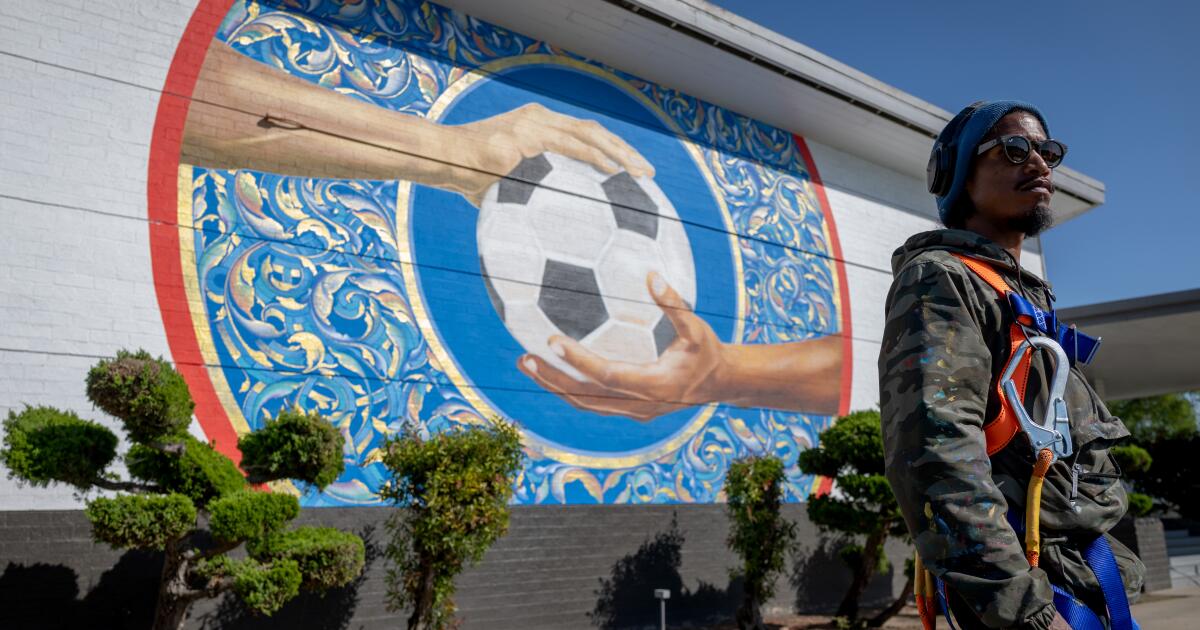
A lot has changed since Jacori Perry attended Morningside High School.
Perry is now a renowned artist who goes by the names Mr. Ace and AiseBorn.
The school is now known as Inglewood High School United.
And the lecture hall on that campus now features a large, ornate mural of a soccer ball being grasped by the hands of two people — freshly painted by the 2004 Morningside graduate as the city of Inglewood prepares to host eight World Cup games at SoFi Stadium starting next month.
Local artist Mr. Ace works on his mural at Inglewood High School United on May 11. The artists, whose real name is Jacori Perry, attended the school when it was known as Morningside High more than two decades ago.
(Eric Thayer/Los Angeles Times)
“If you told me that I would be back here painting one of the walls on this campus when I was in high school, I don’t think that I necessarily would have foreseen it,” Mr. Ace said as he was putting the finishing touches on his mural last week. “So I’m a little in amazement about just the way life works in that sense.”
He was one of several Los Angeles-based artists to participate in a Road to World Cup Community Day last month at Inglewood High United. Many of the artists — including Juan Pablo Reyes (“JP murals”), Michelle Ruby Guerrero (“Mr. B Baby”) and Angel Acordagoitia — sketched designs on portable panels (12-feet by 8-feet) and picnic tables for community members to paint.
The picnic tables will remain at the high school in front of Mr. Ace’s mural. The mobile murals will be placed throughout LAX to welcome visitors arriving for the World Cup.
Kathryn Schloessman, CEO of the Los Angeles World Cup 2026 Host Committee, said in a news release that the event was “just one example of how the energy of the World Cup can be felt in neighborhoods across our region.”
“Students, artists, and volunteers came together to create a work of art that will live on well beyond the end of the tournament,” Schloessman said. “It’s a reflection of the creativity, diversity, and community pride that makes our region so special as we prepare to host the world for FIFA World Cup 2026.”
Community members were encouraged to take part in the painting process, no matter their skill level.
“We made it easy enough for people that have zero experience to a proficient level of experience, for them to all be involved,” said Reyes, who designed and helped paint two mural panels and three tables. “We did the sketch, and then I tried to dab a little bit of color — whatever color is supposed to be there, I dabbed a little bit of color right there, so they would have a guide. …
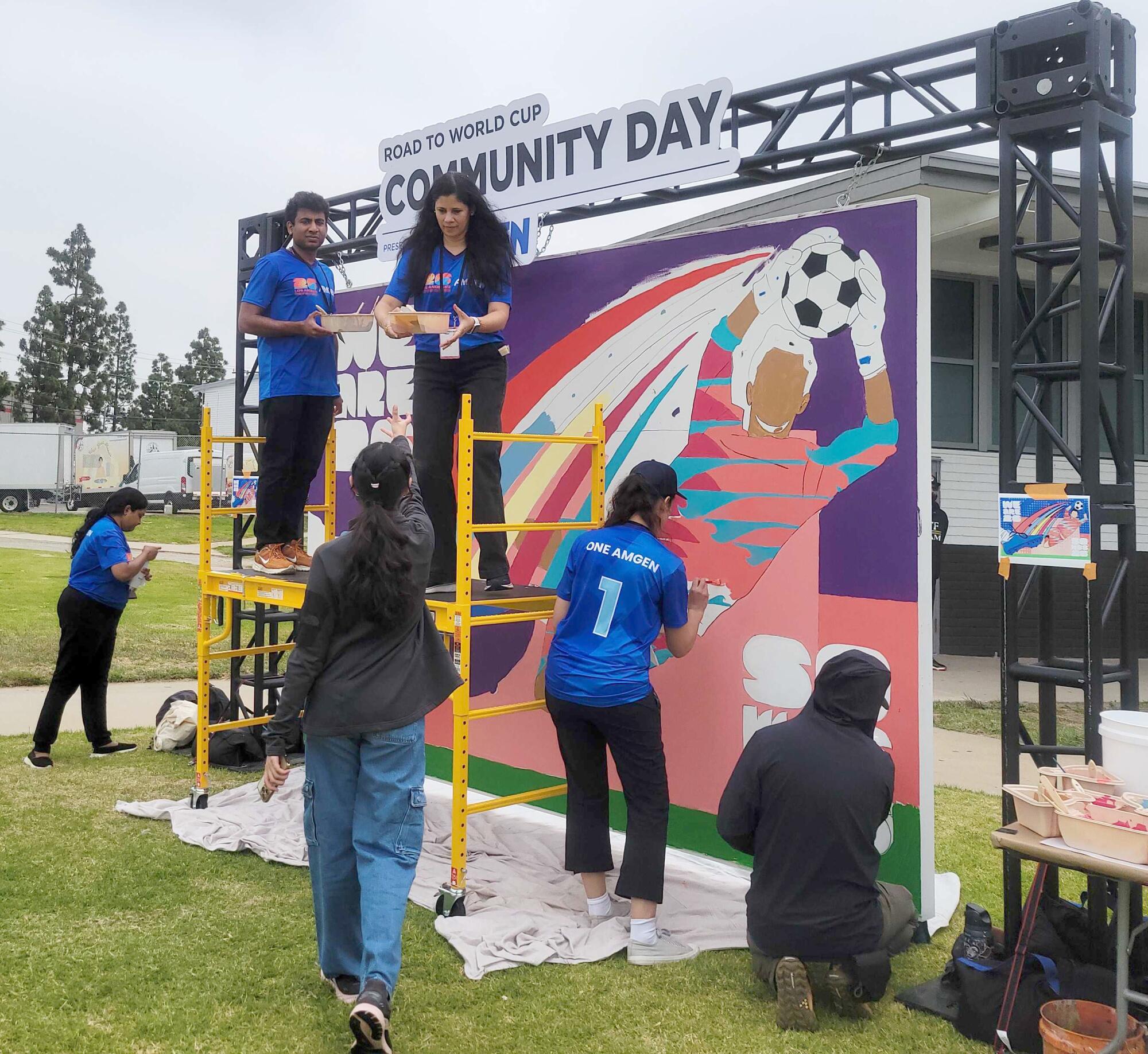
Students and community members help paint a mural panel during a Road to World Cup Community Day event May 2 at Inglewood High School.
(Dawn M. Burkes / Los Angeles Times)
“I was right there, kind of supervising, making sure that everything went as planned. And if anybody has questions, they’re more than welcome to let me know about them. But, yeah, it’s pretty easy for them to kind of be involved and feel that sense of ownership and have a sense of pride that, ‘Yeah, I was part of that mural-creation process.’ It’s a rich experience for them.”
Acordagoitia sketched several table-top designs for the public to paint at the event.
“They did great,” he said of the community members. “They helped a lot. They were asking questions. They got all the other colors correct. So, yeah, they were excited. A lot of kids were excited to see the live painting, because now kids are used to being on their phones. So that was a great experience for them.”
Acordagoitia also opted to paint a mural panel on his own because “it was a little more technical,” involving portraits of his 8-year-old son, a nephew and a friend.
“I wanted to focus more on the youth because that’s really our future,” he said. “So that’s, that’s the main thing about the mural, just about the kids, soccer, culture, community. It’s exciting for me, because I grew up playing soccer and to include soccer with art, it’s just a dream come true.”
Guerrero said “the community was a big help in filling in all the background colors that I need in order to build the detail and layers” on the two mural panels she designed.
“My whole style is based on culture. And I think that there’s a connection there with the World Cup and how I feel like it brings together all the culture and just, like, celebration,” Guerrero said. “It kind of goes hand in hand with the type of work I do, because my stuff is really festive, celebrating culture. And just as an L.A.-based artist, I think the collaboration made sense.”
The four artists also took part in another Road to World Cup Community Day in downtown L.A. at Gloria Molina Grand Park on March 14. At that event, the artists sketched designs on large sculptures shaped like soccer balls and an oversized picnic table, also for community members to paint.
While Mr. Ace opted to paint his permanent mural at Inglewood High School United on his own, he was sure to include the community theme into his work.
“The idea was really centered around just creating something that was community-based — something that represented the World Cup but also represented some sense of community,” he said. “And so what I did was try to create something that was symbolic, very direct in terms of its relationship to soccer and figuring out through that how to create something simple that [brings] into that a sense of community. And that’s how I landed on the two hands holding the soccer ball.”
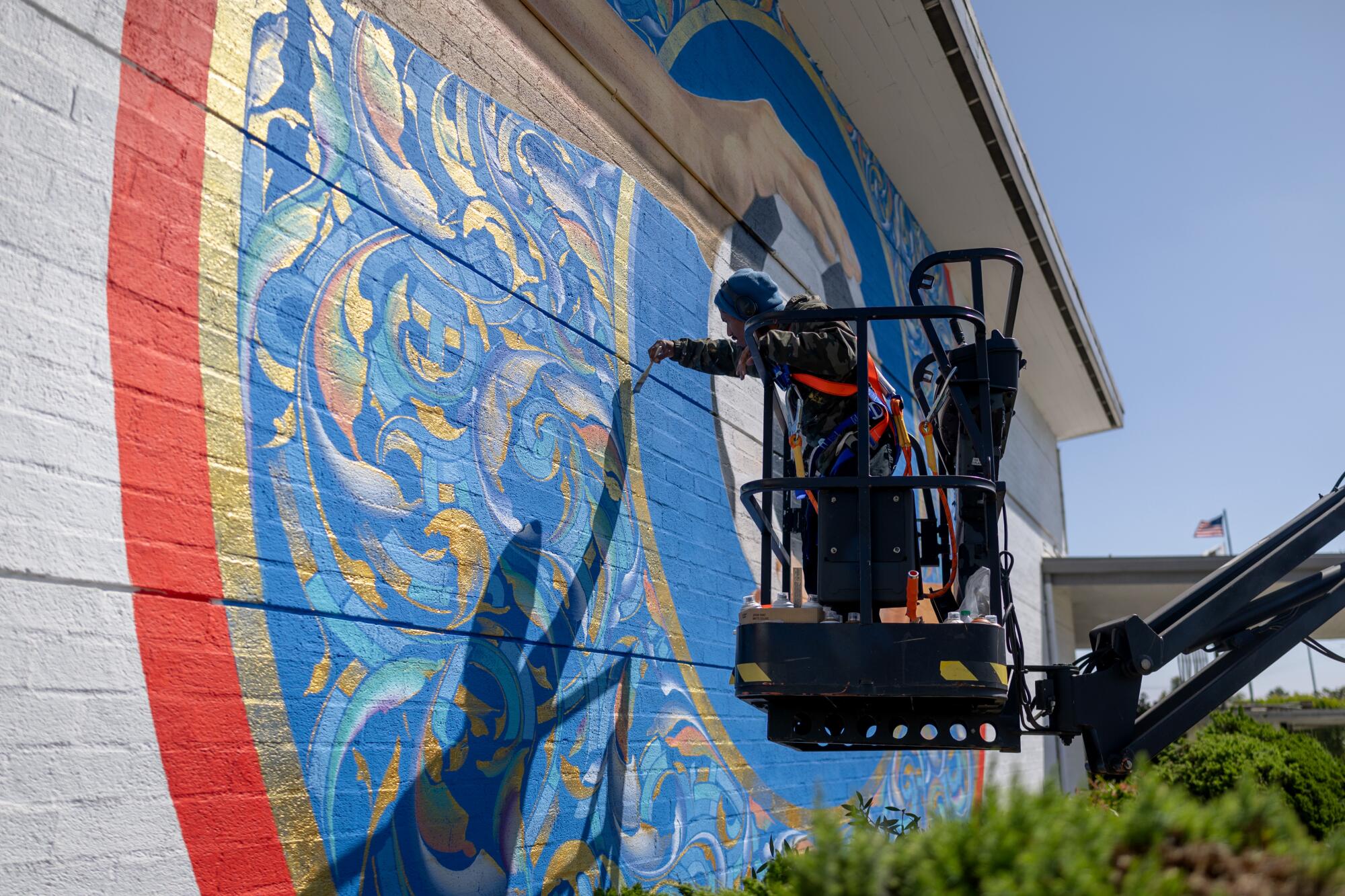
Local artist Mr. Ace works on his World Cup-themed mural at Inglewood High School United on May 11.
(Eric Thayer / Los Angeles Times)
Back when he was a student on that campus, Mr. Ace said he was always involved in art and knew he wanted a career as an artist. He struggled to come up with the right words to describe how it felt being back there creating a work of art to be shared with the students, all of the community and everyone who happens to see it on the way to a World Cup match.
“I guess there’s no words to really describe it,” he said. “I think if any artist gets the opportunity to paint at their own high school — especially if they’ve been doing large-scale works around the city, the country or the world — I think that is a little touching. When it’s attached to something like the World Cup … you know, a large part of my childhood was spent in Inglewood, so coming from my circumstances and life, I think it’s even more intriguing.”

NEWYou can now listen to Fox News articles!
The best Indianapolis 500 finish could be subjective, depending on which driver a fan was rooting for to win.
It certainly is in the eye of the beholder.
So take this list for what it’s worth. One view of the 10 best finishes in Indianapolis 500 history. Of course, it skews to more recent decades when the runs have come a little faster and the finishes have had a tendency to be a little closer.
We’ll add one each day to this list of fantastic finishes ahead of the 110th running of the Indy 500 on May 24 (12:30 p.m. ET on FOX).
10. Ericsson outduels O’Ward (2022)
After a red flag, Marcus Ericsson held off Pato O’Ward in a two-lap shootout. The shootout didn’t last two laps, though, as there was a crash on the final lap behind them. Ericsson had a comfortable lead when the red flag came out for a crash with four laps to go, a situation where in past Indianapolis 500 races, they likely would have ended the race under caution with Ericsson as the winner.
9. Foyt survives chaos (1967)
How does a driver who wins by two laps end up on this list? It’s because the win nearly didn’t happen on the last lap. A big crash with cars and debris littering the frontstretch just ahead of Foyt as he came to the checkered flag forced him to navigate through the wreckage for the win.
8. Sato can’t catch Franchitti (2012)
This was one of those finishes where the leader holds on for the win, but boy did the leader have to hold on. Takuma Sato tried to pass Dario Franchitti early on the final lap but to no avail and Franchitti sped off for the victory. This was one of those Indy 500s that made you hold your breath all the way to the checkered flag.
-

 San Diego, CA6 minutes ago
What we know about the San Diego shooting victims, suspects, possible motive and more
-

 Milwaukee, WI12 minutes ago
Milwaukee crash closes I-794 EB lanes at Van Buren Street
-

 Atlanta, GA18 minutes ago
Atlanta airport security: Council approves private TSA study
-

 Minneapolis, MN24 minutes ago
Man dies days after being injured in attempted Minneapolis carjacking
-

 Indianapolis, IN30 minutes ago
Alexander Rossi suffered injuries to his finger, ankle in crash; what it means for Indy 500
-

 Pittsburg, PA36 minutes ago
3-year-old hit and killed by vehicle in Hill District
-

 Augusta, GA42 minutes ago
After big early voting turnout, Augusta prepares for primary election day
-

 Washington, D.C48 minutes ago
Mayor shares ‘grave concern’ about federal police pursuits in DC

