Sweden is set to finally join Nato on Thursday, meaning the western defence alliance has nearly ringed the entire Baltic Sea, a significant oil trading route for Russia and home to one of its fleets.
“The Baltic Sea becomes a Nato lake,” said Krišjānis Kariņš, Latvia’s foreign minister and a self-declared candidate to head Nato.
As it formally becomes the 32nd member of the US-led alliance during a ceremony in Washington, Sweden brings with it the mid-Baltic island of Gotland — dubbed a “giant aircraft carrier” — which makes the defence of the three small Baltic states easier.
Sweden and Finland joining Nato was all but unthinkable three years ago. But when Russian tanks started rolling towards Kyiv in February 2022, the two Nordic countries woke up to what Moscow could do to its neighbours who were not members of the military alliance. Finland’s accession was completed last year, while Stockholm’s bid was held up by Turkey and Hungary.
Former Swedish Prime Minister Carl Bildt said his country joining Nato “is going to substantially increase the bang for buck in defence and deterrence in northern Europe”.
Advertisement
“For many years, we have been split up. Now, we need to think in more unified terms,” Bildt added.
Vladimir Putin, Russia’s president, has announced plans to reorganise Russia’s military and beef up forces in the region to “neutralise threats” he said arose from Sweden and Finland’s Nato membership.
Russian foreign minister Sergei Lavrov said last week that “all the long decades of good neighbourliness have gone to dust” because the US military “has the right to do whatever they want in Sweden — visit any site and create any of their own”.
Russia’s response would include “additional systems that will be appropriate to the threats that could appear on the territory of Finland and Sweden”, he said.
Russia’s interests in the Baltic Sea are both economic and military.
Advertisement
St Petersburg, which has substantial oil refineries, ships its exports via the Gulf of Finland through the Baltic Sea. The Russian exclave of Kaliningrad, wedged between Poland and Lithuania, is home to Russia’s Baltic fleet and nuclear-capable Iskander ballistic missiles. Russia has threatened to change the region’s “non-nuclear” status in the past but has not said whether the weapons carry nuclear warheads.
In case of a conflict, Estonia, Latvia and Lithuania up until now would have relied almost exclusively on securing reinforcements and supplies via the Suwałki Gap, a narrow and vulnerable 100km strip separating the Baltics from Poland. By joining Nato, Sweden provides new possibilities via the sea, as Gotland is less than 200km from the Latvian coast.
“It reduces the vulnerability of the Baltics through only the Suwałki Gap. The entire security of the region is made stronger because it makes the eastern Baltic less vulnerable,” said Kariņš.
Linas Linkevičius, Lithuania’s former foreign minister who is now its ambassador in Stockholm, said his country had been striving for Sweden to join Nato “for longer than Sweden had”.
He added: “With the opening of the Baltic Sea as a Nato sea, the Suwałki Gap becomes less vulnerable. Maybe the Russians should become more worried. Kaliningrad will not survive if they dare to challenge Nato.”
Advertisement
Sweden’s and Finland’s accessions also enable Nato to look at northern Europe as one big region, without a gaping hole in the map. “From Narva [in Estonia] to Nuuk [in Greenland] east-west, and Kirkenes [in Norway] to Kraków [in Poland] north-south,” as Bildt defined.
The Baltic states may be the biggest immediate beneficiaries from Sweden joining, with Stockholm set to send a battalion to join the multinational presence in Latvia. But the deepest changes over time are likely in the Nordic region itself.
Cooperation between the four main countries — Denmark, Norway, Sweden, and Finland — has long been close but is now set to become more intense.
A taster was provided last year when the four Nordic air forces announced their intention to operate their fleet of about 230 fighter jets as one seamless operation, making it larger than the RAF in the UK or Germany’s air force. Already, Norwegian F-35 and Swedish Gripen fighter jets have practiced landing on Finnish roads.
“Nato consists of a few great powers and lots of medium or small powers. There’s quite a potential for the Nordics,” said Anna Wieslander, director for northern Europe at the Atlantic Council think-tank. “The airspace over the Scandinavian peninsula is important and always has been if you look at world war two or the cold war. If you control the airspace over the Nordics, you really have an advantage.”
Advertisement
She added that there was potential for deeper co-operation among land and naval forces.
Sweden, which does not have a direct border with Russia, is likely to play a different role for Nato military planners than the frontline states. Officials say it would be a logistics hub in case of a conflict as well as a route for reinforcement of Finland or the Baltic states.
But it also brings special capabilities. It has long experience with submarines and sub-sea capabilities, increasingly crucial in a Baltic Sea that has suffered several unexplained incidents of sabotage in recent years from the blowing up of the Nord Stream gas pipelines to the cutting of gas and data links between Finland and Estonia by a Chinese ship’s anchor.
Both Bildt and Wieslander have underscored that the Baltic Sea is open to all, including Russia, and that just because it is now ringed by Nato states does not reduce the risk of a conflict.
The problem with the expression “Nato lake”, Wieslander said, “is that it should not give a false illusion that it won’t be an area of potential tension or high risk”.
Advertisement
“Russia is still there, but it will be more squeezed.”
In the early 2000s, more than half of the passenger vehicles on American roads were traditional cars like sedans. Their hoods were low to the ground.
In the early 2000s, more than half of the passenger vehicles on American roads were traditional cars like sedans. Their hoods were low to the ground.
Advertisement
By the 2010s, larger vehicles like compact S.U.V.s had eclipsed cars.
By the 2010s, larger vehicles like compact S.U.V.s had eclipsed cars.
Advertisement
Today, S.U.V.s and pickup trucks dominate the roads. Many are bigger than ever.
Today, S.U.V.s and pickup trucks dominate the roads. Many are bigger than ever.
Advertisement
And far deadlier, a New York Times investigation found.
And far deadlier, a New York Times investigation found.
Advertisement
They are killing thousands of pedestrians who otherwise might have survived.
They are killing thousands of pedestrians who otherwise might have survived.
Advertisement
Illustrations by Todd M. Detwiler
For decades, American roads were steadily getting safer for pedestrians. But around 2009, the trend reversed. Since then, the number of pedestrians killed each year has risen by about 75 percent.
Advertisement
Source: Insurance Institute for Highway SafetyThe New York Times
Advertisement
The surge in pedestrian deaths has baffled researchers. Most other wealthy countries haven’t seen similar increases, suggesting that possible culprits like smartphones don’t tell the whole story.
Other likely causes of deadly crashes, such as drunken and distracted driving, have attracted immense attention from the public and policymakers. But the trend toward ever-larger vehicles has received much less scrutiny, even after federal researchers in 2022 cautioned regulators that it was endangering pedestrians.
After analyzing federal and industry records, including never-before-examined data on vehicle dimensions, we found that the rise of large pickups and S.U.V.s is an important factor.
Advertisement
Our estimate is that about 200 to 400 pedestrians a year would not have died if vehicles had remained approximately the same size over the past quarter-century. That represents about 10 percent of the recent increase in pedestrian deaths.
There are two reasons bigger vehicles are deadlier: They have taller hoods. And they tend to have larger blind zones.
Advertisement
“We see a lot of devastating collisions even at lower speeds because the pedestrian gets punted forward,” said Shawn Harrington, whose company, Forensic Rock, conducted crash tests for us. “Before the driver knows what’s happened, the pedestrian’s head is under the wheel.”
More vehicles than ever have hoods that exceed the average American’s center of gravity, which is generally around the belly button.
Advertisement
The hood of an average passenger vehicle today is about three feet high. Anyone shorter than 5-foot-6 — about half of American adults — would frequently be rammed to the pavement. So would most children.
Advertisement
, who is , is likely to be knocked down by about XX percent of vehicles today.
In 2002, that number would have been XX percent.
Not only are the high hoods on larger vehicles more lethal, but their bulkier frames can also block drivers’ views of pedestrians.
Advertisement
To analyze how these blind zones have changed, we used a three-dimensional scanner to compare sightlines in four of the most common pickups today — the Chevrolet Silverado, Ford F-150, GMC Sierra and Toyota Tacoma — with their counterparts from the 1990s or early 2000s.
The Silverado’s blind zones have nearly doubled.
Advertisement
The Sierra’s and the Tacoma’s grew by about 60 percent.
The smallest increase was the F-150’s. Its blind zones grew by about 25 percent.
Our overall findings match what we found in court records and heard from dozens of experts who reconstruct crashes for police and lawyers.
Advertisement
One morning last year, Charlene McAlister, 76, set out for work at a child care center in Colorado Springs. “See you tonight,” she called to her daughter as she left their home.
As Ms. McAlister was crossing the street, a Ram 1500 TRX — a pickup marketed for its off-road capabilities and fierce-looking design — was turning left.
Advertisement
Ms. McAlister was not quite five feet tall. The pickup’s hood was at least four feet high. It hit her, throwing her to the pavement.
The driver later said he hadn’t seen Ms. McAlister, according to court records. They show that the truck’s large hood and side mirrors may have impeded his view.
When Ms. McAlister’s daughter, Serena, arrived at the scene, she saw her mother’s hedgehog-themed backpack and red purse in the road, spattered with blood. Emergency workers had draped a white sheet over her body.
Advertisement
Advertisement
Serena McAlister at the intersection where her 76-year-old mother was struck by a pickup truck.Rachel Woolf for The New York Times
Advertisement
Charlene McAlister was hit as the truck turned left.Rachel Woolf for The New York Times
Advertisement
The size of vehicles is far from the only reason that more pedestrians are dying, according to independent experts and industry officials.
“While vehicle safety is critical, blaming larger vehicles for pedestrian deaths overlooks systemic issues” including the design of roads, said Mike Levine, a spokesman for Ford.
Automakers say that new technology designed to detect and avoid pedestrians — including systems that automatically apply the brakes — would dramatically improve safety. For example, Bill Grotz, a spokesman for General Motors, pointed to a recent study that found that G.M. vehicles with so-called front pedestrian braking reduced the frequency of injuries by 35 percent.
Advertisement
The National Highway Traffic Safety Administration is pinning its hopes on automated collision-avoidance systems. Such technologies “are actively reducing the occurrence of these crashes and fundamentally shifting the risk landscape,” said Sean Rushton, an agency spokesman. “We view these technologies as the cornerstone of future mitigation strategies.”
But many experts say that technology is not a perfect substitute for drivers being able to view their surroundings directly. And tests by the Insurance Institute for Highway Safety, which studies ways to make driving less dangerous, have shown that many large vehicles’ automatic braking systems do not consistently prevent collisions.
Advertisement
The owner’s manuals for some of the most popular vehicles caution that safety technology can fail in a variety of common situations: in bad weather; at high speeds; if there are shadows on the road or its surface is uneven; or if a pedestrian is running, pushing a stroller, not standing upright or the size of a small child.
‘King of the Road’
Today’s S.U.V.s and pickups promise more: more seats, more space, more safety, more power, more domination, more prestige.
Advertisement
And, for automakers, more money.
They are the source of virtually all of the U.S. auto industry’s profits, said Mark Wakefield, an industry expert at the consulting firm AlixPartners. For nearly a decade, Ford and G.M. have said in their annual reports that their earnings depend on larger S.U.V.s and pickups.
Advertisement
The cost of making bigger vehicles is usually not much higher than it is for cars, because they are often built in automakers’ most efficient factories and the extra raw materials are relatively cheap.
Yet customers are willing to pay much more for them. The average sticker price for a full-size pickup is $70,000, double that of a sedan, according to Cox Automotive. (Some people pay more to soup up their trucks with “lift kits” that raise their suspensions.)
It is no coincidence that automakers have dramatically scaled back their production of sedans and other passenger cars in the United States. Ford, for example, went from selling more than a million in 2017 to fewer than 100,000 five years later.
Advertisement
What used to be utilitarian vehicles for construction workers are now marketed to the American masses, with messages tailored to specific audiences.
One common pitch centers on machismo. Automakers trumpet how some of their trucks have an “aggressive appearance” or a “piercing glare.”
Advertisement
Chevrolet Silverados from 1998 and 2021.
Other approaches emphasize the perceived safety of being the biggest vehicle around. “You’re the king of the road,” said Frank Hanley, a director at the automotive research firm JD Power.
Advertisement
At Ford, Nicole Gayney’s job was to identify specific social and psychological groups to target.
One was men who hoped to be seen as the neighborhood’s hero, keeping everyone safe, said Dr. Gayney, who left Ford in 2022. Another group was women who viewed a roomy S.U.V. as a way to be the community’s caregiver, taking the soccer team out for ice cream.
Advertisement
“We’re kind of in this American mind-set that bigger is better,” she said.
An Unintended Consequence
In 2009, after a spate of fatal incidents in which drivers were crushed in rollovers, the National Highway Traffic Safety Administration required roofs to be strong enough to support three times the weight of a vehicle. Many automakers responded by installing thicker A-pillars.
Advertisement
James Forbes, who was a longtime engineering manager at Ford, said that after the company began installing the fatter A-pillars, he and his colleagues noticed that they were reducing drivers’ visibility.
The drivers were safer, but pedestrians were in greater peril. “We were very much biasing safety toward the owner of the vehicle,” Mr. Forbes said.
Advertisement
Those potential dangers began attracting attention, with articles in the Detroit Free Press and Consumer Reports.
By 2022, the lack of visibility in large vehicles had become a concern for researchers at the Transportation Department’s Volpe Center, whose mission is to identify and address problems in the transportation system.
That November, the researchers met with leaders at the department and N.H.T.S.A. They delivered a stark message: Large vehicles, with their big blind zones, were increasingly deadly. They were killing hundreds of pedestrians and cyclists every year and injuring thousands more, the researchers estimated, according to attendees and meeting materials we reviewed.
Advertisement
The researchers hoped that their warning would spur regulators to consider how to address the problem.
But a senior N.H.T.S.A. official disputed the data and argued that new pedestrian-sensing technologies were already improving safety.
Advertisement
“There was just zero acknowledgement of the problem,” said Angie Byrne, a former Volpe Center employee who was involved with the research and attended the meeting.
The meeting ended with no plan for action.
The Closed Casket
Advertisement
The U.S. government has paid scant attention to how the size of vehicles affects the safety of pedestrians.
Federal regulators don’t collect much data about the heights of vehicles’ hoods. But we found one service that does: Expert AutoStats.
Advertisement
Our analysis shows a radical change in the makeup of American vehicles over the past two decades.
Not only have many drivers abandoned traditional cars in favor of S.U.V.s and pickups. But millions have flocked to vehicles with hoods that are more than 50 inches tall — like the Ford F-250 and Chevrolet Silverado 2500 — whose ranks have increased more than five-fold since 2002.
Advertisement
Percent of vehicles on the road by hood height
Advertisement
Source: A New York Times analysis of registration data from S&P Global and vehicle dimension data from Expert AutoStats.
To understand how a vehicle’s size affects a crash’s lethality, we built a statistical model. Our goal was to estimate how many fewer pedestrians, if any, would have died in a world in which vehicles had remained roughly the same size since 2002.
We started with a federal database that contains a nationally representative sample of crashes reported to the police from 2016 to 2024. We narrowed that down to those involving a single vehicle and a single pedestrian. And we added the data on hood heights, which wasn’t included in the federal database.
Advertisement
Our model then analyzed the degree to which different factors — such as hood height, weather conditions, time of day and whether alcohol was involved — affected whether pedestrians died.
Crashes are complex events, and the data we fed into our model doesn’t capture everything about each incident. And, of course, there is no way to definitively say what would have happened in an alternate reality where vehicles had not continued to grow larger.
Advertisement
But based on the best available data, the model reached a sobering estimate: The shift toward vehicles with higher hoods caused about 3,000 deaths from 2016 to 2024.
The estimate is conservative in many ways.
For example, it doesn’t include collisions that occur in places like parking lots, driveways or private roads, which are not part of the federal database. Hundreds of pedestrians a year are estimated to die in such crashes, a number that has been increasing.
Advertisement
Only in the past several years have researchers started exploring whether and how larger vehicles threaten pedestrians.
The Insurance Institute for Highway Safety, for example, found last year that vehicles with larger blind zones were substantially more likely to hit pedestrians when turning left.
Advertisement
One evening in October 2016, Margaret Lacey, a 57-year-old nurse, was taking her dog for a walk in Jefferson County, Colo.
She was in a crosswalk as Ernest Martinez, a 50-year-old construction manager, was turning left in his Ford Excursion. He later said he hadn’t seen Ms. Lacey until his S.U.V. was nearly upon her. His view had been blocked by the A-pillar, a crash reconstructionist found.
Advertisement
He slammed the brakes, but he still hit her.
The hood of his 2002 Excursion — large for its time but common by today’s standards — was nearly four feet tall. It came up to Ms. Lacey’s chest. The impact sent her flying. Her head smashed into the pavement.
Advertisement
Advertisement
Margaret Lacey was hit by an S.U.V. in a crosswalk in 2016.Lucy Garrett for The New York Times
Advertisement
When Ms. Lacey’s sister, Betty, learned of her death, she flew to the United States from Ireland.Lucy Garrett for The New York Times
Mr. Martinez leapt out of his vehicle and knelt by her side. “I prayed with her,” he said in an interview. “I just held her hand and watched her go.” Her dog also died.
Advertisement
When Ms. Lacey’s sister, Betty, learned of her death, she flew to the United States from Ireland. She wanted an open casket, following her family tradition. But her sister’s head was grievously misshapen. “The only part that looked like Margaret was her hands,” Betty said.
The coffin was closed. Her funeral was held at a Catholic chapel in Denver, and Mr. Martinez was among the mourners. “May God bless you all, and I pray that you all will find peace,” he wrote in the condolence book.
“I’m sorry.”
Advertisement
Rachel Woolf for The New York Times
Advertisement
Advertisement
Methodology
We used four main datasets to conduct our analysis: crash data from N.H.T.S.A.’s Crash Report Sampling System (C.R.S.S.) from 2016 to 2024, the most recent year available; N.H.T.S.A.’s Fatality Analysis Reporting System (F.A.R.S.); vehicle measurements from Expert AutoStats; and registration information from S&P Global from 2002 to 2024. The datasets characterized vehicle models differently, so we standardized the descriptions. Part of that involved using an A.I. model. We reviewed thousands of matches and found no errors among them.
To estimate the effect of hood height on a vehicle’s lethality, we narrowed the C.R.S.S. data to single-pedestrian, single-vehicle crashes. We excluded motorcycles and commercial trucks, as well as collisions in which the vehicle was moving backward. That left us with about 6,000 incidents.
Advertisement
Then we ran what’s known as a logistic regression. We took the following crash conditions into account: speed limit, bad weather, lighting, alcohol involvement, crash year, and vehicle year and whether the crash occurred in an urban area. We also accounted for the sex and age of the pedestrian and the driver. We included only crashes in which all these variables were available and accounted for C.R.S.S.’s sampling method.
We found hood height to be a statistically significant (p-value = 0.003) predictor of pedestrian death in a crash. The estimated magnitude of this effect is a 2.8 percent increase in the odds of a pedestrian fatality for every one-inch increase in hood height.
Advertisement
We also considered alternative models that included reported crash speed, hood angle and hood length. In all variants, hood height remained a statistically significant predictor of deadliness. Hood height had a lower effect in our model than in most variants, indicating that our estimates may be conservative.
We used our model to estimate the number of pedestrian deaths that would have occurred under two counterfactual scenarios.
In the first scenario, we decreased the hood height of each vehicle in our dataset by three inches, equal to the increase of the average hood height since 2002. We computed how much this change would reduce the predicted probability of a pedestrian death for each crash. We multiplied the yearly average reduction, which was about 7 percent for all years, by the total number of pedestrian fatalities in the F.A.R.S. dataset, which provides a national census of fatal crashes. As with the C.R.S.S. dataset, we also filtered to single-vehicle, single-pedestrian crashes with non-commercial vehicles in the F.A.R.S. dataset. This resulted in a range of 306 to 377 lives saved, or 3,077 in total from 2016 to 2024.
Advertisement
In the second scenario, we took a random sample of hood heights from 2002 and applied them to more recent crashes in our database. Across 10,000 simulations, this reduced the probability of pedestrian death by about 5 percent to 7 percent, depending on the year. That amounted to 222 to 361 lives saved each year, or a total of 2,624.
To measure the differences in visibility among pickup trucks, we used an Artec Leo structured light scanner to create three-dimensional models of the trucks.
Advertisement
We scanned four of the most popular pickup models: Silverado, F-150, Sierra and Tacoma. We scanned one of each model from the 1990s or early 2000s and one from the modern-day fleet. Before scanning, we adjusted the driver’s seat to the middlemost position.
Next, we used a technique called aperture projection to calculate how much space was visible through each window. We used these figures to determine the size and shape of the blind zones in front and to the sides of the driver, up to 50 feet.
We ran these calculations twice for each vehicle: from the perspective of a 5-foot-11 driver and from that of a 5-foot-6 driver. The differences were the same or smaller for the taller driver, so we used those results to be conservative.
Advertisement
We estimated the percentage of Americans under 5-foot-6 based on an analysis by Matthew Parkinson of Pennsylvania State University. The 3D Silverado that appears in the article was created with the help of Kevin Shain from Laser Design.
We consulted with a number of industry experts to develop and check our methodology, including Justin Tyndall from the University of Hawaii Economic Research Organization and Steve Summerskill at Loughborough University in England.
Visitors watch as National Park Service employees use vacuums to clean the Lincoln Memorial Reflecting Pool, Saturday, June 20, 2026, in Washington.
Mark Schiefelbein/AP
hide caption
toggle caption
Advertisement
Mark Schiefelbein/AP
President Trump has claimed that United States Park Police have made several arrests in connection with what he described as deliberate sabotage of the Lincoln Memorial Reflecting Pool in Washington D.C., which underwent a multimillion-dollar renovation earlier this year.
“The United States Park Police have arrested multiple individuals for vandalizing our Nations magnificent Reflecting Pool,” Trump wrote on Truth Social late Saturday evening. “These are very serious crimes having to do with the destruction of National Monuments. Years in jail! Work will begin immediately on its repair.”
In a second post on Saturday, Trump described the alleged damage in greater detail, saying more arrests had followed. He provided no evidence for any of his claims about the nature of the damage, and neither the Park Police nor any other law enforcement agency had publicly confirmed any arrests as of the time of publication.
Advertisement
On Friday, Maryland resident and former Olympian David Hearn was arrested and charged with destroying government property. Hearn says he merely reached into the pool to touch one of the already dislodged blue pieces, and denies the charge.
Trump said that the pool would be drained and repaired quickly, and framed the alleged vandalism as an affront to American history. “We met with contractors today, will probably be forced to release and drain much of the water in order to do the necessary repairs,” he wrote. “What these terrible Vandals have done is a true affront to both Presidents George Washington and Abraham Lincoln, and should be dealt with accordingly”.
A peeling section of blue coating is seen in the Lincoln Memorial Reflecting Pool, Saturday, June 20, 2026, in Washington.
Mark Schiefelbein/AP
hide caption
Advertisement
toggle caption
Mark Schiefelbein/AP
‘A 250-foot long gash’
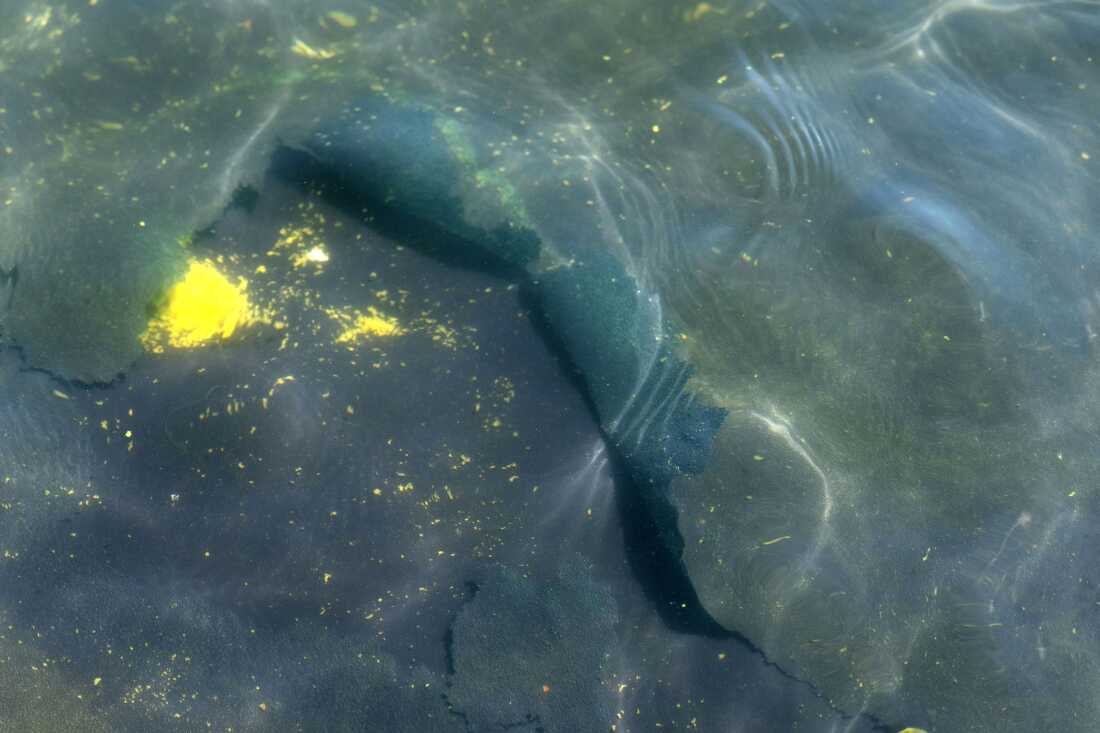
Trump described what he said was physical destruction to the pool’s newly renovated lining. “They took some form of knife or blade, and put a 250 foot long gash into the beautiful facade of what took so much work, competence, and money to build and complete,” he wrote Saturday. “They also poured corrosive and destructive chemicals into the Pool.”
Advertisement
The president connected the alleged vandalism to the recent green color of the pool — again, without evidence. The pool turned green last week after being refilled following its renovation, in which its floor was repainted in a shade Trump calls “American flag blue.”
Aquatic ecologists and pool specialists told NPR the discoloration was caused by a natural bloom of algae from the genus Desmodesmus — a process scientists say is common in shallow, sun-exposed bodies of water, and one that may have been accelerated by the renovation disturbing the nutrient balance of the water.
A George Mason University professor who took water samples confirmed the algae was not toxic.
Water from a vacuum line being used by National Park Service employees to clean the Lincoln Memorial Reflecting Pool pours into a nearby drain, Saturday, June 20, 2026, in Washington.
Mark Schiefelbein/AP
hide caption
Advertisement
toggle caption
Mark Schiefelbein/AP
A renovation that grew in scope and cost
In April, Trump revealed his plans for the pool to be made “American flag blue,” in time for the 250th anniversary of the Declaration of Independence on July 4. The president also posted a fake image of himself and several of his administration officials in swimsuits, along with an unidentified woman in a bikini lounging in the water.
Advertisement
Trump defended the recent work in his Saturday post, writing: “The Reflecting Pool was never so beautiful as it was just one week ago, even going back to 1922 when it opened.” The pool opened in 1923.
The renovation project expanded significantly beyond the initial public cost estimate of $2 million, to more than $14 million by the time work was completed. A Virginia-based contractor received the no-bid contract. A separate Ohio-based company was paid approximately $1.7 million for nanobubble ozone technology deployed to treat the algae bloom.
The project was also the subject of a lawsuit filed in May by the Cultural Landscape Foundation, a nonprofit that argued the administration had bypassed required historic preservation reviews. A federal judge had not yet ruled on the case by the time the administration notified the court that work had been completed.
The White House has also provided no evidence that vandalism caused the pool’s discoloration, or any of the structural damage the president has described.
Gov. Gavin Newsom declared a State of Emergency Saturday night as plumes of black smoke continue to rise from the Lineage Logistics warehouse fire, still burning on the 1400 block of South Los Palos Street in Boyle Heights.
The fire started inside a freezer area at the cold storage facility Wednesday afternoon and was initially extinguished before reigniting on Thursday, according to officials.
Newsom’s declaration allows the state to use additional funding for firefighting efforts, public health services and disaster recovery as Los Angeles continues to deal with the emergency.
“California is mobilizing to support Los Angeles as firefighters and emergency personnel continue their work to contain this fire and protect surrounding communities,” Newsom said in a statement Saturday. “While local officials continue to lead this response, the State of California is prepared to help safeguard public health, support emergency operations, and assist impacted residents. We are coordinating closely with our local partners, deploying specialized expertise, and pre-positioning critical supplies so communities have the support they need both now and throughout recovery.”
File: California Gov. Gavin Newsom speaks during an election-night press conference in 2025. (AP Photo/Godofredo A. Vásquez)
Although local officials have not asked for additional state resources at this time, Newsom preemptively made the declaration to provide the region with resources as soon as they are needed, California Governor’s Office of Emergency Services Director Caroline Thomas Jacobs said.
Advertisement
“Cal OES is working side-by-side with the City and County of Los Angeles and our regional partners to ensure they have the resources, information, and support necessary to respond to this incident,” Jacobs said. “The State of Emergency allows us to further streamline coordination efforts and leverage additional state capabilities as needed. Our focus remains on protecting communities and supporting locally led response operations.”
Smoke from Boyle Heights warehouse fire continues to blow over downtown Los Angeles on Saturday, June 20, 2026. (KTLA)
A massive plume of toxic smoke is seen rising from a Boyle Heights cold storage facility fire on Wednesday, June 17, 2026. (KTLA)
Crews work a warehouse fire in the Boyle Heights section of Los Angeles on Wednesday, June 17, 2026. (AP Photo/Jae C. Hong)
Resources available to Los Angeles following the declaration include:
5.5 million N95 respirator masks available for distribution to impacted communities.
Commercial-grade air purifiers available for deployment to evacuation centers, community facilities, and other public spaces.
Bottled water and other emergency supplies available through the state’s logistics network.
Enhanced air quality monitoring and technical support resources.
Cal OES Fire and Rescue Branch leaders with specialized technical expertise are also available to consult L.A. fire officials on how to deal with the warehouse fire, if necessary. The state provided similar expertise to officials during the chemical tank failure in Garden Grove.
Air quality remains unhealthy in parts of Los Angeles due to the large amount of smoke produced by the fire.
“The warehouse fire has produced significant smoke and particulate matter that may affect air quality in surrounding neighborhoods,” the governor’s office stated. “To support public health monitoring efforts, the California Air Resources Board is coordinating with local and regional partners to ensure access to air quality information and technical expertise. State agencies continue to monitor conditions and stand ready to deploy additional monitoring resources if requested.”