Business
Food truck rip-off? Supplier denies claims he exploited 'campesinos'

Guitars flutter, an accordion wheezes and a singer unwinds the triumphant tale of Fernando Ochoa Jauregui, a Modesto-area builder of food trucks and trailers.
“He still parties just because he feels like it,” the lyrics go. “But what he enjoys the most is partying with a banda at festivals in his town with a beautiful lady by his side.”
In a video accompanying the Spanish-language corrido, images flash of Ochoa beaming in front of shiny cars and atop jet skis. In some, he wears hats with the logo of his company: 8A Food Trucks. It ends with footage of stacks of cash and a money-counting machine.
The narrative ballad, titled “El del 8A” on YouTube, gives the impression that Ochoa is a kingpin at the helm of a burgeoning empire — one who “gives thanks to his father for making him a good kid.”
But unhappy 8A Food Trucks customers across California — from Sacramento to Salinas and San Bernardino — tell their own stories. They describe toiling as cooks, custodians and construction workers, saving for years to get a chance at starting their own business, only to have their dreams dashed. In a rough and tumble industry, largely secluded in poor, immigrant neighborhoods and farming communities, they allege Ochoa stands out for his callousness.
In lawsuits and interviews, former clients accused Ochoa and his company of not delivering trucks or trailers they ordered and refusing to return their partial or full payments. Others alleged that they received vehicles so poorly built that they couldn’t be used. And some have accused Ochoa of taking back trailers they’d purchased from him.
All told, 15 alleged victims claimed more than $475,000 in losses, according to a Times analysis.
In an interview, Ochoa, 28, disputed several of the allegations and acknowledged some mistakes, chalking them up in part to his inexperience in business, which he said led to delays in completing projects for customers. “I’m trying to deal with this scandal so I can make my business better again — I had a real company,” he said. “I’m not a business expert. I just know how to build trucks.”
Ochoa has become a symbol in Spanish media of the perils that lurk in the mobile food industry. In a 2023 report on him, a Univision news anchor warned those entering the business to exercise extreme caution. The controversy comes at a fraught moment for vendors in Southern California. Several in the L.A. area were robbed by gunmen last summer in brazen attacks that highlight the risks of selling food on Southland streets.
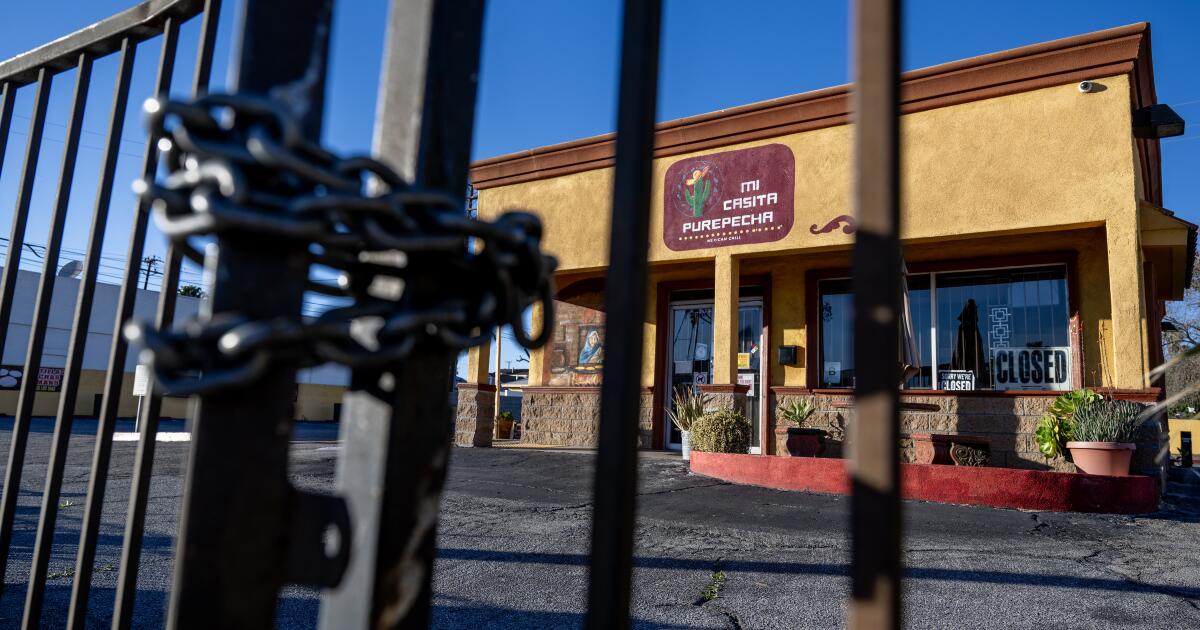
Alejandro Gonzalez was in a dispute over payment for a trailer when an old Toyota Camry pulled up to the drive-through window of Mi Casita Purepecha, his San Bernardino restaurant, on Feb. 1.
“Are you Alejandro?” the front-seat passenger asked Gonzalez, who was standing at the window.
The restaurateur said he was — and the man pulled out a gun and pointed it at him.
In the confusion of the moment, Gonzalez said, he turned to help customers inside the Mexican restaurant and the Camry sped away. Gonzalez, 44, didn’t recognize the men. But he said he fears that they are connected to Ochoa. Asked about the incident, Ochoa said he did not send armed men to Mi Casita Purepecha.
Gonzalez and his wife, Paulina Quintal, had contacted 8A Food Trucks in early January about building them two trailers so they could start a mobile food business. Ochoa delivered a trailer to their home two weeks later. Gonzalez said that he and his wife paid for it in full, and gave the builder a check for the down payment on a second one.
San Bernardino resident Alejandro Gonzalez said that this mobile food trailer, which he purchased from 8A Food Trucks, was stolen from his driveway in January.
(Alejandro Gonzalez)
Soon, however, men working for Ochoa appeared at Mi Casita Purepecha to dispute Gonzalez’s ownership of the trailer he’d bought days earlier, he said. Then, after the couple’s check for the second trailer didn’t clear, a third party passed along what Gonzalez said was a threatening voicemail from Ochoa.
On Jan. 21, Gonzalez said he returned from an errand to find his trailer had been stolen from his driveway. Seeking answers, he said he traveled to 8A Food Trucks’ headquarters in Ceres, Calif., but found the site deserted. The next day, Gonzalez said, the men with the gun visited him.
Gonzalez filed reports with the San Bernardino Police Department over the theft and the run-in at his restaurant. Regarding Ochoa, Gonzalez said, “I don’t know how he sleeps.”
Ochoa denied stealing the trailer from Gonzalez and Quintal’s home — “I would never do that,” he said — and alleged that they had not fully paid for it, saying that the check that bounced was meant to go toward the money they owed on it. Ochoa said he had sent two people to Mi Casita Purepecha to address those matters — and not to intimidate the couple.
“None of my people are armed,” he said. “We are businessmen; we dedicate ourselves to working and building trailers.”
Though the dollar amounts in most of the cases involving Ochoa are not large, for fledgling operators trying to break into the mobile food industry — many of them working-class immigrants — it’s enough to sidetrack their business dreams. And their predicaments highlight the vulnerability of California’s food industry workers, many of whom lack a financial safety net or the time and experience required to navigate the legal system. Some are undocumented and fear speaking to authorities.
“There were nights that we would cry, my husband and I,” said Adriana Nicanor, a San Joaquin resident. She and her husband filed a lawsuit against Ochoa and 8A Food Trucks last year that asserted he never delivered a trailer and claimed he refused to return their $20,000 deposit. They secured a default judgment, court records show, but have been unable to collect on it.
“It’s very frustrating,” Nicanor said. “My brother lent me that money. There were times we would struggle. Who asks for this?”
For many of Ochoa’s clients, making a down payment on a truck or trailer — both of which typically include kitchens — was an important first step in fulfilling a long-held entrepreneurial ambition. Some said that the alleged losses were especially painful because they came at the hands of one of their own: a Mexican immigrant who lived in the Central Valley and previously worked at an industrial shop before founding 8A Food Trucks in 2019.
He’s taking advantage of “the campesinos — the farmworkers,” said activist Alicia Espinoza, a Moreno Valley resident who has helped organize some of Ochoa’s accusers. “My dad, when he came to this country, he was a strawberry picker. It just hurts me that this guy could take advantage of people like him.”
Ochoa said he has many happy customers and has gone out of his way to help them achieve their aspirations, noting, for example, that he has sometimes accepted payment in installments. “Not many businesses do that,” he said. “You know, we’re not a bank.” As for the Nicanors, Ochoa denied that he failed to meet an agreed-upon deadline for delivery, and said he plans to pay them back.
Mi Casita Purepecha owner Alejandro Gonzalez said a car pulled up to the restaurant’s drive-through window and a passenger pulled a gun on him Feb. 1.
(Gina Ferazzi / Los Angeles Times)
Several of those making allegations against Ochoa reside in Stanislaus County, an agricultural hub whose biggest city is Modesto. Wendell Emerson, a deputy district attorney for the county, confirmed that his office is conducting “an active criminal investigation” of Ochoa. He declined to comment further.
After the incident at Mi Casita Purepecha, Gonzalez closed the restaurant and left San Bernardino, relocating his family — he and his wife have three children — to a place they feel safe.
“I don’t know how long it is going to be,” Gonzalez said. “I feel like I lost everything.”
Lawsuits reveal a pattern
Ochoa is an entrepreneur of the internet age.
Food industry workers who’ve done business with the Colima, Mexico, native said that they found him via social media, where his posts depict a professional at the helm of a prosperous company.
The Instagram account for 8A Food Trucks includes several images of gleaming vehicles, their stainless steel kitchens spotless under bright lights. The “8A” in the company’s name is a play on words: pronounced in Spanish, it sounds like “Ochoa.”
A recently divorced father of two young girls, Ochoa has positioned 8A as a brand beyond the world of food services: There are Instagram pages for a hat company with 8A in the name, and another for a jet-ski rental service. It’s all part of a slick image that Ochoa has cultivated online, where it’s easy to find his self-aggrandizing corridos and photographs of him posing in front of his black Chevrolet Corvette.
“Now they see me living well,” the lyrics of one song go, “driving around in a Corvette, buzzing.”
Ochoa’s flaunting of his success has infuriated customers with whom he’s tussled.
For Norma Estevez and her husband, Sebastian Delgado, entering the mobile food trade was a step toward realizing an important goal: owning a business they could pass onto their three children. But Estevez and Delgado, both Mexican American, believe they lost more money than any of Ochoa’s other alleged victims.
The Salinas couple contacted Ochoa in 2021 to build a pair of trailers, selecting him, Estevez said, because he was Latino. “He didn’t have many clients,” she said, “and you could tell he has this aspiration to succeed.”
Estevez needed the trailers for a big opportunity: She had signed a contract with a produce company in nearby Watsonville to feed 70 field workers for 10 months beginning in February 2022. The owner had predicated the deal on her securing a trailer and having proper permits.
Ochoa told her that each trailer would cost $41,000, and promised to complete construction by the end of January, according to Estevez, who showed The Times invoices that documented the deal.
She and her husband sent Ochoa $60,000 over the course of several months, and as the deadline approached, they scheduled a day to pick up the trailers from 8A Food Trucks’ shop, Estevez said. But Ochoa canceled on them, she said, explaining that “his mother had arrived from Mexico and that he needed to pick her up from the airport.” They rescheduled, but he again put them off.
By then, Estevez’s contract with the Watsonville company had begun, and she scrambled to honor it. She was forced to buy meals for the workers, spending about $37 per person a day for the next week and a half — an all-in cost of nearly $26,000. Eventually, she rented a kitchen for $800 a week, and did so until the contract concluded, turning only a small profit on the deal.
And without the trailers, Estevez wasn’t able to renew the contract. “I felt embarrassed … like we had lost a great opportunity,” she said.
Ochoa acknowledged that he didn’t meet the agreed-upon deadline — and that the situation was similar to that of other clients who didn’t receive their vehicles on time. But, he said, others were willing to wait. “Norma’s situation was that if she didn’t get the trailers by a certain date, then she wasn’t going to need them,” he said.
Estevez and Delgado filed a lawsuit against Ochoa for breach of contract and other claims in July 2022. Months later, the parties agreed to a settlement that called for Ochoa to pay Estevez and Delgado about $70,000, including attorney’s fees, according to court documents. Estevez said that Ochoa has only paid $30,000, leaving her deeply disillusioned.
“We were like him, we came to this country to better our lives,” she said. “He knew our dream and ambitions — we told him how hard we worked for it.”
Gonzalez, meanwhile, isn’t the only person who alleged that a trailer purchased from Ochoa was later taken back by him.
Shelly Lopez and her husband, Jesus Avalos, said they paid Ochoa $37,000, and after nine months of delays — and their appearance in a Univision 19 Sacramento segment to discuss them — the Sacramento couple received a trailer in January 2023.
A man Shelly Lopez identified as Fernando Ochoa Jauregui came to her Sacramento home, she said, in February 2023 to take the trailer that 8A Food Trucks had recently sold her.
(Courtesy of Shelly Lopez)
After just a week, though, Ochoa told Lopez that he needed to take it back to his shop to make some adjustments, she said. A video that Lopez provided to The Times shows a man she identified as Ochoa connecting the trailer to the back of a pickup truck in February 2023.
“I didn’t want to let him take it,” Lopez said. “But my husband said, ‘It’s OK, he’ll make the repairs and bring it back to us.’”
It was the last time Lopez and Avalos saw the trailer.
“We had so many fights after that,” she said. “It would come up whenever we were driving and saw people running their businesses, selling food. I would blame him for it.”
Ochoa said that Lopez hadn’t paid for the trailer in full, and that she was making payments in installments. He said that he only retrieved the trailer after she told him it needed repairs. After seeing her negative public comments about him, Ochoa said that he decided to void the payment plan, and resolved to return her funds.
Lopez said she has not gotten the money back.
‘He’s been laughing at us’
In recent days, Ochoa has come under attack online by disgruntled customers — and his former mother-in-law.
Gisela Macias, 48, said that strangers began showing up at her Modesto home over the summer in search of Ochoa. They came, she said, to demand he pay them back for vehicles they’d purchased but never received. The visits were so frequent that she began recording interviews with some of the people to post on TikTok.
Ochoa said that the internet activism and local TV news stories have led to an exodus of clients, which has imperiled his ability to pay back customers like Estevez. He said that he can only make payments in $1,000 increments. “I know it’s not much,” he said, “but I have no business due to everything that’s being said about my company.”
He said he had to close 8A Food Trucks’ headquarters in Ceres because angry clients kept going there to confront him. But his braggadocio is still easy to find on the internet. A 2023 corrido about Ochoa titled “Por 8A Me Conocen” includes the boast that “business is steady and we’re never going to stop.”
“I fought hard and little by little grew the empire that I founded,” the singer trills.
It incenses Estevez. “He’s been laughing at us — the people who had dreams, who worked hard to save money to make those dreams a reality,” she said.
These days, the equipment that Estevez and her husband bought for their two trailers — ovens, cooking wares and more — is mothballed in their garage. It’s hard for her to enter the space without crying.
“That’s our dream right there, collecting dust,” she said.
Times researcher Scott Wilson and columnist Gustavo Arellano contributed to this report.


The Minions took over theaters this weekend as Universal Pictures and Illumination’s “Minions & Monsters” won the top spot at the box office, though with a lower-than-expected domestic haul.
The animated movie, which follows the Minions’ takeover of Hollywood, took in $61.4 million in the U.S. and Canada for the five-day Fourth of July holiday weekend, according to studio estimates. That haul was lower than analysts’ expectations for a domestic opening of about $68 million. The movie’s three-day total was $36.4 million.
But the Minions performed well internationally, bringing in about $85 million. In total, “Minions & Monsters” made $159.9 million worldwide on a production budget of about $85 million.
The film is the latest in the powerhouse franchise that began with “Despicable Me” in 2010. Across its previous six installments, the “Despicable Me” and “Minions” franchise has made more than $5.6 billion at the global box office. The last movie, 2022’s “Minions: The Rise of Gru,” made more than $940 million worldwide.
“Minions & Monsters” marks the lowest opening for the franchise. Part of the issue could be timing — the box office can be negatively affected when the Fourth of July lands on a Saturday, said Paul Dergarabedian, head of marketplace trends at Rentrak.
Walt Disney Co. and Pixar’s “Toy Story 5” came in second at the box office this weekend with a domestic three-day gross of $31 million. Angel Studios’ biopic “Young Washington” ($20.8 million), Warner Bros. and DC Studios’ “Supergirl” ($9.6 million) and Universal’s “Disclosure Day” ($6 million) rounded out the top five, according to Rentrak.
The haul for “Minions & Monsters,” coupled with the strong holdover performance of “Toy Story 5,” proved again that family films are making a dent in the summer box office.
“Toy Story 5” has now brought in a total of $764.3 million worldwide, and last month, Universal, Illumination and Nintendo’s “The Super Mario Galaxy Movie” crossed $1 billion at the global box office, becoming the first film of any kind to do so this year.
The rest of the summer theatrical lineup is also expected to bring in audiences and push domestic box office totals closer to pre-pandemic figures. Next week, Disney will release its live-action “Moana,” followed by Christopher Nolan’s “The Odyssey” and Sony Pictures’ “Spider-Man: Brand New Day.”
To date, the summer box office is now about $2.3 billion, a nearly 12% increase compared with the same period a year ago, according to Rentrak data. Compared with pre-pandemic 2019’s numbers, however, it is still down about 7%.
Earlier this year, a widely circulated 15-second AI-generated video of Brad Pitt fighting Tom Cruise on a rooftop sparked outrage across Hollywood. One screenwriter called the cinematic clip “terrifying.” The Motion Picture Assn. demanded the company behind the artificial intelligence tool — Chinese tech giant ByteDance — halt its “infringing activity.”
Despite the uproar, the former majority owner of TikTok has quietly continued to court filmmakers, independent artists and executives who are eager to adopt the AI video generation model called Seedance.
Seedance was launched in the U.S. this spring at a Santa Monica event hosted by a group linked to the Chinese government.
ByteDance began hiring for 100 open roles, signed multiple independent filmmakers and artists and held private conversations about financing AI films. The company threw a lavish caviar party at Cannes and in May hosted panels promoting its cinematic tool at Amazon’s AI on the Lot event in Culver City.
“Like any new technology, Hollywood ultimately has no choice but to react to market realities. And that reality is that the new crop of AI-empowered Hollywood creatives see Seedance as having the most powerful video generator in the market right now,” said Peter Csathy of Creative Media, an entertainment and AI business advisory firm.
Joel Kuwahara, the animation producer on early seasons of “The Simpsons,” echoed Hollywood’s quiet embrace.
“Within the industry, I know that a lot of studios haven’t approved Seedance, but yet with a wink and a nod, they’re allowing Seedance to be used. … It’s kind of like a ‘don’t ask, don’t tell’ kind of a thing,’” Kuwahara told The Times.
ByteDance declined to comment on its U.S. expansion.
The race to build the dominant AI video model has created a fierce rivalry, pitting U.S. companies against the fast-closing Chinese competitors. On the American side, there are Google Veo and startups such as Runway and Luma. OpenAI’s Sora has discontinued its video tool.
The Chinese challengers Seedance, Kling and Alibaba’s HappyHorse have rapidly closed the gap on cinematic realism and have upstaged their American rivals by undercutting them on cost.
According to Artificial Analysis, a company that tracks cost and performances of different AI models, China’s Seedance is currently the most cost-effective and high-quality option compared with U.S. competitors. Seedance costs $9 per minute for video with audio generation, significantly lower than the $24 per minute required by Google’s Veo model.
That makes it an attractive tool for independent filmmakers like Rupert Wainwright, who recently met with Seedance executives at AI on the Lot.
He wants to use the the tool to help make his feature-length film called “Sebastian,” about a Christian saint set in 3rd century Rome. The hybrid AI film will be shot partly on location in Europe and partly generated with artificial intelligence.
“It’s the equivalent to when streaming a movie over the internet onto your TV finally became possible,” Wainwright said.
Kavan Cardoza.
(Kayla Bartkowski/Los Angeles Times)

A scene from “The Chronicles of Bone.”
(Kayla Bartkowski/Los Angeles Times)
In May, Steven Schneider, the producer of “Paranormal Activity,” famous for its handheld grainy footage-style filmmaking, announced “Terrarium,” his first hybrid AI horror production. The film’s director, Jason Zada, said it will be entirely generated using Seedance’s model.
Zada’s filmmaking workflow involves writing, casting, prompting and editing all simultaneously, allowing him to rewrite scripts based on “dailies” generated by AI that day.
He estimates that generating 15 seconds of high-definition video costs only $5.
“We could go from a very detailed outline, very detailed characters and have it be a bit more fluid, because we could regen[erate] as much as we want,” Zada said.
Zada plans to shoot the movie first on a soundstage with real actors and will decide later which parts work better traditionally and what should be done synthetically. He’s a member of the Directors Guild of America and said he will be employing union actors for his hybrid AI film.
Seedance also has continued building ties by offering indie creators, AI-native studios and filmmakers free monthly credits and access to unreleased features. These “tastemakers” beta test its models, offer feedback on what works, and use it for their personal filmmaking projects — which creates corporate brand awareness.
Kavan Cardoza is one such breakout filmmaker. His AI fantasy series, “The Chronicle of Bones,” which uses Seedance, features half a dozen distinct storylines and an ensemble of characters. New episodes, each not more than 30 minutes, are released on YouTube once a month. The solo filmmaker averages 3 million views per episode and has cultivated a YouTube audience of 500,000.
Most filmmakers are tool agnostic, but lately Cardoza has become completely dependent on Seedance, he said, because it solves a persistent problem: maintaining character consistency between shots.

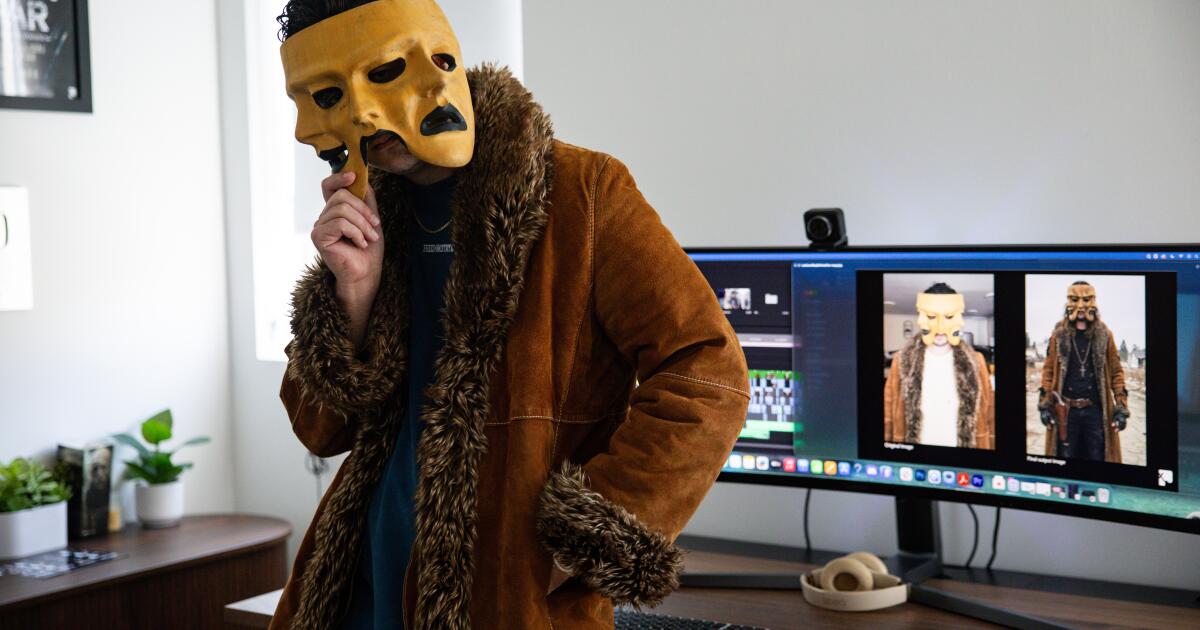
Kavan Cardoza unmasked.
(Kayla Bartkowski/Los Angeles Times)
To create one of his characters, “the last lost boy,” Cardoza took self-portraits wearing a three-faced mask and a tattered brown jacket. He used those reference images for the AI character and transforms them into a stylized person, with a personality, backstory and visual details. He fed those images back to Seedance to get consistent characters — repeating the process for each member of the cast.
“I can’t go get Brad Pitt because he costs like $5, 10, 20 million to be in my film,” Cardoza said. “I can probably get a synthetic actor that will act just as good as Brad Pitt in the future. That’s crazy to me.”
Cardoza has copyrighted his script and characters, and aims to eventually attract major studio interest to turn his intellectual property into a film which comes with a built-in fan base.
Such plans are likely to face resistance from the performers union SAG-AFTRA, which has decried the use of synthetic actors such as Tilly Norwood.
“The rise of Seedance comes down to [its] focus on pleasing filmmakers and making things that look filmic,” said Stephan Vladimir Bugaj, senior vice president of JioStar, a joint venture between Disney and India’s Reliance Industries.
ByteDance introduced timeline-based prompting so filmmakers can actually pick specific moments and tweak them, and improved the understanding of camera direction, physics, lighting and fluidity of action. All of this, Bugaj said, “unlocked a kind of spectacle filmmaking that the other models are not delivering quite as well.”
The company’s tool has been in such high demand, Zada said, that Seedance has been quoting some major Hollywood studios $2 million for unrestricted special access.
While acknowledging Seedance’s popularity and its U.S. expansion, Amit Jain, chief executive of Luma, said its ceiling in Hollywood is severely limited. Traditional studios might adopt Chinese models for some preproduction tasks such as concepting, but the geopolitical and intellectual property risks for commercial generations are too prohibitive.
“Can you imagine Disney using the ByteDance model for the next ‘Snow White’? No way,” Jain said. “This is not even a technical argument, really. That’s the reality.”
Luma has been making inroads into Hollywood selling its software but has separately funded a production service company to teach filmmakers to make hybrid AI films using its tools.
Despite conservative production budgets, AI spending by media companies is projected to grow from $2.6 billion to $12.5 billion from 2024 to 2029, according to a State of Generative AI Media report.

Kavan Cardoza flips through pages of his fine-art photography book.
(Kayla Bartkowski/Los Angeles Times)
Bugaj warned that the quality and competitive price of Chinese models should be a “wake-up call” for American players fighting for market share.
“We’re not loyal,” said Zada, the filmmaker. “Whatever is the best, we’re going to use it.”

Nearly a year after the expiration of a $7,500 federal tax incentive for new electric vehicles, California is stepping in to try to motivate buyers to go electric.
Gov. Gavin Newsom allocated $135 million in his new state budget to provide incentives for new and used EVs. Participating automakers will match the funds.
California leads the nation in EV adoption, though the market has taken a hit under the Trump administration.
The state budget — a more than $350-billion spending plan — went into effect Wednesday. The EV incentives will take effect in the coming weeks as the California Air Resources Board irons out agreements with dealerships.
Here’s what you need to know.
What are the incentives worth?
Senate Bill 168 tasked the California Air Resources Board with setting incentive amounts for new and used electric vehicles sold in California.
Eligible buyers will receive $3,500 off for new EVs and $1,750 off for used ones. Unlike the federal tax credits that expired in September, these incentives offer an instant discount and don’t require buyers to apply for credit later.
State funds will cover half of the incentive amount, and auto manufacturers will cover the other half.
The rebates will mean that most eligible buyers will effectively get between 4% and 7% of their money back.
For used EVs, “this incentive helps what’s already a good deal become an even better deal,” said auto analyst Brian Moody. “I think that’s the perfect use of these kinds of dollars.”
What are the rules and exceptions?
The new incentives can’t be used on all electric vehicles — they apply only to new EVs with a manufacturer’s suggested retail price of $50,000 or less, and used EVs with a sale price of $25,000 or less.
The $50,000 maximum rules out many options on the market, but legislation outlining the incentive program makes a special exception for California-based companies. Buyers purchasing a new or used EV from a company with headquarters in California can claim the discount regardless of the vehicle price.
That’s good news for Lucid, with headquarters in Newark, Calif., and for Irvine-based Rivian. Neither company currently offers new vehicles for less than $50,000. Rivian said it plans to launch a $44,990 SUV in 2027.
Who is eligible?
California’s new EV discounts are available only to first-time EV buyers, according to the legislation.
SB 168 says the buyer’s eligibility will be “confirmed by a buyer attestation” that they have not previously owned a zero-emission vehicle.
The new EV incentive is less than half of the federal incentive that expired nine months ago. Whereas the federal incentive may have been enough to spark interest in a range of buyers, Moody said the lesser amount will probably appeal mainly to people who already have their eye on an EV.
“I think you have to already be considering it, or in the market,” Moody said. “I think that the amount is just right for that.”
What are California’s clean car goals?
The incentives are intended to help California reach its electric vehicle and air quality goals as those targets have been under fire from President Trump.
Shortly after taking office, Trump signed an executive order that revoked California’s authority to set its own EV regulations, which included a goal of having 100% of new vehicle sales in the state be zero-emission by 2035.
California sued the administration in response. The state also has goals, including some that have been in place since 2012, that set declining limits on smog-causing pollutants and required automakers to sell increasing percentages of electric and hybrid vehicles through 2025.
In March, the administration filed a new lawsuit again trying to block California’s ability to set stricter-than-federal emissions standards for cars.
Early this year, California announced that more than 2.5 million zero-emission vehicles had been sold in the state since 2010, surpassing a target to put 1.5 million zero-emission vehicles on the road by 2025.
-
 Idaho14 seconds ago
Residents displaced after Boise home found fully engulfed in flames, fire officials say
-

 Illinois3 minutes ago
26-Year-Old Woman Killed In I-55 Crash, Coroner Says
-

 Indiana8 minutes ago
Fever take down Aces 84-68, led by Kelsey Mitchell’s 27 points
-

 Iowa15 minutes ago
14-year-old Dyersville girl dies in July 4 Clear Lake watercraft crash
-
 Kansas18 minutes ago
Police in Kansas City, Missouri, investigate Sunday night homicide
-

 Kentucky23 minutes ago
1 missing, 4 injured in Fourth of July boating collision on Kentucky lake
-

 Louisiana30 minutes ago
Louisiana State Police Detectives Investigating Shreveport Police Department Officer-Involved Shooting
-

 Maine33 minutes ago
One dead, another injured in Madison ATV crash

