New Hampshire
State universities admit more out-of-state students for the tuition bump – New Hampshire Bulletin

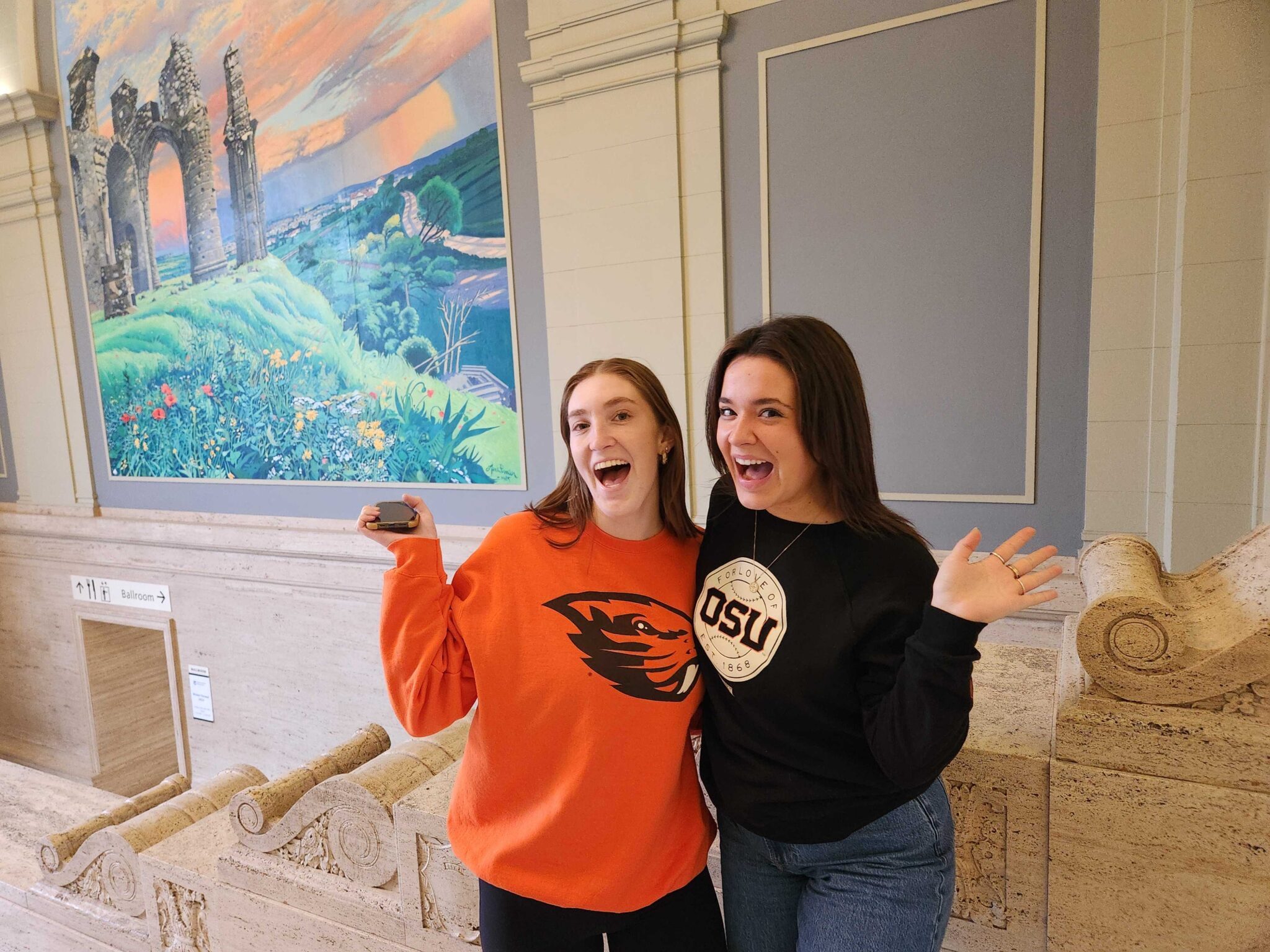
CORVALLIS, Ore. — Kennedy Cole, a college junior studying accounting, knew she wanted to attend school outside her native Nevada to expand her choices, meet new people, and explore different places.
Emma Nichols, a sophomore majoring in vocal performance, chose a school close to her home in Corvallis, Oregon.
The two friends, Oregon State University tour ambassadors who guide prospective students and families around campus, both think they made the right decision.
Cole said it was scary and tough to be at a school where many first-year students already knew one another or had gone to local high schools, but she found most students were friendly. Nichols said one of the exciting aspects of Oregon State’s campus is the ability to meet “out-of-state students and international ones from a different culture.”
But while they both have scholarships, there’s a big difference in their base tuition.
The university charges an estimated $13,800 in tuition and fees for in-state undergraduates in the 2023-24 academic year and about $36,600 for nonresidents.
At a time when school budgets are tightening and college enrollment is decreasing, state universities are increasingly turning to nonresident students to boost their revenues.
In 47 states, public research universities increased the proportion of out-of-state undergraduate students they admitted between 2002 and 2022, according to an analysis of federal education data done for Stateline by University of Wisconsin-Madison education professor Nicholas Hillman.
In those two decades, the percentage of out-of-state undergraduate students at those universities rose steadily from a nationwide average of 18 percent to 28 percent, Hillman found. Public research schools are generally large state universities that receive significant grants for research.
“Universities that have broad access missions have the least revenue stream,” Hillman said in an interview. Any shift in public funding “affects them more. Slots are being given away to people paying higher tuition. Politically, this is such a hot potato. Legislators are getting interested in this.”
While the funding boosts universities, critics worry that in-state students are being shut out. To minimize that, some states limit the number of out-of-state students.
Aaron Klein, a senior fellow at the Washington, D.C.-based Brookings Institution, a centrist think tank, wrote a report on out-of-state enrollment in 2022.
In an interview with Stateline, Klein said: “The ability to go to a high-quality school near where you grew up is being taken away for many kids through a complex process in which public universities are swapping in-state students for out-of-state. In the end, society is no better educated, and student debt rises substantially.”
In Oregon, the average percentage of undergraduate students from out of state rose from 23 percent to 47 percent at the state’s public research universities, according to Hillman’s analysis.
At Oregon State University, 63 percent of undergraduate students are nonresidents, according to Jon Boeckenstedt, vice provost of enrollment management, who has written extensively on the subject. The percentage drops to about half when including graduate students, he said. But Boeckenstedt also said virtually no Oregonian applicant who is qualified is denied a place at his campus. The university’s acceptance rate for first-year applicants in 2022-23 was nearly 83 percent, according to data provided by the school to the U.S. Department of Education.
“Up until about 2019 or 2020, we had sort of an informal, trustee-mandated ratio of two-thirds resident, one-third nonresident balance,” he said in an interview in his office on the lush Oregon State campus.
“But if you manage to that ratio, and resident enrollment falls by 100 [students], you need to purposely exclude out-of-state residents who want to come here and bring their out-of-state tuition dollars,” Boeckenstedt said. “And so I said, ‘Let’s think about this differently.’”
Shift toward out-of-state students
The trend toward admitting more out-of-state students started as far back as the 1980s, when state legislatures and governors began reducing funding for higher education, said Ozan Jaquette, an associate professor of higher education at the UCLA Graduate School of Education & Information Studies who has studied nonresident enrollment at public universities. He added that the trend has accelerated over the past decade.
“Once states said, ‘Hey, you can make your own money,’ the public universities that could, said, ‘We are going to dramatically increase nonresident enrollment because they pay higher tuition,’” he said.
Up until the end of the last decade, the move toward out-of-state recruitment mostly applied to flagship state universities, Jaquette said, as they had the widespread name recognition to attract students from other places. But now, he said, it has trickled down to the next tier of public colleges, as budgets get tighter and more nonresidents apply.
Some universities that recruit out-of-state students tend to focus on private high school students, since their families often can afford to pay higher tuition, he said. But some recruiting lately has expanded to public high schools, usually in affluent suburbs, or areas where there are few public state universities and pockets of affluent students all competing for the in-state slots. It’s easier, sometimes, to get in at a university in another state.
“The only viable route [to increase the budgets] is nonresident enrollment,” he said of schools with declining state funding. “If you are not Stanford or Princeton, there are limits to how much donation and endowment you have and there are limits to research funding.”
Some schools also recruit internationally.
Arizona State University spotlights the fact that it is the top public university choice for international students, according to an Institute of International Education’s Open Doors report. Nearly 18,000 international students studied at the school in the 2022-23 school year, according to Open Doors data. The research institution tracks U.S. students studying abroad and international students coming to the United States.
About two hours south at the University of Arizona in Tucson, current undergraduate enrollment is 50 percent students from the state, 45.2 percent from out of state and 4.5 percent international, for about a nearly even split between residents and nonresidents, Kasandra Urquidez, the school’s chief enrollment officer, wrote in an email.
While University of Arizona enrollment for undergraduate state residents dropped 4.6 percent over the last decade, from 19,206 to 18,323, nonresident undergraduates have risen 41 percent, from 10,244 to 14,478, according to figures provided by Urquidez. Arizona resident tuition for undergraduates is $13,200 and nonresident tuition is $39,600, she said.
“As a state university, non-resident enrollment … provides university revenue and decreased state funding causes the university to seek alternative forms of revenue,” she wrote in the email.
She added that Arizona does not limit spots for residents: “We are very dedicated to the citizens of our state and would never turn away a qualifying resident for a non-resident.”
Chanah Tanioka is a senior of Japanese descent from Hawaii studying pre-med at Oregon State University. She’s the first of her family to go to college and said she looked at public universities all over the country, but chose Oregon State because it felt more welcoming to someone of her heritage than some schools in the Midwest or Southeast.
She also had a close family friend who attended the school and now lives in nearby Salem. Tanioka has scholarships that make it possible for her to afford the steeper tuition and recommends that students from other places who want to attend a big public university check out its culture before going.
Tanioka belongs to the Hawai’i Club on campus, which helps make her feel at home. She said one jarring thing about going to school on the mainland is the lack of understanding of her native Hawaiian Pidgin vernacular, in which “Are you pau with your food?” means “Are you finished?”
Some states seek limits
While many public universities have embraced nonresident enrollment in recent years, some states have quotas or laws that are aimed at putting in-state residents first.
In North Carolina, five state schools — including the University of North Carolina-Chapel Hill and North Carolina State University — have an 18 percent cap. Seven have a 25 percent cap, two have a 35 percent cap, and one, Elizabeth City State University, has a 50 percent cap. Historically Black colleges and universities, known as HBCUs, and schools that had declining in-state enrollment were granted the higher caps.
In Texas, state law mandates that high school students graduating in the top 10 percent of their class (except the top 6% for the University of Texas at Austin applicants) are automatically admitted to any public Texas university.
That can effectively limit the number of non-Texas students at those schools. Out-of-state enrollment in Texas public universities grew only 1 percentage point over the past decade, from 6 percent to 7 percent, according to Hillman’s research.
The University of California Board of Regents, under pressure from state lawmakers alarmed at the high percentage of nonresident students attending California universities, in 2017 adopted a new policy to limit nonresident enrollment. The board settled on 18 percent at five campuses; on four other campuses that already had exceeded that percentage, enrollment would be capped at their 2017-2018 levels.
The legislature then worked to appropriate more money to make up for the revenue hit the California campuses would take by admitting fewer higher-paying nonresident students.
The deal directed $31 million in state funding to the universities in 2022-23, and grew to $61 million in 2023-24, and is expected to increase to $92 million in 2024-25, according to Justin Tran, spokesperson for California state Sen. John Laird, a Democrat and chair of the Senate Budget Subcommittee on Education, who was instrumental in the actions. That is aimed at reducing nonresident enrollment to 18% of the undergraduate student body, replacing about 900 nonresidents with Californians annually, Tran wrote in an email.
Oregon lawmakers also are concerned about the number of nonresident students attending state universities. State Rep. John Lively, a Democrat and chair of the House Committee on Higher Education, wrote in an email that the lower ratio of Oregon students to nonresidents is something that deserves a “hard look” to see what role cost plays in that calculation.
He also suggested that people from elsewhere who go to school in Oregon may enhance the state’s economy by staying after graduation to work.
“It’s also a goal of mine to attract new students and decrease the barrier that cost of higher education creates on individuals and families hoping to make a future here in Oregon,” he wrote.
This story was originally published by Stateline, which like the New Hampshire Bulletin is part of States Newsroom, a nonprofit news network supported by grants and a coalition of donors as a 501c(3) public charity.



Sara Doherty
Franklin, NH – Sara Jane (Sanford) Doherty, 79, of Franklin, New Hampshire, passed away peacefully at her home on June 11, 2026. A beloved wife, mother, grandmother, and friend, Sara was born on June 5, 1947, in Hanover, New Hampshire, to Harold and Sadie (Pettengill) Sanford.
As the daughter of a U.S. Army Corps of Engineers employee, Sara spent her childhood moving throughout New England, living in New Hampshire, Massachusetts, and Connecticut. She graduated from high school in Hudson, Massachusetts, and later returned to New Hampshire, eventually settling in Franklin, where she made her home for more than forty years.
Sara built a successful career in the textile industry. She worked as a seamstress at Howland Originals before joining Star Specialty Knitting, where she began as a stitcher and, through hard work and determination, advanced to Plant Manager. She retired in 2003, and one of the greatest joys of her retirement was caring for several of her grandchildren, whom she adored.
Sara was a remarkably talented and creative artisan. She sewed clothing for her children when they were young and later created outfits for her grandchildren and their dolls. She was a gifted painter and artist whose extraordinary drawings and paintings brought joy to those around her. An accomplished seamstress, knitter, crocheter, cake decorator, and musician, Sara had an exceptional ability to create beauty in many forms. Her handmade gifts and treasured creations will be cherished by her family for generations to come.
Her talent for cake decorating blossomed into a successful side business that spanned more than thirty years. Sara created hundreds of stunning and imaginative cakes, including wedding and birthday cakes for her own children and grandchildren. Her passion for baking was so well known that for many years her license plate proudly read “CAKES+.”
Sara also had a remarkable gift for bringing people together. She hosted countless family reunions, each one more creative than the last. With elaborate themes, games, prizes, delicious food, and endless laughter, she created memories that her family will treasure forever. She was also known for her generous holiday gatherings, often welcoming more than thirty family members and friends into her home for Thanksgiving and Christmas celebrations. Summers brought cherished Fourth of July cookouts by Webster Lake, where Sara delighted in decorating the waterfront and gathering loved ones to enjoy the annual boat parade.
Sara’s love of giraffes was known by all who knew her. She spent years collecting hundreds of them, giving each a special “G” name. Before her passing, she shared one of her favorites, “Geebri,” with her granddaughter Sydni, who is expecting Sara’s first great-grandchild.
Her warmth, creativity, generosity, and love of family touched everyone who knew her. To say she will be missed is a vast understatement. She was truly the heart of her family.
Sara leaves behind her devoted husband of 43 years, Joel Doherty; her sons, Todd (Michelle) Chapman of Sanbornton, New Hampshire, and Paul (Cheryl) Chapman of Northfield, New Hampshire; her stepdaughters, Ali (Oliver) Frates of Amherst, New Hampshire, and Kate Hodge of Durham, New Hampshire; and her beloved grandchildren, Shelby, Sydni, Morgan, Owen, Duncan, Calum, Macy, and Elyse, and Step-grandchildren, Matthew, Jennifer, Eric, & Kevin.
Sara was predeceased by her parents.
Sara’s family would like to express their heartfelt thanks to Franklin VNA for their rapid and seamless response in setting up hospice, and to The Payson Center for their dedication and care, which gave us more precious time with her.
A graveside service will be held on Tuesday, June 30, 2026 at 11:00 AM in Franklin Cemetery, Thompson Park in Franklin.
For more information or to leave the family an online condolence, please visit www.smartmemorialhome.com.
Click here to sign the guest book or honor their memory with flowers, donations, or other heartfelt tributes

A staple of many New Hampshire town fairs, the pig scramble may soon look a little different.
A bill signed into law by Gov. Kelly Ayotte last week requires the commissioner of the state Department of Agriculture to create best practices for any event in which people compete to capture a pig. Those guidelines will be published before the 2027 fair season, so they won’t be in place for any fairs with pig scrambles this year, such as the upcoming Deerfield Fair in the fall.
Generally, a pig scramble involves people of the same age competing to capture pigs that have been let loose in a large pen. Contestants have to catch the pig in a drawstring bag, and the first one to do so can take the pig home.
Rep. Cathryn Harvey, a Democrat from Spofford, is the prime sponsor of the bill. She said each fair has different rules for their pig scrambles, meaning some can be more humane than others. One aspect of the events she hopes will change is the bags pigs are captured in.
“They’re putting an animal in a plastic bag on a hot summer day,” Harvey said. “It isn’t a great idea.”
Although some fairs already use more breathable bags out of burlap, Joan O’Brien, president of the New Hampshire Animal Rights League, said she’s also seen pigs being kept in plastic bags for long periods of time after the event. Not only would a burlap bag improve the pig’s ability to breathe in the heat, she said, but she also wants fairs to require participants to bring an animal carrier for the trip home. Her organization was ultimately in favor of the legislation.
“If you don’t have a carrier, you should not be allowed to leave your pig lying in a bag,” O’Brien said, adding that some fairs already ask contestants to bring carriers. “You should be taking them right home.”
The Deerfield Fair has implemented another rule that O’Brien and Harvey hope becomes part of statewide best practices — having parents supervise their child in the pen. O’Brien once witnessed a child hang a pig upside down by its legs and then lower it headfirst into the bag.
“In the heat of the moment, the kids get excited and they just do whatever it takes to get the pig in the bag,” O’Brien said. She said parents should work with the event referee to make sure their kid is handling the pig humanely.
Harvey’s bill originally called for pig scrambles to be banned around the state, but both she and O’Brien feel that universal guidelines for fairs would still make the experience better for the animals. Even seemingly small things, Harvey said, like giving the pigs water after the scramble, would be an improvement to the current situation for them.
“I think that the bill will embolden people to speak up at these events,” O’Brien said. “If they think a pig is being mistreated, they’ll be able to say to themselves, ‘I know that there’s supposed to be a rule, so I’m going to say something.’ So I think that would be a good outcome.”

-

 Tennessee7 minutes ago
Tennessee Aquarium, Chattanooga Lookouts team up to teach fans about waterway trash
-

 Texas7 minutes ago
8 convicted of terrorism charges in Texas immigration center shooting sentenced to decades in prison
-

 Utah15 minutes ago
Utah Jazz’s Direction for the No. 2 Pick Is Becoming Clear
-

 Vermont22 minutes ago
Commentary | Vermont Chamber: Vermont is in trouble
-

 Virginia25 minutes ago
Vehicle crashes into Virginia Beach seafood restaurant
-

 Washington30 minutes ago
Washington Commanders announce 2026 training camp schedule
-

 Wisconsin37 minutes ago
Wisconsin man arrested in Colorado in connection with deadly hit-and-run in north suburbs
-

 West Virginia39 minutes ago
The Moving Wall returns to West Virginia with stop in St. Albans this week – WV MetroNews

