Michigan
A new anti-poverty program in Flint, Michigan, gives cash to new moms


When Alana Turner’s son, Ace, was a baby, she had to boil bottled water to give him a warm bath — the water from the tap was contaminated with lead. But more difficult, she recalls, was having to go back to work five weeks after giving birth.
“I just had to go back so quickly, and I always regret doing that, even though I had to,” Turner said. “It’s traumatic not only to you, but to the baby as well. And I was breastfeeding. So to be away from a newborn that you’re breastfeeding at five weeks old, it’s stressful.”
Four years later, and now expecting her second child, Turner is one of the people who will benefit from Rx Kids, a new program in Flint, Michigan, that “prescribes” cash payments to every pregnant person (or guardian) and infant in the city. The program gives a one-time $1,500 payment after 20 weeks of pregnancy, and $500 a month during the infant’s first year.
Alana Turner with her son, Ace, and fiancé Orlando Brown at Rx Kids’ January open enrollment event in Flint, Michigan. Photo by Douglas Pike/Rx Kids
There are no income requirements or restrictions on how participants spend the money. The goal of the program is to improve infant and maternal health outcomes and economic stability for the city’s youngest residents and their families.
Enrollment began Jan. 10, and the program hosted a big community launch party Feb. 14.
The program is a public-private partnership, funded in part by the state of Michigan through a novel use of the federal Temporary Assistance for Needy Families (TANF) grant, along with major support from the Charles Stewart Mott Foundation. It also involves a research partnership with Michigan State University, the University of Michigan, and Hurley Children’s Hospital. Other supporters include foundations, community organizations, city government, health insurance companies, and individual donors. More than $43 million has been raised so far, enough to run the program for at least three years. The goal is to raise $55 million to fund the program for five years.
Gov. Gretchen Whitmer also included $24 million in her budget proposal for fiscal year 2025 to expand a version of this program to seven other cities across Michigan, on a slightly smaller scale — $1,500 before the birth of a child, and $500 a month for the first three months of life.
The program is “about a new vision of how we fundamentally should be caring for each other,” said Dr. Mona Hanna-Attisha, one of the program’s co-directors.

Dr. Mona Hanna-Attisha with baby Khim’Meir Taylor at Rx Kids’ Jan. 10 open enrollment celebration in Flint, Michigan. Photo by Douglas Pike/Rx Kids
About 1,200 children are born in the city of Flint every year. Almost 70 percent of Flint children grow up in poverty, five times the U.S. average, according to the University of Michigan Center for Poverty Solutions. Flint is one of the poorest places in the country, with a median household income of $35,451.
This city of about 80,000 people was once a vibrant automobile manufacturing center; General Motors was founded here in 1908. After years of deindustrialization, disinvestment, and “white flight,” Flint is better known today for the lead found in the city’s water supply in 2014, after an emergency financial manager appointed by then-Gov. Rick Snyder changed Flint’s water source without adding anticorrosive measures. Hanna-Attisha was one of the first people to sound the alarm on the issue.
Having a program for every child born in the city with no income requirements and with no strings attached is “sharing a message of trust in a city where there is no trust,” said Hanna-Attisha, the associate dean for public health at Michigan State University’s College of Human Medicine.
While there have been other cash assistance pilots and programs focused on maternal-infant health, including the Abundant Birth Project in California and the Bridge Project in New York, Hanna-Attisha said the new initiative in Flint stands out as the first universal citywide initiative, with the largest overall financial investment.
WATCH: Child poverty increases sharply following expiration of expanded tax credit
The first year of a child’s life is generally when families struggle the most financially, Hanna-Attisha said, and it’s also critical for a child’s neurodevelopment.
“We do so much for our kids, especially since the water crisis,” she said. “But so much of it is Band-Aids. So much of it is after the fact.”
The opportunity, she added, is to start building a more steady foundation from the start.
What research says
While this kind of program is relatively new for the U.S., it is not new for other countries around the world. Many other countries have more paid parental leave, child benefits, and child cash allowances.
A recent review of nearly two dozen studies on cash transfer programs for families in Canada, published in the Canadian Journal of Public Health, found they can lead to healthier pregnancies, better birth weight, fewer premature births, more breastfeeding, better parental mental health, better food security, and better early cognitive development in infants.
“We have strong evidence that more resources when women are pregnant can lead to healthier births — meaning higher birthweight, better maternal health,” said Hilary Hoynes, professor of economics and public policy and director of the Berkeley Opportunity Lab at the University of California Berkeley.
WATCH: Policies to reduce child poverty can help in their growth and development, study finds
An analysis from the Institute for Women’s Policy Research said that cash transfer programs in the U.S. have increased significantly since 2018, and especially in the wake of the COVID-19 pandemic. Ninety guaranteed income programs were implemented between 2017 and early 2023, it found, across 30 states and the District of Columbia. At least half of these were focused on women or households with children, it noted, suggesting such programs “will touch the lives of many women across the U.S.”
“The U.S. spends less as a share of GDP on anti-poverty programs for families with children compared to other rich countries. That lower spending is consequential — we also have higher child poverty rates compared to other rich countries,” Hoynes said.
Most existing government social safety net programs in the U.S. respond in kind, like providing food and nutrition, or housing vouchers. Many are also conditional, for instance on jobs or work.
Hoynes’ own research on Supplemental Nutrition Assistance Program (SNAP) showed that legislative, media, and public attention on the program “is too focused on decisions of the mothers,” like whether assistance changes whether they work or how they shop, Hoynes said. Over the past 10 years, research has begun to shift from the behavior of the mother to how these programs affect the general well-being of the family in the short and long term. Recent research by Hoynes and others shows that more spending on SNAP in early childhood leads to improved education and labor market outcomes, reductions in contact with the criminal justice system, better health, and lower mortality.
“This shows that the social safety net is an investment in children with a return on investment,” Hoynes said. “These benefits need to be weighed against the costs of the program. For too long we have focused on costs and not enough on the benefits.”
The changes to the 2021 child tax credit during the COVID-19 pandemic expanded eligibility and increased the amount families could receive, but it also distributed benefits on a monthly basis, rather than in one lump sum. A 2022 University of Michigan study found that the 2021 expanded child tax credit decreased poverty and food insecurity, and helped reduce medical hardships and people’s inability to pay utility bills, and more. Evidence showed that people generally spent that money on things like food, rent, utilities, and enrichments for their children like school supplies and clothing. It did not affect people’s employment.
Research by UNICEF found that when countries adopt a family cash allowance policy, child poverty decreases dramatically. Universal cash benefits for children at 1 percent of GDP leads to a 20 percent decline in poverty across the entire population.
The expanded child tax credit was not renewed, and the child poverty rate more than doubled in 2022, a result of expiring programs and other pandemic-era initiatives, according to an analysis from the Center on Budget and Policy Priorities. The House of Representatives just passed an updated version for 2024, with bipartisan support.
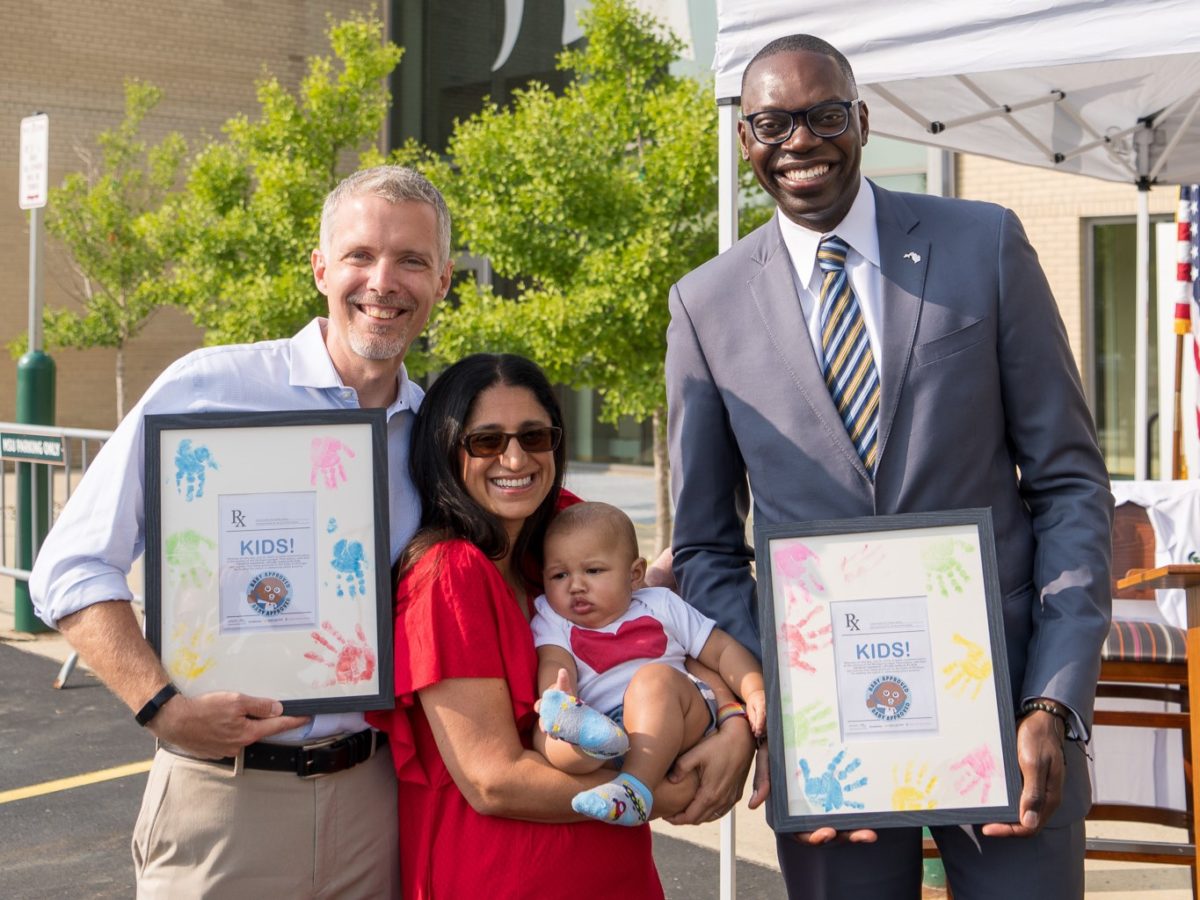
Luke H. Shaefer (left to right), Dr. Mona Hanna-Attisha, and state Lieutenant Gov. Garlin Gilchrist celebrating the inclusion of Rx Kids funding in Gov. Gretchen Whitmer’s state budget that was signed into law last summer. Shaefer and Gilchrist hold up handprints from babies “endorsing” the Rx Kids program. Photo courtesy of Charles Stewart Mott Department of Public Health
“Rx Kids was in part inspired by the incredible success of the expanded child tax credit that brought child poverty to an all-time low,” said H. Luke Shaefer, professor of public policy and director of Poverty Solutions at the University of Michigan. “[It] showed what is possible. Rx Kids though adds important pieces, including by supporting pregnant moms in pregnancy, before a baby is born, and being immediately available to families upon the birth of a child when poverty spikes and so do expenses rather than the year following the birth of a child.”
Rx Kids also provides an opportunity to expand research on these types of programs, and on health more broadly, he said.
“We’ll look at the impact of Rx Kids on health care utilization, such as when pregnant moms start prenatal care and how often they go, health outcomes at birth, and health for moms and babies in the first year of life,” said Shaefer, a co-director of the program. “We also have a big look at impacts on child welfare involvement that peaks during the first year of life. We’ll be able to assess whether the program helps reduce out of home placements for neglect and abuse. We’ll also be able to look at questions about whether Rx Kids spurs civic participation through things like voting, and the impacts to the local economy.”
One month into the program, 300 families have enrolled and almost $400,000 in cash has been prescribed.
Response to the program
The idea has received broad support in Michigan from the local and national level.
“Investing in strong families is an investment in Flint’s future,” Flint Mayor Sheldon Neeley said in a statement. “Rx Kids will support mothers and children in Flint when they are most vulnerable. This blessing will lift families out of poverty and improve health outcomes.”
Critics of guaranteed income or cash assistance programs have often argued that they do little to incentivize work or other requirements that may help improve economic stability. Hanna-Attisha said the limited nature of this program — ending at 12 months of age — has alleviated some arguments about work and lifestyle choices.
Republican state Sen. Jim Runestad voted against the 2024 budget last year, which included Rx Kids. He told Bridge Michigan last summer that cash handouts without restrictions are “emotional programs” that “create dependence on the government” and that “to just willy-nilly hand checks out is irresponsible to the nth degree.”
Why Flint?
Part of what makes Flint an ideal place for Rx Kids is that Flint is a small big city that already has a community-partnered academic infrastructure.
“Everything that we do in Flint is hand in hand with community,” said Hanna-Attisha, who is the founding director of the Pediatric Public Health Initiative, a Michigan State University and Hurley Children’s Hospital partnership. “We built this public health program here in Flint. And it was built in partnership with community. We asked the community, ‘What do you want us to work on?’” Rx Kids has a parents group, a kids group, and a new moms’ group.
WATCH: New study reveals the effect of racism and poverty on children’s brains
She added that the city has a “track record of transforming practice into policy.” Many of the changes that occurred after the Flint water crisis have also been implemented elsewhere across the country — lead pipes have been replaced, EPA lead and copper rules have been tightened, and a nutrition prescription program inspired a U.S. farm bill.
“There’s a lot of things that we have done here that have gone on to help kids in communities across the nation,” she said. “I want to do this for every kid in the country.”
What’s next
Whitmer’s budget proposal for fiscal year 2025 would launch several more cash assistance programs like Rx Kids in cities across the state. The prenatal and infant support program would give pregnant people $1,500 before the child’s birth and then $500 for the first three months of the newborn’s life. The money can be used to buy food, toys, diapers, and anything else needed to care for the newborn. If approved by the state legislature, these new programs could potentially be ready to implement in the next fiscal year.
“In Michigan, we support new parents by having their back every step of the way,” Whitmer said in an emailed statement to the NewsHour. “By expanding the program to seven more cities across the state, we will lower costs for new moms and ensure they and their babies can ‘make it’ in Michigan.”
In Flint, Hanna-Attisha sees firsthand how much new mothers struggle. “I was in clinic the other day and a newborn missed their first appointment,” Hanna-Attisha said. “Staff called, and the mom had to go back to work at four days of age.” Another new mother went back to work before her newborn was eight days old.
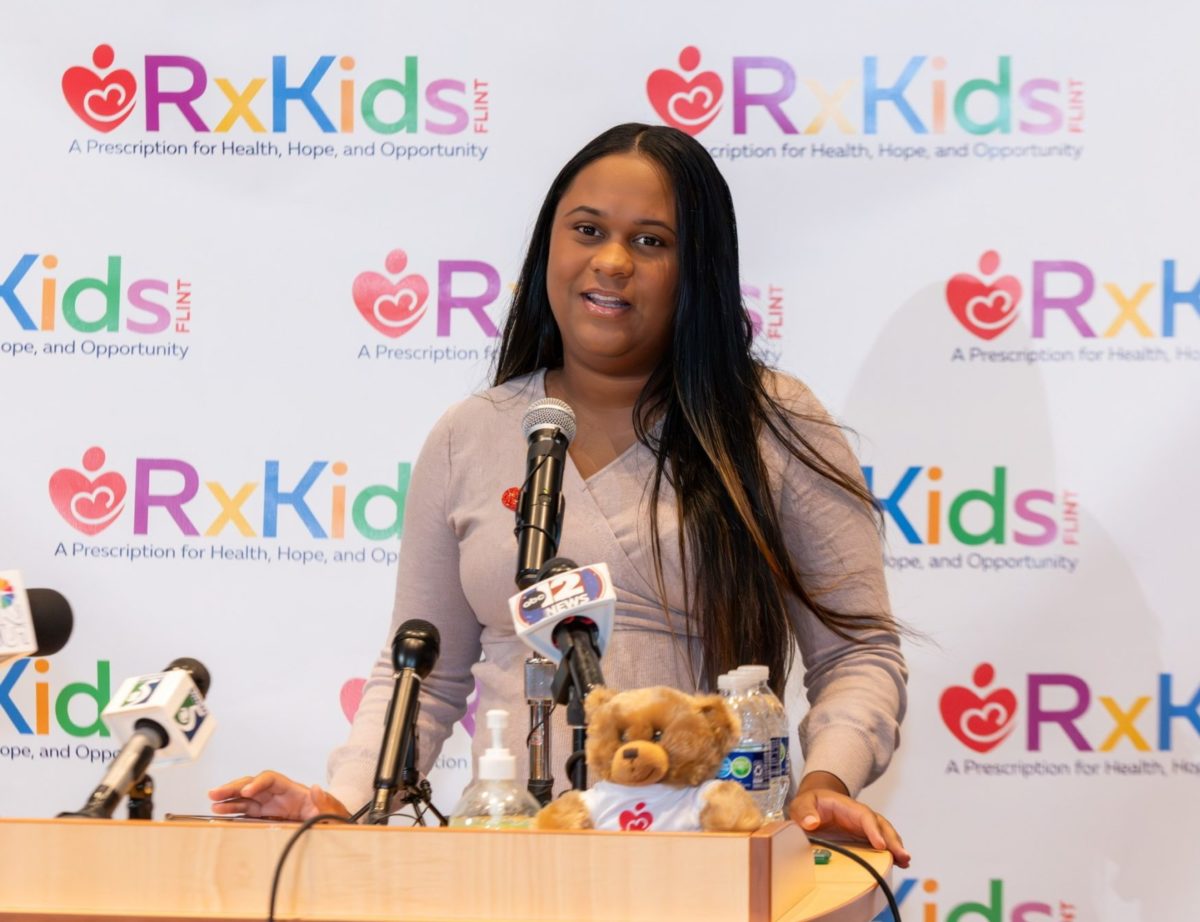
Alana Turner speaks at a Rx Kids event on Jan. 10. Photo by Douglas Pike/Rx Kids
For Turner, things look different now than they did four years ago. The lead pipes to her home have been replaced, and she is now 31 weeks pregnant, with her second child due in April. She currently works two jobs — as a property manager and at a call center. Turner said she hopes that the extra support from Rx Kids will allow her to gradually return to first one position and then the other, “instead of just jumping full force back into two positions and a new baby [with a] little one at home already. Maybe take a little bit of the chaos out of all of that. So there’s some breathing room.”
With some of the financial burden lifted from her shoulders, Turner is looking forward to being able to “take time to nurture my baby and really, mentally and physically, be present for her.”
“How much this means to us never changes. Everyone is just so excited,” said Turner, who is also in the program’s moms’ group. “I was just thrilled to know that someone cared enough about our community here in Flint to even organize this and put this together. From the ground up. I think this is how moms should be supported everywhere.”


Powerball, Mega Millions jackpots: What to know in case you win
Here’s what to know in case you win the Powerball or Mega Millions jackpot.
Just the FAQs, USA TODAY
The Michigan Lottery offers several draw games for those aiming to win big.
Here’s a look at June 29, 2026, results for each game:
Winning Daily 3 numbers from June 29 drawing
Midday: 3-0-9
Evening: 4-0-7
Check Daily 3 payouts and previous drawings here.
Winning Daily 4 numbers from June 29 drawing
Midday: 0-0-0-7
Evening: 0-7-7-6
Check Daily 4 payouts and previous drawings here.
Winning Poker Lotto numbers from June 29 drawing
KS-3C-9D-9H-5S
Check Poker Lotto payouts and previous drawings here.
Winning Fantasy 5 numbers from June 29 drawing
05-14-16-21-27
02-11-14-17-30
Check Fantasy 5 payouts and previous drawings here.
Winning Daily Keno numbers from June 29 drawing
09-12-13-14-21-22-26-27-30-35-36-38-41-46-55-58-67-70-71-72-76-80
Check Daily Keno payouts and previous drawings here.
Feeling lucky? Explore the latest lottery news & results
Are you a winner? Here’s how to claim your lottery prize
All Michigan Lottery retailers can redeem prizes up to $600. For prizes up to $99,999.99, winners have the option to submit their claim by mail or in person at one of Michigan Lottery’s Regional Offices.
To claim by mail, complete a ticket receipt form, sign your winning ticket, and send it along with original copies of your government-issued photo ID and Social Security card to the address below. Ensure the names on your ID and Social Security card match exactly. Claims should be mailed to:
Michigan Lottery
Attn: Claim Center
101 E. Hillsdale
P.O. Box 30023
Lansing, MI 48909
For prizes over $100,000, winners must claim their prize in person at the Michigan Lottery Headquarters in Lansing located at 101 E. Hillsdale in downtown Lansing. Each winner must present original versions of a valid government-issued photo ID (typically a driver’s license or state ID) and a Social Security card, ensuring that the names on both documents match exactly. To schedule an appointment, please call the Lottery Player Relations office at 844-887-6836, option 2.
If you prefer to claim in person at one of the Michigan Lottery Regional Offices for prizes under $100,000, appointments are required. Until further notice, please call 1-844-917-6325 to schedule an appointment. Regional office locations are as follows:
- Lansing: 101 E. Hillsdale St. Lansing; Phone: 844-917-6325
- Livonia: 33231 Plymouth Road, Livonia; Phone: 844-917-6325
- Sterling Heights: 34700 Dequindre Road, Sterling Heights; Phone: 844-917-6325
- Detroit: Cadillac Place, 3060 W. Grand Blvd., Suite L-600, Detroit; Phone: 844-917-6325
- Grand Rapids: 3391-B Plainfield Ave. NE, Grand Rapids; Phone: 844-917-6325
- Saginaw: Jerome T. Hart State Office Building, 411 E. Genesee Ave., Saginaw; Phone: 844-917-6325
For additional information, downloadable forms, and instructions, visit the Michigan Lottery’s prize claim page.
When are Michigan Lottery drawings held?
- Daily 3 & Daily 4: Midday at 12:59 p.m., Evening at 7:29 p.m.
- Fantasy 5: 7:29 p.m. daily
- Poker Lotto: 7:29 p.m. daily
- Lotto 47: 7:29 p.m. Wednesday and Saturday
- Lucky for Life: 10:38 p.m. daily
- Daily Keno: 7:29 p.m. daily
- Millionaire for Life: 11:15 p.m. daily
This results page was generated automatically using information from TinBu and a template written and reviewed by a Michigan editor. You can send feedback using this form.
Michigan
60% of traffic restrictions to be lifted in Michigan during Fourth of July travel — what to expect

Governor Gretchen Whitmer has announced 60% of traffic restrictions will be removed for the Fourth of July weekend.
Traffic restriction removal will begin at 3 p.m. Thursday, July 2, and continue until 6 a.m. Monday, July 6.
Restrictions include road and bridge projects statewide.
106 out of 179 MDOT projects statewide will have lane restrictions removed.
For the Fourth of July weekend AAA estimates more than 2.6 million Michiganders will travel at least 50 miles or more from home.
Adjustments are aimed to keep traffic moving smoothly for the busy travel weekend.
While drivers will see suspended operations in most road work zone, equipment and certain temporary traffic shifts or shoulder closures may remain.
“As we celebrate America’s 250th birthday this Fourth of July, we want every Michigander to get where they’re going safely and with fewer delays,” said Governor Whitmer. “That’s why we’re temporarily lifting lane restrictions and removing orange barrels along key routes across the state. But once the holiday weekend ends, we’ll get right back to work fixing the damn roads.”
Here is a list of work zones and their status for the Fourth of July weekend.
Some routes may have detour routes posted at the project location.
All closures are subject to change.
Here is the most up-to-date information on MDOT projects.
Copyright 2026 by WDIV ClickOnDetroit – All rights reserved.

U.S. Republicans face gas-price attacks once used on Democrats
Republican Congressional candidates who once tried to harness outrage over high prices are now facing Democratic attacks over soaring fuel costs.
Three first-time Democratic candidates for key Michigan U.S. House districts each own at least one home in Washington, D.C., that’s valued at more than $1 million as they stump for votes in a campaign where the cost of housing has become a prominent issue.
In the 7th Congressional District, anchored by the Lansing area, Democrat Bridget Brink reported in a financial disclosure form having four investment properties in Washington, D.C., though one was sold last year, according to her campaign.
Brink, a former U.S. ambassador to Ukraine, valued two of the four properties between $1 million and $5 million, and, according to Washington, D.C., property tax records, she’s listed as an owner of two homes in the nation’s capital worth more than $1 million.
Another 7th District hopeful, former Navy SEAL Matt Maasdam, reported having an investment property in Washington, D.C., worth between $1 million and $5 million. And Democrat Eric Chung, a former Commerce Department lawyer who’s running in the 10th District, owns a home worth more than $1 million in Washington, D.C., according to property tax records.
The details underscore what some observers see as a growing trend in the battleground state: Congressional hopefuls with ties to Michigan returning to the state to run for Congress there.
“There does seem to be an uptick in the number of such candidacies in recent years,” said Bill Ballenger, a former Republican state lawmaker and longtime political pundit in Michigan.
The ties each candidate has to the area where they are running for Congress could be more scrutinized this year as national Democrats and Republicans both target the 7th and 10th districts in the midterm elections, with Democrats aiming to flip control of the seats.
What Brink, Chung and Maasdam are attempting to do — running for the U.S. House in a Michigan congressional district where they aren’t longtime residents — has precedent.
In 2017, Elissa Slotkin, a former Central Intelligence Agency official who worked for presidents George W. Bush and Barack Obama, moved back to her family’s farm in Oakland County and beat Republican incumbent Rep. Mike Bishop of Rochester for a seat in the U.S. House, representing what’s now the 7th District. The Holly Democrat is now Michigan’s junior U.S. senator.
Lansing, where Brink and Maasdam are now running for Congress, is more than 500 miles from Washington, D.C., where they own properties and hope to serve constituents. The average home value in Ingham County is $229,189, according to the real estate website Zillow.
The homes that Brink and Maasdam own in Washington, D.C., are worth more than four times that amount. In Macomb County, where Chung is running, the average home is worth $273,000, per Zillow.
“I’m a little taken aback by the opportunism here by people who have relatively little to no ties to a district showing up to run there,” said John Sellek, CEO of the firm Harbor Strategic, who has advised Republican campaigns.
“It’s galling to think that I could pick up and move to Dayton, Ohio, because maybe there’s an open seat there, and I run because they didn’t have another candidate. That’s not great.”
Both Brink and Maasdam are in a three-way Democratic primary race with climate activist Will Lawrence for their party’s nomination to challenge U.S. Rep. Tom Barrett, R-Charlotte, in the general election. Barrett is a former state lawmaker serving his first term in Congress.
Jason Cabel Roe, a consultant who works with Barrett, contended that Brink and Maasdam were both recruited by Democrats in Washington, D.C., to run in the 7th.
“I think it underscores that they have little connection to the districts that they’re running in,” Roe said. “And they’re creatures of D.C.”
Lawrence said the candidates’ ties to the district matter to voters there.
“People want a representative of the district to work for us in D.C.,” Lawrence said. “They don’t want someone hand-selected by D.C. insiders to come out here and tell us what we want.”
Lawrence contended that affordable housing is a huge issue in the race. In some areas of the 7th, new housing hasn’t been built in decades, he added.
Maasdam’s campaign said the D.C. property dates back to the candidate’s time working at the Obama White House and is now a rental property. Maasdam lives in Ann Arbor Township.
The D.C. houses were bought over a quarter-century when Brink, who now lives in Lansing, had overseas assignments in the Foreign Service as well as worked at the State Department and the National Security Council under Obama, Brink’s campaign said. The three houses are now leased out, the campaign said.
The campaign of Chung, who lives in Sterling Heights, refused to answer questions about his D.C. house.
Moving home to run for office
During the 2024 election, neither Brink, Maasdam nor Chung was registered to vote in the districts where they are now running.
Brink bought a house in Lansing in May 2025 before launching her campaign for the 7th District seat a few weeks later. She registered to vote in Michigan in June 2025, according to VoterRecords.com.
Maasdam lives in Ann Arbor Township, outside the 7th District. He registered to vote in 2020 at the Ann Arbor Township address, according to VoterRecords.com, which is located in the 6th District held by Rep. Debbie Dingell, D-Ann Arbor. Congressional candidates are not legally required to live in the district they are running for.
Chung registered to vote in Sterling Heights in April 2025, after previously being registered in D.C., according to VoterRecords.com. He is vying for the Democratic nomination in a three-way contest in the 10th District, which is open as Republican U.S. Rep. John James of Shelby Township runs for governor.
Another congressional candidate in a competitive district, Republican Amir Hassan, also moved from the Washington, D.C. area back to Michigan to run for Congress last year, aiming to challenge Democratic Rep. Kristen McDonald Rivet of Bay City in the 8th District that includes Flint, Saginaw and Midland.
Hassan worked in federal law enforcement for 11 years before moving back to his hometown of Flint in July 2025 and launching a campaign. He and his wife, however, sold their home in Maryland’s Charles County last year, according to local records.
Hassan’s campaign said that, because of the nature of his work, Hassan had to live near where his protectees ― Transportation Secretary Pete Buttigieg and then Secretary Sean Duffy ― were based, which is why he lived in suburban Washington.
Chung’s home in D.C. is also likely from his days working there, though his campaign refused to answer questions about it.
An attorney, Chung spent two years at the Commerce Department in Washington working to implement President Joe Biden’s 2022 law to boost U.S. semiconductor manufacturing. Before that, he was at the law firm Covington & Burling LLP.
Chung has said he quit the Trump administration after President Donald Trump “gutted” the CHIPS Act program. He moved back to Michigan (he grew up in Madison Heights) in April 2025 and launched his campaign for Congress the same month.
“Eric lives in the community he grew up in, in Sterling Heights, and is proud of the grassroots momentum behind his campaign to flip this seat,” Chung spokesperson Taylor Whitsell said in an email.
Chung did not disclose his downtown D.C. property in a financial disclosure in 2025. When a Detroit News reporter visited the home on Thursday, there were cobwebs on the front gate and the door, suggesting no one is currently occupying the row house.
Candidates and members of Congress are not required to disclose personal residences on their financial disclosures, according to ethics guidelines. If a property does not generate rental income, it generally does not need to be reported.
Why Matt Maasdam owns 3 homes
To qualify for office, candidates for the U.S. House are not required to reside in the district that they are seeking to represent. They must, however, live in that state.
Other members of Congress from Michigan have lived outside of the district that they’re elected to represent, including the late Democratic Rep. John Conyers Jr. of Detroit and James, who won the 10th District seat in 2022 while living outside of the district in Farmington Hills. After being elected, James moved to Shelby Township in the district.
But it’s generally considered good form to live among your constituents. Both Reps. John Moolenaar, a Republican, and Debbie Dingell, a Democrat, for instance, moved after the redistricting process in 2022 drew them out of their respective districts.
Owning homes out of state can lead to residency questions that can dog politicians for multiple election cycles, including GOP Senate hopeful Mike Rogers’ $1.7 million home in Cape Coral, Florida, and U.S. Rep. Jack Bergman’s home in St. Francisville, Louisiana.
Calling Rogers a “Florida resident” was a recurring theme among Democrats during his 2024 Senate bid, and Bergman’s home in Louisiana has continued to fuel critics, who claim he doesn’t really live in the remote western Upper Peninsula.
But residency questions and other local issues are increasingly overshadowed by national issues in races like U.S. House contests, thanks in part to social media “outrage” takes, Sellek said.
“The way that politics has been whipped into a frenzy over the last decade means people get mad over policy positions every day on social media,” he said. “Something as quaint as, ‘Are you even from here, do you shop at our stores or your kids go to our schools?’ It doesn’t matter as much.”
Maasdam’s campaign said he intends to move into the 7th District from his home in Ann Arbor Township by the Fourth of July.
In October, he purchased a lake home in Livingston County’s Genoa Township for $725,000. The house is on West Crooked Lake near Brighton.
Maasdam grew up in Nebraska, graduated from the University of Michigan and spent 20 years in the U.S. Navy, deploying to Iraq, Afghanistan, Africa and the Pacific as a SEAL. He later served as Obama’s military aide at the White House, responsible for carrying the “nuclear football.” Maasdam then went into business, working as an executive at Under Armor and then at e-commerce startups.
Maasdam previously told The Detroit News that he moved to Michigan in 2019.
“After their service, he and his wife, Laura, a veteran Navy helicopter pilot, chose to bring their family back to Michigan, because they wanted their two sons to grow up with the values that define this state: family, teamwork, grit, and hard work,” Maasdam spokeswoman Emma Grundhauser said.
In addition to his two homes in Michigan, Maasdam owns a row home in the Capitol Hill neighborhood of D.C., which is valued at $1.1 million in tax records. The average residential home in Washington’s Capitol Hill neighborhood is $922,903, according to Zillow.
The D.C. home dates to Maasdam’s time working at the White House when he wanted to be close enough that he could access the campus quickly in case of an emergency, Grundhauser said.
Since leaving D.C., he has rented that home out to military families in the area, Grundhauser said. The property produces up to $50,000 a year in rental income, according to Maasdam’s financial disclosure.
Maasdam also appears to own a share of a property valued at over $1 million in the area of the ski town of Steamboat Springs, Colorado. The property’s owner is a limited liability company called MBros LLC that’s registered to an address in Lincoln, Nebraska, according to state and county records.
Maasdam’s campaign said this property dates to Maasdam’s great-grandfather, who homesteaded in Colorado in 1904. Maasdam and his brothers have kept the 122-year-old, unwinterized property in the family “as a means of preserving this important part of their family’s history,” Grundhauser said.
The story behind Brink’s D.C. homes
Like Chung, Brink quit the Trump administration last year over disagreements with Trump’s policies.
Brink and her husband purchased four homes in D.C. over the last 25 years, including a six-bedroom, five-bath house purchased in 2010 in the Cleveland Park neighborhood that is valued at an estimated $2.3 million, according to Zillow.
Brink’s campaign said her 28 years in the Foreign Service required her to be “worldwide available,” moving her family every one to three years on U.S. government orders to posts abroad, as well as assignments in Washington with Obama’s National Security Council and at the State Department.
When her assignments required Brink to live in D.C., her family purchased homes that were later rented out after Brink received her next assignment, requiring them to move again, a campaign spokeswoman said.
All three D.C. properties are leased out, and a fourth was sold in April 2025, the campaign said. The combined income from rent and capital gains generated by Brink’s D.C. properties last year was $230,000 to $2.1 million, according to her 2025 financial disclosure.
After 28 years of working for the federal government, Brink left the Foreign Service and moved to Michigan last year. She grew up in west Michigan (outside of the Lansing-based 7th District), raised by a single mom near the Lake Michigan shore in Spring Lake and later in Grand Rapids with her grandparents. That region is represented in the House by two-term Democratic Rep. Hillary Scholten.
In May 2025, Brink and her husband purchased a riverfront home in Lansing for $565,000 and began claiming a homestead exemption, which designates the property as their primary residence. This is where she and her family currently live, Brink said.
“I’m a sixth-generation Michigander and the granddaughter of a Lansing autoworker. As I’ve fought for our rights and freedoms and American democracy, Michigan has always been top of mind for me, and we’re so proud to call Lansing home,” Brink said in a statement last week to The Detroit News.
“I left Michigan to serve my country, and I came home to Michigan to serve my community.”
Asked last year how she would respond to potential carpetbagging attacks, Brink said she would be happy to talk to people about questions about her background.
“I think this election is going to be about the future and what candidate can deliver for the people of my community. … I think I have a proven ability to deliver, and I think that’s what’s going to be important,” she said.
“But I’m so happy to be here. This is my home. I’m delighted to be back and especially now at this really important point for our country and for future generations.”
cmauger@detroitnews.com
mburke@detroitnews.com
gschwab@detroitnews.com
eleblanc@detroitnews.com
-

 Politics3 minutes ago
Fetterman unleashes on ‘dirtbag’ wing of Dems after far-left victories: ‘Orgy of socialism’
-

 Health6 minutes ago
Doctors thought man had brain cancer — they found live tapeworms instead
-

 Sports11 minutes ago
Paraguay stuns four-time World Cup champions Germany in penalty shootout after controversial call
-
 Business21 minutes ago
Comcast is spinning off NBCUniversal media and entertainment assets
-
 Entertainment26 minutes ago
Alannah Keyser is latest fired ‘Love Island USA’ contestant to apologize for using a racist slur
-

 Lifestyle33 minutes ago
Chanel’s Bruno Pavlovsky on Reengineering an Iconic Brand
-
 Politics36 minutes ago
Supreme Court limits police use of cellphone data to find crime suspects
-
 Sports48 minutes ago
Teoscar Hernández returns, and Dodgers unleash 17-hit barrage in win over Athletics

