Midwest
Kansas City radio DJ, mom of 2 killed in shooting after Chiefs' Super Bowl celebration

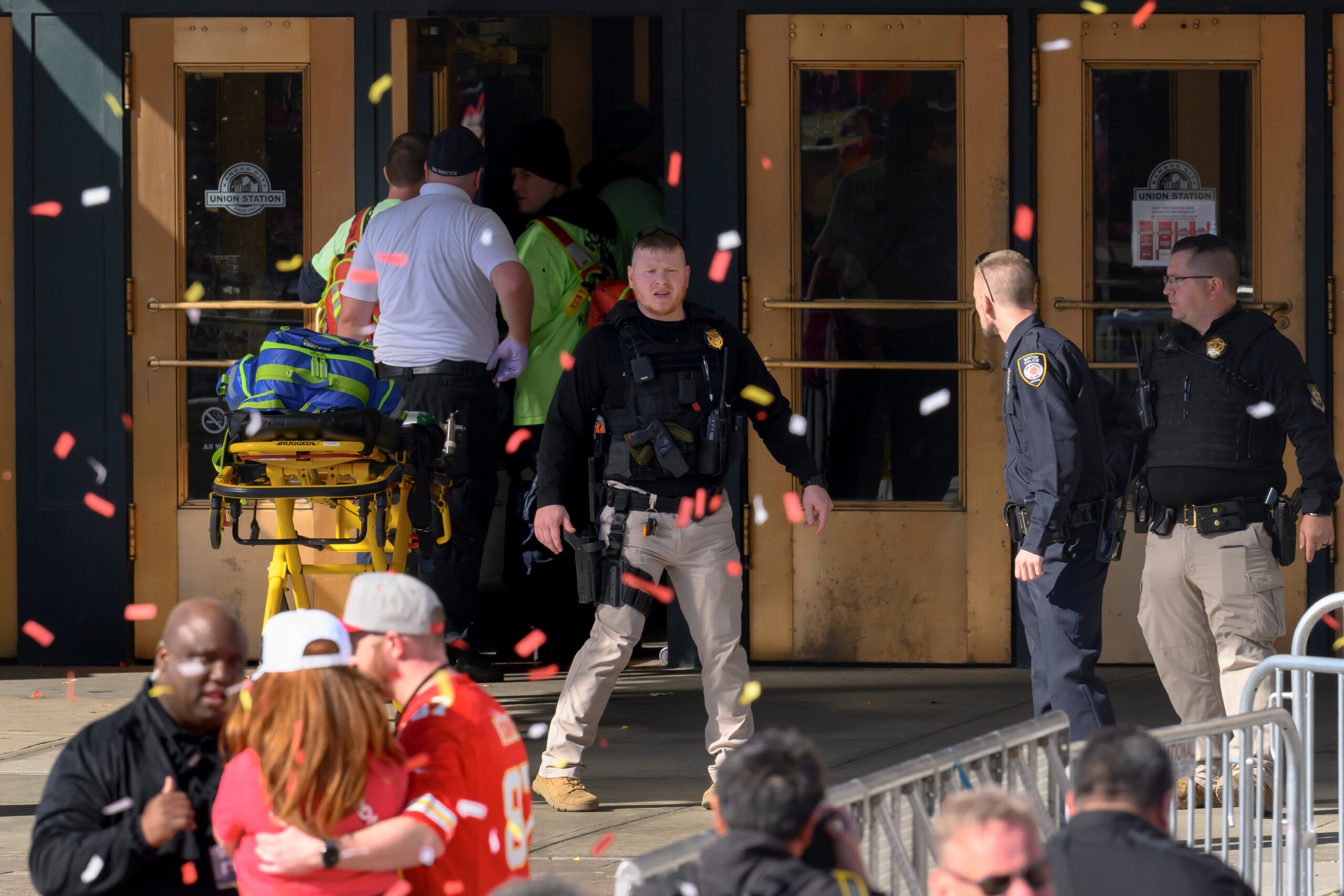
A beloved radio disc jockey and diehard Kansas City Chiefs fan was killed Wednesday as shots rang out and marred the NFL team’s victory celebration that ended with at least 22 others injured.
In a Facebook post, the KKFI community radio station said DJ Lisa Lopez-Galvan’s life was taken by a “senseless act.”
“It is with sincere sadness and an extremely heavy and broken heart that we let our community know that KKFI DJ Lisa Lopez, host of ‘Taste of Tejano’ lost her life today in the shooting at the KC Chiefs’ rally,” the post stated. “Our hearts and prayers are with her family. We encourage anyone who feels they saw something to reach out to law enforcement at 816-234-5111.”
KANSAS CITY CHIEFS RELEASE STATEMENT AFTER FATAL SHOOTING NEAR SUPER BOWL PARADE
Kansas City Chiefs fans leave the area after shots were fired following the celebration of the Kansas City Chiefs’ Super Bowl title in Kansas City, Mo., Wednesday. (Kirby Lee-USA TODAY Sports)
“This senseless act has taken a beautiful person from her family and this KC Community,” the post continued.
Lopez-Galvan, a mother of two, was confirmed killed in the shooting at the end of the parade at Kansas City’s Union Station, The Kansas City Star reported. Authorities held a news brief where they confirmed one person had died, but did not mention Galvan by name.
Fox News Digital has reached out to the Kansas City Police Department.
Friends confirmed Lopez-Galvan’s death to the newspaper. She reportedly died during surgery at a hospital from a gunshot wound to her abdomen.
“She was the most wonderful, beautiful person,” said Lisa Lopez, a friend for decades (no relation) who also works as The Star’s newsroom executive administrative assistant. “She was a local DJ. She did everybody’s weddings. We all know her. She was so full of life.”
PATRICK MAHOMES, CHIEFS PLAYERS CALL FOR PRAYERS AFTER SHOOTING ERUPTS AT SUPER BOWL PARADE
EMS, left, take a stretcher into Union Station following a shooting at the Kansas City Chiefs’ Super Bowl celebration in Kansas City, Mo., Wednesday. (AP Photo/Reed Hoffmann)
Lopez-Galvan was a disc jockey known as “Lisa G” for KKFI and co-host of the program “Taste of Tejano,” which features Hispanic music, the newspaper reported. Beto Lopez, the president and CEO of the Guadalupe Centers, is her brother.
Lopez-Galvan was in her mid-40s and lived with her husband and two children in the suburb of Shawnee. Her personal Facebook page includes multiple posts and images supporting the Chiefs, which won its second consecutive Super Bowl on Sunday.
Other victims of the shooting have not been named. The gunfire erupted around 2 p.m. local time near the Union Station parking garage as more than 800 police officers were in the area, authorities said. Of the 22 victims, 11 were children and are expected to recover. At least one weapon was also recovered by police.
Kansas City Mayor Quinton Lucas added that all Chiefs players, staff, and their families were safe and accounted for.
Several people were shot Wednesday in Kansas City at the celebration of the Chiefs’ Super Bowl victory. (AP Digital Embed)
“The celebration was marred by a shooting. This is absolutely a tragedy,” Lucas said.
In a statement, President Biden urged lawmakers to strengthen gun control measures.
“It is time to act. That’s where I stand,” he said. “And I ask the country to stand with me. To make your voice heard in Congress so we finally act to ban assault weapons, to limit high-capacity magazines, strengthen background checks, keep guns out of the hands of those who have no business owning them or handling them.”
Wednesday’s rally was the latest to be marred by violence. A shooting injured several people last year in downtown Denver after the Nuggets’ NBA championship, and gunfire last year at a parking lot near the Texas Rangers’ World Series championship parade.
The Associated Press contributed to this report.
Read the full article from Here


SIOUX FALLS, S.D. (Dakota News Now) – One of the most thankless jobs in sports is the one that gives the players the opportunity to compete in every sport.
Referees dedicate their time to help the kids of South Dakota enjoy the sports they love.
Yesterday was the High School Football All Star game in Brookings.
12 officials were there, sharpening up their skills for the regular season.
Tate Schoenfeld, 10 year referee and Alexandria native said, “Football is different than other sports where Basketball you have team camps in the summer, things like that. Football you really don’t have those opportunities so anytime you can get on the field and see live plays before the season starts is definitely a benefit.”
The South Dakota Football Coaches Association and the South Dakota High School Athletics Association partnered with improving the game of football in mind.
Justin Ingalls, state wide coordinator of officials for the SDHSAA says coaches and refs may not see eye to eye on everything.
“But one thing we will always agree on is the opportunity that we want to make this game and give back to this great game of football in every way we can to make it as good as possible for our student athletes,” said Justin Ingalls, SDHSAA State wide coordinator for officials.
Just because it was an all star game didn’t mean the refs were holding back. Ingalls quoted NFL referee Ed Hochuli.
Ingalls said, “Yes, there are penalties in a pro bowl, in here I think we had five or six different penalties, we had some good situations that we’ve talked about, teaching and learning situations.”
This has been a weekend long event.
On Friday Ingalls hosted classroom sessions with film study.
Ingalls said, “What we want called, how we want it called, and the mechanics of the game. What’s important to officials and officiating in the game.”
Ingalls was not the only one giving pointers.
There were many hands on deck making sure every ref could get their questions answered.
Ingalls said, “We had people that literally had experience in the Big 10, at the college level, and tons and tons of experience and expertise at the high school level.”
Even a 10 year veteran like Tate Schoenfelder was able to pick up a thing or two.
Schoenfelder said, “This is my first year attending but I really liked how it was run, the organization of it, and I feel like it was really beneficial to me as an individual and I think that everyone who was here as an official.”
Ingalls wants to continue to grow the game of football.
With many of the 80 athletes competing Saturday finishing their playing career.
Ingalls let them know they don’t have to step away from the field.
Ingalls said, “A number of us talked about our journeys and how we got into officiating, we want to give them some information as they go off to college about how to continue to be involved and get involved and be supported in becoming an official.”
This fun, pressureless environment set up the refs for their best chance at success with the high school football season just two months away.
Copyright 2026 Dakota News Now. All rights reserved.

However, in perhaps the most important development of the just completed 2025-26 academic year, a few of America’s universities are waving the white flag in a long-running war mounted by conservative critics of higher education. Five years ago, JD Vance argued that conservatives should declare that college professors are “the enemy” and treat the most prestigious schools as “totalitarian” institutions.
His proposed solution: Conservatives need “to seize the institutions of the left and turn them against the left. We need a… de-wokeification program.” They need “to deinstitutionalize the left, reinstitutionalize the right.”
As the 2025-2026 academic year comes to a close, Yale, Harvard, and others like them are on board with the “de-wokeification program.” Vance wants these colleges and universities and their students, faculty, and staff to be more deferential. Alas, that will not help prepare their students for the responsibilities of democratic citizenship.
Viewpoint diversity does not guarantee that students will be willing to practice empathy before judgment, to read deeply, and to listen attentively to any argument, left, right, or center. Only if they do can they live well in a democracy.
And as hard as it is for universities to hire faculty with conservative views, it is much harder to rediscover the habits of mind, like those I just enumerated, that are necessary if free speech and democratic political life are to flourish. Trying to appease the JD Vance‘s of the world or powerful alumni who complain that we need to hire fewer faculty to teach about the evils of colonialism or the injustices of America’s past and more who will teach about the virtues of capitalism and our country’s founding ideals, is a mistake that elite colleges and universities seem eager to commit.
The problem is cultural, not representational. Conservatives think that addressing the latter will cure the former and bring a vibrant marketplace of ideas back to our campuses.
Sadly, this year, some of the most prestigious colleges and universities seem to have bought that line.
In November 2025, the New York Times published an interview with the leaders of Dartmouth College, the University of Wisconsin, Madison, and Wesleyan University. They did not agree on everything, but here is one example of how they are drinking the Kool-Aid on viewpoint diversity.
Jennifer Mnookin, then Chancellor at Wisconsin and now incoming president of Columbia University, put it this way: “I think that many universities, not all, but many, were for a period of time deeply focused on identity diversity, and really not so focused on viewpoint diversity or belief diversity. I think there’s a danger of a pendulum swinging too far in the other direction, and we need to worry about that.”
“But,” she continued, “I think universities should be spaces where ideas, and different ideas, embodied by people from different backgrounds, come together, and where it won’t always be comfortable, but where we will learn and do better from that engagement.”
Note how Mnookin elevates viewpoint diversity and offers a vision of higher education as bringing together “different ideas, embodied by people from different backgrounds….” She assumes, I guess, that a good college will be a place where the whole is greater than the sum of its parts.
But she said nothing about how that alchemy is supposed to take place once her Noah’s Ark has been assembled, nor how it would help to be equipped for the responsibilities of democratic citizenship.
Moreover, Mnookin pushed back when Wesleyan’s president, Michael Roth, warned about the danger of parroting the White House’s talking points about higher education and the Trump Administration’s plan “to capture higher education for ideological purposes.”
“Michael,” she responded, doubling down on her “commitment to viewpoint diversity and to pluralism,” it “should prevent external capture and internal capture. And it should be a way of thinking about a piece of our mission and looking for excellence that can actually bring people together, even across their differences.”
Then in April, Yale University issued the report of a committee charged with the task of addressing the crisis of trust in higher education. It highlighted the conservative talking point that “the nation’s leading universities, including Yale, tend to exclude conservative intellectual traditions.”
“Some,” it said, “point to the partisan composition of the faculty, noting that professors overwhelmingly identify with the Democratic party. Others focus on the curriculum, or on the suggestion that liberal professors indoctrinate their students. Taken together, these critiques frame universities as intellectual and ideological echo chambers, out of touch with the American nation and out of step with its political currents.”
While the committee did not agree on whether that was the right diagnosis of the problem of free speech and academic freedom at Yale, it did conclude that in ways that would please conservatives that “Echo chambers do not produce the best teaching, research, or scholarship.”
Of note, two years ago, a prominent conservative intellectual, Prof. Keith Whittington, was hired to join Yale’s law school faculty. At that time, Whittington seemed clear about one of the reasons he was hired and about his mission.
As he explained, “I’m not unmindful of the significance of this move at the present moment….Yale has notoriously lacked right-of-center public law faculty for decades…The lack of political diversity on elite law school faculties,” he added, “is unhealthy, and I’m glad to be able to do my small part to mix things up.”
“With the very meaning of the conservatism in the United States up for grabs,” Whittingham said, “I look forward to lending what perspective and expertise I can to public debates.”
Yale seemed to be conceding that conservatives have been right about elite colleges and universities all along.
Not to be outdone, we also learned last month that “Harvard is quietly asking donors for $10 million gifts to establish new endowed professorships in a sweeping bid to reshape its faculty under the banner of ‘viewpoint diversity.’ The campaign, driven by Harvard’s top brass, aims to raise several hundred million dollars to support a new cohort of professors. If successful, the funding could bring dozens of faculty members to campus and drastically shift Harvard’s academic makeup.”
Wow.
As an article in the Chronicle of Higher Education published in the wake of that revelation points out, Professor Harvey Mansfield, “the sharpest conservative thorn in the side of Harvard’s body politic,” is “entitled to a kind of victory lap…” He has long said, “I think it has to be explicit that you’re hiring conservatives,” and now it seems that Harvard is doing just that.
There is nothing wrong with viewpoint diversity, but it will neither fix the problems that elite schools are experiencing nor equip their students to preserve and improve democratic life. In fact, this year’s let’s hire conservatives crusade may make matters worse.
As my colleague Leah Schmalzbauer and I have argued, that crusade “misses the point and distracts us from the work that needs to be done to further improve the quality of the education students receive in American colleges and universities. Put simply, instead of fixating on who is in the classroom, and whether they are liberal or conservative, we should be focused on how we are in the room.”
“Higher education’s greatest challenge to achieving open inquiry,” we argue, “is not one of ideology or viewpoint diversity, but of disposition….You can decorate campuses with all the colors of the political rainbow, but not make them better places to learn.”
Unfortunately, 2025-26 may go down as the year when elite colleges and universities started doing that kind of decorating. Conservatives may take a victory lap, and the Trump Administration may think its pressure campaign is working.
But for those of us who are privileged to teach in privileged places and want to get students ready for democratic citizenship, our most important work will remain the same whether or not we bring more conservatives to campus: Teaching students to think democratically.
Austin Sarat is the William Nelson Cromwell professor of jurisprudence and political science at Amherst College.

Metro Detroit is set to trade this weekend’s comfortable weather for a stretch of increasingly hot and humid conditions this week, with temperatures climbing into the upper 80s and lower 90s and humidity levels high enough to make it feel even warmer.
While Monday remains pleasant, the 4Warn Weather team is tracking a developing pattern that could bring rounds of showers and thunderstorms Tuesday through Thursday, followed by a period of heat that may pose health risks for some people.
The dry weather will hold through Monday before moisture surges northward ahead of a low-pressure system. That setup will lead to increasing clouds Monday night and a growing chance of showers and thunderstorms Tuesday.
The atmospheric moisture levels will be unusually high for June, meaning storms will be capable of producing locally heavy rainfall in a short amount of time Tuesday.
Metro Detroit will have daily chances for showers and thunderstorms through the week, but attention will also turn to the heat.
Temperatures are expected to soar to around 90 degrees Wednesday and the lower 90s Thursday across Metro Detroit, with muggy nights only falling into the upper 60s to lower 70s. Combined with dew points rising into the upper 60s and lower 70s, heat index values could climb well into the 90s to 100 degrees.
These values can create dangerous conditions for vulnerable populations, including older adults, young children, people with chronic health conditions and anyone working or exercising outdoors for extended periods.
After weeks of relatively mild temperatures, the human body has not yet fully acclimated to summer heat, making heat-related illnesses more likely.
Heat Safety
People are encouraged to begin practicing heat safety habits now:
-
Drink water regularly, even before feeling thirsty.
-
Limit strenuous outdoor activity during the hottest part of the afternoon.
-
Wear lightweight, light-colored clothing.
-
Take frequent breaks in air-conditioned spaces.
-
Never leave children or pets in vehicles.
-
Check on elderly neighbors and relatives.
The hottest day of the stretch is likely to be Thursday, when Metro Detroit could reach the lower 90s. Depending on sunshine and thunderstorm coverage, a few communities may push even higher.
For residents of the Thumb, temperatures will be somewhat cooler thanks to the moderating influence of Lake Huron. Highs there are expected to remain largely in the lower to middle 80s during the warmest part of the week.
Thunderstorm chances continue through Thursday and could briefly interrupt the heat. However, any breaks are expected to be short-lived, and many locations will spend much of the week feeling decidedly summerlike.
By Friday and next weekend, temperatures may ease slightly back into the upper 80s, although isolated showers and thunderstorms remain possible.
Share your weather photos and how you’re staying cool with Local 4 at MIPics.
Copyright 2026 by WDIV ClickOnDetroit – All rights reserved.
-

 South Dakota5 minutes ago
A thankless job, a big impact: SD officials prep for football season at All-Star Game
-
Tennessee8 minutes ago
TN Lottery Cash 3 Evening, Cash 4 Evening winning numbers for June 7, 2026
-

 Texas13 minutes ago
Caleb Downs impressing vets at OTA
-
 Utah20 minutes ago
Local Utah church speaks out during Pride, Fidelity Month conversation
-

 Vermont23 minutes ago
Mountaineers take home opener over North Shore
-

 Virginia28 minutes ago
Virginia Lottery Pick 3 Night, Pick 3 Day results for June 7, 2026
-
Washington35 minutes ago
Washington Lottery Cash Pop, Pick 3 results for June 7, 2026
-

 Wisconsin38 minutes ago
Wisconsin School Board Keeps Dual‑Language Program After Community Pushback

