Lifestyle
Street style after hours is its own genre. Bear witness with Nichelle Dailey

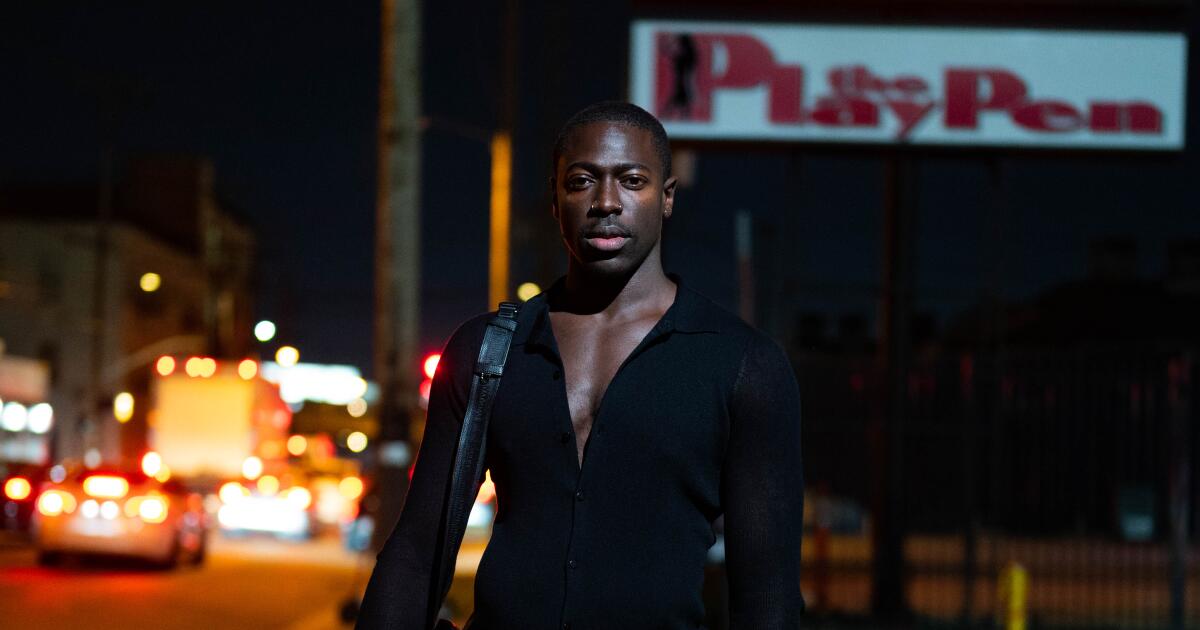
The style gods of Los Angeles walk among us after the sun goes down.
(Nichelle Dailey / For The Times)
Fashion metaphors are usually forward-facing.You’ve got to look the part. Dress for the role you wish to inhabit. Style is a means to an end — a goal. An ambition. A designation or title. A reward. Riches. Clout. But the style gods who walk among us pull fits not for a desired job or salary; they do so as a statement of who they desire to be as they make moves. They dress for where they are going.
Every style capital has its own personality, with interlocutors who make fashion decisions that play into the specific energy of their surroundings. Cities have unique ways of facilitating interactions, and residents choose to present themselves based on their relationships to the choreography of the day. The New Yorker leaves the house dressed like they’re ready for anything. An Angeleno gets ready with the light in mind.
The drip on display in Los Angeles crescendos as the day goes on. It’s not as the outsiders and carpetbaggers understand it — all Uggs and tumblers and athleisure all the the time. You can feel style evade categorization as the day progresses. Then, at 3:32 p.m., the temperature begins to shift. That little nip in the air is the signal that the fashun hour is quickly approaching.
Style after hours is its own genre. With that in mind, we asked photographer Nichelle Dailey if she could head outside to document people as they get active during nights out on the town. Dailey has a way of bringing a subject’s essence to the fore. Her lens is tapped into — and pulls out — what’s within with remarkable clarity.
Her street style shots in this photo essay reveal the unique character of style at night. She’s showing it to us in all its luminosity. — The editors
(Nichelle Dailey / For The Times)
Style after hours is its own genre.
(Nichelle Dailey / For The Times)
(Nichelle Dailey / For The Times)
(Nichelle Dailey / For The Times)
Cities have unique ways of facilitating interactions, and residents choose to present themselves based on their relationships to the choreography of the day.
(Nichelle Dailey / For The Times)
The drip on display in Los Angeles crescendos as the day goes on. (Nichelle Dailey / For The Times)
(Nichelle Dailey / For The Times)
Dailey has a way of bringing a subject’s essence to the fore. Her lens is tapped into — and pulls out — what’s within with remarkable clarity.
(Nichelle Dailey / For The Times)
(Nichelle Dailey / For The Times)
(Nichelle Dailey / For The Times)
(Nichelle Dailey / For The Times)
Dailey’s street style shots reveal the unique character of style at night.
(Nichelle Dailey / For The Times)
(Nichelle Dailey / For The Times)
(Nichelle Dailey / For The Times)
(Nichelle Dailey / For The Times)
An Angeleno gets ready with the light in mind.
(Nichelle Dailey / For The Times)



Once rivals on the tennis court, Martina Navratilova, left, and Chris Evert have become close friends in retirement. They are pictured above at the French Open in 1986.
Trevor Jones/Getty Images Europe
hide caption
toggle caption
Trevor Jones/Getty Images Europe
Chris Evert and Martina Navratilova were the most successful women’s tennis champions of their generation. Both were 18-time Grand Slam tournament winners — and each other’s greatest rivals.
Evert, a Florida native, became a tennis star in her teens. Navratilova was born in communist Czechoslovakia, and emerged as a player after Evert was established. They first faced off during a match in Akron, Ohio, in 1973, when Evert was 18, and Navratilova was 16. Evert won, but Navratilova left an impression.
“I remember thinking to myself, holy cow, when this young girl gets into better shape, she is going to be a force to be reckoned with,” Evert says. “She had so much talent. Her hands were quick, she had a big first serve, she had a big forehand, and she just was so powerful.”

Two years later, on the day she lost a semifinals match to Evert at the U.S. Open, Navratilova defected to the U.S. In the years that followed, her tennis game improved. Though she and Evert had initially been friendly, the friendship cooled as their rivalry heated up.
“Playing Chris was difficult because how can you not like Chris? What’s not to admire?” Navratilova says. “She was like the epitome of cool.”
The new Netflix documentary Chris & Martina: The Final Set tells the story of how Evert and Navratilova re-established their friendship and how they both faced cancer in retirement. Evert was diagnosed with ovarian cancer in 2021; Navratilova was diagnosed with throat and breast cancer in 2022.
“I can’t get away from her,” Evert jokes. “We had a 15-year career, and then we got cancer at the same time. It really is freaky, but I always say: If I want someone to be in the trenches with me, it’s Martina because she has been so supportive and so understanding.”

Navratilova agrees: “We have such a level of trust that we know whatever we say to each other, it stays there. We give each other the best advice we know how to. And there is no ulterior motive, no playing games.”
At the time that this interview was taped, Evert and Navratilova were both in remission from cancer. But late last week, Evert disclosed she’d recently been diagnosed with a recurrence of ovarian cancer.

“We know whatever we say to each other, it stays there,” Martina Navratilova says of her friendship with Chris Evert.
Netflix
hide caption
toggle caption
Netflix
Interview highlights
On supporting each other through cancer
Evert: There are a lot of phone calls between us. … I don’t cook, but Martina would bake bread for me, and her wife Julia would cook, make some chicken soup. … I got a lot of food from Martina. She got a necklace from me.
Navratilova: I get jewelry from Chris, she gets food from me.
Evert: Martina’s and my relationship — because we’ve had one for 50 years — is not the type where we have to talk to each other every day to maintain the closeness. I always knew she was there. She always knew I was there if we needed to talk, and that was that.
On the weakness they experienced with cancer
Navratilova: Chris’ diagnosis and treatment was much more life-threatening than mine, percentage wise, but my treatment was more difficult physically. … I was in New York for seven weeks and I literally sat on a yoga mat, maybe half an hour of the seven weeks, and did some stretching. I couldn’t even do the down dog pose because I would have fallen down. I had absolutely zero strength left.
Evert: The chemo kicked my butt, let’s put it that way. … It left me very weak, very, very weak. After chemo I would have three or four days of intense nausea and I just would feel tingling in my body and it just wasn’t nice. I didn’t have the energy. To walk six blocks was a big deal for me. And it was foreign. You know, it felt like it wasn’t my body, for sure.
On watching the old footage of their matches together for the documentary
Navratilova: For me, it was fun watching with Chris, because we had different reactions to what happened on the court. But what impressed me is how well we played with those wooden rackets. Because you know what? Those rackets are not easy to play with. But you try to put yourself in there physically, what it was like, mentally, what it is like. And it’s like, “Oh, I should have gone down the line,” or, “I can’t believe I missed that shot.” Or “Chris, you had such a great pass.” It was amazing. So it was impressive. … I wish I could still have that six-pack, but anyhow.

Evert: I remember feeling genuinely happy for her. I remember it was her first Wimbledon. That’s always been her dream since she defected. Her family couldn’t be there to watch her. She was all alone. And I just was happy for it. And I knew that this was gonna be one of many for her to win.
On defecting to the U.S. in 1975 when she was 18 years old
Navratilova: I was thrilled to be in the States. I always loved American cars. And when you ordered a ham sandwich, you got, like, two inches of ham and two slices of bread. Whereas growing up, you had thick bread and one slice of ham. So I thought I was in heaven. And it was $2.30 for that sandwich. I still remember it. I couldn’t believe how much ham I was getting.
Lauren Krenzel and Nico Gonzalez Wisler produced and edited this interview for broadcast. Bridget Bentz, Molly Seavy-Nesper and Beth Novey adapted it for the web.

-

 Pittsburg, PA3 minutes ago
Pittsburgh area’s low jobless rate beats state, U.S. rates
-

 Augusta, GA10 minutes ago
Salvation Army of Augusta collects heat relief supplies
-

 Washington, D.C13 minutes ago
Washington Spirit Announces Midseason Roster Update
-
 Cleveland, OH18 minutes ago
No idling: Why it’s against the law in Cleveland
-

 Austin, TX25 minutes ago
Home Automation Austin Brings Personalized, Full-Service Home Automation to Homeowners in Austin
-

 Alabama28 minutes ago
Former Alabama Inmate Arrested After Allegedly Flying Drone with Contraband Toward Prison
-

 Alaska33 minutes ago
As war stalls, Putin concedes he never cut a deal with Trump in Alaska
-

 Arizona40 minutes ago
Flags are at half-staff today in Arizona. Here’s who is being honored

